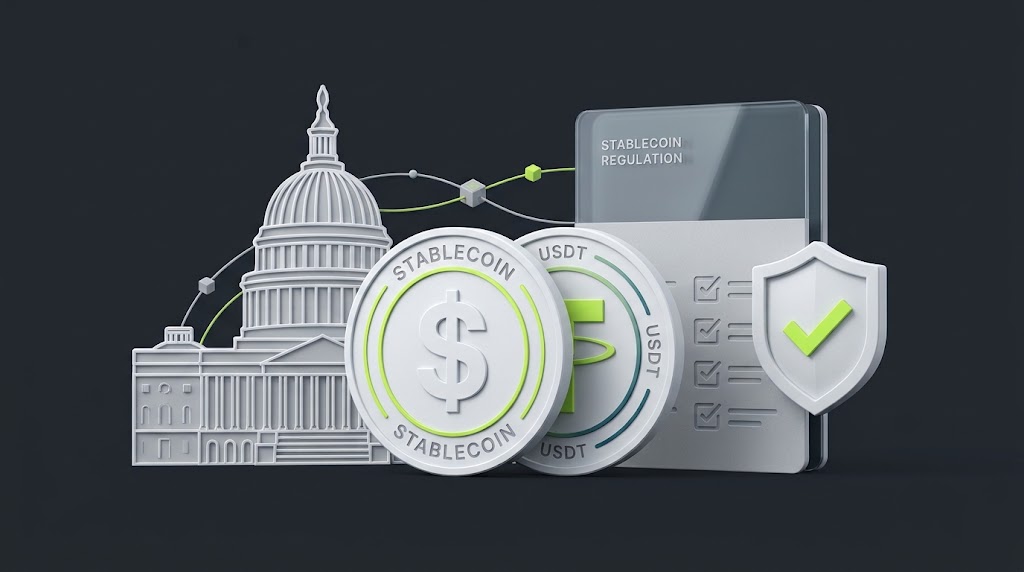
The GENIUS Act does not eliminate every way to earn yield on stablecoins, but it draws an important line between interest paid by a payment stablecoin issuer and returns generated through third-party arrangements. That distinction matters for USDT and USDC holders, crypto exchanges offering rewards, and users lending stablecoins through decentralized finance (DeFi) protocols.
On October 21, 2026, the Office of the Comptroller of the Currency (OCC) finalized its first major implementing rule under the GENIUS Act. The rule retains the prohibition on issuers paying interest or yield solely for holding, using, or retaining payment stablecoins, while taking a case-by-case approach to certain third-party rewards arrangements. It is scheduled to take effect on January 18, 2027.
For stablecoin users, the key question is not simply whether USDT or USDC is permitted. It is who pays the yield, how the payment is structured, and what risks the arrangement introduces.
What Does the GENIUS Act Say About Stablecoin Yields?
The Guiding and Establishing National Innovation for U.S. Stablecoins (GENIUS) Act, enacted on July 18, 2025, establishes a federal framework for payment stablecoins. Among other requirements, it addresses permitted issuers, reserve backing, redemption, supervision, and the payment of yield to stablecoin holders.
The Act's yield restriction is central to the debate over how stablecoins should fit into the financial system.
The Ban on Issuer-Paid Interest
Under the GENIUS Act, a permitted payment stablecoin issuer cannot pay a holder interest or yield solely in connection with holding, using, or retaining a payment stablecoin.
The restriction means a payment stablecoin should not be treated as an interest-bearing bank deposit simply because it is designed to maintain a stable value against the U.S. dollar.
For example, holding $1,000 worth of a payment stablecoin does not, by itself, entitle the holder to an issuer-funded annual percentage yield (APY). This differs from a deposit account that explicitly pays interest.
The distinction is important because payment stablecoins are designed primarily for payments and transfers, rather than to function as investment products that distribute their reserve income to holders.
For the legal framework and its broader implications, see Bitunix's GENIUS Act and stablecoin regulation overview.
What Changed in the OCC's October 2026 Final Rule?
The OCC's October 21, 2026 final rule clarifies how the agency will implement the GENIUS Act for issuers and other activities under its jurisdiction.
One particularly important change concerns third-party rewards.
The OCC's earlier proposal included a rebuttable presumption that certain arrangements involving affiliates, intermediaries, or other third parties could violate the issuer-yield prohibition. The final rule removed that presumption and instead emphasized evaluating arrangements individually.
This is a meaningful change, but it should not be interpreted as blanket approval of every stablecoin rewards program. The legal and economic substance of each arrangement still matters, including whether an issuer is effectively paying yield through another party to circumvent the statutory restriction.
The final rule is scheduled to take effect on January 18, 2027. Additional implementation work, including rules concerning anti-money laundering and sanctions requirements, remains separate from this rulemaking.
Why the Source of Yield Matters
Stablecoin products can advertise similar APYs while generating returns through very different mechanisms.
Yield source | How it works | Key consideration |
Issuer-paid interest | The issuer pays holders for holding or retaining a stablecoin | Subject to the GENIUS Act's issuer-yield prohibition |
Exchange or platform rewards | A platform offers incentives under its own program | The arrangement's structure and funding source matter |
DeFi lending | Users supply stablecoins to a lending protocol or pool | Returns depend on borrowing demand, utilization, incentives, and protocol risks |
Liquidity provision | Users supply assets to a liquidity pool | Returns may depend on fees, incentives, liquidity conditions, and smart-contract risks |
These categories are not interchangeable legal classifications. In particular, describing a payment as a reward rather than interest does not automatically determine whether it complies with the law. The underlying arrangement must be assessed on its facts.
How Could the Rules Affect USDT and USDC Holders?
USDT and USDC are widely used dollar-pegged stablecoins, but their holders may encounter different reward programs, platform policies, and regulatory considerations.
The GENIUS Act's yield restriction does not, on its own, establish that one token will offer better returns or gain market share at the expense of the other.
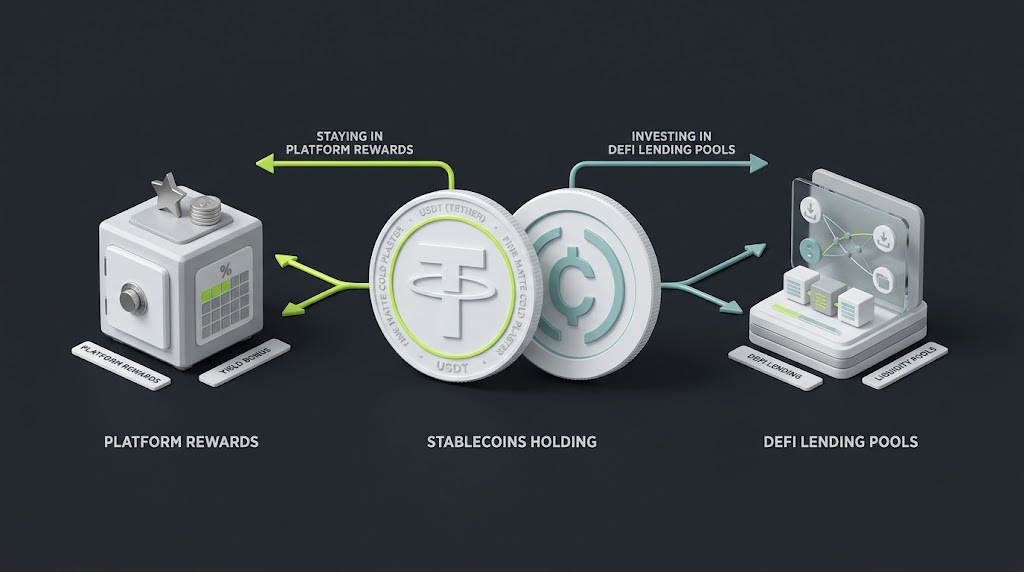
Stablecoin rewards depend on the product structure and funding source, not just whether users hold USDT or USDC.
USDT: Separate Token Use from Yield Opportunities
USDT is used for exchange trading, transfers, and liquidity across centralized and decentralized markets. Its usefulness as a trading asset does not automatically create a right to receive interest from its issuer.
A USDT holder seeking yield may encounter exchange rewards, lending products, or DeFi protocols. Each involves a different arrangement and potentially different legal, operational, and counterparty risks.
Before using one of these products, check:
Who provides the advertised return and where the funds come from.
Whether the product is available in the user's jurisdiction.
Whether the platform lends, reinvests, or otherwise deploys deposited assets.
Whether withdrawals can be delayed, restricted, or suspended.
Whether the return is variable, promotional, or subject to eligibility conditions.
The important distinction is between holding USDT as a payment or trading asset and placing it into a separate product designed to generate returns.
USDC: Issuer Compliance and Platform Rewards Are Separate Questions
USDC is also used for payments, trading, and DeFi applications. As with USDT, holding USDC does not automatically entitle the holder to interest paid by its issuer.
Third-party platforms may offer USDC rewards under their own terms. Those programs should not be assumed to be compliant or noncompliant solely because they involve USDC. Their structure, funding arrangements, and applicable regulatory requirements matter.
Users should also distinguish an issuer's regulatory status from a platform's ability to offer a particular product. A stablecoin's availability does not guarantee that every associated lending or rewards service is available in every jurisdiction.
Will the GENIUS Act Make USDC More Competitive Than USDT?
That outcome is possible, but it is not established by the yield restriction alone.
Stablecoin competition depends on several factors, including liquidity, exchange support, redemption arrangements, regulatory access, payment integrations, and demand from trading and DeFi users. The ability to offer particular reward products may also influence user preferences, but the effects depend on how regulators apply the rules and how platforms adapt.
It would therefore be premature to conclude that USDC will necessarily benefit more than USDT, or that either stablecoin will lose its competitive position because of the Act.
What Could the GENIUS Act Mean for DeFi Lending Yields?

DeFi lending yields fluctuate with borrowing demand, liquidity, incentives, and protocol-specific risks.
DeFi lending is one of the most important areas to distinguish from issuer-paid stablecoin interest.
When a user supplies USDT or USDC to a lending protocol, the return may come from borrowers paying interest, protocol incentives, or other mechanisms defined by the platform. These returns are not necessarily payments from the stablecoin issuer.
The GENIUS Act's issuer-yield restriction does not automatically prohibit every instance of lending stablecoins through DeFi. However, the legal treatment of a particular protocol or arrangement cannot be determined simply by labeling it decentralized.
DeFi Lending Yields Depend on Borrowing Demand
A lending protocol typically connects users supplying assets with borrowers seeking liquidity. The yield earned by suppliers can change with the amount of available liquidity, borrowing demand, utilization rates, incentives, and protocol parameters.
When demand for leverage rises during a bullish crypto market, borrowing rates and stablecoin lending yields may increase. When demand weakens or liquidity becomes abundant, yields can fall.
The Bank Policy Institute's analysis of DeFi stablecoin yields highlights how these returns can vary substantially with market conditions. It also points to operational disruptions and other risks as factors that can influence observed yields.
This provides an important counterpoint to the idea that stablecoin yield is simply a fixed rate attached to a dollar-pegged token. In DeFi, a high advertised APY may reflect strong borrowing demand, temporary incentives, or risks that are not obvious from the headline number.
Protocol-Generated Returns Are Not Automatically Exempt
The distinction between issuer-paid interest and DeFi lending returns is useful, but it is not a universal legal safe harbor.
A lending protocol's structure, the entities involved, the flow of funds, and any relationship with a stablecoin issuer may affect the legal analysis. Other laws and regulatory requirements may also apply, depending on the activity and jurisdiction.
For example, a lending pool that pays suppliers based on borrower interest is economically different from an issuer paying holders solely for retaining its stablecoin. But the economic distinction alone does not resolve every legal question.
The practical takeaway is to evaluate the actual arrangement rather than assuming that all DeFi activity is outside the scope of stablecoin regulation.
What Could Happen to DeFi Liquidity?
The rules may influence how issuers, exchanges, and DeFi platforms design rewards, but the eventual effect on liquidity remains uncertain.
Several outcomes are possible:
Some centralized platforms may redesign rewards programs to meet applicable requirements.
Users may compare issuer-related rewards with lending and liquidity-provision opportunities.
DeFi yields may continue to fluctuate according to borrowing demand and available liquidity.
Regulatory uncertainty may affect how some platforms offer products in particular markets.
None of these outcomes is guaranteed. The GENIUS Act does not establish a fixed yield for USDT or USDC, nor does it determine how much liquidity any specific protocol will attract.
What Are Industry Experts Saying About the GENIUS Act's Stablecoin Yield Rules?
The debate reflects a broader disagreement over how stablecoin rewards should be regulated. The banking industry has emphasized the potential effects on deposits and lending, while the OCC's final approach leaves room for case-by-case assessment of certain third-party arrangements.
Crypto Platforms May Retain More Flexibility to Offer Rewards
In its October 21, 2026 coverage, S&P Global Market Intelligence reported that the OCC's final rule removed the proposed presumption against certain third-party yield arrangements.
Raymond James policy analyst Ed Mills described the change as incrementally favorable for crypto exchanges, stablecoin issuers, and digital asset platforms. His assessment reflects the view that the final rule leaves firms more room to structure rewards programs than the earlier proposal would have allowed.
That does not mean every program will be permitted. The OCC's approach still leaves the regulator room to examine specific arrangements and take action where it identifies violations or attempts to evade the statutory restriction.
Banks Warn About Deposit Competition
The banking industry has raised concerns that stablecoin rewards could encourage customers to move funds away from traditional bank deposits.
In its response to the OCC's final rule, the American Bankers Association argued that the narrower approach could leave opportunities for crypto platforms to offer economically similar returns through third parties. The association warned that such arrangements could weaken the distinction between payment stablecoins and bank deposits, potentially affecting the funding banks use to make loans.
This is a policy position from the banking industry, not proof that stablecoin rewards will cause a particular amount of deposit outflows. The scale of any effect will depend on consumer behavior, product design, market adoption, and future regulatory decisions.
The disagreement matters because the rules governing rewards may affect not only stablecoin products but also competition between crypto platforms and traditional financial institutions.
DeFi Yields Remain Driven by Market Conditions
The Bank Policy Institute's October 2026 research commentary also highlights that DeFi lending yields can be volatile and substantially higher than traditional money-market rates at certain times. It attributes much of this variation to crypto-market borrowing demand and leverage, while also noting that operational disruptions can affect yields.
This helps explain why a regulatory change does not translate directly into a predictable APY. Even if a platform can legally offer a particular product, its yield will still depend on market conditions and the risks involved.
Taken together, these perspectives point to an unresolved balance: regulators must enforce the prohibition on issuer-paid yield, while determining how to treat third-party rewards without automatically treating every lending or incentive arrangement as equivalent to issuer interest.
What Should Stablecoin Holders and DeFi Users Check?
The most useful response to changing rules is to examine the product's mechanics, not just its advertised APY.
1. Identify Who Pays the Yield
Check whether the return comes from a stablecoin issuer, a centralized exchange, a lending protocol, borrowers, or a promotional incentive. The funding source and contractual arrangement can affect both regulatory treatment and financial risk.
2. Read the Withdrawal and Redemption Terms
A stablecoin may be designed to maintain a dollar peg, but that does not guarantee instant access to funds in every circumstance. Platforms may impose withdrawal limits, and DeFi protocols may experience liquidity shortages.
Understand the difference between redeeming a stablecoin through an eligible issuer or service and withdrawing assets from a separate investment or lending product.
3. Evaluate the Risks Behind the APY
Consider whether the advertised return is fixed or variable, whether incentives are temporary, and whether the product involves leverage, rehypothecation, smart contracts, or third-party custody.
A high yield can reflect strong demand, but it may also compensate users for taking risks that are absent from simply holding a stablecoin.
4. Check Jurisdiction and Eligibility
Regulatory treatment and product availability can vary by location. A service accessible to one user may be restricted for another, and eligibility requirements may change as new rules take effect.
Confirm the platform's current terms and the applicable requirements rather than relying on a promotional page or a general statement about the GENIUS Act.
5. Follow Implementation, Not Just Headlines
The OCC's final rule is scheduled to take effect on January 18, 2027, and other aspects of the GENIUS Act's implementation remain relevant. Further regulatory guidance, supervisory decisions, and changes to platform products may clarify how specific rewards arrangements are treated.
For a broader view of the law's implications for decentralized finance and payments, see Bitunix's related analysis of stablecoin regulation, DeFi yields, and payments.