Statistical Period: July 4, 2026 – July 10, 2026
Data Cutoff: July 10, 2026
Market Overview: Renewed US-Iran Tensions Trigger Limited Market Reaction, ETF Inflows Drive Crypto Market Recovery
This week, the core focus of global financial markets once again centered on geopolitical risks and capital flow trends. The renewed escalation of tensions between the US and Iran briefly disrupted market risk sentiment; however, compared with previous periods of geopolitical uncertainty, investors showed significantly lower sensitivity to such shocks. The crypto market did not experience large-scale panic selling. As the market gradually digested the related risks, BTC traded sideways around $62,000, demonstrating stronger resilience and adaptability toward external uncertainties.
On the capital flow side, US spot Bitcoin ETFs rebounded after experiencing previous outflows, recording net inflows again in early July. Institutional demand showed signs of recovery, providing additional support for crypto asset prices. Driven by improving market sentiment and renewed capital inflows, major crypto assets including BTC, ETH, and BNB posted moderate rebounds this week. Although uncertainty remains surrounding macro policies and geopolitical developments, fading market panic and recovering risk appetite have helped the crypto market gradually return to a consolidation and recovery phase.
The Bitunix Token Pulse Weekly Report will continue monitoring the top 300 tokens by market capitalization listed on Bitunix, while tracking the performance of popular US stock futures contracts, providing investors with strategic insights and short-term market observations.
Crypto Asset Performance: Mixed Performance Among Top 300 Tokens, Market Rotation Becomes More Pronounced
Recently, as ETF capital inflows resumed and traditional financial institutions continued to express optimism toward the long-term growth potential of the crypto market, several blue-chip crypto assets experienced oversold rebounds. This week, Bitcoin (BTC) rose 2.87%, reclaiming the $60,000 level. Ethereum (ETH) gained 2.61%, slightly underperforming BTC. After surging nearly 20% last week, Solana (SOL) failed to break above the $80 resistance level this week, with its price retreating to around $78.
Among the top 300 tokens by market capitalization, approximately 50% recorded gains this week, with the median return standing at 0.04%. The market remained in a consolidation and recovery phase, while performance divergence between different sectors and individual tokens continued to widen.
Top Gainers - EDGE Surges Over 70%, DeFi Sector Shows Strong Performance
The DeFi sector emerged as one of the strongest-performing areas in the market this week, with multiple projects recording notable gains. UNI increased by 8.59%, AAVE rose 7.16%, and LIT gained 15.76%. Among them, EDGE delivered the strongest performance, surging more than 70% over the week. EDGE is the governance token of EdgeX, a decentralized derivatives trading platform. The platform aims to combine Wall Street-level high-frequency trading performance with the self-custody and asset sovereignty features of decentralized finance (DeFi), providing users with a more efficient on-chain trading experience.

Data Source: Bitunix Note: Price and performance data were collected at 1:00 AM UK time (UTC+0).
Top Losers - M, BEAT, and JUP Pull Back, Altcoin Market Shows Clear Rotation Effect
The crypto market did not experience a broad-based sharp sell-off this week, with BEAT recording the largest decline at approximately 28%. Notably, several tokens that experienced pullbacks, including BEAT, M, and JUP, were among the strongest-performing assets last week. Increased short-term profit-taking pressure contributed to their declines, highlighting a clear “seesaw effect” within the altcoin market. In addition, the Solana ecosystem underperformed overall this week. Besides SOL’s price retreat, ecosystem tokens such as JTO and JUP also declined, indicating continued capital rotation among different trending sectors. Market divergence has further intensified as liquidity shifts between narratives and sectors.

Data Source: Bitunix Note: Price and performance data were collected at 1:00 AM UK time (UTC+0).
Hot Token Deep Dive: Perpetual DEX EdgeX Completes New Organizational Restructuring
EdgeX is a Perp DEX focused on perpetual contract trading. The platform was co-incubated by a team with high-frequency trading backgrounds and Amber Group. Its core objective is to combine the high-performance trading experience of centralized exchanges (CEXs) with the asset sovereignty and security advantages of decentralized exchanges (DEXs).
On July 9, edgeX announced the completion of a new round of organizational restructuring and continued recruitment of key talent across engineering, risk management, product development, and other areas. Meanwhile, edgeX is introducing new strategic partners and advancing cooperation in areas including liquidity, asset integration, fiat payment infrastructure, market expansion, and ecosystem development. These initiatives aim to further strengthen the platform’s global operational capabilities.
EDGE Technical Analysis Over the Past Week: Price Trends Higher Before Pulling Back After Hitting $0.56
The EDGE token completed its TGE (Token Generation Event) at the end of March 2026. In early June, EDGE experienced a flash crash, with its price plunging from approximately $1.12 to a low of $0.32 within around one hour, representing a decline of more than 70%. According to the official investigation, the sharp price volatility was not caused by a hacker attack or smart contract vulnerability. Instead, it was attributed to a combination of factors, including insufficient market liquidity, concentrated selling from multiple addresses, and cascading liquidations of highly leveraged long positions.
Entering July, EDGE gradually entered an oversold rebound phase. On July 6, EDGE initiated its first recovery wave, with the token price rising from $0.24 to around $0.27. However, at that time, technical indicators including RSI and MACD had not yet generated clear bullish signals. On July 7, the MACD indicator formed a bullish crossover, while the RSI broke above 60, indicating strengthening buying momentum. This drove EDGE’s price to quickly rise from $0.33 to $0.42. Following the upward momentum, EDGE continued to climb and reached a short-term high of $0.56. After increased profit-taking pressure from short-term traders, the token entered a pullback phase and is currently undergoing technical consolidation following the recent rally.

Data Source: Bitunix
EdgeX Fundamental Analysis: Open Interest Remains Among the Top Five Decentralized Exchanges
In the decentralized perpetual exchange (Perp DEX) sector, Hyperliquid remains the market leader, with its open interest (OI) exceeding $70 billion. EdgeX’s total open interest has consistently ranked among the top five decentralized exchanges, currently trailing only platforms such as Hyperliquid, Aster, and Lighter. Notably, in January 2026, EdgeX’s open interest briefly surpassed $12 billion, reaching a record high. However, as the broader crypto market experienced a correction during the first half of the year, some traders reduced leverage and closed positions, resulting in a decline in the platform’s open interest. As of July 5, EdgeX’s total open interest had fallen to approximately $4 billion.

Data Source: Artemis
EDGE Smart Money Analysis: Address “0x691AF” Conducts Multiple Buy-Low-Sell-High Operations
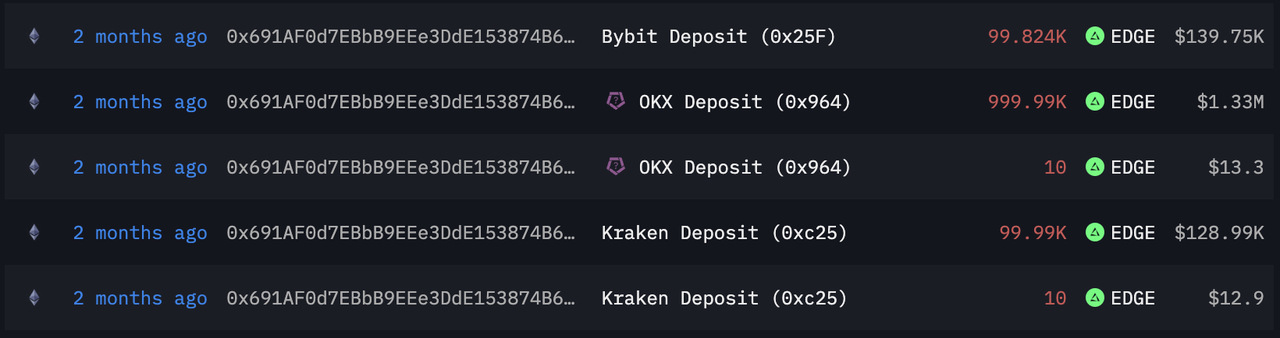
As an ERC-20 standard token, EDGE benefits from relatively comprehensive on-chain data availability on Ethereum. According to Arkham data, the address “0x691AF” currently holds approximately 1.31 million EDGE tokens, making it one of the larger EDGE holders. At the end of May, when EDGE was trading at around $1.32, the address transferred more than 1.2 million EDGE tokens in multiple transactions to exchanges including OKX, Bybit, and Kraken. These tokens may have subsequently been sold through trading platforms.
In mid-June, when EDGE was trading around $0.33, the address transferred another 250,000 EDGE tokens. On July 9, the address received an additional 750,000 EDGE tokens from an address suspected to be associated with Amber Group, when EDGE was trading at approximately $0.44. Based on on-chain fund flows, the address has repeatedly adjusted its EDGE holdings across different price levels, showing a relatively clear pattern of buying at lower prices and selling at higher levels.

Data Source: Arkham
Is It Too Late to Buy EDGE Now?
From a fundamental perspective, EdgeX’s trading volume has remained relatively stable, providing certain fundamental support for the EDGE token. From a technical perspective, EDGE formed a long-wick candlestick on the evening of July 8. The intraday high and low reached $0.56 and $0.35 respectively. The sharp short-term volatility may have prompted some short-term traders to take profits or reduce positions, allowing part of the selling pressure to be released.
From an on-chain perspective, several large addresses, including “0x691AF,” have recently continued accumulating EDGE, suggesting that some market participants remain optimistic about its future performance. However, EDGE’s price remains influenced by multiple factors, including broader market conditions, liquidity levels, and investor sentiment. Whether the token can sustain its upward momentum remains uncertain. Investors should carefully evaluate market risks and maintain appropriate position sizing when trading EDGE in spot or futures markets.
Summary of EDGE Recent Trends
As the governance token of the EdgeX decentralized perpetual exchange, EDGE has recently benefited from the platform’s organizational restructuring, ecosystem partnership expansion, and improving market sentiment, leading to a strong oversold rebound. On-chain data shows that several large addresses have continued adjusting their EDGE positions recently. However, the token’s future price performance remains dependent on liquidity conditions, market sentiment, and the broader crypto market environment. Investors should continue monitoring further developments.
U.S. Stock Contracts Performance: US Equity Market Consolidates, SpaceX Falls Close to Issuance Price
The US stock market remained in a consolidation phase this week, with no clear leading sector emerging. Following a sharp decline of more than 25% in the previous week, SanDisk staged an oversold rebound, gaining 6.47% over the week. In contrast, Intel, Strategy (formerly MicroStrategy), and SpaceX underperformed this week, with all three stocks declining more than 6%. Among them, SpaceX continued to face selling pressure, with its share price approaching its issuance price of $145. Bitunix provides trading tools with up to 50x leverage, supporting both long and short strategies. The platform aims to help users improve capital efficiency in low-volatility markets, capture structural trading opportunities, and enhance potential return opportunities.

Featured Stock Contract Analysis — NVDA
NVDA rose approximately 4.12% this week, primarily driven by growing market expectations that restrictions on supplying the Chinese market may ease. Previously, US government restrictions on the export of certain high-performance AI chips to China raised concerns among investors. However, recent policy signals have shown signs of stabilization, prompting the market to reassess NVIDIA’s growth potential in China.
As a key supplier in global AI infrastructure development, NVDA continues to benefit from the growing demand for artificial intelligence computing power. Improving expectations surrounding access to the Chinese market may reduce uncertainty regarding its international expansion strategy and further strengthen investor confidence. Overall, improving policy expectations served as a key catalyst behind NVDA’s rebound this week.

Data Source: Bitunix
Commodities Contracts Analysis: Commodities Weaken Amid Consolidation, Market Awaits Macroeconomic Signals
Bitunix currently offers commodity contracts covering gold, silver, crude oil, and natural gas, providing users with broader cross-market trading opportunities. This week, the overall commodity market experienced a mild correction, with major assets including crude oil and precious metals facing downward pressure. Price movements were influenced by a combination of shifting risk sentiment and changing expectations surrounding supply and demand dynamics.

Data Source: Bitunix
Macro Catalysts: Key Focus Next Week — US June Unadjusted CPI YoY
Looking ahead to next week, market attention will focus on the release of the US June unadjusted CPI annual rate on July 14. As one of the key indicators measuring US inflation pressure, this data will directly influence market expectations regarding the Federal Reserve’s future monetary policy trajectory and serve as an important reference point for assessing whether inflation continues to ease.
Against the current backdrop where markets remain highly sensitive to the timing of potential rate cuts, a CPI reading below expectations could reinforce expectations for monetary policy easing and provide support for risk assets. Conversely, if inflation data shows continued persistence, markets may reassess rate-cut expectations, potentially pushing the US dollar and Treasury yields higher while creating short-term pressure on high-risk assets, including cryptocurrencies.
Conclusion
This week, renewed ETF inflows helped gradually restore market confidence, supporting moderate rebounds in major assets such as BTC and ETH. However, the altcoin market remained highly differentiated, with capital rotation between popular sectors accelerating.
Looking ahead, the market will continue monitoring the impact of US CPI data on Federal Reserve rate-cut expectations, as well as how macro policy changes influence liquidity conditions for risk assets. Amid continued market uncertainty, investors should closely track capital flows and on-chain activity to identify structural trading opportunities.
Disclaimer
This article is not intended to provide:
(i) investment advice or investment recommendations;
(ii) an offer or solicitation to buy, sell, or hold digital assets; or
(iii) financial, accounting, legal, or tax advice.
Digital assets (including stablecoins and NFTs) involve high risk and may be highly volatile. You should carefully consider whether trading or holding digital assets is suitable for you based on your financial situation. For your specific circumstances, consult your legal, tax, or investment professionals. You are responsible for understanding and complying with all applicable local laws and regulations.
About Bitunix
Bitunix is a global cryptocurrency derivatives exchange trusted by over 3 million users across more than 100 countries. At Bitunix, we are committed to providing a transparent, compliant, and secure trading environment for every user. Our platform features a fast registration process and a user-friendly verification system supported by mandatory KYC to ensure safety and compliance. With global standards of protection through Proof of Reserves (POR) and the Bitunix Care Fund, we prioritize user trust and fund security. The K-Line Ultra chart system delivers a seamless trading experience for both beginners and advanced traders, while leverage of up to 200x and deep liquidity make Bitunix one of the most dynamic platforms in the market.
Bitunix Global Accounts
X | Telegram Announcements | Telegram Global | CoinMarketCap | Instagram | Facebook | LinkedIn | Reddit | Medium