
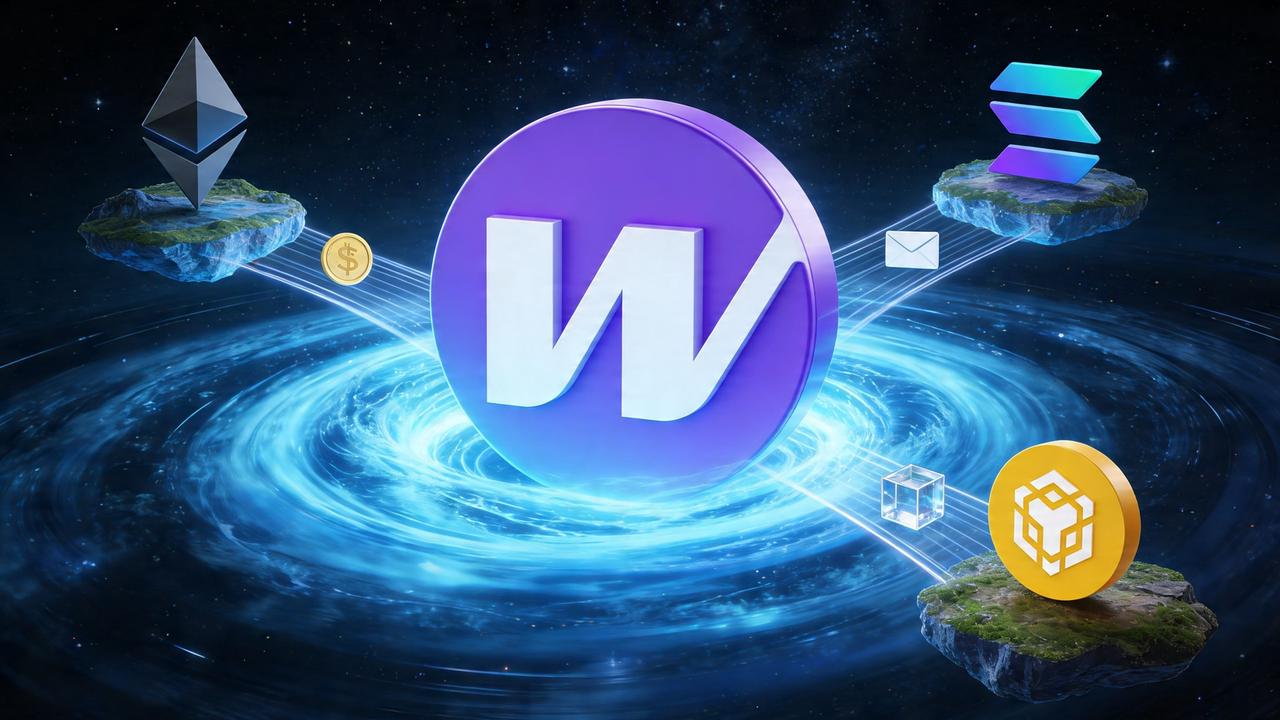
Article Summary
- This article provides a detailed price prediction and fundamental analysis for the Wormhole (W) token.
- It explains Wormhole as a leading interoperability protocol that allows disparate blockchains (like Ethereum, Solana, and Binance Smart Chain) to communicate and transfer assets seamlessly.
- The bull case focuses on the inevitable multi-chain future of crypto, Wormhole's massive total value locked (TVL) across bridges, and its deep integration with major DeFi protocols.
- The bear case highlights the severe security risks associated with cross-chain bridges (including past exploits), intense competition from LayerZero, and the complexity of multi-chain governance.
- It presents detailed price prediction scenarios (bearish, neutral, bullish) for both 2026 and 2030, based on cross-chain volume and security track records.
As crypto moves further into a world of specialized blockchains, the need to move assets and data across those networks becomes much more important. Ethereum still dominates parts of settlement and security, Solana keeps leaning into speed, and other chains focus on payments, gaming, or RWAs. Wormhole protocol is built for that environment, acting as a messaging layer and cross-chain bridge for applications that need to operate across multiple ecosystems. For traders who use crypto exchanges like Bitunix to access infrastructure tokens, W/USDT offers exposure to one of the core systems trying to connect that fragmented market.
Whether that role translates into durable economic value is still an open question. Wormhole already supports cross-chain token transfers, NFT movement, multichain governance, and application messaging across a broad network footprint. But interoperability is a tough category. Security failures are costly, competition is intense, and the market still has very different views on how much W should be worth by the end of the decade.
This analysis will examine Wormhole's bridging technology, its position in the interoperability wars, and provide data-driven price predictions for 2026 and 2030.
The Technology and Ecosystem
Wormhole's core design is based on generic message passing, meaning smart contracts on one chain can send verified instructions to contracts on another chain. That lets developers build multichain apps rather than just moving wrapped tokens around. Wormhole is a protocol for secure and efficient communication between blockchains, with use cases including borrowing and lending across chains, oracle networks such as Pyth, governance coordination, and native token transfers.
Regarding security, Wormhole does not rely on a large anonymous validator crowd secured by a native token in the normal way. Instead, it uses a decentralized set of Guardians that observe chains and verify messages. The official docs summarize the philosophy well:
"Wormhole relies on a network of established validator companies instead of token-based incentives. These 19 Guardians are among the most trusted operators."
That model can sound more centralized, but it is also one reason Wormhole presents itself as institutional-grade infrastructure. The current homepage highlights 19 validator nodes, a global accountant and governor system, continuous audits, and a $5 million bug bounty. The same page says the network has processed more than 1 billion messages, supports more than 30 blockchains, and powers messaging use cases for more than 200 applications.
The W token sits on top of that system as the protocol's native multichain asset. W is designed to power governance, staking, and ecosystem growth across more than 40 blockchains. MultiGov documentation states that token holders can create proposals, vote, and execute decisions across any supported chain, since a multichain protocol cannot really claim to be decentralized if governance works only on one chain or with a single asset format. In other words, W is tied to the protocol's effort to coordinate upgrades and decision-making across a fragmented network map.
A more practical point about the ecosystem is the scale Wormhole has already reached. The protocol supports more than 30 blockchains and 6 runtimes, while institutional and asset-expansion announcements from late 2025 push that footprint above 40 leading networks. That spread reflects how quickly the network is evolving, as Wormhole aims to become the default transport layer for multichain assets, governance, and messaging.
The Bull Case: The Interoperability Standard
Forecast models already show why upside remains possible, but not settled. CoinGecko puts W at about $0.01297 today, with roughly $29.97 million in daily trading volume, a market cap near $74.38 million, and about 5.7 billion tokens in circulation.
Public forecast models for W diverge noticeably once you move beyond the current price level. CoinCodex's forecast sees Wormhole trading in a 2026 range of about $0.009038 to $0.01313, while Kraken's model and MEXC's price prediction stay more conservative, with 2026 estimates near $0.013 and $0.01298 and 2030 levels around $0.016 and $0.015779. TradersUnion's forecast is more optimistic in the near term at roughly $0.0287 to $0.0299 for 2026, while Changelly's 2030 maximum reaches about $0.0543, and CoinLore's long-range model climbs as high as $0.5501 by 2030. That widespread view shows the market still sees Wormhole as an infrastructure bet with real upside, but not as a settled winner. A serious Wormhole crypto price prediction has to account for that gap.
1. The Multichain Future
As crypto infrastructure becomes more specialized, the need to connect chains keeps getting stronger. Wormhole supports multiple blockchains and runtimes and has processed over 1 billion messages, used by more than 200 applications. Those numbers matter because they show that interoperability is no longer a side feature, it is already part of how multichain DeFi works in practice.
That trend also extends beyond retail DeFi. In November 2025, Wormhole powered the expansion of BlackRock's tokenized BUIDL fund to BNB Chain, bringing a tokenized treasury product worth more than $2.5 billion at the time into another major ecosystem. That kind of institutional use suggests the multichain future is about moving regulated, real-world financial products across networks.
2. Massive Ecosystem Integration
Wormhole's integration footprint is one of its strongest arguments in favor, as the protocol is already embedded in important parts of crypto. Official company materials from 2025 say the wider Wormhole network is trusted and used by BlackRock, Apollo Global, VanEck, Google Cloud, Circle, and Uniswap, while a November 2025 announcement tied to BlackRock and Securitize said Wormhole had already facilitated more than $70 billion in cross-chain transfers through over 1 billion messages. That kind of scale suggests Wormhole is already being used in infrastructure that touches major tokenized funds, stablecoins, and multichain financial products.
The same point shows up in Wormhole’s native token infrastructure. Its NTT framework is being used to expand assets such as RLUSD and M across multiple chains while keeping native issuance and reducing liquidity fragmentation. That matters because multichain assets become much more useful when they can move without relying on wrapped versions scattered across separate ecosystems. If more issuers adopt that model, Wormhole gains value as a deeper interoperability layer for multichain DeFi and tokenized real-world assets.
3. Institutional Backing
Institutional support strengthens Wormhole's bullish case because the protocol is already tied to real asset issuers. It serves as the interoperability layer for tokenized products linked to BlackRock, Apollo, Hamilton Lane, and VanEck through Securitize, while also supporting more than $70 billion in cumulative asset transfers across over 1 billion messages.
That kind of backing matters because institutions tend to prioritize security, uptime, and legal reliability. When large tokenized funds and stablecoin issuers choose Wormhole rails, the protocol gains credibility, more transaction activity, and a better chance of becoming default infrastructure for multichain finance.
The Bear Case: The Bridge Security Trilemma
Current price models already show why the bearish case deserves serious attention, because most forecasts still assume Wormhole remains useful without becoming dramatically more valuable. CoinCodex keeps 2026 close to today's price, while the 5% growth tools from Kraken and MEXC only push W modestly higher by 2030. Even the more optimistic projections from TradersUnion and Changelly still stop well short of the kind of revaluation you would expect from a protocol that had clearly won the interoperability race. Taken together, those forecasts suggest the market sees Wormhole as important infrastructure, but still questions whether it can turn that role into dominant long-term value capture.
1. The Exploit History
Security remains the biggest threat to Wormhole's long-term case because the protocol already carries one of the most famous bridge failures in crypto. In February 2022, an attacker exploited a verification flaw and minted 120,000wETH without proper backing, draining about $320 million from the Solana-Ethereum bridge. Jump Crypto later restored the missing funds, which prevented more serious immediate damage, but the incident permanently tied Wormhole's brand to bridge security risk.
That history still impacts valuation because bridge users do not forget large failures easily. Cross-chain systems hold concentrated value, involve complex verification logic, and give attackers a clear incentive to keep probing for weaknesses. Even though Wormhole expanded audits, bug bounties, and Guardian-based protections after the exploit, another major incident would likely hurt trust, usage, and token demand far faster than governance could repair it.
2. Fierce Competition
Competition is one of Wormhole's biggest risks because interoperability is no longer a niche category with only a few serious players. Messari's March 2026 valuation report says LayerZero accounts for an estimated 57% of all cross-chain volume and has already processed more than $100 billion in cumulative value transferred. That gives LayerZero a strong network-effect advantage at the exact moment Wormhole is trying to expand beyond its early bridge identity and become a broader messaging protocol.
LayerZero's model gives applications more flexibility in how they configure verification, while Wormhole relies on its Guardian-based architecture and a more opinionated security model. That difference means Wormhole is competing on architecture, developer preferences, and trust simultaneously. If more multichain apps decide they prefer LayerZero's design or its larger volume footprint, Wormhole can remain important infrastructure while still losing enough market share to limit long-term upside for the W token.
3. Governance Complexity
Governance becomes much harder when a protocol spans dozens of chains, runtimes, and asset standards at once. Wormhole's MultiGov system solves that by aggregating voting power across connected networks and enabling proposals, voting, and execution without forcing everyone onto a single chain.
That complexity matters because every upgrade, fee change, or new chain integration has to work across a very broad technical surface area. Wormhole's own materials say the network supports more than 30 blockchains, 6 runtimes, and over 200 applications, while MultiGov is built to coordinate decentralized decision-making across that footprint. The more chains and use cases Wormhole adds, the harder it becomes to keep incentives aligned, execute upgrades smoothly, and avoid governance friction slowing down the protocol's response to risk or competition.
Wormhole Crypto Price Prediction Scenarios (2026 & 2030)
Forecast ranges for W are wide because the market is trying to price two things at once: the long-term importance of interoperability and the short-term fragility of bridge infrastructure. Conservative models from Kraken, MEXC, and CoinCodex stay close to the current price range. TradersUnion offers a stronger 2026 view, Changelly adds more 2030 upside, and CoinLore provides the most aggressive stretch case by far.
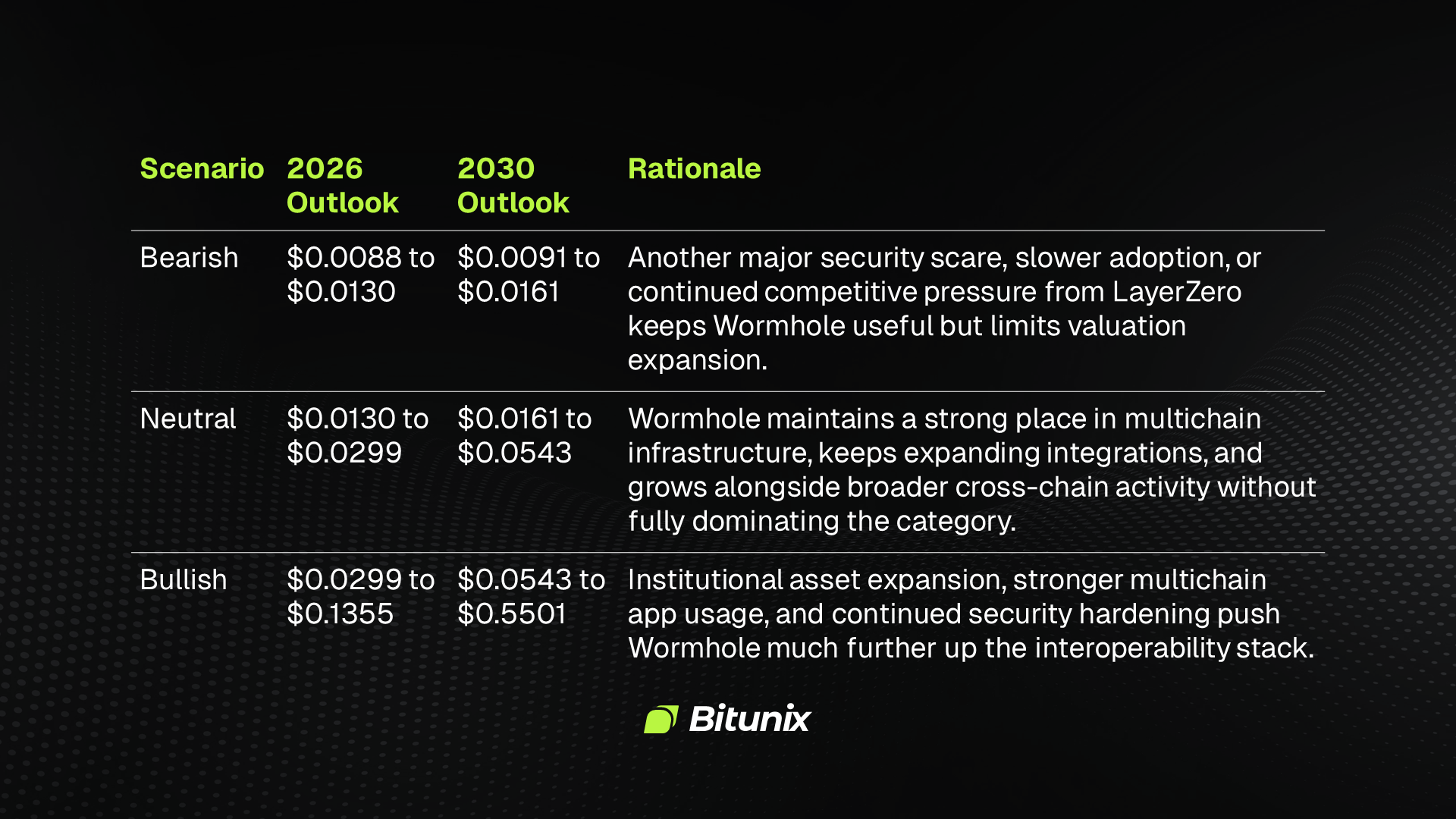
Wormhole price prediction scenarios for 2026 and 2030, comparing bearish, neutral, and bullish outcomes based on security, cross-chain adoption, and competition in interoperability.
Conclusion: A Bet on a Connected Crypto World
Wormhole represents genuinely important infrastructure for a multichain future. It already supports messaging, native token transfers, cross-chain governance, and a large set of applications across a wide network footprint. It is trusted by serious institutions, used by major asset issuers, and large enough to have processed more than $70 billion in transfers and more than 1 billion messages.
At the same time, the risk cannot be ignored. Bridges remain among the most attack-prone pieces of crypto infrastructure, competition from LayerZero is intense, and governance becomes harder as the protocol spreads across more chains and use cases. Investing in W is a long-term bet that interoperability remains essential and that Wormhole can maintain security tight enough to earn a larger share of multichain DeFi. If you want exposure, Bitunix offers W/USDT trading, so you can download the Bitunix app, register, and decide whether the current market cap is discounting too much risk or not enough.
FAQ
What is Wormhole (W)?
Wormhole is a multichain messaging and interoperability protocol that allows data, assets, and instructions to move between blockchains. W is its native multichain token, tied to governance, staking, and broader ecosystem participation.
How does a cross-chain bridge work?
A cross-chain bridge moves assets or messages between different chains by observing activity on one chain and triggering a corresponding action on another. In Wormhole's case, Guardians verify messages and applications use those verified actions across connected networks.
What is generic message passing?
Generic message passing means sending verified instructions or data across chains, not just wrapped assets. That lets smart contracts trigger actions on remote chains and enables more complex multichain applications.
How does Wormhole secure its network?
Wormhole uses 19 Guardians, continuous audits, a global accountant and governor system, and a $5 million bug bounty. The model relies on reputable validator companies instead of anonymous token-based validation.
What is the utility of the W token?
The W token is Wormhole's native utility and governance asset. It is used for DAO voting on upgrades and chain integrations, staking for rewards, and paying network-related fees for cross-chain activity. In short, W helps govern, secure, and support Wormhole's multichain infrastructure.
How does Wormhole compare to LayerZero?
Wormhole emphasizes Guardians, messaging, and multichain infrastructure products such as NTT and MultiGov. LayerZero uses a different architecture and, according to Messari's March 2026 report, currently accounts for an estimated 57% of all crosschain volume.
Which blockchains does Wormhole support?
Wormhole supports more than 30 blockchains, including Ethereum, Solana, BNB Chain, Polygon, Avalanche, Arbitrum, Optimism, Base, Sui, Aptos, Cosmos Hub, Osmosis, Near, and others. Its Guardian network helps move tokens, NFTs, and messages across these ecosystems through cross-chain infrastructure.
What happened during the 2022 Wormhole exploit?
Ethereum.org’s 2026 bridge documentation says 120,000 wETH, worth about $325 million, was stolen in the Wormhole hack. Later reports note that the hole was backstopped and the vulnerability was patched, but the incident still defines the protocol’s security reputation.
What are the risks of investing in W?
The biggest risks are security failures, competition from LayerZero and other interoperability protocols, and the complexity of governing a protocol spread across many chains. The forecast models also vary widely, which shows conviction remains limited.
Where can I buy W tokens?
You can buy W on centralized exchanges such as OKX, Bitunix, KuCoin, Gate, and Kraken. CoinGecko currently lists OKX as the most active market, while Bitunix offers W/USDT spot trading.
Glossary
- W token: Wormhole's native multichain asset used for governance, staking, and ecosystem participation.
- Wormhole protocol: The broader interoperability system that powers messaging, token transfers, and cross-chain applications.
- Cross-chain bridge: Infrastructure that moves assets or messages between otherwise separate blockchains.
- Interoperability: The ability of different blockchain networks to communicate and exchange value or data.
- Multichain DeFi: Decentralized finance activity that spans more than one blockchain network.
- Messaging protocol: A system that sends verified instructions or data across chains.
- Guardian Network: Wormhole's decentralized set of 19 validator companies that observe chains and verify messages.
- Generic message passing: A method that lets applications send arbitrary verified instructions across chains.
- MultiGov: Wormhole’s multichain governance system for proposals, voting, and execution across supported chains.
- Native Token Transfers: Wormhole’s framework for moving native tokens across chains without relying on wrapped representations.
- Wrapped token: A tokenized representation of an asset that originated on another chain.
- Bug bounty: A reward program that pays researchers for finding security vulnerabilities.
- Cross-chain volume: The value transferred across bridge or messaging infrastructure between chains.
- Institutional tokenized asset: A regulated or institution-backed onchain asset such as a tokenized fund or stablecoin.
- Validator company: A professional infrastructure operator that runs verification or network security services.
Disclaimer
This article does not provide:
(i) investment advice or investment recommendations;
(ii) an offer or solicitation to buy, sell, or hold digital assets;
(iii) financial, accounting, legal, or tax advice.
Digital assets, including stablecoins and NFTs, involve high risk and may fluctuate significantly. Consider whether trading or holding digital assets is appropriate for you given your financial situation. Consult a qualified legal, tax, or investment professional when needed. You are responsible for understanding and complying with applicable local laws and regulations.
About Bitunix
Bitunix is a global cryptocurrency derivatives exchange trusted by over 3 million users across more than 100 countries. At Bitunix, we are committed to providing a transparent, compliant, and secure trading environment for every user. Our platform features a fast registration process and a user-friendly verification system supported by mandatory KYC to ensure safety and compliance. With global standards of protection through Proof of Reserves (POR) and the Bitunix Care Fund, we prioritize user trust and fund security. The K-Line Ultra chart system delivers a seamless trading experience for both beginners and advanced traders, while leverage of up to 200x and deep liquidity make Bitunix one of the most dynamic platforms in the market.
Bitunix Global Accounts
X | Telegram Announcements | Telegram Global | CoinMarketCap | Instagram | Facebook | LinkedIn | Reddit | Medium