
Article Summary
- This article provides a detailed price prediction and fundamental analysis for the QTUM token.
- It explains QTUM's unique value proposition as a hybrid blockchain that combines Bitcoin's secure UTXO model with Ethereum's smart contract capabilities (EVM).
- The bull case focuses on its proven security, ongoing development (including Web3 and metaverse initiatives), and potential appeal to enterprise users seeking a stable, hybrid environment.
- The bear case highlights its loss of market share to newer, faster Layer 1s and Layer 2s, a lack of mainstream developer adoption, and its status as an "older" project in a hype-driven market.
- It presents detailed price prediction scenarios (bearish, neutral, bullish) for both 2026 and 2030, based on ecosystem revival and broader market trends.
Qtum launched in 2017 with a pitch that still sounds smart today. It tried to combine Bitcoin-style transaction security with Ethereum-style smart contracts in one network. That design still makes the project technically interesting, even if the market has spent the last few years chasing newer Layer 1 stories. Qtum describes itself as an open-source public blockchain that uses the security of the UTXO model while enabling the Ethereum Virtual Machine.
At the center of that design is the Account Abstraction Layer, which helps EVM smart contracts run on top of a Bitcoin-like UTXO base. If you want market access while following that technology, Bitunix is a crypto exchange where you can trade QTUM/USDT.
This analysis will examine QTUM's technological foundation, its struggle for relevance in the modern Web3 landscape, and provide data-driven price predictions for 2026 and 2030.
The Technology: UTXO Meets EVM
Qtum's current tech page explains the project in the clearest possible way:
"Qtum combines Bitcoin's reliable UTXO model with Ethereum's flexible smart contract capabilities through its innovative Account Abstraction Layer, creating a unique blockchain architecture."
The UTXO model is the Bitcoin side of the story. This model improves security against double-spending and supports efficient parallel transaction validation. That matters because UTXO systems tend to be easier to reason about at the transaction level, especially when you care about traceability and clear input-output accounting.
The EVM side comes from the Account Abstraction Layer, which serves as a translator between Bitcoin's UTXO model and Ethereum’s account model, enabling the network to support full smart contract functionality while retaining its Bitcoin-like base. Its developer page also says builders can use Solidity, test Account Abstraction Layer behavior, and work with tools like Truffle, Hardhat, Qmix, and qtum.js. In other words, Qtum built a bridge between two different blockchain logics.
Consensus is the third piece, and unlike Bitcoin, Qtum uses proof-of-stake instead of proof-of-work. Qtum's PoS model is more energy-efficient, averages roughly 32-second block times, and supports faster confirmations. Decentralized governance is also highlighted, allowing some blockchain parameters to be adjusted without a hard fork. So if you trade QTUM on Bitunix, the chain underneath is still running a different operating model from Bitcoin, even though its transaction design borrows from Bitcoin's UTXO model.
The Bull Case: Security and Persistence
On April 8, 2026, CoinCodex's forecast showed QTUM trading around $0.94. CoinGecko put the market cap near $99.4 million, the fully diluted valuation near $101.1 million, and 24-hour trading volume around $8 million.
Regarding forecasts, well-known sources have mixed results.
- Kraken's model puts QTUM at $0.94 in 2026 and $1.15 in 2030.
- CoinCodex is more cautious at $0.92 for 2026 and $0.36 for 2030.
- Changelly's price prediction is more bullish for late 2026, projecting a December 2026 average around $1.67 and a maximum around $1.86, though its 2030 average drops back toward $0.39.
- MEXC's forecast published a far more aggressive outlook, with a 2026 high of $3.20 and a 2030 upside case near $15.73, but that sits well outside the more conservative models.
1. Battle-Tested Infrastructure
The strongest bullish argument is the token's survival. Qtum is still here, still upgrading core infrastructure, and still integrating both Bitcoin and Ethereum improvements into the chain. In November 2025, the Qtum Foundation announced that the v29.1 hard fork would merge Bitcoin Core 27.2, 28, and 29 alongside Ethereum Pectra-related improvements, with activation concluded on January 12, 2026. That proves that this is the behavior of a chain trying to stay technically current while keeping its original architecture intact.
That matters for investors who care more about durability than trendiness. A lot of newer chains look exciting until they run into the slow, messy part of crypto, where upgrades, compatibility, and long-term maintenance matter more than launch-week excitement. Qtum's case is that stability and persistence still have value, especially if the market rotates back toward older, proven infrastructure.
2. Continuous Development
The second bullish point is that Qtum was not frozen in 2017 after its mainnet launch. It has kept shipping upgrades over the years, including major core releases and a hard fork in late 2025, which shows the chain is still being maintained and updated.
Its August 2025 development update said mainnet deployment of the Qtum bridge had begun after community testing, bringing bridged USDC to the network and aiming for deeper DeFi integration. The same update said the team had put 10,000 GPUs online for Qtum Qurator and Qtum Solstice on Qtum AI, and it also confirmed ongoing work around Ordinals, BRC-20 tools, ERC-721, and ERC-1155 support. Current official pages also highlight Bitcoin Ordinals support, Qtum.AI, and active developer tooling.
That shows that the current Qtum story is broader than the old hybrid-chain pitch. The network is trying to attach itself to newer use cases, including AI tooling, bridge infrastructure, NFT-related support, and better EVM alignment.
3. Older Coin Revival Dynamics
Older coins often come back when liquidity rotates down the risk curve, and traders start looking for neglected assets with recognizable names, exchange access, and lower fully diluted uncertainty. CoinGecko says QTUM is effectively fully distributed already, with all 92 million initially unlocked and a maximum supply of 107.8 million. CoinGecko also shows the token still ranking around #275 by market cap, and Bitunix’s market listings show that QTUM remains available in current trading menus. That kind of persistence does not guarantee a comeback, but it helps explain why old assets can still move hard when attention returns.
The Bear Case: The Attention Economy
The bearish setup is not subtle, and the numbers look worse when you translate them into percentage change from today’s roughly $0.91 QTUM price. Kraken’s $1.11 target for 2030 is only about 22% above current levels, which is hardly a strong long-term case. CoinCodex’s $0.3632 forecast implies a decline of about 60%, and Changelly’s 2030 average near $0.397 still means QTUM would be down roughly 56% from here.
That means the more conservative forecasters do not see strong compounding adoption yet. A second QTUM price prediction challenge is that even the optimistic numbers often rely on a broader crypto rebound more than clear evidence of Qtum-specific demand.
1. The Layer 1 and Layer 2 Squeeze
Qtum is trying to stay relevant in a market where much bigger ecosystems already dominate mindshare and liquidity. DeFi Llama’s April 2026 chain page showed Solana with a TVL of around $5.5 billion. Its Sui page showed bridged TVL around $1.02 billion and 24-hour DEX volume near $71.8 million. L2Beat's April 8, 2026, summary put the total Ethereum Layer 2 value secured at $31.57 billion, and L2Beat's Arbitrum page showed Arbitrum One alone at $15.40 billion TVS. Against those numbers, QTUM's sub-$100 million market cap looks very small.
That does not automatically mean Qtum is worthless, but it does mean the chain is playing catch-up. Solana wins attention with speed and activity, Sui with growth and fresh capital, and Ethereum L2S with users, liquidity, and developer gravity. Qtum has to compete with all of that while also explaining why an older hybrid design matters now.
2. Developer Mindshare
Qtum still supports Solidity and advertises EVM compatibility, which is useful, but EVM support by itself is no longer enough to stand out. Ethereum and its rollups already have the deepest developer base, the most active liquidity, and the biggest installed user networks. Qtum's own developer page highlights Solidity, Hardhat, Truffle, qtum.js, and Account Abstraction Layer testing, which means the tooling exists. The harder question is whether builders have a reason to choose Qtum first.
3. Narrative Exhaustion
The original Bitcoin-plus-Ethereum story was powerful years ago because it sounded like a clean answer to blockchain fragmentation. In 2026, that is no longer enough. The market is now obsessed with AI, DePIN, app-specific chains, consumer crypto, and high-speed DeFi. Qtum's own recent updates make that clear indirectly. The project is talking about AI apps, USDC bridge rollout, Ordinals, BRC-20 support, and Ethereum Pectra integration because the old hybrid message no longer sells itself.
Price Scenarios For 2026 And 2030
Kraken gives a relatively stable path around $0.94 in 2026 and $1.15 in 2030. CoinCodex is more cautious at $0.92 and $0.36. Changelly peaks much higher in late 2026, but weakens by 2030. MEXC offers the outlier bullish case. A serious Qtum 2030 forecast has to sit somewhere between those conservative models and the much hotter exchange-published upside cases.
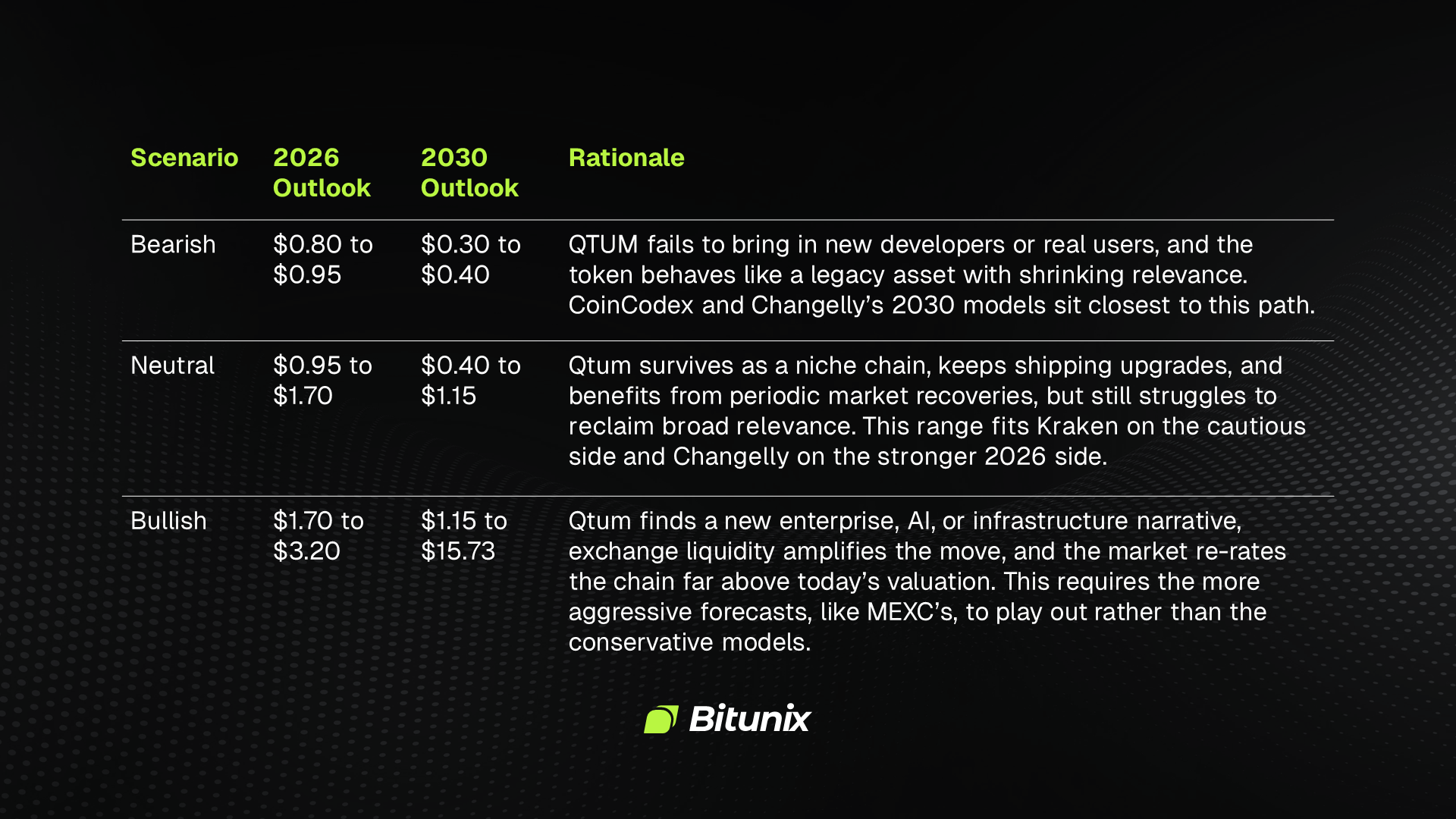
QTUM outlook table comparing bearish, neutral, and bullish scenarios for 2026 and 2030 based on adoption, relevance, and the chance of a broader market revival.
Conclusion: A Legacy Project Seeking a New Spark
QTUM is still one of the more interesting old-school blockchain designs because it genuinely tried to merge two important architectures instead of copying one and renaming it. The UTXO model, EVM compatibility, and proof-of-stake design still give the chain a real technical identity, but good architecture alone does not guarantee attention, users, or price appreciation.
That leaves QTUM in a contrarian spot. You are not buying a fresh narrative. You are buying the idea that battle-tested infrastructure, ongoing upgrades, and a smarter market rotation can still matter. That can work. It can also stay a niche story for much longer than bulls want.
If you want to follow or trade the asset directly, Bitunix is a crypto exchange where you can trade QTUM/USDT. To start, just download the Bitunix app and register there to track QTUM and other established Layer 1 tokens.
FAQ Section
What is QTUM?
QTUM is an open-source public blockchain that combines a Bitcoin-style UTXO base with Ethereum-compatible smart contracts. Its main technical identity comes from the Account Abstraction Layer, which helps those two models work together on one network.
How does QTUM combine Bitcoin and Ethereum?
QTUM uses the UTXO model for transaction handling and an Account Abstraction Layer to translate that structure into an environment where EVM smart contracts can run. That lets developers use Solidity while the base chain keeps Bitcoin-like transaction logic.
What is the UTXO model?
The UTXO model tracks coins as individual unspent outputs rather than as balances in a single account. Qtum's official tech page says that the structure improves double-spend resistance and supports efficient parallel transaction validation, which is one reason Bitcoin-style systems remain attractive.
Can I stake QTUM?
Yes. QTUM supports staking through its Proof-of-Stake network, so holders can help secure the chain and earn rewards. You can stake through the Qtum Core wallet or some third-party services. Rewards vary based on stake size, network weight, and wallet uptime.
What is the Account Abstraction Layer?
The Account Abstraction Layer is the bridge that lets EVM smart contracts work on top of Qtum's UTXO structure. It works as a translator between Bitcoin's UTXO model and Ethereum's account model.
Is QTUM a good long-term investment?
QTUM is a high-risk contrarian bet. The upside depends on whether the chain can turn steady development into renewed adoption. The downside is that it stays technically respectable but commercially small, which is close to what some conservative 2030 forecasts already imply.
Who are QTUM's main competitors?
QTUM's main competitors are other Layer 1 blockchains focused on smart contracts, staking, and scalability. Key rivals include Algorand, Lisk, Kava, Flow, and Oasis, as they compete on developer tools, interoperability, privacy features, and broader ecosystem adoption.
What is the all-time high of QTUM?
CoinGecko lists QTUM's all-time high at $100.22. That number matters mainly as historical context. It shows how much the asset has fallen from peak-cycle enthusiasm and how large a comeback would need to be to revisit old levels.
Does QTUM support NFTs and Web3?
Yes. QTUM supports NFTs and Web3 applications through its EVM compatibility and smart contract support. It can handle token standards, dApps, DeFi tools, and wallet integrations that connect users to Web3 services. Recent upgrades have also improved interoperability and broader ecosystem support.
Where can I buy QTUM?
QTUM is available on major exchanges, and Qtum's own About page lists Binance, Kraken, HTX, and OKX among trading venues. Bitunix also lists QTUM/USDT in its markets, which gives traders another route for access.
Glossary
- QTUM crypto: The native asset of the Qtum network, used across staking, transaction fees, and broader network activity.
- Qtum blockchain: A public blockchain that combines Bitcoin-style UTXO transactions with Ethereum-compatible smart contracts.
- UTXO model: A transaction model that tracks spendable outputs rather than updating balances in a single account state.
- EVM compatibility: Support for Ethereum Virtual Machine smart contracts, allowing Solidity-based applications to run on Qtum.
- Account Abstraction Layer: The component that translates between Qtum's UTXO structure and Ethereum-style account-based smart contracts.
- Proof-of-Stake: Qtum's consensus model, which replaces mining with staking and lowers energy use compared with proof-of-work.
- Decentralized Governance Protocol: Qtum's on-chain governance mechanism for changing some network parameters without a hard fork.
- Solidity: The smart contract programming language Qtum developers can use because of the chain's EVM support.
- Qmix IDE: Qtum's browser-based tool for writing, compiling, deploying, and interacting with Solidity contracts.
- Ordinals support: Qtum's ability to support Bitcoin Ordinals-style functionality, highlighted in current official materials.
- ERC-721: An NFT token standard that Qtum says it supports on the EVM smart-contract layer.
- ERC-1155: A multi-token standard for NFTs and related assets that Qtum also says it supports on the EVM layer.
- Bridged USDC: USDC moved onto Qtum through bridge infrastructure, which the Qtum Foundation said began mainnet deployment in 2025.
- FDV: Fully diluted valuation, or the market value implied if the maximum token supply were counted in circulation.
- Qtum 2030 forecast: A long-range view of where QTUM could trade by 2030, usually based on adoption, ecosystem relevance, and broader market conditions rather than certainty.
Disclaimer
This article does not provide:
(i) investment advice or investment recommendations;
(ii) an offer or solicitation to buy, sell, or hold digital assets;
(iii) financial, accounting, legal, or tax advice.
Digital assets, including stablecoins and NFTs, involve high risk and may fluctuate significantly. Consider whether trading or holding digital assets is appropriate for you given your financial situation. Consult a qualified legal, tax, or investment professional when needed. You are responsible for understanding and complying with applicable local laws and regulations.
About Bitunix
Bitunix is a global cryptocurrency derivatives exchange trusted by over 3 million users across more than 100 countries. At Bitunix, we are committed to providing a transparent, compliant, and secure trading environment for every user. Our platform features a fast registration process and a user-friendly verification system supported by mandatory KYC to ensure safety and compliance. With global standards of protection through Proof of Reserves (POR) and the Bitunix Care Fund, we prioritize user trust and fund security. The K-Line Ultra chart system delivers a seamless trading experience for both beginners and advanced traders, while leverage of up to 200x and deep liquidity make Bitunix one of the most dynamic platforms in the market.
Bitunix Global Accounts
X | Telegram Announcements | Telegram Global | CoinMarketCap | Instagram | Facebook | LinkedIn | Reddit | Medium