
Article Summary
- Solana (SOL) has emerged as a leading blockchain platform, known for its high speed and low transaction costs.
- The path to a $1,000 SOL depends on several key factors, including continued network stability, growth of its DeFi and NFT ecosystems, and increasing institutional adoption.
- Technical analysis shows key resistance and support levels that will determine SOL's trajectory in the coming year.
- While the $1,000 target is ambitious, this article provides a balanced analysis of both the bullish catalysts that could drive it there and the bearish risks that could prevent it.
- Bitunix offers a premier platform for trading SOL, with both spot and futures markets available to capitalize on its volatility.
After a stunning comeback from the 2022–2023 bear market, Solana is back near the top of the rankings by market cap, trading around the mid-$100s as of December 2025. It recovered from FTX-related fear, survived a brutal DeFi winter, and now sits at the center of narratives around DePIN, DeFi, and institutional adoption.
Today, many traders and analysts are asking a simple but bold question: could SOL really hit $1,000? At first glance, the number looks wild. It would mean a multi-hundred-billion-dollar valuation and a huge jump from current levels. But given how fast crypto sentiment can flip, it’s a scenario worth unpacking calmly instead of dismissing out of hand.
Solana’s core pitch hasn’t changed: it’s a high-performance Layer-1 that can process tens of thousands of transactions per second with fees that are often a fraction of a cent.
That combination makes it attractive, not just for traders and NFT flippers, but for any app that needs speed and low costs—DeFi, gaming, payments, and even traditional finance experiments. You can buy SOL on almost every major crypto exchange, which keeps liquidity deep and on-ramps simple for new users.
The $1,000 target is not a meme line on a chart. It’s a stress test. If Solana hits that level, it means its tech, ecosystem, and narrative are all lined up in a very specific way by 2026.
This article will provide a comprehensive and realistic Solana price prediction for 2026, analyzing the fundamental drivers, technical chart patterns, and competitive landscape to assess the viability of the $1,000 price target.
The Bull Case for a $1,000 SOL
1. Unmatched Performance and Low Costs
Solana’s performance is still one of its biggest selling points. Thanks to its proof-of-stake plus proof-of-history design, the network can theoretically handle up to ~50,000 transactions per second, with average transaction fees often ranging from $0.00025 to $0.01.
For regular users, that means cheap swaps, mints, and transfers. For builders, it means they can design apps that assume “internet-like” speed rather than “blockchain-slow” congestion.
This matters for things like:
- High-frequency DeFi protocols
- On-chain order books and perps DEXs
- Game economies with lots of micro-transactions
- Real-time DePIN systems that constantly send small updates
If Solana keeps this performance edge while other chains struggle with scaling trade-offs, it supports a narrative where SOL deserves a hefty premium.
2. The DePIN and DeFi Ecosystem Explosion
One of the clearest signs of Solana’s momentum is how many DePIN (Decentralized Physical Infrastructure Network) projects have chosen it as home. Helium migrated from its own L1 to Solana in 2023 to tap cheaper fees and better scalability.
Render, a leading decentralized GPU rendering network, also moved from Ethereum to Solana in 2024. Add Hivemapper, Grass, io.net, and others, and you get a cluster of “real-world” infrastructure projects settling on the same chain.
A recent Grayscale report summarized the trend by noting that DePIN projects are increasingly picking Solana to connect crypto incentives with physical infrastructure, from wireless networks to mapping. That’s not just narrative fluff; these apps generate real transactions and fee revenue.
On the DeFi and trading side, Solana now has:
- Jupiter – a top-tier DEX aggregator and perps venue
- Raydium and Orca – DEXes with deep SOL and USDC liquidity
- Jito and Marinade – liquid staking and MEV-aware staking protocols
According to Messari’s Q4 2024 report, “Chain GDP on Solana (total app revenue) grew by 213% QoQ from $268 million to $840 million.” That surge in app-level revenue is exactly the kind of metric long-term investors watch when they’re evaluating whether a chain deserves a re-rating.
If that kind of growth continues—even at a slower pace—it supports a more aggressive Solana price prediction 2025 than simple “trend line from last year” models.
3. Institutional Interest and Spot ETFs
Institutional adoption is no longer a future hope; it’s happening now:
- Visa has expanded USDC settlement to Solana, citing speed and low fees.
- J.P. Morgan issued a $50M commercial paper for Galaxy Digital on Solana, calling it a “milestone” for on-chain securities.
On top of that, 2025 finally brought spot Solana ETFs to life. Franklin Templeton filed for a spot SOL ETF early in the year, and by late 2025, sources like NerdWallet and Bitget report that the SEC has approved the first spot Solana ETFs in the U.S.
For price, this matters in two ways:
- It opens a regulated channel for advisors, funds, and institutions that can’t or won’t hold native SOL.
- It tightens the link between demand spikes and on-chain liquidity, especially if ETF providers source from existing exchanges.
If ETF inflows follow a pattern like Bitcoin’s, they could be a major tailwind during the next macro risk-on phase.
4. The “Solana Phone” and Consumer Adoption
The Solana Mobile Saga line is easy to joke about (“who really wants a crypto phone?”), but it’s more interesting than it looks. The device ships with a built-in Solana wallet, native dApp store, and specific perks like NFT access and airdrops, all designed to turn a standard smartphone into a Web3 gateway.
Even if Saga phones never reach iPhone-scale volumes, they help Solana in a few ways:
- They give devs a testbed for mobile-first Web3 UX.
- They keep the Solana brand in front of both builders and retail users.
- They show that Solana is willing to experiment with hardware, not just protocols.
If the mobile stack leads to one or two breakout consumer apps, that can create a new demand wave for SOL that standard L1s don’t capture.
The Bear Case: Hurdles on the Path to $1,000
1. Network Stability Concerns
Solana’s outage history is the first thing critics bring up—and they’re not wrong to care. The network suffered several major outages between 2021 and early 2024, with a notable halt in February 2024.
Engineers have introduced upgrades and tooling to improve reliability, and uptime has improved. But even in 2025, third-party monitors reported smaller disruptions that weren’t always clearly communicated.
If Solana were to experience another long, high-profile outage right as institutions and ETFs are ramping up, it would be a serious blow to the $1,000 storyline. Big money does not like chains that go offline.
2. Intense Competition
Solana isn’t racing alone. It faces pressure from:
- Other high-performance L1s like Aptos and Sui, built by ex-Meta engineers, with their own scaling tricks.
- Ethereum Layer-2s like Arbitrum and Optimism, which give users cheap and fast transactions while piggybacking on Ethereum’s settlement layer.
If L2s keep absorbing the bulk of DeFi and stablecoin activity, or if another L1 hits the sweet spot of performance plus decentralization, Solana’s valuation might plateau long before $1,000.
3. Centralization Worries
Solana’s design requires relatively powerful hardware to run a validator. That, plus its history of coordinated restarts, has led some analysts to argue that it’s more centralized than Ethereum.
Messari data shows Solana has over 1,300 active validators across nearly 40 countries, which is not tiny, but the debate isn’t just about count—it’s about how easy it is for new validators to join and how much stake a few entities control.
If these concerns grow, SOL might trade at a discount compared with more “credibly neutral” chains, limiting upside even if usage grows.
Technical Analysis: The Chart’s Path to $1,000
Key Resistance Levels
From a chart perspective, Solana has already telegraphed the high levels:
- Old cycle high (~$260) – The 2021 peak around $260 acted as a long-term reference point, and Solana came close to or slightly exceeded it again in late 2024.
- $300–$350 zone – This is where many long-term holders might start taking heavy profits after being underwater for years.
- $500 – A major psychological line that would likely draw huge attention from both crypto and mainstream media.
- $750–$800 – A possible “blow-off” target if a full bull mania returns.
- $1,000 – Not just a round number, but a level where Solana’s market cap would put it in direct competition with Ethereum for second place in some scenarios, depending on ETH’s own price.
For SOL to reach $1,000 in 2026, you’d probably need:
- A strong macro risk-on environment.
- Continued ecosystem growth (DePIN, DeFi, NFTs).
- Large ETF inflows and institutional adoption.
- No major outages or regulatory shocks.
That’s a high bar, but it’s not fantasy if everything breaks the right way.
Key Support Levels
On the downside, several levels matter for anyone planning entries or risk management:
- $100–$120 – The current price region, which has acted as a consolidation area in Q4 2025.
- $70–$80 – A deeper pullback zone that roughly lines up with previous ranges from 2023–2024.
- $30–$40 – A “nuclear winter” scenario where the broader market unwinds hard, and leverage flushes out.
If Solana can keep making higher lows (for example, holding above $100 even in sharp corrections), the bullish structure stays intact, even if $1,000 takes longer than one cycle.
Scenario Table: 2025–2030 Price Ranges
Below is a speculative scenario table based on current information, ecosystem growth, and comparisons with other L1s. This is not financial advice; it’s a structured way to think about possibilities.
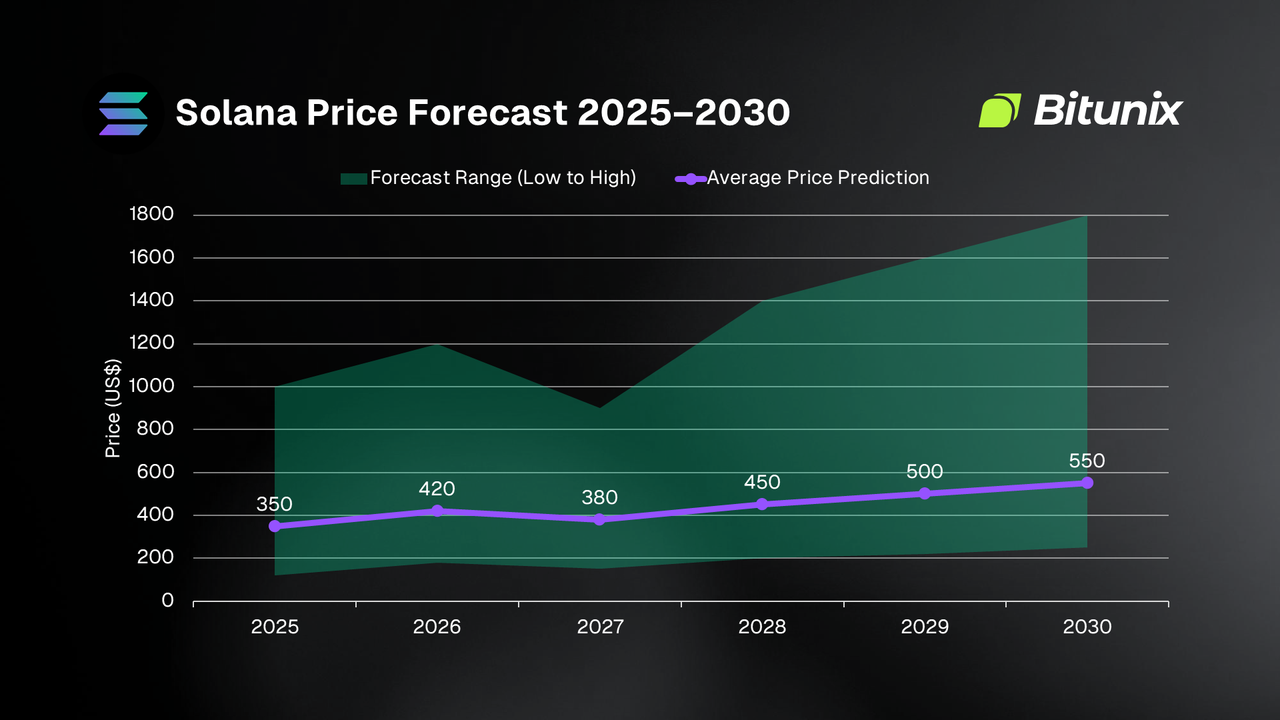
In this framework, a Solana price prediction 2026 of $1,000 sits at the extreme bullish edge of the range, not the base case. The base case for 2026 is more in the low-to-mid-hundreds, with $1,000 reserved for a perfect mix of ETF flows, strong risk sentiment, and flawless execution.
How to Trade Solana (SOL) on Bitunix
How to Sign Up for Bitunix
Follow these steps to create your Bitunix account and start using it on both web and mobile:
- Go to the official registration page, and choose to sign up with your email or phone number.
- Create a strong password (8–32 characters with letters, numbers, and symbols), agree to the Terms and Privacy Policy, and click “Register.”
- Enter the verification code sent to your email or phone to activate your account, then you can log in anytime.
- To use Bitunix on your phone, visit the app download page and select iOS (App Store) or Android (Google Play / official APK).
- Install the app, log in with the same email address or phone number and password you used on the website, and enable two-factor authentication (2FA) in the Security settings before you start depositing and trading.
Spot Market: Simple Exposure to SOL
If you just want exposure to Solana’s long-term growth, the spot market is the simplest route.
On Bitunix, you can:
- Deposit USDT or other supported assets.
- Buy SOL on the spot market and move it to self-custody, or keep it on the exchange if that fits your setup.
This approach suits you if:
- You believe in Solana’s multi-year story.
- You prefer low stress over short-term trading.
- You want to combine SOL with staking or DeFi strategies later.
Futures Market: Trading Volatility With Leverage
If you’re more active, Bitunix also offers SOL perpetual futures contracts. You can trade SOL-USDT perps with leverage and access tools like take-profit/stop-loss directly on the futures interface.
Futures let you:
- Go long if you expect a breakout.
- Go short if you think SOL is overheated.
- Hedge a spot bag during uncertain macro conditions.
Leverage cuts both ways. A 10% move against you on 10x leverage can wipe out your margin. So it’s usually smarter to start small, use hard stops, and size positions based on how much you’re actually willing to lose.
Whether you believe in the $1,000 target or see a short-term drop, Bitunix is the best place to execute your SOL strategy. Sign up and trade with low fees today!
Conclusion: Ambitious, But Not Impossible
Solana has a rare mix of strengths:
- High throughput and low fees.
- A fast-growing DePIN and DeFi ecosystem.
- Increasing institutional attention, from Visa integrations to on-chain securities and spot ETFs.
On the other hand, it still carries baggage:
- A history of outages that hasn’t fully faded.
- Strong competition from Ethereum L2s and other L1s.
- Ongoing debates around decentralization and validator hardware.
Putting it all together, hitting $1,000 in 2025 is an aggressive upside case that would require a perfect storm: strong macro tailwinds, big ETF inflows, no major technical failures, and continued ecosystem expansion. It’s not the “most likely” outcome, but it’s one of the few L1s where that kind of target sits within the realm of possible rather than absurd.
The future of Solana is being built today. Be part of the action by trading SOL on Bitunix!
FAQ
What makes Solana faster than Ethereum?
Solana combines proof-of-stake with proof-of-history and parallel transaction processing. This design lets it handle tens of thousands of TPS with low fees, while Ethereum’s base layer processes far fewer transactions per second.
Has the Solana network stopped having outages?
The network has improved and has gone longer stretches without major halts, but it still faces occasional performance issues and remains under scrutiny from analysts who track uptime closely.
What is DePIN, and why is it important for Solana?
DePIN stands for Decentralized Physical Infrastructure Networks—projects like Helium, Hivemapper, and Render that link real-world infrastructure to crypto incentives. Many of these have migrated to Solana, boosting its real economic activity.
Will there be a Solana ETF?
Yes. In 2025, U.S. regulators approved the first spot Solana ETFs after firms like Franklin Templeton filed proposals, giving institutions a regulated way to get SOL exposure.
Who are Solana’s biggest competitors?
Its main rivals are other high-performance L1s like Aptos and Sui, plus Ethereum Layer-2 networks such as Arbitrum and Optimism that offer low-cost transactions on top of Ethereum.
What was Solana’s all-time high price?
Sources differ slightly, but major trackers show an all-time high just under $300 (around $294–$295) reached in early 2025, surpassing the prior ~$260 peak from 2021.
Is Solana a good long-term investment?
It depends on your risk tolerance. Solana has strong growth and adoption, but also higher technical and regulatory risks than older networks. Treat it as a high-volatility asset and size your position accordingly.
How does the Solana phone work?
The Solana Saga is an Android-based smartphone with a built-in Solana wallet, a dApp store, secure key management, and incentives like NFT access and airdrops for users.
What are the biggest dApps on the Solana network?
Popular names include Jupiter (DEX/perps), Raydium and Orca (DEXes), Jito and Marinade (staking), plus DePIN projects like Helium and Hivemapper that run on Solana.
Where is the best place to trade Solana futures?
You have several choices, but Bitunix offers SOL perpetual futures with up to 125x leverage, deep liquidity, and an interface designed for active traders.
Glossary
- Layer-1 (L1): A base blockchain that handles its own consensus, security, and transaction processing (e.g., Solana, Ethereum, Bitcoin).
- Layer-2 (L2): A network built on top of an L1 that processes transactions off-chain and settles them back to the base chain, improving speed and cost.
- Proof-of-Stake (PoS): A consensus mechanism where validators lock up tokens as collateral to secure the network and earn rewards.
- Proof-of-History (PoH): Solana’s time-stamping method that provides a verifiable order of events, helping the network process transactions faster.
- TPS (Transactions Per Second): A measure of how many transactions a blockchain can process in one second.
- DePIN (Decentralized Physical Infrastructure Network): Projects that connect crypto incentives with real-world infrastructure like wireless networks, mapping, or computing.
- DeFi (Decentralized Finance): On-chain financial apps—DEXes, lending protocols, derivatives—that operate without traditional intermediaries.
- NFT (Non-Fungible Token): A unique digital asset on a blockchain, often used for art, collectibles, in-game items, or tickets.
- Validator: A node that participates in consensus by validating blocks and transactions, often earning rewards in the network’s native token.
- Stablecoin: A cryptocurrency designed to track the value of a fiat currency, usually the U.S. dollar (e.g., USDC, USDT).
- ETF (Exchange-Traded Fund): A regulated investment product that tracks the price of an underlying asset or basket of assets and trades on stock exchanges.
- Perpetual Futures (Perps): A type of futures contract with no fixed expiry date, widely used by crypto traders to go long or short with leverage.
- Spot Market: A market where assets are bought and sold for immediate delivery, as opposed to derivatives like futures or options.
- Leverage: Borrowed capital used to increase the size of a trading position; it amplifies both gains and losses.
- Support/Resistance Levels: Price zones where an asset tends to find buying pressure (support) or selling pressure (resistance) based on past trading activity.
About Bitunix
Bitunix is a global cryptocurrency derivatives exchange trusted by over 3 million users across more than 100 countries. At Bitunix, we are committed to providing a transparent, compliant, and secure trading environment for every user. Our platform features a fast registration process and a user-friendly verification system supported by mandatory KYC to ensure safety and compliance. With global standards of protection through Proof of Reserves (POR) and the Bitunix Care Fund, we prioritize user trust and fund security. The K-Line Ultra chart system delivers a seamless trading experience for both beginners and advanced traders. At the same time, leverage of up to 200x and deep liquidity make Bitunix one of the most dynamic platforms in the market.
Bitunix Global Accounts
X |Telegram Announcements |Telegram Global |CoinMarketCap |Instagram |Facebook |LinkedIn |Reddit |Medium