
Article Summary
- This article provides a long-term price prediction for Kaspa (KAS) for 2026 and 2030.
- It explains Kaspa's core innovation: the BlockDAG (a directed acyclic graph) structure combined with the GHOSTDAG protocol. This allows multiple blocks to be created simultaneously and then ordered, enabling massive scalability and near-instant transaction confirmations while maintaining the security and decentralization of Proof-of-Work.
- The bull case centers on Kaspa's claim to have solved the blockchain trilemma, its fair launch (no pre-mine, no pre-sale, no team allocation), its passionate community, and its positioning as a pure, ultra-fast, and scalable digital currency—a true evolution of Bitcoin's original vision.
- The bear case highlights its current lack of smart contract functionality, the immense competition from established smart contract platforms like Ethereum and Solana, and the significant challenge of building a developer ecosystem from the ground up.
- It presents three detailed price prediction scenarios (bearish, neutral, bullish) for both 2026 and 2030, with the future of smart contract integration being the key variable.
Crypto investors love speed until it breaks security. Kaspa is a Proof-of-Work project built to chase both. It uses a BlockDAG crypto design rather than a linear chain, so the network can accept many blocks in parallel and still reach consensus fast.
Newcomers usually start with one practical question, what is Kaspa supposed to be. The answer is a PoW digital currency that aims for internet-speed confirmations without giving up the basic security model people associate with Bitcoin.
For traders who want access to KAS markets, Bitunix is a crypto exchange that supports spot and derivatives products, and it has published KAS/USDT trading content, including a Kaspa margin trading guide with interface examples and risk tools like SL and TP toggles.
This analysis explains the tech, the bull and bear drivers, and then frames 2026 and 2030 scenarios using published forecasts and known catalysts.
The Bull Case: Solving the Blockchain Trilemma
Bull cases need numbers, and forecast models do not agree, but they give a useful reference range. CoinCodex projects Kaspa at about $0.0927 by the end of 2026 and about $0.1021 by the end of 2030.Coin Price Forecast forecasts $0.0441 by the end of 2026 and $ 0.0607 by the end of 2030. DigitalCoinPrice shows a 2026 path in which the upper monthly values cluster in the mid single-cent range, with late-2026 maximums around $0.056.
A bullish outcome sits closer to the higher bands, but it still needs real catalysts. In 2026, the biggest one is a protocol upgrade path aimed at smart-contract readiness and native asset support.
1. The BlockDAG Breakthrough
Kaspa's core bet is that a linear chain wastes too much work. When two miners find a block at the same time, a classic chain keeps one and discards the other as an orphan. Kaspa's BlockDAG approach is built to include parallel blocks rather than throwing them away, then order them in consensus.
On the technical side, Kaspa describes itself as a PoW network using the GHOSTDAG protocol, where parallel blocks can coexist and still be ordered. It also publishes performance targets and current throughput goals, including a high block rate and the intention to push it further over time.
The project also distributes public materials that frame the system as a multi-leader PoW consensus that can handle high volume and faster confirmations, with a stated block time of 0.1 seconds in its 2025 overview document. If that design continues to work under real network conditions, Kaspa can offer a payments-first experience closer to instant settlement.
2. A Fair Launch and Strong Community
Kaspa leans hard into the Bitcoin-style ethos. It highlights a fair launch model with no premine and no allocated coins. That matters for investors who don't like supply cliffs, early investor unlocks, or private allocations that can dominate the market in the first big rally.
Kaspa also publishes supply facts that set expectations. The project cites a maximum supply of about 28.7 billion KAS and anchors network fundamentals such as consensus type and hashing algorithm in its official materials. A predictable supply does not guarantee price appreciation, but it removes one common source of long-term uncertainty.
Community strength is harder to measure, but PoW projects tend to live or die on grassroots participation. More miners and more independent nodes raise the cost of attacks and reduce reliance on a few large actors. In a bull scenario, Kaspa keeps attracting miners because the design stays profitable enough, and users because confirmations stay fast enough.
3. The Digital Silver to Bitcoin's Gold Narrative
Kaspa's investor narrative often lands on a simple split. Bitcoin is the long-term store of value. Kaspa aims to behave more like spendable money, with fast settlement, high throughput, and low friction for everyday transfers.
This narrative works best when the network feels usable at human time scales. Kaspa's own materials emphasize speed and fast confirmation accumulation at internet latency levels, paired with PoW security assumptions. If the user experience stays smooth during busy periods, the idea of KAS as a payment coin becomes more credible.
The narrative also benefits from supply dynamics. CoinMarketCap's March 2026 analysis highlights that by July 2026, around 95% of KAS is expected to be mined, reducing ongoing emissions and potentially tightening sell pressure if demand holds steady. In bull markets, reduced new supply often amplifies price moves because fewer newly minted coins need to be absorbed each day.
4. Future Smart Contract Integration
The biggest bull unlock is functionality. In its 2025 one-pager, Kaspa references Crescendo v1.0.0 and frames it as enabling smart-contract readiness, improving MEV resistance, and pushing the network toward internet speeds.
CoinMarketCap's 2026 note is more explicit about what the near-term upgrade aims to bring. It points to a May 5, 2026, hard fork and describes planned additions, such as programmable covenants, a native asset standard (KIP-20), and a scripting language for richer on-chain behavior.
If that roadmap turns into real developer tooling and real apps, Kaspa stops being only a fast coin, and it becomes a platform. That is the path that supports higher-end models like CoinCodex's 2030 projection and keeps the door open for the more aggressive scenario ranges.
The Bear Case: A Ghost Town Without Smart Contracts
The bear case also has numbers. The same forecast sources show how modest long-run outcomes can look when adoption stays limited. Coin Price Forecast's path ends in 2026 at $0.0441 and in 2030 at $0.0607, which is growth, but not significant. DigitalCoinPrice's 2026 ceilings are in a similar range around mid-$0.05. Even CoinCodex, while higher in 2026 than the others, still forecasts 2030 at around $0.1021, which is not an excellent outcome.
In other words, the bearish outcome does not require failure. It only requires Kaspa to stay a
niche PoW asset while other ecosystems keep compounding.
1. No Smart Contracts Yet
For most of crypto's last cycle, demand concentrated around ecosystems, not just coins. DeFi, stablecoins, NFTs, and on-chain trading all sit on programmable platforms. Without
smart contracts, a PoW coin mostly competes on payments and settlement speed.
CoinMarketCap's 2026 analysis frames the May 2026 hardfork as a major catalyst precisely because it is expected to unlock covenant-style programmability and native asset tooling. If those features slip, ship with limits, or fail to attract builders, Kaspa can remain a fast base layer that lacks the apps that create demand.
2. Immense Competition
Layer 1 competition is not fair. The leaders already have liquidity, wallets, bridges, and developer mindshare. Even if Kaspa's base-layer design is cleaner, ecosystems do not move quickly.
There is also the investor attention problem. In risk-on moments, markets chase the chains with the most obvious on-chain activity. In risk-off moments, markets crowd into majors. That leaves less room for a payments-focused alt to build a durable bid unless it has a clear, differentiated niche.
Kaspa's best defense is speed plus PoW purity. But it still needs usage that goes beyond speculative trading. Otherwise, the token behaves like many great tech coins, respected, discussed, and still outperformed by the ecosystems that ship faster.
3. Building an Ecosystem Is Hard
Even if programmability lands, the work is just starting. Builders need docs, SDKs, indexers, wallets, and reliable tooling. Users need a smooth onboarding and liquidity.
Kaspa's 2025 materials talk about smart contract readiness and MEV resistance as part of the Crescendo upgrade framing. That is a good start, but ecosystems are won with execution, stable infrastructure, and consistent developer support over the years. If those pieces do not show up, Kaspa stays a high-performance settlement layer without the network effects that typically drive long-term value.
4. The PoW Stigma
PoW still carries an energy narrative, fairly or not. A 2025 open-access review describes PoW as energy-intensive and notes that alternative mechanisms like PoS and DAG approaches can cut energy use dramatically, while also pointing out trade-offs.
That stigma affects listings, institutional comfort, and sometimes even retail sentiment. It does not kill PoW, but it can limit upside if the market decides green narratives deserve higher multiples.
A grounded reminder from a 2025 PoW review paper is useful here:
"The Proof-of-Work (PoW) consensus algorithm has been a foundational element of blockchain technology, designed to establish decentralized security, enable trustless transactions, and ensure tamper-proof record-keeping."
Kaspa inherits the strengths and the baggage of that model.
Kaspa Price Prediction Scenarios (2026 & 2030)
This section turns forecasts and catalysts into scenarios. The published models above already provide a range. CoinPriceForecast sits around $0.044 at the end of 2026 and $0.0607 at the end of 2030. CoinCodex is higher, with $0.0927 end-2026 and $0.1021 end-2030. DigitalCoinPrice's 2026 path clusters around the mid-$0.05 band.
A Kaspa price prediction is still just a model. The real drivers in 2026 are supply compression, the May 2026 upgrade narrative, and whether the network attracts real usage beyond trading.
The scenario table below uses the outline ranges and ties them to what has to go right or wrong.
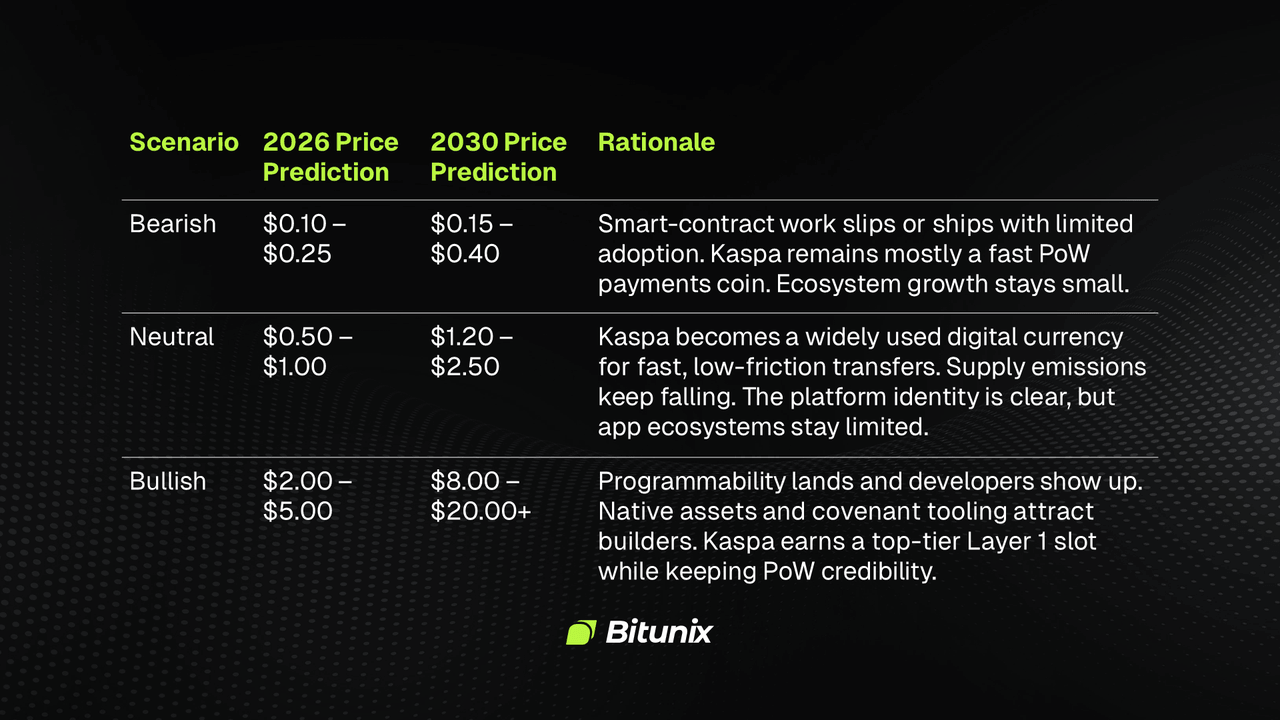
Bear, neutral, and bullish KAS price scenarios for 2026 and 2030.
To be clear, these scenario ranges are well above the 2026–2030 model outputs cited earlier, so they require a major adoption step change, not just a market rebound. Use them as narrative stress tests, not as expectations.
If you are comparing this to a KAS price prediction page, the practical difference is the assumptions. Most models extrapolate price behavior. Scenarios force you to ask what has to ship and what has to grow.
Conclusion: A Bet on Pure, Scalable Proof-of-Work
Kaspa is built for a specific audience. People who still believe PoW is the cleanest security model, and people who want speed without handing everything to a small validator set.
The upside case depends on two levers. First, the BlockDAG design continues to deliver high throughput and fast confirmations in real-world conditions. Second, the 2026 upgrade path translates into real programmability and real apps.
The risk case is simpler. Without a thriving ecosystem, Kaspa can remain a respected technology that fails to capture sustained demand. In that world, forecasts stay closer to the modest bands published by mainstream prediction sites.
For investors who want exposure and prefer trading on a large venue, Bitunix supports KAS-related markets, publishes KAS/USDT trading content, and runs a broad spot and derivatives infrastructure with hundreds of pairs. If KAS fits your thesis, download the Bitunix app and register, then start small, test transfers, and scale only after the basics feel solid.
FAQ
What is a BlockDAG?
A BlockDAG is a ledger where blocks form a directed acyclic graph instead of a single chain. Multiple blocks can be produced in parallel and still be ordered by consensus rules. The goal is higher throughput and faster confirmations without discarding valid blocks as orphans.
Who is the founder of Kaspa?
Kaspa was founded by Yonatan Sompolinsky, an Israeli computer scientist who co-developed the GHOSTDAG approach behind Kaspa's design. He launched Kaspa in 2021 as a fair-launched Proof-of-Work network aimed at improving throughput while keeping decentralization and security.
Is Kaspa a fork of Bitcoin?
Kaspa is not a direct Bitcoin fork. It uses Proof of Work but follows a different data structure and consensus approach. The inspiration is the Bitcoin security model, while the implementation aims to handle parallel blocks so confirmations can accumulate faster.
What is the GHOSTDAG protocol?
GHOSTDAG is the consensus method that orders blocks in Kaspa's BlockDAG. Instead of choosing one chain tip and orphaning the rest, it assigns an ordering to many blocks created around the same time. That allows higher block rates while keeping consistent transaction ordering.
Can you mine Kaspa?
Yes. Kaspa uses Proof of Work, so miners contribute hash power and earn block rewards plus fees. Mining setup depends on available hardware and network difficulty. Like any PoW coin, profitability changes with price, hashrate, and electricity costs, so miners monitor all three.
What is Kaspa's monetary policy (emission schedule)?
Kaspa uses a time-based emission schedule that trends downward over time, so new supply becomes a smaller part of the circulating supply as years pass. In 2026, a key narrative point is that most supply is already mined, which reduces new issuance pressure.
Does Kaspa have smart contracts?
Kaspa's roadmap focuses on making the base layer more programmable, including covenant-like features and native asset functionality. Full smart-contract ecosystems take time even after primitives ship. The practical answer is that programmability is evolving, and the ecosystem depends on what developers build next.
How is Kaspa different from other DAG projects like Hedera or Fantom?
Kaspa is a PoW network built around a BlockDAG of blocks, with consensus rules designed to order parallel blocks securely. Other DAG projects often use different consensus models, governance setups, or permissioning assumptions. The key difference investors track is PoW security plus a high block rate.
What is the blockchain trilemma?
The trilemma is the idea that blockchains struggle to maximize security, decentralization, and scalability at the same time. Kaspa's pitch is that parallel blocks and fast ordering can raise throughput while keeping PoW security and wide participation. The debate is whether trade-offs still appear at scale.
Where can I store my KAS tokens?
You can store KAS in wallets that support the Kaspa network. Many users keep trading balances on an exchange for convenience and move longer-term holdings to a self-custody wallet. The right choice depends on how often you trade and how comfortable you are managing keys.
Glossary
- Kaspa (KAS): A Proof-of-Work cryptocurrency designed for fast confirmations using a BlockDAG structure.
- Proof of Work (PoW): A consensus method where miners use computing power to secure the network and produce blocks.
- BlockDAG: A block-based directed acyclic graph that allows multiple blocks to exist in parallel and still be ordered.
- Directed Acyclic Graph (DAG): A graph structure with directed edges and no cycles, used to model parallel relationships.
- GHOSTDAG: Kaspa's consensus protocol for ordering blocks in a BlockDAG without discarding parallel blocks.
- Block Time: The targeted time interval between new blocks, often used as a rough speed indicator.
- Confirmation: A measure of finality that increases as more blocks are built on top of the ledger state.
- Finality: The point where reversing a transaction becomes highly unlikely under normal network security assumptions.
- Hashrate: The total computing power miners contribute, usually measured in hashes per second.
- Mining: The process of producing blocks in PoW networks and earning rewards for securing the ledger.
- Emission Schedule: The planned rate at which new coins enter circulation through block rewards over time.
- Max Supply: The upper limit on total coins that can ever exist, defined by protocol rules.
- Hardfork: A network upgrade that changes consensus rules and requires nodes to update to stay compatible.
- Covenants: Script-like constraints that restrict how coins can be spent, enabling more advanced on-chain logic.
- MEV (Maximal Extractable Value): Value that block producers can capture by reordering or selecting transactions, often linked to on-chain trading.
Disclaimer
This article does not provide:
(i) investment advice or investment recommendations;
(ii) an offer or solicitation to buy, sell, or hold digital assets;
(iii) financial, accounting, legal, or tax advice.
Digital assets, including stablecoins and NFTs, involve high risk and may fluctuate significantly. Consider whether trading or holding digital assets is appropriate for you given your financial situation. Consult a qualified legal, tax, or investment professional when needed. You are responsible for understanding and complying with applicable local laws and regulations.
About Bitunix
Bitunix is a global cryptocurrency derivatives exchange trusted by over 4 million users across more than 100 countries. At Bitunix, we are committed to providing a transparent, compliant, and secure trading environment for every user. Our platform features a fast registration process and a user-friendly verification system supported by mandatory KYC to ensure safety and compliance. With global standards of protection through Proof of Reserves (POR) and the Bitunix Care Fund, we prioritize user trust and fund security. The K-Line Ultra chart system delivers a seamless trading experience for both beginners and advanced traders. At the same time, leverage of up to 200x and deep liquidity make Bitunix one of the most dynamic platforms in the market.
Bitunix Global Accounts
X | Telegram Announcements | Telegram Global | CoinMarketCap | Instagram | Facebook | LinkedIn | Reddit | Medium