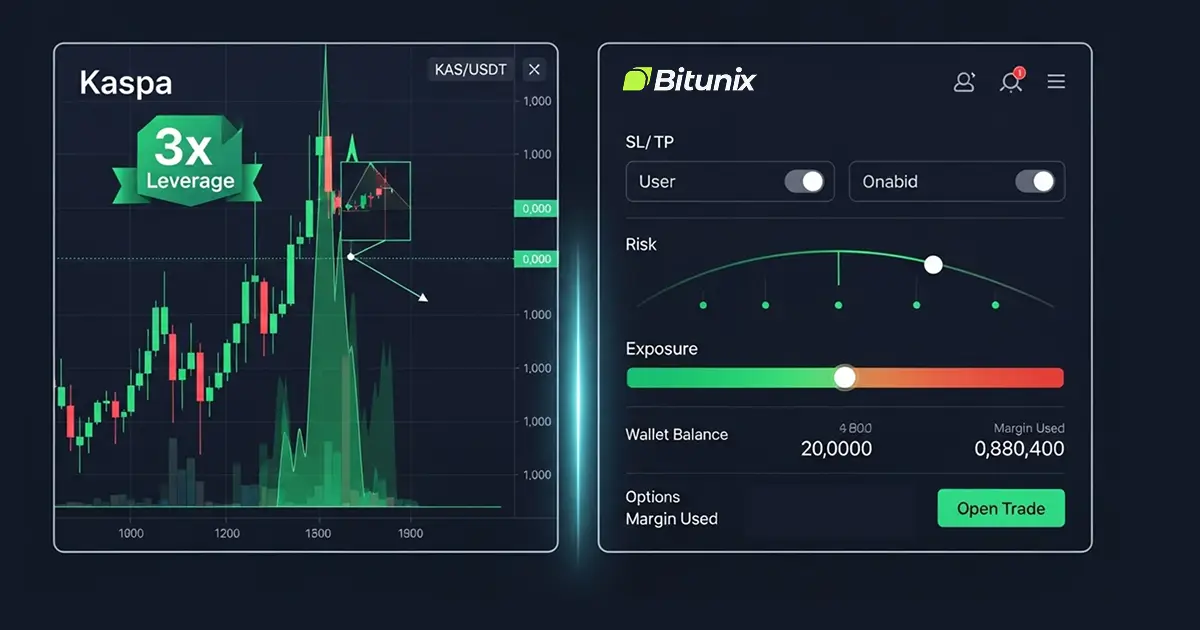
Kaspa (KAS) has become one of the more active altcoins in the proof-of-work ecosystem, attracting attention from both long-term holders and short-term traders. Its high market activity and frequent price movements have also made Kaspa a popular asset for traders exploring margin and leveraged trading strategies.
Before opening a leveraged KAS position, understanding crypto liquidation mechanisms is essential. Leverage can increase market exposure, but it also reduces the margin buffer available before forced liquidation occurs.
At Bitunix, we have seen growing interest in KAS/USDT trading, especially among traders looking for short-term opportunities with controlled leverage settings. This guide explains how Kaspa margin trading works, why traders use leverage on KAS, how to trade KAS with margin on Bitunix, and how to manage liquidation risks.
What Is Kaspa (KAS)?
Kaspa (KAS) is a proof-of-work cryptocurrency built on a BlockDAG architecture and powered by the GHOSTDAG consensus protocol, designed to improve transaction speed while maintaining Bitcoin-like decentralization principles.
Unlike traditional blockchains that process blocks in a single sequence, Kaspa allows multiple blocks to coexist and be ordered through its BlockDAG structure. This design enables faster block processing and shorter confirmation times compared with many conventional proof-of-work networks.
Key characteristics of Kaspa include:
BlockDAG architecture: Enables parallel block processing instead of relying on a single linear chain.
GHOSTDAG consensus: Extends Nakamoto consensus to support high block rates while maintaining network security.
Fair launch model: Kaspa launched without a pre-mine or private token allocation.
Open-source development: The protocol is developed through contributions from a global community of developers and researchers.
Kaspa’s open-source approach has helped attract contributors interested in blockchain scalability, consensus mechanisms, and network security. The project’s development model focuses on transparent protocol improvements rather than centralized control.
For traders, the practical importance of Kaspa’s technology is its impact on market activity. A fast-growing ecosystem and active development community can contribute to increased user interest, liquidity, and trading participation.
When trading KAS with leverage, these factors matter because margin traders typically pay close attention to:
What Is Kaspa Margin Trading?
Kaspa margin trading allows traders to open KAS positions using borrowed funds or leveraged exposure instead of relying only on their available account balance.
In a margin trade, traders provide collateral (margin) to control a larger position size.
For example:
Trading Setup | Position Value | Trader Collateral |
|---|
Without leverage | 100 USDT | 100 USDT |
3x leverage | 300 USDT | 100 USDT |
5x leverage | 500 USDT | 100 USDT |
Higher leverage increases market exposure, but it also means smaller price movements can have a larger impact on account equity.
How Does KAS Leverage Trading Work?
KAS leverage trading works by using margin as collateral to open a larger KAS/USDT position. The exchange monitors margin levels in real time and may liquidate positions if available equity falls below required maintenance levels.
A leveraged KAS trade typically involves:
1. Collateral
Collateral is the amount of funds allocated to support the position.
More collateral generally provides a larger buffer against market fluctuations.
2. Leverage Selection
Leverage determines how much larger the position is compared with the initial margin.
Example:
3x leverage means a 100 USDT margin controls a 300 USDT position.
10x leverage means a 100 USDT margin controls a 1,000 USDT position.
Higher leverage does not change the market direction. It only changes the size of exposure and liquidation distance.
3. Position Direction
KAS margin traders can typically open:
Both directions involve risk because market movements can reduce account equity.
Why Are Traders Using Kaspa Margin Trading?
Kaspa’s active market conditions and price movements are two reasons traders consider KAS for leveraged trading.
Market Activity and Liquidity
Higher trading activity can improve:
Liquidity conditions can vary depending on market conditions, so traders should review available order depth before opening positions.
Price Volatility
Volatility creates more frequent price movements, which attracts traders using short-term strategies.
At the same time, volatility can increase liquidation risk when leverage is involved.
Technical Trading Opportunities
Some traders use technical analysis tools such as:
These tools do not predict future price movements but can help traders structure their risk parameters.
How to Margin Trade Kaspa on Bitunix
Trading KAS with leverage on Bitunix involves selecting the KAS/USDT market, choosing margin settings, setting leverage, and managing risk controls such as SL/TP.
The exact interface may change as Bitunix updates its platform, but the general workflow is:
Step 1: Open the KAS/USDT Trading Page
Log in to your Bitunix account.
Open the Futures or margin trading section.
Search for KAS/USDT.
Enter the KAS/USDT trading interface.
Before opening a position, review:
Current KAS price
Available balance
Funding information
Market conditions
Step 2: Select Margin Mode
Bitunix supports different margin management options depending on the product.
Common modes include:
Isolated Margin
Cross Margin
Choosing the appropriate margin mode depends on each trader’s risk management approach.
Step 3: Set Leverage and Position Size
After selecting margin mode:
Adjust the leverage multiplier.
Enter the position size.
Review required margin.
Check estimated liquidation price.
For volatile altcoins like KAS, using higher leverage can significantly reduce the distance to liquidation.
Step 4: Set Take Profit and Stop Loss (TP/SL)
Bitunix allows traders to configure TP/SL settings when placing or managing futures positions.
Current workflow:
Open the KAS/USDT trading page.
Select your order type.
Enable the TP/SL option before confirming the trade.
Set:
Confirm the order.
After opening a position, traders can also manage TP/SL settings from the open positions panel.
Remember that stop-loss orders help automate risk controls but do not guarantee execution at the exact trigger price during extreme market volatility.
How to Calculate Kaspa Liquidation Price
A Kaspa liquidation price is the price level where your position may be automatically closed because your account equity is no longer sufficient to support the leveraged trade.
The exact liquidation price depends on several factors, including:
Because exchanges use different risk models, there is no universal liquidation formula that applies to every platform.
Basic Factors That Affect KAS Liquidation Price
Factor | Impact on Liquidation Risk |
|---|
Higher leverage | Reduces the distance between entry price and liquidation price |
More margin added | Increases the available buffer |
Higher volatility | Can cause faster changes in unrealized PnL |
Cross margin | Uses broader account balance as support |
Isolated margin | Limits risk to the assigned position margin |
Example: 3x Kaspa Margin Trade
Assume:
Parameter | Example Value |
|---|
Trading pair | KAS/USDT |
Position direction | Long |
Entry price | $0.127 |
Leverage | 3x |
Margin | 100 USDT |
Position size | 300 USDT |
With 3x leverage, the trader controls a larger position than their initial margin amount.
If KAS moves against the position, unrealized losses reduce account equity. Once equity reaches the liquidation threshold, the exchange may close the position automatically.
The example above is simplified. Actual liquidation prices vary based on exchange maintenance margin rules and contract specifications.
How Leverage Affects Kaspa Margin Trading Risk
Leverage does not change the market movement itself. It changes how strongly price movements affect your account balance.
For example:
Leverage | Market Exposure | Margin Buffer |
|---|
2x | Lower exposure | Larger buffer |
3x | Moderate exposure | Medium buffer |
10x | Higher exposure | Smaller buffer |
For volatile assets like KAS, higher leverage can cause liquidation from relatively small price movements.
Many traders prefer lower leverage settings because they provide more room for the position to move before reaching liquidation levels.
Risk Management Strategies for Kaspa Margin Trading
Successful margin trading depends less on maximizing position size and more on controlling downside exposure.
Several risk management practices can help traders manage leveraged KAS positions.
1. Use Appropriate Leverage
Lower leverage provides a larger margin buffer.
Instead of selecting the highest available leverage, traders often consider:
Current volatility
Trading timeframe
Position size
Risk tolerance
A 3x position and a 20x position can have very different liquidation distances even with the same entry price.
2. Set Stop-Loss Orders Before Market Moves
A stop-loss order can automatically close a position when price reaches a predefined level.
For KAS trading, traders may use stop-loss levels based on:
A stop-loss does not prevent every loss, but it can help avoid relying on manual decisions during fast market movements.
3. Monitor Margin Ratio and Liquidation Price
When holding a leveraged position, regularly check:
Margin ratio
Unrealized PnL
Liquidation price
Available balance
Waiting until a position approaches liquidation leaves fewer options for adjustment.
4. Consider Isolated Margin for Individual Trades
Isolated margin can help separate one position’s risk from other account funds.
Example:
If a trader opens an isolated KAS position, only the margin assigned to that position is used for liquidation calculations.
Cross margin works differently because available account balance may support open positions.
Common Mistakes When Trading Kaspa With Leverage
Many liquidation events happen because traders underestimate position size or market volatility.
Common mistakes include:
Using Maximum Leverage Without a Risk Plan
High leverage can make small price movements create significant account changes.
A position that appears manageable during calm conditions may become difficult to maintain during sudden volatility.
Ignoring Funding Fees and Trading Costs
Holding leveraged positions may involve additional costs.
Traders should consider:
Funding fees
Trading fees
Spread
Slippage
These costs can gradually affect available margin.
Entering Positions Without TP/SL Settings
Without predefined exit levels, traders may react emotionally during rapid price changes.
Setting TP/SL before entering a trade can help create a clearer trading plan.
Bitunix Features for Kaspa Margin Traders
Bitunix provides trading tools designed to help users manage leveraged KAS positions more efficiently.
Key features include:
KAS/USDT Trading Support
Traders can access the KAS/USDT market through Bitunix’s trading interface.
Adjustable Margin Settings
Users can select suitable margin modes and leverage settings based on their trading approach.
TP/SL Risk Controls
Bitunix provides take-profit and stop-loss functions that allow traders to set automated exit conditions.
Real-Time Position Monitoring
The trading interface displays important information such as:
Entry price
Mark price
Unrealized PnL
Margin ratio
Liquidation price
These metrics help traders monitor position conditions without manually calculating changes.
Is Kaspa Margin Trading Suitable for Beginners?
Kaspa margin trading requires a clear understanding of leverage, liquidation, and risk management before opening positions.
Beginners should first understand:
Starting with smaller position sizes and lower leverage settings can help new traders become familiar with the mechanics of leveraged products.
Margin trading is different from spot trading because losses can occur faster when leverage is involved.
Is Kaspa a Long-Term Asset or Mainly a Trading Asset?
Kaspa can be viewed from different perspectives depending on a user's goals and market approach.
Long-term participants may focus on:
Kaspa’s technology
Network development
Community activity
Traders may focus on:
These approaches involve different considerations. A project’s technology does not remove the risks associated with leveraged trading.
Conclusion
Kaspa margin trading combines exposure to an active altcoin market with the mechanics of leveraged trading.
Understanding how KAS leverage works, how liquidation prices are determined, and how to use tools such as TP/SL orders can help traders better manage their positions.
Before trading Kaspa with leverage, review your position size, margin settings, and risk parameters carefully. Leverage can increase market exposure, but it also increases the impact of adverse price movements.
About Bitunix
Bitunix is a global cryptocurrency derivatives exchange trusted by over 5 million users across more than 150 countries. The platform is committed to providing a transparent, compliant, and secure trading environment for every user. Bitunix offers a fast registration process and a user-friendly verification system supported by mandatory KYC to ensure safety and compliance.
With global standards of protection through Proof of Reserves (POR) and the Bitunix Care Fund, Bitunix prioritizes user trust and fund security. The K-Line Ultra chart system delivers a seamless trading experience for both beginners and advanced traders, while leverage of up to 200x and deep liquidity make Bitunix one of the most dynamic platforms in the market.
Bitunix Global Accounts
X | Telegram Announcements | Telegram Global | CoinMarketCap | Instagram | Facebook | LinkedIn | Reddit | Medium