
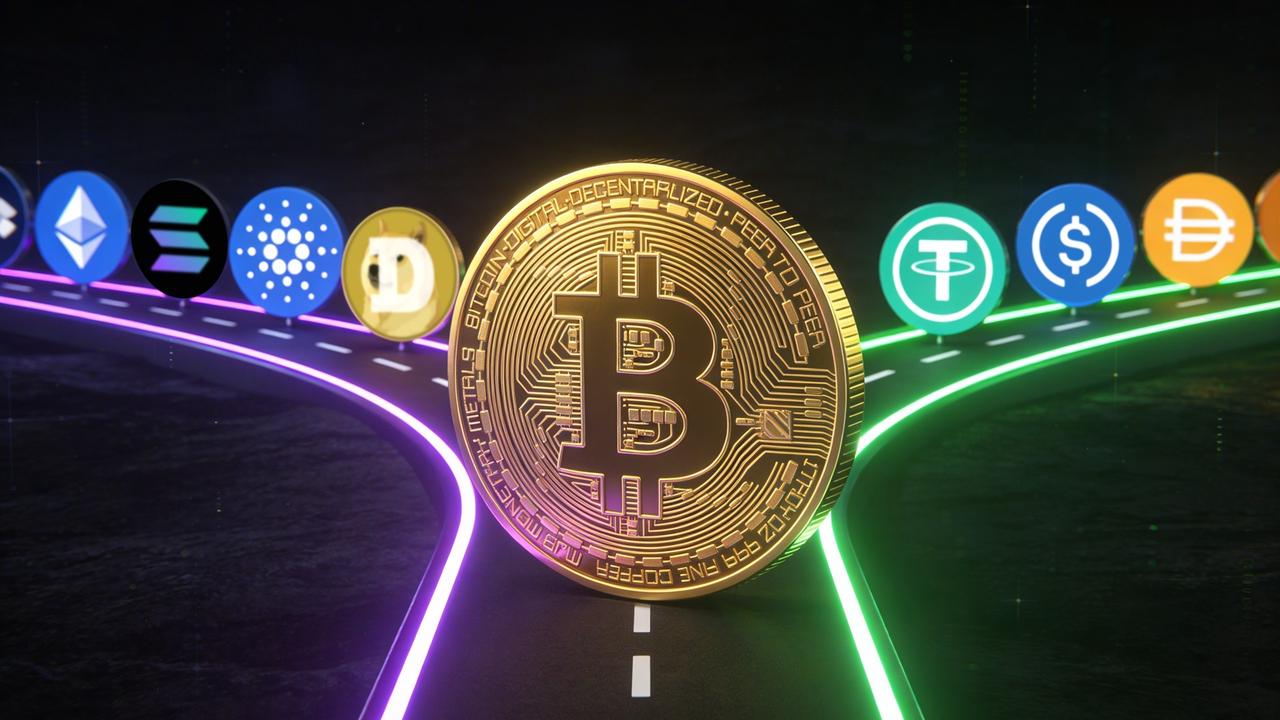
Article Summary
- This article provides a clear, foundational explanation of the difference between two major categories of cryptocurrency: altcoins and stablecoins.
- Altcoins are defined as any cryptocurrency other than Bitcoin, characterized by high volatility and the potential for high returns (and losses). They are primarily speculative investment vehicles.
- Stablecoins are defined as a type of altcoin specifically designed to maintain a stable value by being pegged to a real-world asset, like the U.S. dollar. They are primarily a store of value and medium of exchange.
- The guide explains the different roles these two asset types play in a diversified crypto portfolio.
You’ve heard of Bitcoin. Then you open a market tracker, and suddenly it looks like the internet invented money in bulk. You keep seeing two terms: altcoin and stablecoin. They sound similar, but they point to two different goals, and they behave very differently when prices start swinging.
After Bitcoin, the crypto world splits. One branch focuses on new networks and new features, and it comes with real volatility. The other branch focuses on price stability so people can trade, move value, and build apps without constant price shocks. If you use a crypto exchange like Bitunix, you’ll usually see both categories side by side, even if you’re only browsing prices.
This guide will clearly define and contrast altcoins and stablecoins, helping you understand their unique purposes, risks, and how they fit into the broader crypto ecosystem.
What Is An Altcoin?
Let’s answer what is an altcoin in the simplest way. An altcoin is any cryptocurrency other than Bitcoin. That includes large networks (like Ethereum), newer high-speed chains (like Solana), and a long tail of tokens that launch, trade for a bit, and disappear.
The scale is huge. CoinMarketCap’s “All Cryptocurrencies” view lists 35.37M different cryptos. CoinGecko applies different tracking rules, but still tracks 17,801 cryptocurrencies across 1,468 exchanges on its global charts page. The gap shows how broad altcoin really is, covering everything from liquid majors to short-lived tokens.
Data Check: Survivability Is Rough
A lot of tokens don’t make it. CoinGecko research reported that 11.6 million tokens failed in 2025 alone, representing 86.3% of token failures in its five-year window. This means that the market has very low barriers to launch and very high competition for attention and liquidity.
Why Altcoins Exist: Innovation And Speculation
Altcoins often exist to do something Bitcoin doesn’t prioritize. Ethereum expanded smart contracts, Solana pushed for fast confirmations and low fees, and other projects focus on privacy, interoperability, storage, governance, or niche app ecosystems.
Altcoins also attract speculation. When an asset can move 10–30% quickly, it invites traders. It also creates losses fast if you buy late or panic-sell early. If you’ve ever searched Solana price prediction, you’ve seen how narratives and price expectations can move faster than fundamentals.
Volatility Is The Defining Trait
Altcoins usually swing more than Bitcoin because many are smaller, less liquid, and driven by narratives that change fast. You can see that uneven performance in CoinMarketCap’s Altcoin Season Index, it sits at 31/100, which means fewer than 35% of the top 50 altcoins beat Bitcoin over the last 90 days. In other words, even when people talk about altcoins as a group, a lot of them still fall behind BTC's price action.
So when you hear altcoin, start with a clear mental model: you get higher upside potential, higher downside risk, and a higher chance the project never becomes meaningful. Well-known names like Ethereum (ETH), Solana (SOL), Cardano (ADA), and Dogecoin (DOGE) still carry that risk, but they’re easier to research than the long tail because they tend to have deeper liquidity and more public data.
What Is a Stablecoin?
Now, what is a stablecoin? A stablecoin is a crypto asset designed to maintain a stable value by being pegged to an external reference, most commonly the U.S. dollar, at a 1:1 target. The whole point is to keep the price close to a fixed number, usually $1.
Stablecoins let people trade without constantly converting back to bank money. They also support transfers, settlements, and many DeFi applications. And yes, they’re still crypto assets, so they still carry risks.
Here’s one key signal that stablecoins are not a niche corner anymore: Reuters reported that stablecoin market capitalization reached a record $251.7 billion in June 2025, up 22% in 2025 at that point. CoinGecko’s 2025 annual report later said stablecoin market cap surged by $102.1B (+48.9%) in 2025, reaching a new all-time high of $311.0B.
That growth happens because stablecoins do a clear job, which is that they give the crypto ecosystem a stable unit of account. You’ll see them used to park funds between trades, settle positions, and move value across platforms.
How Big Is Stablecoin Usage?
Stablecoins also move huge amounts of value. CoinMarketCap’s Q1 2025 data note said daily stablecoin transfer volumes regularly exceeded $72 billion, more than doubling in a year. Bloomberg reported that total stablecoin transaction volumes rose 72% to $33 trillion in 2025, with USDC accounting for $18.3T and USDT $13.3T.
That doesn’t mean every stablecoin is safe. It means stablecoins are heavily used for settlement and transfer. Their role is utility first, speculation second. Some examples are USDT (Tether), USDC (USD Coin), and DAI.
The Head-to-Head Comparison
At this point, you already have the core split. Altcoins aim for growth, new tech, and network adoption. Stablecoins aim for steadiness so people can transact and rebalance without riding constant price waves.
Here’s the simplest comparison table to keep in your head.
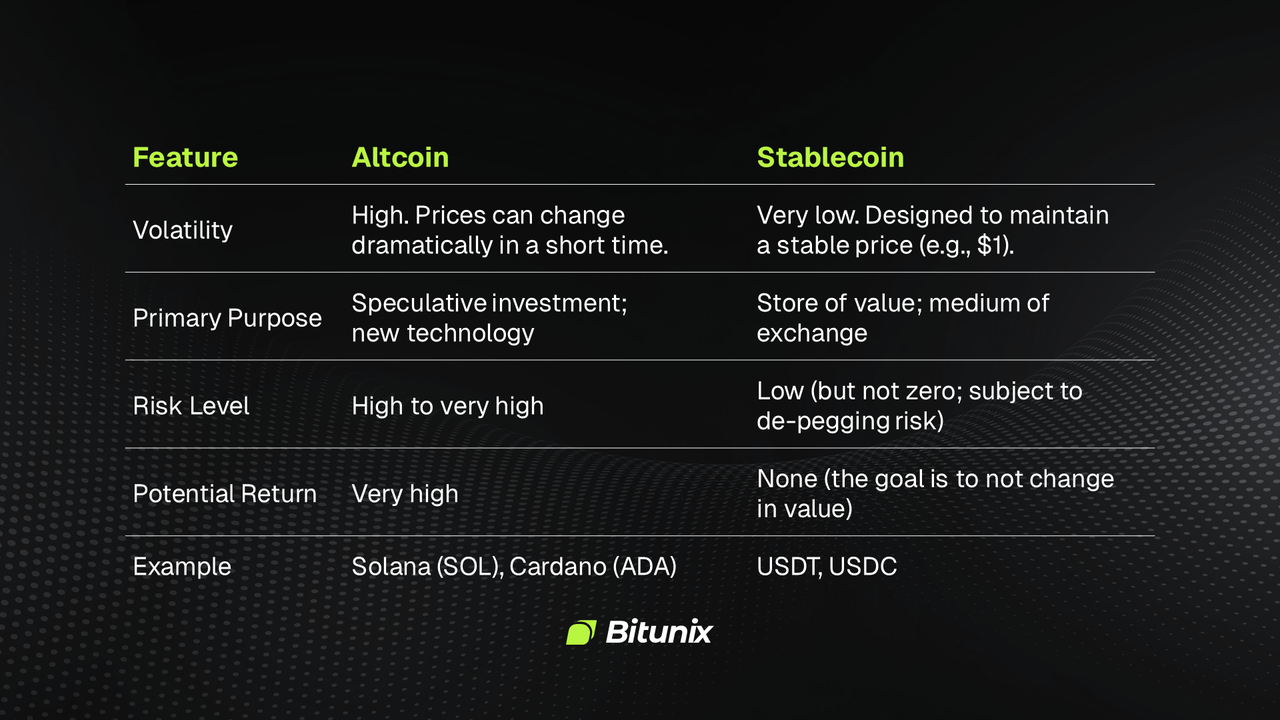
If you keep mixing these categories up, zoom out and ask: are you trying to grow capital through price appreciation, or are you trying to hold value steady while you wait, transfer, or reposition? The altcoin vs stablecoin decision gets easier when you answer that first.
How They Work Together in a Portfolio
Altcoins and stablecoins can work together because they do different jobs. In many portfolios, altcoins are the risk-on part, and stablecoins are the cash-like part inside crypto.
Here’s a common real-world pattern. You buy an altcoin because you expect a move. If you get the move you wanted, you sell into a stablecoin instead of immediately sending money back to a bank. That locks the gains into a unit that usually stays near $1, and it keeps you ready to redeploy quickly.
Stablecoins also serve real utility outside trading, especially where local currencies are volatile or cross-border payments are expensive. Reuters reported in February 2026 that nearly 80% of Nigerian and South African respondents already hold stablecoins, and 95% of Nigerian participants preferred stablecoin payments over the naira.
So when you ask should I buy altcoins or stablecoins, the practical answer is that many people use both. They take risks with altcoins when they want growth exposure, and they use stablecoins when they want stability, transferability, or a quick way to pause without leaving the crypto ecosystem. If you search USDC price prediction, you’re usually trying to answer one question: will it hold the peg and remain usable for its job?
Conclusion: Two Sides of the Same Crypto Coin
Altcoins and stablecoins reflect two very human desires: you want upside, and you want stability. Altcoins give you exposure to new networks and narratives, and they come with volatility and a high failure rate across the long tail. Stablecoins keep the ecosystem functional by providing a stable base for trading, transfers, and settlement.
The takeaway is simple. Learn what each category is designed to do, then choose based on the job you need today. And if you want a place to compare markets across both categories, Bitunix lists a range of altcoins and stablecoins, so download the app, register, and then you can observe how each behaves before you commit meaningful capital.
FAQ
Is Bitcoin an altcoin?
No. Bitcoin isn’t an altcoin because altcoin means “alternative coin” to Bitcoin. Bitcoin (launched in 2009) is the original benchmark crypto, with a fixed 21 million supply and Proof-of-Work. Altcoins are all other cryptocurrencies created after Bitcoin, like ETH or SOL.
Are all altcoins good investments?
No. CoinGecko reported 11.6 million token failures in 2025 alone, which shows how harsh the survival curve is. Some major altcoins are established, but the long tail carries a very high risk.
Can a stablecoin lose its value?
Yes. A stablecoin can de-peg during liquidity stress, reserve concerns, or market shocks. Some recover quickly, others don’t. Always check how it maintains its peg and whether redemptions and reserves are transparent.
Why would I hold a stablecoin instead of U.S. dollars in a bank?
You might hold a stablecoin (like USDC) for near-instant, 24/7 transfers and typically lower cross-border fees than bank wires. It also keeps value in digital dollars and can be used for trading or DeFi yields.
Is Ethereum an altcoin?
Yes. Ethereum is not Bitcoin, so it’s an altcoin by definition. It’s also a major smart contract platform with deep liquidity, which separates it from most small tokens.
How many altcoins are there?
It depends on the tracker. CoinMarketCap shows around 35.37M on its full listings view, while CoinGecko tracks 17,801 coins on its global charts page.
What is a blue-chip altcoin?
It’s an informal label for large, widely used altcoins with deep liquidity and long track records, often ETH. It doesn’t remove risk, but it usually signals broader adoption and better market depth than micro-caps.
What is the difference between a coin and a token?
A coin is usually the native asset of a blockchain (like BTC or SOL). A token usually lives on top of an existing chain using a token standard, often created by a smart contract.
Can I earn interest on stablecoins?
Sometimes, through exchange programs or DeFi lending. Yields vary and carry risks, including platform risk and smart contract risk.
What is the most popular altcoin?
By market recognition and ecosystem size, ETH is often seen as the leading altcoin.
Glossary
- Altcoin: Any cryptocurrency other than Bitcoin, ranging from major platforms to tiny experimental tokens.
- Stablecoin: Crypto designed to target a stable price, usually by pegging to fiat currency.
- Peg: Target price relationship, commonly $1, that a stablecoin aims to maintain.
- De-peg: When a stablecoin trades meaningfully away from its target price for a sustained period.
- Market cap: Current price multiplied by circulating supply, used to estimate an asset’s market size.
- Liquidity: How easily you can buy or sell without moving the price much.
- Trading pair: Two assets quoted together, showing what you pay with to buy the other.
- Volatility: The size and speed of price changes over time.
- Smart contract: On-chain code that automatically executes rules for tokens, apps, and financial protocols.
- Reserves: Assets held to support a stablecoin’s peg, such as cash or short-term Treasuries.
- Redemption: Converting stablecoins back into the referenced asset, typically fiat currency, through an issuer.
- Settlement: Final transfer of value, often using stablecoins as the unit to close trades.
- DeFi: Decentralized finance apps that run on blockchains, including lending, swaps, and liquidity pools.
- On-chain transfer volume: Total value moved on blockchain rails, often used to gauge real usage.
- Portfolio allocation: How you split funds across assets, balancing risk exposure and stability needs.
About Bitunix
Bitunix is a global cryptocurrency derivatives exchange trusted by over 3 million users across more than 100 countries. The platform is committed to providing a transparent, compliant, and secure trading environment for every user. Bitunix offers a fast registration process and a user-friendly verification system supported by mandatory KYC to ensure safety and compliance. With global standards of protection through Proof of Reserves (POR) and the Bitunix Care Fund, Bitunix prioritizes user trust and fund security. The K-Line Ultra chart system delivers a seamless trading experience for both beginners and advanced traders, while leverage of up to 200x and deep liquidity make Bitunix one of the most dynamic platforms in the market.
Bitunix Global Accounts
X | Telegram Announcements | Telegram Global | CoinMarketCap | Instagram | Facebook | LinkedIn | Reddit | Medium
Disclaimer: Trading digital assets involves risk and may result in the loss of capital. Always do your own research. Terms, conditions, and regional restrictions may apply.