
Article Summary
- Polygon has upgraded its native token from MATIC to POL as part of its Polygon 2.0 vision, transforming it into a multi-chain ecosystem.
- POL is designed to be a "hyper productive" token, allowing holders to stake it across multiple chains and earn rewards from various services.
- The future price of POL depends on the success of Polygon's transition to a network of Zero-Knowledge (ZK)- powered Layer-2s.
- This analysis explores the bullish case for POL, driven by its ambitious technology roadmap, and the bearish case, including intense competition and execution risk.
- Price predictions for 2026, 2030, and 2040 are provided, with a key focus on whether POL can reclaim and exceed the previous MATIC all-time high.
- Bitunix is the ideal platform for trading the new POL token with low fees and high security.
Polygon is one of the industry’s boldest blockchain networks, aiming to become the Value Layer of the Internet. Its latest upgrade to Polygon 2.0 represents a fundamental shift in tokenomics and network architecture. And while Polygon was the king of the last bull run, outpacing many other altcoins in 2021, its recent price action has been very bearish.
With all this in mind, analysts are divided over the most accurate Polygon price prediction. Will Polygon 2.0 ever deliver and send its new token to heights that MATIC never reached?
This article will provide a long-term price prediction for Polygon's new POL token, analyzing the Polygon 2.0 roadmap, the role of ZK technology, and the competitive landscape to determine its potential to recover to, and surpass, former MATIC highs. In the end, you should have a clear understanding of the POL price prediction when visiting a crypto exchange.
The Case for a Bullish POL Price Prediction
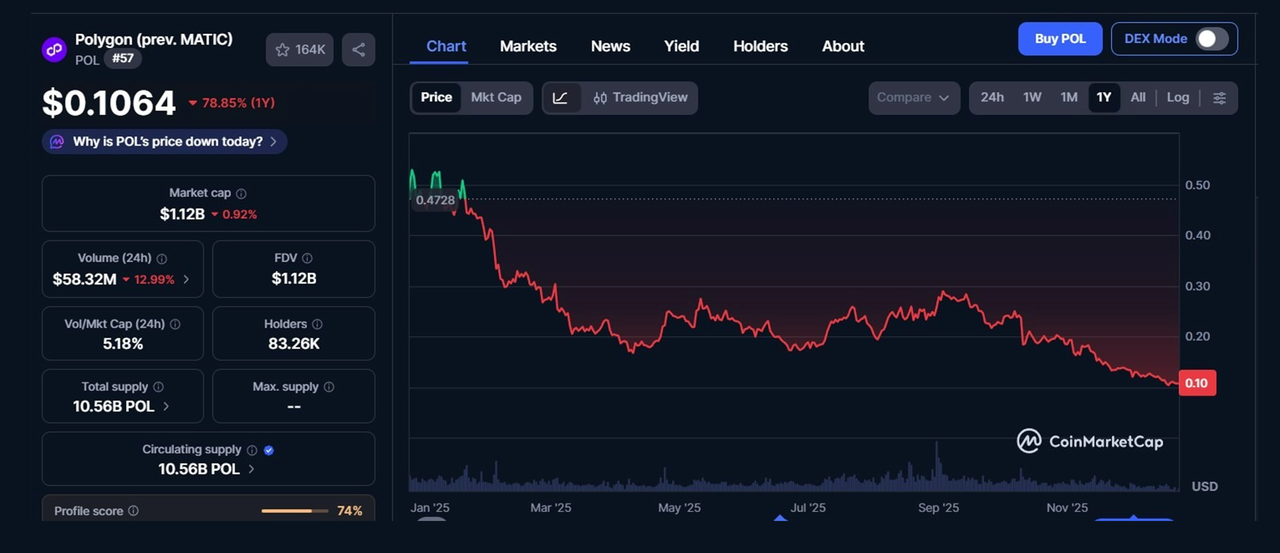
$POL has solid arguments for a considerable increase in value in the next bullish market. The underlying Ethereum Layer-2 ecosystem and significant technological advancements could propel it to new heights. Other conditions that would help POL push for a bullish case include:
Become the Value Layer of the Internet
According to Polygon Labs, Polygon 2.0 aims to connect several Layer-2 solutions, such as sidechains, app chains, and zkEVMs, via a shared liquidity layer, AggLayer. This exceptional design should help it reach its goal of becoming the "Internet of blockchains."
At that point, the POL token would be more than just a native utility token. It would play a fundamental role in securing and facilitating activity across the entire Polygon ecosystem, thereby driving demand and value.
Hyperproductive Staking
Hyperproductive Staking is one of the core elements of the Polygon ecosystem and a feature that sets it apart from other layer-2 blockchains. It is a staking model that enhances ecosystem security, offers stakers higher potential yields without increasing capital investment.
Through hyperproductive staking, validators can use a single $POL stake to secure multiple chains simultaneously. Additionally, it enables stakers to assume various roles and earn rewards, thereby increasing the token's utility and demand.
ZK-Rollup Leadership
Polygon has established itself as the most advanced scaling solution for Ethereum and a leader in ZK rollups through heavy investment and key acquisitions. Since its early days, Polygon purchased innovative ZK projects, including Hermez Network and Mir in multi-million-dollar deals.
Next, Polygon developed Plonky2, a highly efficient proving system that makes ZK technology practical for use on Ethereum. Today, Polygon has a considerable lead over other networks using zero-knowledge (ZK) rollups, driven by an investment-heavy strategy to build a unified, scalable blockchain.
Strategic Partnerships
Polygon has advanced on several fronts, besides the underlying technological development. The $POL token has become the heart of a thriving ecosystem of dApps, with over 517 million total unique addresses across all of Polygon's networks as of late 2025. This broad adoption allowed Polygon to partner with global brands such as Disney, Google Cloud, Starbucks, and Mastercard, driving the token’s real-world applications.
The Case for a Bearish Polygon Price Prediction
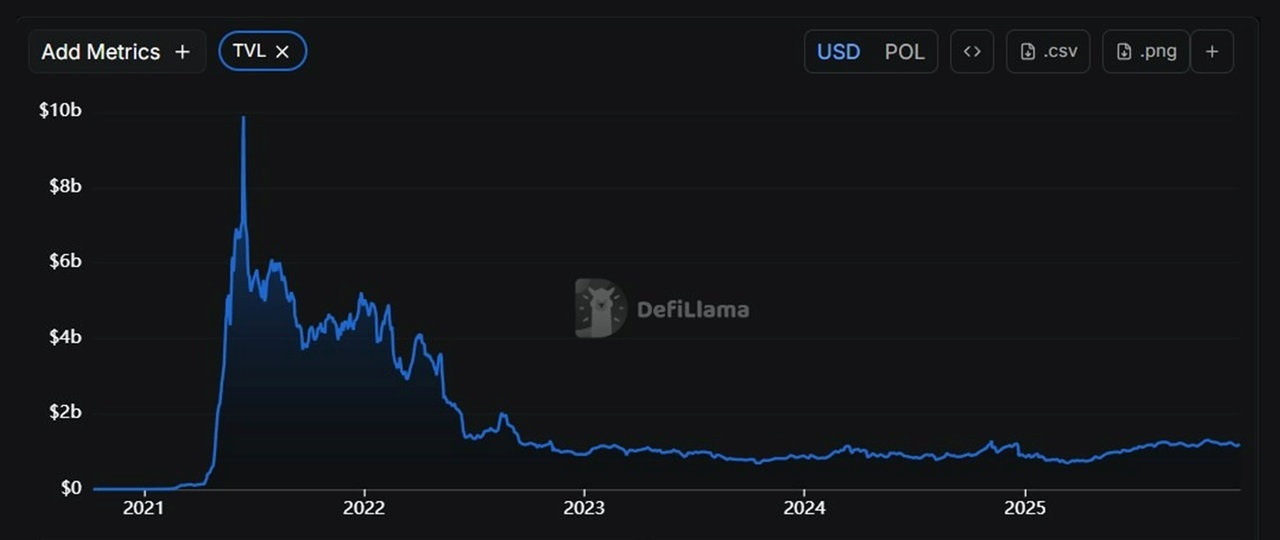
Despite Polygon’s significant development, the $POL token still faces a potential bearish case. In fact, the analysts’ most pessimistic POL price prediction is that a substantial price increase is not in the cards anytime soon. CoinCodex experts say that $POL would have to gain over 9,400% to reach $10, a somewhat challenging mission for the coin priced at $0.1 as of late 2025.
Here are other conditions that would send $POL on a bearish trajectory:
The ZK-Rollup Wars
Polygon has a considerable head start in the ZK-rollup niche. However, it cannot rest on its laurels for too long. The network is facing stiff competition from other major players like zkSync, StarkNet, and Scroll, all competing to be the top ZK-rollup.
StarkNet is a prominent ZK-rollup that uses ZK-STARK proofs and has a $237.65m TVL according to DefiLlama. Another major competitor is Scroll, a fully Ethereum-equivalent ZK-rollup aiming for seamless compatibility with existing Ethereum tools and applications. Scroll has a TVL of nearly $200 million as of December 2025.
Execution Risk
The Polygon 2.0 network aims to become a powerhouse of blockchain technology with global use and applications. However, its ambitious vision has several technical challenges and execution risks ahead.
Trying to build and connect so many different chains and services will inevitably lead to smart contract bugs, regulatory issues, high migration costs, and a slow overall development process. These factors could impede the network’s mainstream adoption and ability to develop new strategic partnerships.
Polygon Price Prediction 2026, 2030, 2040
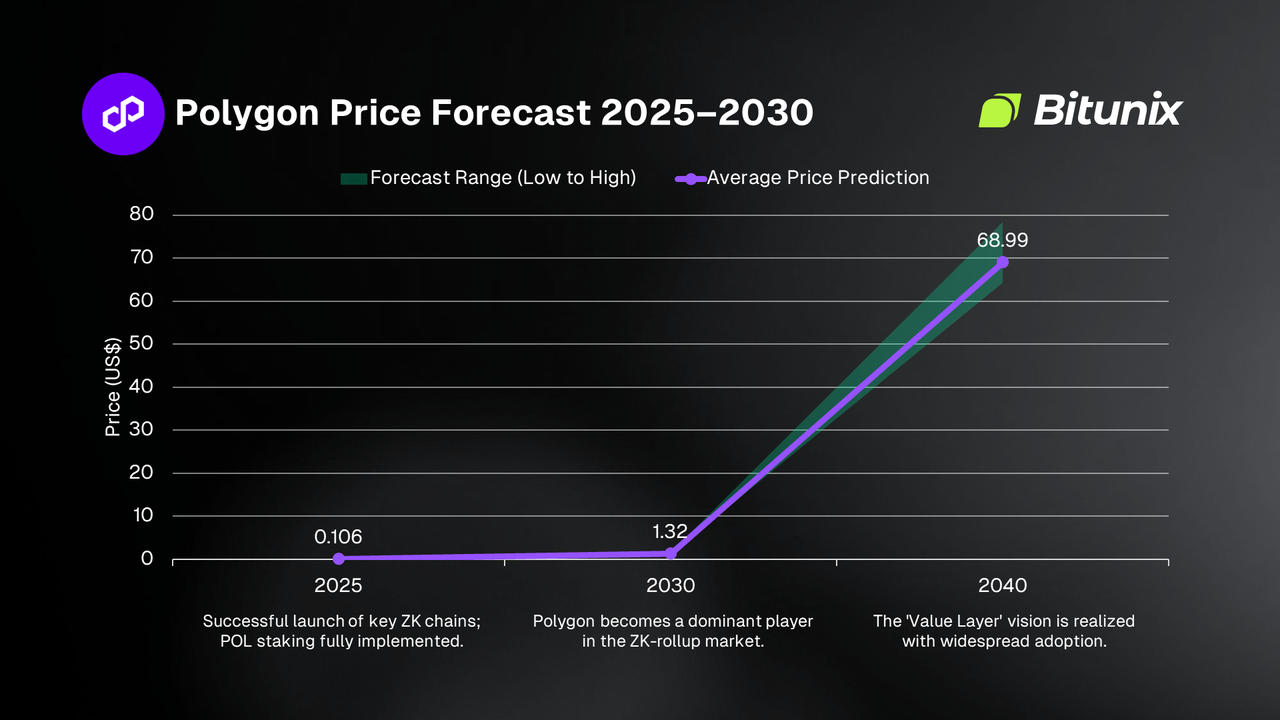
| Year | Potential Low | Average Price | Potential High | Key Milestone Assumption |
| 2026 | $0.139 | $0.237 | $0.404 | Successful launch of key ZK chains; POL staking fully implemented. |
| 2030 | $1.14 | $1.32 | $1.77 | Polygon becomes a dominant player in the ZK-rollup market. |
| 2040 | $15.72 | $68.99 | $137.81 | The 'Value Layer' vision is realized with widespread adoption. |
The most common Polygon price prediction 2026 has to offer is shared by several industry experts and is considerably bearish. For example, Changelly experts predict $POL will trade for an average of $0.237 in 2026. On the other hand, CoinCodex analysts estimate that $POL will not surpass $0.07569 this year.
$POL Price Prediction 2027
Predictions regarding $POL’s price in 2027 remain bearish. Experts believe that a slow development pace and limited adoption will prevent Polygon from increasing significantly that year. Changelly analysts suggest $POL’s price will not reach higher than $0.558, and an average price of $0.407 is expected.
Meanwhile, CoinCodex experts predict that $POL will trade within a price range of $0.06461 and $0.1269 in 2027. However, the coin will require bullish market conditions to push it toward the higher value, which represents a 3.58% increase on its current price.
$POL Price Prediction 2028
Severe market fluctuations could impact $POL’s value in 2028, with experts divided about its potential trajectory. According to Changelly, a significant rally could increase its value by over 212%, reaching a maximum of $0.682. However, the same experts believe that $POL could trade as low as $0.473 in 2028.
On the other hand, CoinCodex analysts believe $POL will not surpass $0.1066 in 2028, but it will not go under $0.08307 either. $POL’s average trading price for that year should be at around $0.09084 according to their technical analysis.
$POL Price Prediction 2029
If the POL staking feature is fully implemented by 2029, the coin could see a rapidly increasing demand in the market. Changelly analysts take this scenario into consideration when predicting that $POL will reach as high as $1.20 in 2029. Their average POL price forecast for that year is $0.891.
CoinCodex experts are less optimistic about Polygon’s development by 2029. They predict that $POL will drop further below on the traders’ lists of preferred coins. As a result, its value could drop by as much as 64% by the end of 2029, taking its value to around $0.04043. In fact, their most bullish prediction for POL’s value in 2029 is $0.04520.
Polygon Price Prediction 2030
Meanwhile, their forecast for the Polygon price prediction 2030 is increasingly optimistic. Changelly predicts $POL will trade between $1.14 and $1.77 by the end of that year. However, CoinCodex remains pessimistic about the coin’s chances of surpassing $1 even five years from now. Their forecast sees $POL trading for an average of $0.02776 in 2030.
$POL Price Prediction 2031
Looking further ahead to 2031, $POL price predictions continue to divide industry experts. For example, Changelly predicts that POL will surpass $2 by the end of that year. However, it will not trade higher than $2.62.
Meanwhile, CoinCodex expects POL to trade between $0.02440 on the lower end and $0.04945 on the high end. Reaching the higher price forecast would represent a nearly 60% drop from its current value.
$POL Price Prediction 2032
This is the year that POL might reach and even surpass MATIC’s former ATH at $2.92, according to some experts. The historic event should occur toward the middle of the year if we consider Changelly’s optimistic price prediction. The same website expects POL to trade as high as $3.87 by the end of 2032.
Other industry experts are not as confident about POL’s chances to grow substantially in 2032. For instance, Kraken, one of the world’s leading crypto exchanges, predicts that POL will trade at an average of $0.23 in 2032.
$POL Price Prediction 2033
Polygon could become a dominant player in the ZK-rollup market by 2033, according to some analysts. The network’s newfound status could increase demand for POL, taking its average trading value to $4.78 in 2033, according to Changelly. However, if the project fails to reach this important milestone by then, its price may not overcome $0.24 in 2033, according to Kraken.
$POL Price Prediction 2034
Polygon’s steady rise and increased adoption could help POL reach as high as $8 in 2034, according to Changelly. On the other hand, if the network loses its competitive advantage to other ZK-tech companies, POL could experience a further drop in value. This pessimistic forecast is shared by FINST, which expects POL to trade at an average price of $0.23 throughout 2034.
$POL Price Prediction 2035
Analysts are reserved about the POL price evolution within the next decade. The more optimistic forecasts see the coin gain considerable value thanks to Polygon’s rise to industry prominence. However, technical analysis from crypto exchanges like Kraken and Coinbase predict POL will trade between $0.17 and $0.26 in 2035.
$POL Price Prediction 2036
The 2036 market could see a highly oscillating trajectory for POL’s value. According to Coingape, Polygon could reach as high as $0.471, during this year, after forming a low of $0.452. Meanwhile, a technical and fundamental analysis from Kraken predicts POL will trade at an average of $0.28 in 2036.
$POL Price Prediction 2037
Market analysts predict that the Polygon price will remain highly volatile in 2037. For example, Cryptomus experts believe that $POL will dominate the ZK-rollup market by then, boasting an average price of $17 for 2037. Meanwhile, at the other end of the spectrum, Coingape experts predict POL will not surpass $0.491 that year.
$POL Price Prediction 2038
Technical analysis and macroeconomic factors suggest that the Polygon price will continue to experience significant price swings in 2038. Cryptomus believes that POL could trade between $12 and $22 that year. However, a technical analysis from Coinbase suggests that $POL will not surpass $0.19 that year. This forecast is shared by Coingape analysts who see POL trading between $0.491 and $0.510 in 2038.
$POL Price Prediction 2039
Looking further ahead toward the end of the next decade, most POL price forecasts remain bullish. However, predictions vary depending on the experts’ analyses and expectations for the Polygon network. For example, Cryptomus analysts predict that POL will trade for an average of $22 in 2039. Meanwhile, Coingape experts believe the value will likely be around $0.529.
$POL Price Prediction 2040
Generally, analysts do not believe that $POL has the prerequisites to surge substantially and reach three digits within the next two decades. For example, CoinCodex predicts $POL will drop 96% by the end of 2040, trading at an average of $.0.004681.
Changelly is more optimistic about Polygon’s price evolution within the next 15 years. The platform predicts $POL will have an average trading price of $68.99 in 2040.
Coinbase predicts that $POL will trade at around $0.21 in 2040. Kraken’s price prediction for POL is $0.34 for the same year. Meanwhile, Coingape expects POL to trade at about $0.549 at the beginning of the 2040s. Lastly, Cryptomus analysts predict POL will reach $30 in 2040.
The $POL price forecast below is from Changelly analysts, who believe $POL will not reach MATIC’s ATH (~$2.92) before September 2032.
Can POL Recover to MATIC's Highs?
Based on our analysis of the Polygon price prediction 2025, $POL has a strong potential to surpass $2.92 during an unprecedented bull market. As discussed above, however, POL would have to meet specific conditions to surge considerably past MATIC’s ATH in 2025.
Additionally, the most optimistic Polygon price prediction 2030 has to offer is not particularly encouraging for POL’s chances of equaling MATIC’s ATH. Therefore, its proponents must wait longer for a substantial increase in value.
How to Trade POL on Bitunix
Bitunix is a high-performance exchange consistently supporting innovation and development. To this end, the platform has fully supported the POL upgrade, providing traders interested in the project with a seamless trading experience.
Trading POL on Bitunix is a direct way to invest in the future of Zero-Knowledge technology and Ethereum's scalability. Follow these simple steps to trade POL on Bitunix:
- Sign up on Bitunix using your email or mobile number.
- Deposit crypto or link a fiat method (KYC required only for fiat operations).
- Go to the Spot Market to buy POL or sell POL instantly.
- For advanced traders who are margin trading crypto, open a POL perpetual futures position to trade with leverage and capitalize on market swings.
Additionally, users can start trading with as little as $10 or join theEarn program, which provides several staking opportunities.
The low Bitunix fees have convinced over 3 million traders to join the platform. Moreover, Bitunix reassures users that their assets are safe with a dedicated Protection Fund, high security, and compliance with global regulations.
Bitunix is available for both desktop and mobile users. You can download the Bitunix mobile application for iOS or Android on the app download page.
The next era of Polygon is here. Trade the new POL token on Bitunix with the lowest fees and the most secure platform. Sign up now!
Conclusion: A Bold Vision for the Future
Zero-Knowledge technology has the potential to revolutionize the blockchain industry. Polygon 2.0 is at the forefront of this revolution and has the potential to become the globally used multi-chain of a ZK-powered future.
Its mainstream adoption could lead to a significant value boost for the $POL token, confirming the most optimistic Polygon price prediction. This scenario would allow $POL to reach MATIC’s former ATH ($2.92) sooner than 2032, a date currently favored by some analysts.
Polygon’s vision faces daunting challenges and considerable risks. However, the potential reward is justifiably proportional to the difficulties ahead. And if the developers deliver on their promises, $POL could become one of the most valuable and productive assets in the entire crypto ecosystem, far surpassing MATIC's legacy.
Be part of the Polygon 2.0 journey. Get your POL position on Bitunix today!
FAQ
What happened to my MATIC tokens?
Almost all MATIC tokens were converted to POL as part of Polygon's major network upgrade, with MATIC to POL conversion at a 1:1 ratio in September 2024.
What is the difference between MATIC and POL?
MATIC is the original token for the Polygon network. Meanwhile, POL is its upgraded successor, representing a significant evolution to support Polygon 2.0's vision of becoming the internet's value layer.
What is a ZK-rollup?
A ZK-rollup (Zero-Knowledge Rollup) is a Layer-2 scaling solution designed for blockchains like Ethereum. Its function is to significantly boost transaction speed and reduce costs by bundling thousands of off-chain transactions into a single batch. A cryptographic "zero-knowledge proof" (ZK-proof) is generated to verify the batch's validity and posted to the main chain (Layer 1) along with minimal data. This process drastically lowers the computational burden on the main blockchain while preserving its robust security.
Is Polygon still a Layer-2 for Ethereum?
Polygon (POL) is a Layer-2 scaling solution for Ethereum designed to boost speed, lower costs, and increase transaction capacity for Ethereum-compatible apps.
What is Polygon 2.0?
Polygon 2.0 is a major network upgrade transforming Polygon into a unified, scalable ecosystem of Zero-Knowledge (ZK)-powered Layer-2 chains.
Can POL reach $10?
According to CoinCodex experts, POL will not reach $10 before 2050, excluding exceptional bullish market events.
Who are Polygon's main competitors?
Polygon's main competitors include StarkNet, zkSync, Scroll, Linea, Arbitrum, Taiko, and Optimism.
Glossary
Layer 1: Base blockchain that verifies and records transactions.
Layer 2: A scaling solution that processes transactions off the main chain and posts proofs to L1.
Gas: Network fee for processing a transaction.
Altcoin: Any crypto asset that is not Bitcoin.
DeFi: Decentralized finance applications on public blockchains.
Volatility: Degree of price fluctuation for an asset over time.
Proof of Stake (PoS): Consensus where validators lock native tokens to secure the network and earn rewards.
Validator: Operator that proposes or attests blocks in PoS and shares rewards with delegators.
Incentive Program: Extra token rewards used to direct liquidity or votes.
Governance: Process for changing parameters or logic, often token-based with timelocks.
Trading Pair: A combination of two different digital or fiat currencies that can be exchanged for one another on a cryptocurrency exchange.
Stable Pair: A pool of assets that track similar values, such as two stablecoins.
TVL: Total value locked in a protocol, a rough usage proxy.
About Bitunix
Bitunix is a global cryptocurrency derivatives exchange trusted by over 3 million users across more than 100 countries. At Bitunix, we are committed to providing a transparent, compliant, and secure trading environment for every user. Our platform features a fast registration process and a user-friendly verification system supported by mandatory KYC to ensure safety and compliance. With global standards of protection through Proof of Reserves (POR) and the Bitunix Care Fund, we prioritize user trust and fund security. The K-Line Ultra chart system delivers a seamless trading experience for both beginners and advanced traders. At the same time, leverage of up to 200x and deep liquidity make Bitunix one of the most dynamic platforms in the market.
Bitunix Global Accounts
X |Telegram Announcements |Telegram Global |CoinMarketCap |Instagram |Facebook |LinkedIn |Reddit |Medium