Every trader dreams of it: buying at the absolute bottom, just before a big price surge. But consistently timing the market perfectly does not happen in real life. Price moves on news, liquidity, leverage, and pure randomness. If you chase a single magic hour for when to buy crypto, you end up reacting instead of trading.
The practical takeaway is that if you’re looking for the best time to enter spot trading, stop treating the clock like a crystal ball. Start treating entries like a repeatable decision. You want a method that tells you what to do when the price is calm, when it’s swinging, and when your emotions try to hijack the plan.
Instead of chasing impossible perfection, this guide will provide you with data-driven strategies and analytical frameworks to identify opportune moments to enter the spot market, helping you build a more disciplined and potentially profitable trading habit. And if you want to execute on a crypto exchange like Bitunix, these ideas translate directly into how you place limit orders, manage slippage, and avoid panic entries.
The Most Reliable Strategy: Dollar-Cost Averaging (DCA)
Dollar cost averaging is simple. You invest a fixed amount on a fixed schedule, like $50 every Monday or $100 every payday, no matter what the price is doing.
This works because it cuts out the hardest part of crypto market timing, which is your emotions. When the price drops, your plan still buys. When price jumps, your plan still buys, but your fixed amount picks up fewer units. Over time, your average entry price smooths out.
On Bitunix, you can automate this routine with Spot Auto-Invest, which is built for scheduled spot purchases using a DCA-style plan. You choose one or more assets, set allocation percentages, enter an amount per cycle, and pick a schedule (daily, weekly, and other options shown on the setup screen). You can also add optional controls like a price range filter. After you activate the plan, Bitunix runs the buys automatically on the schedule you set.
The useful part is how it supports discipline. Once the plan is live, you can open Plan Details to see the next scheduled buy, review performance data, and check trigger status and settings. If your budget changes, you can pause, modify, or stop the plan from the Auto-Invest dashboard. Also, Bitunix's Spot Auto-Invest does not add extra fees beyond normal spot trading fees when each scheduled order executes.
DCA fits best if you hold a long-term view, want less stress, and prefer a plan you can follow even on steadier weeks. If you want the mechanics of placing spot orders and understanding how spot positions work, use a spot trading starter guide before you put real size on.
The Reactive Strategy: Buying the Dip With Indicators
Buying the dip sounds easy until you try it. A dip is not just a red candle. A usable dip looks like a pullback inside a broader uptrend, where price temporarily weakens and then stabilizes.
That means you need a trigger. Indicators do not predict the future, but they help you measure conditions consistently. Your job is to use them to avoid guesswork.
RSI As a Momentum Indicator
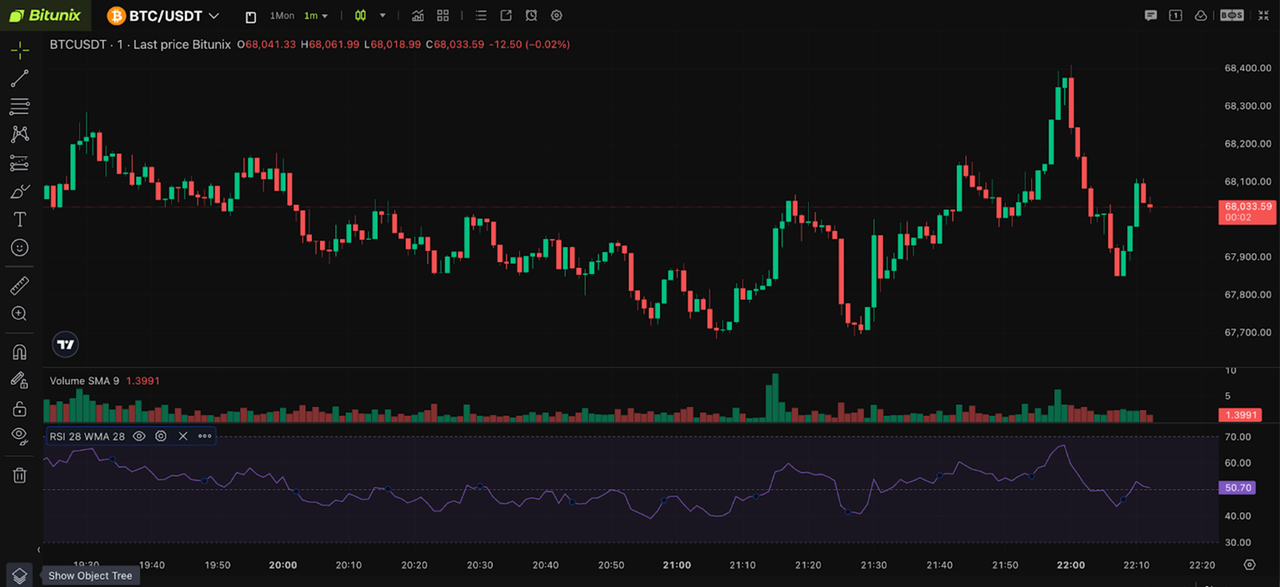
The Relative Strength Index (RSI) measures momentum by comparing recent gains and losses over a set period (commonly 14 candles). Traders often treat RSI below 30 as oversold and RSI above 70 as overbought. Those levels don’t guarantee reversals, but they flag when the price has stretched too far, too fast.
A practical dip-entry approach looks like this:
- Trend check: higher highs and higher lows on the larger timeframe.
- Pullback: price drops into an area where buyers previously stepped in (a support zone).
- RSI confirmation: RSI dips below 30 on the entry timeframe, then climbs back above 30 as selling pressure fades.
That last step matters. You want evidence that momentum is shifting, not just a low number on the indicator.
A Data-Driven Look at Market Hours and Volatility
Crypto trades 24/7, but your execution quality still changes a lot by hour and day. In practice, the market has busy windows where liquidity is deeper and price impact is smaller, plus quieter windows where spreads widen and slippage gets worse.
The 24/7 Market
A study published by Finance Research Letters that analyzed trading across 38 exchanges and 1,940 trading pairs found a clear daily rhythm even in an always-on market.
Trading activity, volatility, and illiquidity all peaked around 16:00–17:00 UTC. The same paper also reported that returns tended to be lowest in early morning hours and higher in early afternoon and evening. In other words, 24/7 availability doesn’t remove timing patterns, it just shifts them into global hot zones.
The Weekend Effect
Weekends often feel thinner because parts of institutional participation step back. Kaiko’s research found in 2025 that about 55% of BTC-USD trading happens during US market hours, while weekend trading made up 13.3% of BTC-USD volume. That difference in who’s active can change liquidity and intraday behavior.
Order-book data also shows weekend-specific patterns. In a 2025 analysis, Amberdata observed weekend conditions that skewed more ask-heavy, including an average 1.80% imbalance on Sunday and some of the most extreme ask-heavy periods clustering on weekends.
Global Trading Sessions
The cleanest way to think about session effects is overlap. When major regions trade at the same time, you usually see more two-sided activity and better execution conditions.
Kaiko found that BTC-USD volume concentrates heavily around US hours, and it highlighted clustering around the US market open and close in recent data. That matters because those hours often coincide with major information releases and risk-on/risk-off positioning.
Amberdata’s 2025 work adds useful execution numbers. It flagged a golden hour overlap window at 07:00–09:00 UTC (Asia–Europe) and 14:00–16:00 UTC (Europe–US), and reported that imbalance variability dropped by about 20% during overlap periods versus single-session hours.
It also summarized practical liquidity windows, with stronger conditions around 09:00–13:00 UTC and weaker conditions around 20:00–23:00 UTC, plus a peak-to-trough liquidity relationship around 1.42x in its sample.
If you want to double-check this on your own pairs, use your charting tools to line up volume spikes, spread changes, and RSI behavior with the UTC clock.
The Single WORST Time to Enter a Trade
The worst entries usually come from one place: emotion. FOMO shows up when the price rips upward, and you feel like you missed a good opportunity. That is when spreads can widen, and your market order can fill higher than you expected, especially in fast moves.
This is also where the bull trap happens. Early buyers sell into the surge, late buyers chase, and price snaps back. If you want a simple guardrail, watch momentum. An RSI above 70 (and especially near 80) often signals an overheated move where the risk-reward gets ugly for a fresh long. Wait for the price to cool off, let liquidity rebuild, and then plan your entry.
Conclusion: Strategy Trumps Timing
The perfect entry point is a myth. A successful trader relies on a consistent strategy. Whether you choose the discipline of Dollar-Cost Averaging or the reactive approach of buying dips with technical indicators, the key is to have a plan and stick to it.
The best time to enter spot trading shows up when your setup is complete, and your execution stays consistent. Sometimes that’s mid-week during higher liquidity. Sometimes it’s after a fake-out wick when the price stabilizes. You run the same checklist, then improve it with your own results.
Bitunix supports this style of spot trading because you can study markets with TradingView charts using Bitunix data, set alerts to avoid staring at screens, and lean on clear spot-market execution tools when you’re ready to place an order.
Don't let FOMO dictate your decisions. Download the app, sign in, and use the powerful charting tools on Bitunix to analyze the market, set your strategy, and execute your trades with confidence. Your journey to smarter trading starts today.
FAQ
Is it better to place a market order or a limit order when entering a trade?
Use limit orders when you care about price and want to reduce slippage. Use market orders when you need immediate execution and accept that you might pay a worse fill during fast moves.
What is slippage, and how can I avoid it?
Slippage is the gap between the price you expect and the price you actually get, often during volatility or low liquidity. You reduce it by using limit orders, trading higher-liquidity pairs, and avoiding thin weekend hours.
Do news and current events affect the best time to trade?
Yes. News can spike volatility and widen spreads within seconds. If you trade around major announcements, pre-plan entries and exits. Otherwise, wait for the first reaction to cool down and let liquidity normalize.
How long should I hold a spot trade?
Hold time depends on your timeframe. A swing trade can last days or weeks. A short-term spot trade can last hours. Decide before you enter by setting a target, an invalidation level, and a reason for the trade.
Is it true that crypto prices go down on the weekend?
There’s no reliable rule that weekends mean down only. What changes more consistently is liquidity. Weekend volume often drops, which can make moves feel sharper because fewer orders sit in the book.
What is the witching hour in crypto trading?
In traditional markets, it refers to scheduled expiries that can spike volatility. In crypto, similar bursts happen around large derivatives expiries or major funding and settlement events. Watch calendars for big expiries and expect busier price action.
How can I practice identifying entry points without risking real money?
Replay charts and mark entries using your rules, then log outcomes. You can also trade a very small size to test execution. The key is consistency, same rules, same timeframes, same journal format.
Should I use the same entry strategy for every cryptocurrency?
No. Liquidity, volatility, and market structure vary a lot by coin. Keep the same framework, but adjust thresholds. For small caps, widen stops and reduce size. For majors, expect cleaner technical levels.
What is a support level, and how can it help me find a good entry?
Support is a price area where buying previously absorbed selling. It helps because it gives you a defined entry zone and a clear invalidation point. You can pair support with RSI to filter for stretched pullbacks.
Does Bitunix offer any tools for automated trading or DCA?
Bitunix supports tools that help you trade systematically, including recurring-buy style options such as Spot Auto-Invest and other execution features depending on your region and account settings. Use them to automate routine entries and reduce emotional trading.
Glossary
- Spot trading: Buying and selling crypto for immediate ownership and settlement.
- Entry point: The price and moment you choose to open a position.
- Dollar-cost averaging (DCA): Investing a fixed amount at regular intervals.
- RSI (Relative Strength Index): Momentum indicator comparing recent gains and losses.
- Oversold: Condition where selling pressure looks stretched (often RSI < 30).
- Overbought: Condition where buying pressure looks stretched (often RSI > 70).
- Volatility: How quickly and how much the price moves over time.
- Liquidity: How easily you can buy or sell without moving the price much.
- Order book: List of active buy and sell orders at different prices.
- Spread: Difference between best bid and best ask.
- Market order: Order that executes immediately at the best available price.
- Limit order: Order that executes only at your chosen price (or better).
- Slippage: Difference between expected fill price and actual fill price.
- Support level: Price zone where buying historically stepped in.
- FOMO: Emotional urge to buy after a rapid price rise.
About Bitunix
Bitunix is a global cryptocurrency derivatives exchange trusted by over 3 million users across more than 100 countries. The platform is committed to providing a transparent, compliant, and secure trading environment for every user. Bitunix offers a fast registration process and a user-friendly verification system supported by mandatory KYC to ensure safety and compliance. With global standards of protection through Proof of Reserves (POR) and the Bitunix Care Fund, Bitunix prioritizes user trust and fund security. The K-Line Ultra chart system delivers a seamless trading experience for both beginners and advanced traders, while leverage of up to 200x and deep liquidity make Bitunix one of the most dynamic platforms in the market.
Bitunix Global Accounts
X | Telegram Announcements | Telegram Global | CoinMarketCap | Instagram | Facebook | LinkedIn | Reddit | Medium
Disclaimer: Trading digital assets involves risk and may result in the loss of capital. Always do your own research. Terms, conditions, and regional restrictions may apply.