

Article Summary
- This article provides an analytical overview of the Ethereum gas fee market in 2026, focusing on current on-chain costs and trends.
- It breaks down the components of L1 and L2 transaction fees and analyzes the trends driving them down, such as the migration to Layer 2s and the impact of EIP-4844.
- A key section introduces Bitunix as the zero-gas alternative, explaining that while on-chain fees are lower, they still exist. For active trading, a centralized exchange offers an environment with zero gas fees, instant execution, and lower overall costs.
- The guide presents a hybrid strategy for modern crypto users: using L2s for decentralized activities (DeFi, NFTs) and using a CEX like Bitunix for cost-sensitive, high-frequency activities like trading and derivatives.
- It concludes that a complete crypto strategy involves understanding both on-chain costs and the significant advantages of a zero-gas off-chain environment.
Ethereum’s fee story used to be simple. You want to do something on-chain, you pay a lot, and you complain about it on social media. In 2026, that narrative feels dated. Fees still move, congestion still happens, and yes, you can still get wrecked by timing. But the system has changed enough that you can plan around costs instead of guessing.
If you already understand basic wallets and transfers, the next step is understanding the fee market as a set of levers you can control. That includes where you transact (L1 vs L2), when you transact (demand cycles), and how you transact (transaction type, batching, and routing).
And if your goal is active trading rather than on-chain app usage, you also need a clean comparison with off-chain venues, where trades settle on an internal ledger and avoid gas entirely.
Deconstructing On-Chain Costs
At the base level, an ETH gas fee is what you pay to get computation and data included in Ethereum’s blocks, as stated on the official Ethereum website: “Your gas fees are the total cost of the actions in your transaction.” Each action consumes a certain number of gas units, and you pay a price per unit. Modern Ethereum uses an EIP-1559 style mechanism where a base fee adjusts with demand, and you can add a tip to prioritize inclusion.
What trips people up is that the ETH gas fee is not one thing. It is the product of three moving parts: how complex your transaction is, how busy the network is, and how urgently you want it confirmed. That is why a simple transfer can be cheap while a swap or NFT mint costs more, even at the same gas price.
ETH Gas Fees in 2026
When analysts talk about Ethereum transaction costs, they usually mean the all-in USD amount a user pays for a typical action, not just the gas price. That all-in cost depends on the gas used by the action and the current base fee environment. Tools like Etherscan publish “featured actions” estimates for swaps, NFT sales, bridging, and borrowing, which makes it easier to compare behaviors instead of raw gas numbers.
For L2s, the cost model changes. You still pay for execution, but you also pay for the rollup’s cost to publish data back to Ethereum for security. Historically, that “data posting” part was a big constraint because it relied heavily on calldata. Proto-danksharding changed that by introducing blobs, which are cheaper data containers that are pruned after a set period, specifically designed to lower rollup posting costs.
Here is a practical comparison table using widely referenced fee trackers.
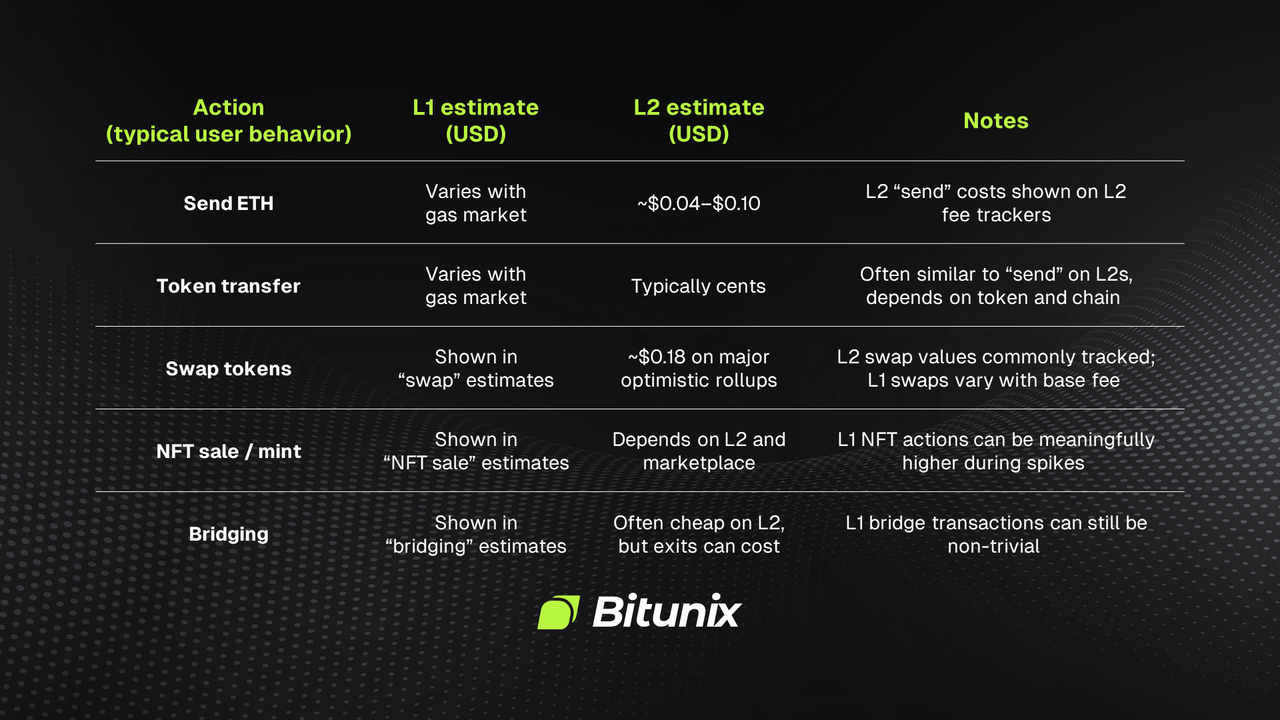
If you are building models, separate the questions. One question is the L1 gas market itself. The other is how L2s translate L1 conditions into end-user fees.
Analyzing the On-Chain Trends
The biggest driver of ETH gas price trends since 2024 has been activity moving off mainnet and onto rollups, plus cheaper rollup data availability after EIP-4844. L2BEAT’s activity dashboards make the migration visible in aggregate user operations, showing rollups processing far more user activity than L1 by count over the last year window they track.
On the cost side, Ethereum.org is direct about the intent. Proto-danksharding exists to make L2 transactions as cheap as possible for users by giving rollups cheaper data than calldata, using blobs that are not EVM-accessible and are deleted after a fixed time.
A second shift is the emergence of a separate blob fee market. Coin Metrics describes EIP-4844 as introducing a new transaction type and a fee market for pricing blobs, with blob base fees adjusting dynamically based on blob space demand, similar in spirit to EIP-1559.
For analysts, this matters because rollup costs can decouple from L1 execution costs. You can see days where L1 is calm but blob demand is hot, or the reverse.
To ground the “fees came down” claim in an observable metric, YCharts tracks average transaction fees over time and ties the statistic to a charted history.
Another trend worth flagging is fee abstraction. With account abstraction patterns, apps can sponsor fees, let users pay gas in tokens other than ETH, or bundle actions so the user sees one cost instead of several. It does not remove fees, but it changes who pays, when they pay, and how visible the fee is. That improves UX and can reduce “oops I paid $40 to claim $8” moments.
Finally, Ethereum transaction costs remain reflexive. When markets get volatile, demand spikes, and costs rise. When activity spreads across L2s, L1 becomes less of a universal choke point.
Strategies for On-Chain Cost Reduction
If your goal is to reduce Ethereum fees to scalping, you need a playbook that treats gas like a variable input cost, not a surprise tax. The good news is that most fee savings come from a few repeatable moves.
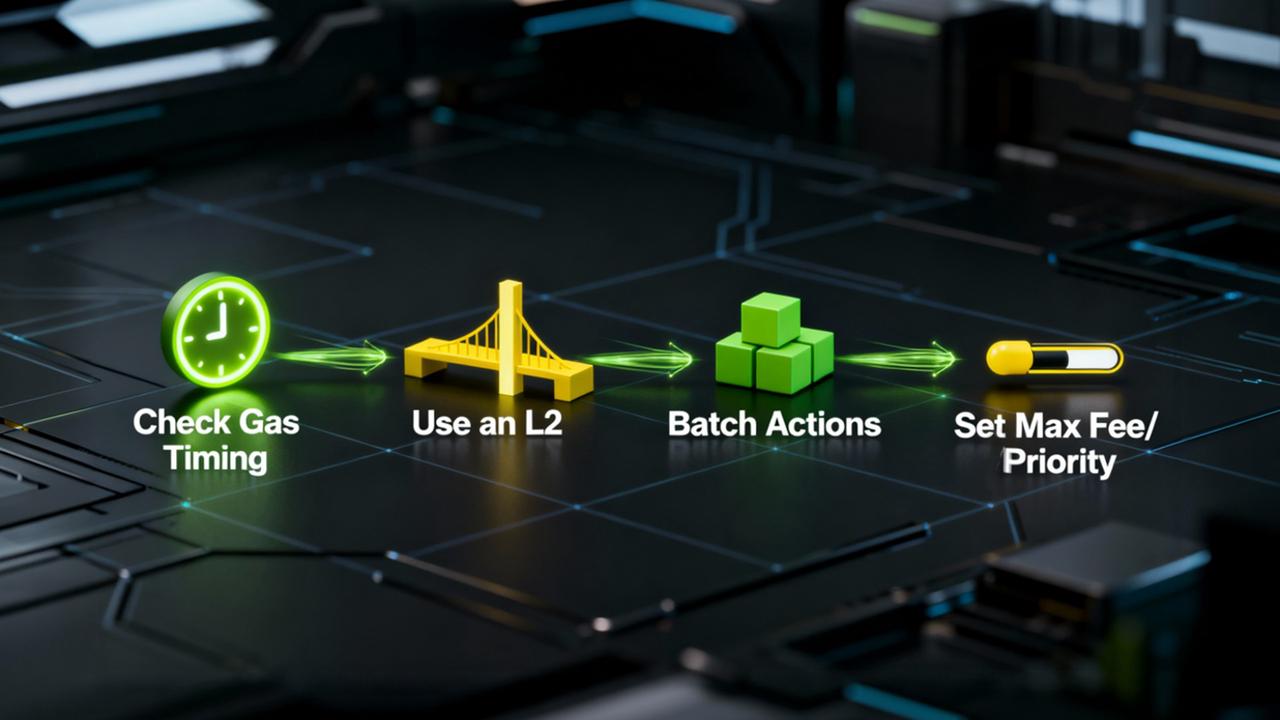
Here are the strategies that work in practice:
Use L2s by default for routine activity.
If you are swapping, transferring, or interacting with common DeFi apps, doing it on a rollup often saves you orders of magnitude versus L1. Public fee trackers show L2 send and swap costs in the cents range on major rollups, which is exactly what you need if you want to reduce Ethereum fees to scalping levels for frequent small actions.
Time L1 transactions like your time entries.
L1 is still the settlement layer. Some actions demand L1, and some bridges or contracts still lean on it. If you must use L1, treat it like a scheduled task. Watch the gas tracker, choose low-demand windows, and avoid known congestion events. The point is not to predict the exact bottom. The point is to stop paying peak prices out of habit.
Separate smart contract execution fees from data fees in your analysis.
Post-EIP-4844, rollup fees have a clearer relationship to blob pricing and batch posting behavior. When blob fees rise, your L2 fees can rise even if L1 execution stays calm. Coin Metrics’ breakdown of blob fee dynamics is useful here because it explains why rollup fees move in their own cycles.
Batch and bundle when possible.
If you are doing multiple actions, use tools and apps that batch approvals and operations. Two transactions almost always cost more than one. This is also where fee abstraction patterns help, because the app can optimize the sequence behind the scenes.
Use routing and aggregators for swaps.
A swap cost is not only gas. There is also slippage and price impact. Aggregators can reduce total cost by finding better routes, and in some cases by using contract patterns that minimize redundant steps. You still pay for gas, but you pay it once for a better execution.
If you track ETH gas price trends for a few weeks and log what you actually paid for your top actions, you will start seeing a pattern. Your costs are usually dominated by a small number of behaviors. Fix those behaviors first.
The Bitunix Solution: A Zero-Gas Trading Environment
Understanding on-chain fees is essential for DeFi, NFT activity, and anything that needs Ethereum’s settlement guarantees. But active trading is a different job. You are trying to enter and exit quickly, manage risk tightly, and repeat a process. In that setting, paying an ETH gas fee every time you adjust exposure is friction that stacks up.
On a centralized exchange, trades happen off-chain inside the platform’s internal ledger. That is why trades execute instantly without waiting for block confirmations and without per-trade gas. If you are executing frequently, that difference is not cosmetic. It changes whether a strategy remains profitable after costs.
Reducing Fee Impact With Bitunix Earn
Another way traders reduce the impact of Ethereum gas fees is by keeping idle capital productive. Instead of moving assets on-chain to chase small yields and paying gas for deposits, withdrawals, and claims, users can allocate funds to Bitunix Earn, where rewards accrue off-chain without transaction fees.
This approach is especially useful for capital that is waiting between trades. By earning yield inside the platform’s zero-gas environment, traders avoid repeated on-chain interactions while still generating returns. In practice, this can offset trading fees and reduce the need for frequent Ethereum transactions, lowering total cost over time.
A few practical examples:
- Active trading workflows
- If you are trading intraday or running tight risk controls, using the spot market avoids on-chain congestion and keeps execution consistent.
- Derivatives and leverage
- Perpetuals and margin-style products are typically off-chain instruments. If you need that toolkit, you use venues built for perpetual futures.
- Moving capital efficiently
- A hybrid approach still requires transfers in and out. If you want a clean operational flow, keep a reference for depositing funds and withdrawing funds.
This is also where fees become easier to model. On-chain, your cost per action floats with demand. Off-chain, your primary variable cost is the trading fee schedule, usually expressed as maker and taker rates. You can check the current maker and taker rates and plug them into a strategy backtest.
When to Use Bitunix Over On-Chain
Here are the best cases to use Bitunix when dealing with Ethereum gas fees:
- Active trading
- If you trade often, per-trade gas on L1 is a constant drag, and even L2 fees add up when you churn positions.
- Derivatives trading
- Leverage products are built for off-chain execution and risk engines. You get tools like liquidation logic, margin controls, and fast order matching.
- Frequent swaps between majors
- Rotating between BTC, ETH, and stablecoins is faster off-chain when you do it repeatedly, especially when you care about timing.
Conclusion: Building a Complete, Hybrid Crypto Strategy
The smartest setups in 2026 treat on-chain and off-chain as complementary tools. Use L2s when you want to explore DeFi, mint, stake, or interact with protocols that live on Ethereum’s security model. Use a centralized venue when you want speed, repeatability, and cleaner cost control.
A simple way to think about it is task-based. On-chain is great for ownership and composability. Off-chain is great for execution and iteration. Combine both, and you stop forcing one environment to do every job.
By combining your knowledge of the on-chain world with the zero-gas, high-speed trading environment of Bitunix, you can optimize for every situation. Master the on-chain world with your new knowledge, and master your trading on Bitunix. Sign up or download the Bitunix app today and start saving on fees.
FAQ
What is the difference between an on-chain and an off-chain transaction?
On-chain transactions are recorded on a blockchain and require gas. Off-chain trades happen inside a platform’s internal ledger and settle later when you deposit or withdraw.
Are there any fees for trading on Bitunix?
Yes. You generally pay trading fees like maker and taker rates rather than gas, plus network fees when you withdraw on-chain.
Why is trading on Bitunix cheaper than on a DEX?
DEX trades require an on-chain transaction, so you pay gas, and you wait for confirmation. Off-chain trades avoid per-trade gas.
Can I avoid gas fees completely if I only use Bitunix?
You can avoid per-trade gas, but deposits and withdrawals that touch a blockchain still use network fees.
What was EIP-4844, and how did it lower L2 fees?
It introduced blob transactions so rollups can post data more cheaply than calldata, reducing rollup cost pressure.
Is it still expensive to use the Ethereum mainnet (L1)?
It can be, especially during volatility spikes. Fee estimates move with demand.
Which Layer 2 has the lowest fees right now?
It changes, but public trackers compare send and swap costs across L2s in near real time.
How do I move my funds from an L2 back to Bitunix?
You typically withdraw from the L2 to a supported address or bridge back to a network supported by the exchange, then deposit. Use the deposit and withdrawal guides for the operational steps.
What are the advantages of trading futures on Bitunix vs on-chain?
You get fast matching, margin controls, and you avoid paying gas per adjustment, which
matters when you manage risk actively.
What is a hybrid strategy for crypto?
It means using on-chain rails for protocol interaction and custody, while using off-chain venues for high-frequency execution and capital efficiency.
Glossary
Gas: Unit that measures computational work required for a transaction on Ethereum.
Gwei: Common denomination for gas prices, equal to 1e-9 ETH.
Base Fee: EIP-1559 fee component that adjusts with network demand and is burned.
Priority Fee (Tip): Extra fee paid to incentivize faster inclusion by validators.
Gas Limit: Maximum gas units you allow a transaction to consume.
Layer 1 (L1): Ethereum mainnet settlement layer.
Layer 2 (L2): Scaling networks that execute transactions off L1 and post proofs or data back.
Rollup: L2 design that batches transactions and relies on Ethereum for security.
Calldata: Transaction data posted on L1, historically a major cost driver for rollups.
Blob: EIP-4844 data container that reduces rollup data posting costs and is pruned after a period.
EIP-4844 (Proto-danksharding): Upgrade that introduced blob transactions to lower rollup costs.
Blob Fee Market: Separate fee market for blob space where blob base fees adjust with demand.
Fee Abstraction: UX pattern where users can pay fees in different tokens or have fees sponsored by apps.
CEX: Centralized exchange where trades settle off-chain on an internal ledger.
DEX: Decentralized exchange where swaps execute via smart contracts on-chain and require gas.
About Bitunix
Bitunix is a global cryptocurrency derivatives exchange trusted by over 3 million users across more than 100 countries. The platform is committed to providing a transparent, compliant, and secure trading environment for every user. Bitunix offers a fast registration process and a user-friendly verification system supported by mandatory KYC to ensure safety and compliance. With global standards of protection through Proof of Reserves (POR) and the Bitunix Care Fund, Bitunix prioritizes user trust and fund security. The K-Line Ultra chart system delivers a seamless trading experience for both beginners and advanced traders, while leverage of up to 200x and deep liquidity make Bitunix one of the most dynamic platforms in the market.
Bitunix Global Accounts
X | Telegram Announcements | Telegram Global | CoinMarketCap | Instagram | Facebook | LinkedIn | Reddit | Medium