Chat with us, powered by LiveChat
BeginnerOperation Guide

Understanding Bitunix Withdrawal Fees: How to Minimize Costs and Maximize Your Crypto Transfers

AG 2026/03/06 9min 81.01K


Article Summary


  • This guide provides a clear and comprehensive explanation of withdrawal fees on the Bitunix platform.
  • It explains the crucial difference between trading fees and withdrawal fees, clarifying that withdrawal fees are paid to the blockchain network, not to Bitunix.
  • The article breaks down the two main factors that determine the cost of a withdrawal: the specific cryptocurrency being withdrawn and the network selected.
  • It provides three actionable strategies to help users minimize their withdrawal costs, including choosing the right network and withdrawing larger amounts less frequently.
  • The guide includes a critical task for the content writer to create a comparison table showing fees for popular assets across different networks.


You’ve made a successful trade, and now you want to move your crypto. Then you hit the withdrawal screen and see a fee. Annoying, confusing, and sometimes higher than you expected. If you’ve ever stared at that number like it personally insulted you, you’re not alone.


This is a common pain point on any crypto exchange. Fees look small until you withdraw often, withdraw on the wrong network, or move stablecoins through an expensive chain.


In this guide, you’ll learn how withdrawals work on Bitunix, what drives the cost, and three simple ways to shrink that cost on future transfers. You’ll also get a real table of current withdrawal fees so you can compare options quickly.


The Basics - What Are Bitunix Withdrawal Fees?


Trading Fees vs. Withdrawal Fees


First, separate two things that people mix up. Trading fees are what you pay to execute trades. They are usually a percentage, and they depend on your market, order type, and fee tier.


Withdrawal fees are different. They exist because moving funds on-chain is not free. Bitunix describes on-chain withdrawals as charging a network gas fee based on network conditions, and the calculation varies by blockchain. In other words, the withdrawal cost is mainly about paying the chain to process your transaction, not about paying for trading.


This is why Bitunix fees can feel low while trading, but withdrawals still cost something. Here’s a clean mental model: trading fees are platform costs; withdrawals are network costs.


To put the network part in a way easy to understand, BVNK explains it like this: "Network fees, often referred to as transaction fees, are essential payments made to incentivise miners or validators in the processing of transactions on the blockchain network."


What Determines the Fee?


Two big variables decide what you pay in crypto withdrawal fees.


Factor 1: The cryptocurrency itself


Withdrawing BTC won’t match withdrawing USDT. Different chains have different fee markets and different transaction sizes.


Factor 2: The network you choose


This is the lever you control most often. Many assets can be withdrawn on multiple networks. USDT is the classic example. You might see options like Ethereum (ERC-20), Tron (TRC-20), BSC (BEP-20), Arbitrum, and more. Each one has its own fee level.


The Strategy - How to Minimize Your Withdrawal Fees


Strategy 1: Choose the Right Network


This is the fastest way to save money. If you withdraw stablecoins, ERC-20 is often the priciest option. TRC-20 and BEP-20 are frequently cheaper, and L2 networks like Arbitrum or Optimism can also reduce costs depending on the asset. The comparison table below makes this difference obvious.


One warning that matters more than any fee tip: the receiving wallet must support the same network you select. If you send USDT on TRC-20 to an ERC-20-only address, you can lose access to those funds. Bitunix explicitly tells users to double-check the asset, network, and address before confirming.


If you want a refresher on where to select the network in the interface, use the withdrawal form.


Strategy 2: Withdraw Larger Amounts, Less Frequently


Most withdrawal fees are flat amounts for the asset you withdraw. That means the fee hurts more when you withdraw tiny amounts.


Simple math with a flat 1 USDT fee:


  • Withdraw 100 USDT, your effective cost is 1%
  • Withdraw 1,000 USDT, your effective cost is 0.1%


This is one of the easiest answers to how to reduce crypto fees without changing anything about your trading.


Strategy 3: Withdraw During Off-Peak Hours


Some networks, especially Ethereum, get more expensive when they are busy. Bitunix publishes fixed withdrawal fees for clarity, but it also notes that on-chain withdrawals depend on current network conditions and that the final fee should match what you see on the withdrawal page.


So while you won’t always see minute-by-minute changes inside the platform, it’s still smart to avoid times when the network is clogged, particularly if you’re deciding between Ethereum and an L2 alternative.


A Practical Comparison


The table below is based on the published fee schedule, last updated on January 15, 2026.
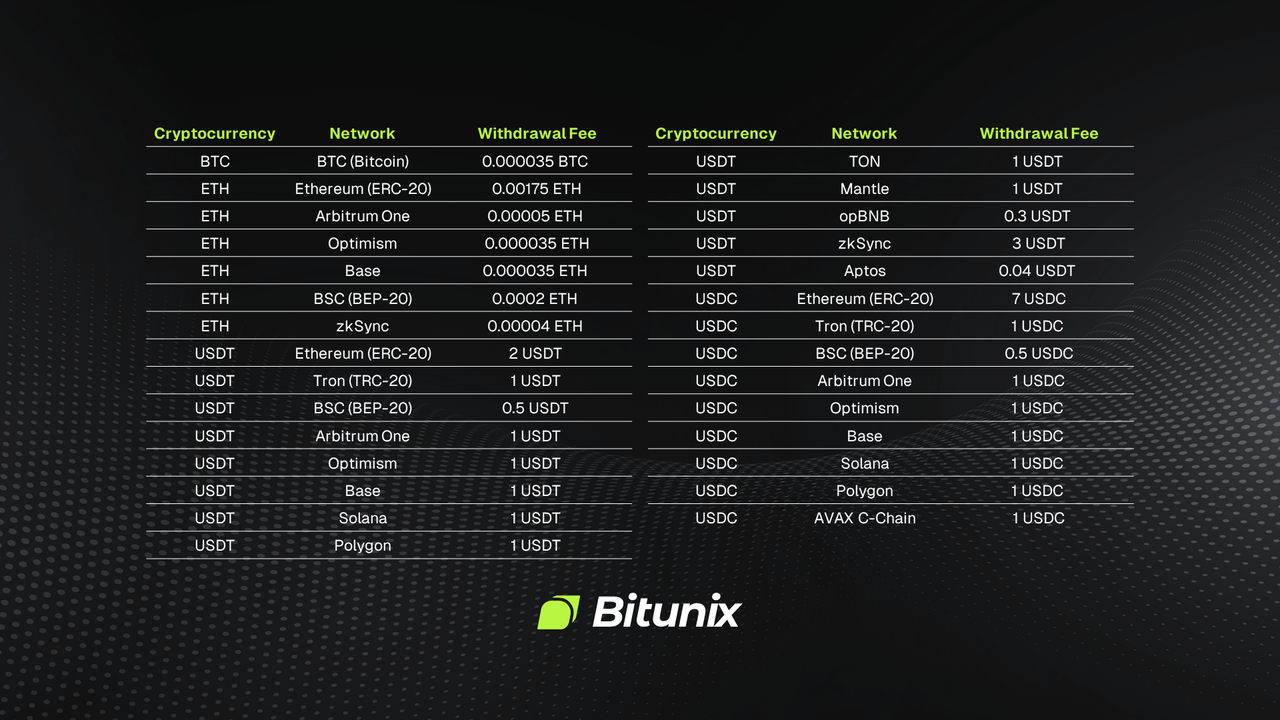

Side-by-side withdrawal fees by coin and network, showing how the same asset (like USDT or ETH) can cost very different amounts to withdraw depending on the network you choose.


Bitunix also notes that the actual fee should be the one shown on the withdrawal page at the time you make the transfer.


The pattern is clear. The network choice often matters more than the coin, especially for stablecoins.


Conclusion: Withdraw Smarter, Not Harder


Understanding Bitunix withdrawal fees is a simple way to protect your balance. Most of the time, the cost is driven by the network you pick, and you can lower it by choosing a cheaper chain, withdrawing less often, and timing transfers when networks are quieter.


Before your next transfer, check the network options, confirm the receiving wallet supports that network, and keep more of your crypto.


Before your next transfer, check the network options. Make the smart choice and keep more of your crypto. Download the app, log in to Bitunix to see the withdrawal options for your favorite assets.

FAQ Section


Why does Bitunix charge a withdrawal fee if they don’t profit from it?


Bitunix explains withdrawals as charging a flat amount to cover transaction costs and on-chain network gas fees. It frames the fee as network-driven, and the final fee should match what you see in the withdrawal screen.


How can I check the current withdrawal fee for a specific coin?


Use the published fee schedule for a baseline, then confirm the exact number on the withdrawal page right before you submit. Bitunix explicitly says the withdrawal page is the final reference.


What happens if I choose the wrong network for my withdrawal?


You can lose access to the funds if the receiving wallet or exchange does not support that network for that asset. Bitunix tells you to double-check the asset, network, and address before confirming.


Are there any assets with zero withdrawal fees?


Some entries in the published schedule list a fee of 0 for specific assets or networks. Availability can change, so always confirm the fee shown in the withdrawal screen.


How long does a crypto withdrawal from Bitunix usually take?


Bitunix says withdrawals need network confirmation and can take 5 to 30 minutes, depending on network status.


Is the withdrawal fee different from the gas fee?


On-chain, gas is what the network charges to process a transaction. Bitunix describes its on-chain withdrawal charge as a network gas fee, so for users, it is effectively the gas cost packaged as a withdrawal fee.


Can I see the withdrawal fee before I confirm the transaction?


Yes. Bitunix notes that the actual fee should be the one shown on the withdrawal page, which you see before final confirmation.


Why are ERC-20 withdrawal fees usually the highest?


Ethereum mainnet fees tend to spike when demand is high because users compete for block space. That fee market pressure is a core reason many people use L2 networks for withdrawals when possible.


Does Bitunix have a minimum withdrawal amount?


Yes. The minimum depends on the asset and network, and it is listed in the published schedule.


Are there fees for depositing crypto into Bitunix?


Bitunix states it does not charge deposit fees. You still pay whatever network fee your sending wallet charges to broadcast the transaction.


Glossary


  • Withdrawal fee – The amount you pay to move crypto from an exchange to an external wallet. On most assets, it covers the cost of processing the transaction on the blockchain network.
  • Network fee – A blockchain transaction fee paid to the network participants who process and secure transactions.
  • Gas fee – The network fee on Ethereum, tied to the computational work needed to process your transaction or smart contract action.
  • Miners – Participants in proof-of-work networks (like Bitcoin) who confirm transactions and add blocks, earning transaction fees (and sometimes block rewards).
  • Validators – Participants in proof-of-stake networks (like Ethereum) who stake assets and help propose and confirm blocks, keeping the network running.
  • Blockchain network – A distributed system of computers (nodes) that follow the same rules to record and verify transactions on a shared ledger.
  • On-chain transaction – A transfer or action that gets recorded directly on the blockchain ledger and requires network confirmation.
  • ERC-20 – A common Ethereum token standard that defines how fungible tokens behave so wallets and apps can interact with them consistently.
  • TRC-20 – A token standard on the Tron network, similar in concept to ERC-20, used by many tokens (including some stablecoin versions).
  • BEP-20 – A token standard on BNB Smart Chain that defines how tokens work in that ecosystem, designed to be similar to ERC-20.
  • Layer 2 (L2) – A network built on top of a Layer 1 (like Ethereum) to make transactions cheaper and faster, while still relying on the base chain for security in different ways.
  • Arbitrum – An Ethereum scaling solution (L2) that aims to make transactions cheaper and faster than the Ethereum mainnet by using rollup technology.
  • Optimism – An Ethereum L2 ecosystem based on optimistic rollup technology and the OP Stack, built to reduce costs and increase throughput.
  • Network congestion – When a blockchain gets more transactions than it can process quickly, it can slow confirmations and push fees higher.
  • Minimum withdrawal amount – The smallest amount an exchange allows you to withdraw for a specific coin and network, usually to avoid transactions that are too small relative to fees.


About Bitunix


Bitunix is a global cryptocurrency derivatives exchange trusted by over 3 million users across more than 100 countries. The platform is committed to providing a transparent, compliant, and secure trading environment for every user. Bitunix offers a fast registration process and a user-friendly verification system supported by mandatory KYC to ensure safety and compliance. With global standards of protection through Proof of Reserves (POR) and the Bitunix Care Fund, Bitunix prioritizes user trust and fund security. The K-Line Ultra chart system delivers a seamless trading experience for both beginners and advanced traders, while leverage of up to 200x and deep liquidity make Bitunix one of the most dynamic platforms in the market.


Bitunix Global Accounts


X | Telegram Announcements | Telegram Global | CoinMarketCap | Instagram | Facebook | LinkedIn | Reddit | Medium


Disclaimer: Trading digital assets involves risk and may result in the loss of capital. Always do your own research. Terms, conditions, and regional restrictions may apply.