
Article Summary
- This article provides a long-term price prediction for Fetch.ai (FET) for 2026 and 2030, in the context of its merger into the Artificial Superintelligence Alliance (ASI).
- It explains Fetch.ai's core mission: to create a decentralized platform where autonomous AI "agents" can perform economic tasks on behalf of individuals and organizations.
- The bull case is overwhelmingly driven by the AI narrative, the first-mover advantage in the decentralized AI space, and the massive potential of the ASI merger with SingularityNET (AGIX) and Ocean Protocol (OCEAN) to create a dominant, vertically integrated AI powerhouse.
- The bear case highlights the immense execution risk of the three-way merger, intense competition from centralized Web2 AI giants like Google and OpenAI, and the risk that the current AI hype cycle may not be sustainable.
- It presents three detailed price prediction scenarios (bearish, neutral, bullish) for both 2026 and 2030, based on the successful integration and market capture of the new ASI token.
AI keeps getting better, faster, and cheaper. Crypto keeps trying to make it more open, more composable, and less controlled by a handful of platforms. That overlap creates a new kind of narrative trade where token prices react to product launches, partnerships, and market attention all at once.
Fetch.ai sits in the agent bucket of AI crypto coins. It focuses on autonomous software agents that can coordinate tasks and transact. On a crypto exchange, that story shows up as a simple question: Does the token attract enough liquidity and attention to justify the risk?
This analysis will explore the fundamentals of Fetch.ai, dissect the monumental Superintelligence Alliance merger, and provide data-driven price predictions for 2026 and 2030, weighing the enormous potential against the significant risks.
The Bull Case: The Decentralized AI Powerhouse
Before getting into the drivers, anchor the optimism in published forecasts. CoinPedia's 2026 outlook puts a 2026 high at $1 and a 2030 high at $12.45. CoinDCX's 2025 forecast table projects 2026 up to $0.90 and 2030 up to $8.20. CoinCodex is far more conservative, estimating $0.3814 by the end of 2026 and $0.3845 by 2030. The bull scenario assumes the alliance execution pulls the market toward the higher bands and keeps attention on the agent narrative long enough for utility to catch up.
1. The AI Narrative
In 2025 and 2026, AI narratives shifted from the future to a global computing race. One 2025 snapshot that shows the scale is xAI's reported trajectory, with 230,000 GPUs already and an ambition measured in H100-equivalent compute that runs into the millions over time. When the broader world spends aggressively on AI infrastructure, crypto investors tend to look for public, tradeable proxies, which is why AI crypto coins get sharp inflows during narrative rotations.
For Fetch.ai, the narrative angle is agent-first. The project's docs describe Agentverse as an AI agent marketplace and attach a tangible scale metric, 2.7 million agents. That is not proof of revenue, but it is a measurable ecosystem surface area. It also supports the key bull assumption that agent networks can develop network effects if discovery and reuse become easier over time.
A bullish path also relies on repeated attention triggers. In March 2026, CoinMarketCap's analysis noted a rotation into the AI agent narrative and tied it to a reported 24h volume jump to $168.7M during that move. The takeaway is that the token already reacts strongly when the market rotates into agents, which is exactly what bullish forecasts assume will happen again in the next risk-on cycle.
2. The Superintelligence Alliance (ASI)
The alliance story works in a bull scenario because it consolidates liquidity and product narratives into one banner. It also reduces the friction of picking the right token by pushing toward a unified ticker. The token conversion rates are fixed and simple at the core; FET converts to ASI 1:1, while OCEAN and AGIX convert at ~0.433 ASI per token.
This merger also gives investors a cleaner way to reason about supply. Official ASI docs set the total ASI token supply at 2.63055 billion. When bullish forecasts talk about multi-dollar targets, this supply figure is what turns price into valuation. For example, a $10 token implies a valuation in the tens of billions, which is only realistic if the Alliance becomes a category leader and keeps deep liquidity.
The bull case improves further if the Alliance roadmap turns into shipping milestones. The 2025 roadmap document is useful because it provides a public checklist investors can track rather than guessing progress from headlines.
3. Real-World Use Cases
Real-world use cases matter because they can create ongoing demand for FET instead of relying on speculation. In the ecosystem, FET supports network activity like transaction fees, service payments, and staking, so higher app usage can translate into more token utility.
A strong 2025 signal is Fetch.ai's AI-to-AI payment demo, where agents coordinated a real booking and completed payment while users were offline. The system supported card payments and on-chain options, including USDC and FET.
4. First-Mover Advantage
First-mover advantage only helps when it compounds. In 2026, Fetch.ai's documentation positions the ecosystem around agent discovery, agent interaction, and agent payments, which is a cohesive product arc. If the project keeps improving the developer surface area and keeps agents easy to deploy, it can maintain mindshare in the agent niche even when broader AI narratives cool temporarily.
A practical reason this matters in a bull scenario is that markets reward category ownership. When investors decide they want exposure to agents rather than compute or data, they look for the token that feels most directly tied to that category. The 2.7 million Agentverse metric is not a guarantee, but it is a credible scale anchor that supports category positioning.
This is where bullish forecasts like CoinPedia and CoinDCX come from. They assume the Alliance keeps category leadership long enough for valuation multiples to expand in the next major cycle.
The Bear Case: Hype vs Reality
The bear case becomes easier to understand when it's grounded in published numbers. CoinPriceForecast projects $0.27 by the end of 2026 and $0.48 by the end of 2030. Changelly's 2026 forecast stays tight, with $0.351–$0.397 as the expected range. CoinCodex estimates $0.3814 by the end of 2026 and $0.3845 by 2030. The common thread is that execution takes longer than expected, adoption stays niche, and the market stops paying a premium for the AI token basket.
1. Immense Execution Risk
Mergers fail more often from complexity than from bad intent. The Alliance has to unify products, incentives, and communities across tokens, chains, and user bases. Even the clean parts introduce operational work. Token conversions require coordination across assets and swaps, and the final structure sets a new supply baseline of 2.63055 billion ASI tokens.
If delivery slows during integration, the token can underperform while the market chases faster narratives. This is where conservative forecast models earn attention. CoinCodex's long-range projection stays near $0.38 for both the end of 2026 and 2030.
A bearish scenario also includes coordination risk at the ecosystem layer. If builders do not see a clear advantage in moving to the merged ecosystem, the Alliance becomes a branding layer rather than a utility layer, and the market prices it accordingly.
2. Competition From Web2 Giants
The bear case gets sharper when competition is expressed in compute scale. In 2025, xAI discussed operating 230,000 GPUs and targeting compute measured in huge H100-equivalent units over the next five years. In 2025–2026, major players also continued massive infrastructure spending on AI data centers, including NVIDIA-class chips such as the H100 and H200.
A decentralized agent network can still win niches, but it competes against platforms that ship to billions of users. In a bearish scenario, most users keep choosing convenience, and developers keep choosing distribution. Decentralized AI stays a specialist category, and the token gets valued like a specialist asset rather than a mainstream AI proxy.
That competitive pressure also affects investor psychology. If Web2 keeps shipping agent experiences inside familiar apps, the agents narrative stops being unique, and AI crypto coins lose the narrative premium that many bull forecasts rely on.
3. Is the Hype Sustainable
AI tokens trade like high-beta narratives. They pump on rotation, then fade when the market shifts back to majors or to the next theme. CoinMarketCap's March 2026 analysis is a good illustration of the rotation effect, linking a price move to narrative-driven flows and highlighting a reported 24h volume surge during the AI agent rotation.
In a bearish scenario, that rotation becomes a one-off spike rather than the start of a multi-year uptrend. Price moves still happen, but they fail to build higher long-term levels. This is exactly the logic behind the conservative forecasts. Changelly's 2026 range tops out around $0.397, and CoinPriceForecast ends 2026 at $0.27. Those numbers reflect a market that sees periodic excitement but does not reward it with durable repricing.
4. Technological Complexity
Agents are powerful, but complexity creates adoption friction. The Fetch.ai documentation emphasizes smart contracts, agent payments, public ledgers, and agent tooling. That stack can be compelling for builders, but it also increases the learning curve, especially for developers who already have strong Web2 agent frameworks.
Even if the tech is solid, a bearish scenario assumes slower onboarding and fewer must-have applications. Fetch.ai Labs lists multiple experimental apps, which is positive, but it also highlights the reality that the ecosystem is still in an experimentation phase in 2026. If those experiments don't turn into repeat usage, token demand relies mostly on trading, which is fragile.
This is why the conservative price paths are plausible. They don't assume the project fails. They assume it stays complex, stays niche, and struggles to convert narrative attention into broad adoption.
FET (ASI) Price Prediction Scenarios (2026 and 2030)
In these scenarios, the bearish one assumes the conservative models dominate, and the market stays skeptical. The neutral scenario assumes the Alliance earns a meaningful niche and rides at least one strong narrative cycle. The bullish scenario assumes category leadership and sustained developer growth.
In this Fetch.ai price prediction, the table below acts as a structured way to think about outcomes, not a single-point forecast.
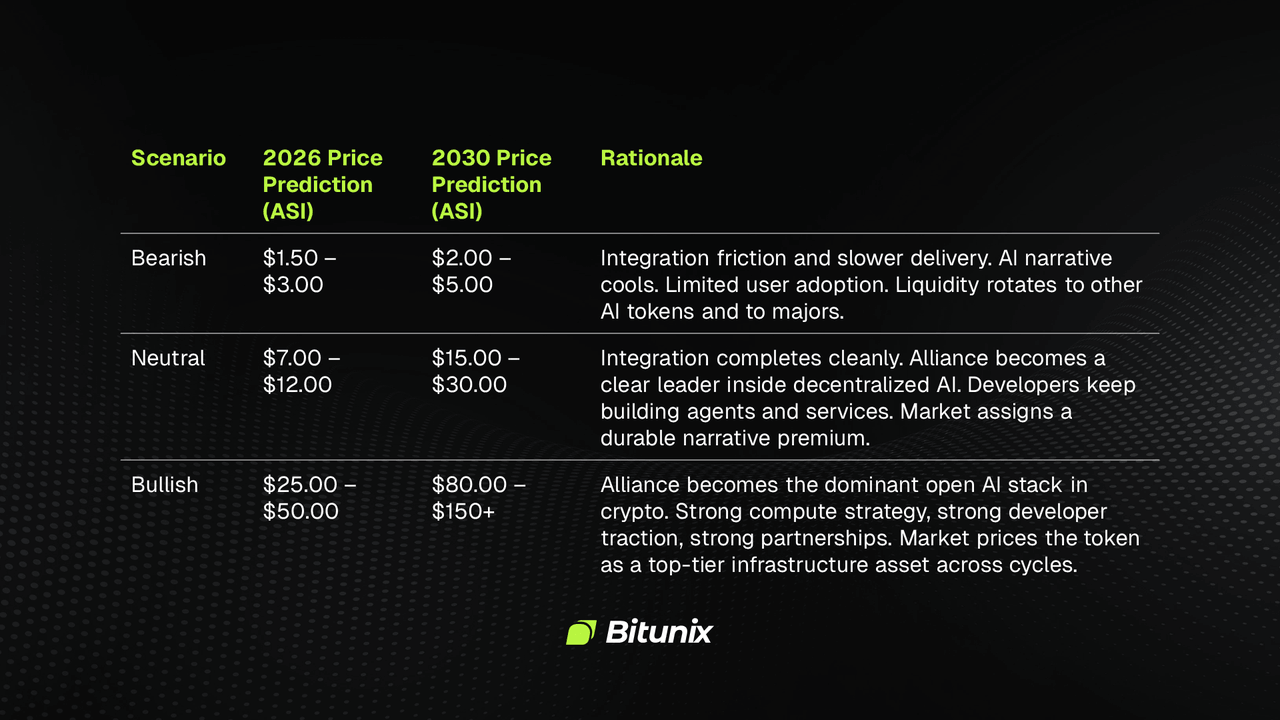
Bull, neutral, and bearish ASI price scenarios for 2026 and 2030.
Conclusion: A High-Stakes Play on the Future of AI
Fetch.ai sits at the intersection of two forces. AI keeps expanding across software. Crypto keeps pushing for open infrastructure and composability. If agents become a normal part of consumer and enterprise tooling, the Alliance has a path to real demand.
The long-term question is execution. The upside depends on whether the ecosystem continues to ship products, attract builders, and improve the agent experience. Signals like a large agent directory and visible consumer app packaging help the story feel more real in 2026.
For traders, access and liquidity are part of the decision. Bitunix lists FET markets that allow spot trading against USDT, providing a simple on-ramp to the theme when AI returns to the spotlight. Download the Bitunix app, register, and set risk limits before trading volatile AI tokens at size.
FAQ
What is the Superintelligence Alliance (ASI)?
Superintelligence Alliance is a combined ecosystem that brings together AI agents, AI services, and data tooling under a shared token and roadmap. It aims to create a broader decentralized AI stack, rather than three separate projects competing for attention and liquidity.
What will happen to my FET, AGIX, and OCEAN tokens after the merger?
Token holders convert into the alliance token using fixed conversion rules. Some exchanges handle swaps automatically. Self-custody holders usually follow official swap steps. The practical result is one consolidated asset that represents the combined ecosystem.
What is the conversion rate for FET to ASI?
FET converts to ASI at a 1-to-1 rate. AGIX and OCEAN convert into ASI at fixed ratios. Anyone holding multiple tokens should check the exact ratios, since the final ASI amount depends on the mix of assets.
Who are the founders of Fetch.ai?
A team with backgrounds in AI, software systems, and decentralized tech founded Fetch.ai. Humayun Sheikh is often listed among the co-founders and has remained a visible figure throughout the project's growth and ecosystem expansion.
What is an Autonomous Economic Agent (AEA)?
An AEA is a software agent designed to act toward a goal on behalf of a user, business, or device. It can discover services, coordinate with other agents, and complete tasks with economic settlement, reducing the need for constant human input.
How does Fetch.ai use blockchain?
Blockchain provides identity, coordination rules, and settlement. Agents can coordinate off-chain, but a token-based settlement layer supports payments and incentives. The chain serves as the economic backbone that enables agents to transact without a central controller.
Is Fetch.ai built on Cosmos?
Fetch.ai has used Cosmos-related tooling and interoperability concepts over time, while also operating its own network components and agent framework. The easiest way to view it is a network designed to plug into a multi-chain ecosystem.
What are some of Fetch.ai's key partnerships?
Partnership signals tend to show up as pilots, deployments, and foundation structures rather than one-off headlines. The ecosystem has referenced industrial and mobility initiatives, as well as validator and infrastructure activity tied to decentralized AI support and network participation.
How is Fetch.ai different from SingularityNET?
Fetch.ai focuses on agents and coordination. SingularityNET focuses more on AI services and a marketplace for models. Under the alliance thesis, they complement each other, with one side leaning toward agent execution and the other toward AI service supply.
Where can users store FET tokens?
FET can be stored on supported exchanges or in self-custody wallets that support the relevant network and token format. Self-custody adds responsibility. Network selection, address checks, and secure backups matter, especially when storing larger amounts.
Glossary
- Autonomous Economic Agent (AEA): A software agent that can act, negotiate, and transact toward a goal for an owner.
- AI agents: Automated programs that perform tasks and coordinate actions with minimal manual input.
- Agent marketplace: A directory or platform where agents can be discovered, deployed, and used.
- Superintelligence Alliance (ASI): A merged ecosystem aimed at building a broader decentralized AI stack under one token.
- Token merger: A conversion process that consolidates multiple tokens into one shared token.
- Conversion rate: The fixed ratio used to swap one token for another during a merger.
- Compute infrastructure: Hardware resources used to train and run AI models, often GPUs.
- Token supply: The total number of tokens that exist or can exist, used to estimate valuation impact.
- Market cap: Token price multiplied by supply, used as a rough valuation measure.
- Liquidity: How easily a token can be traded without moving the price too much.
- Order book: The list of buy and sell orders that determines the price on an exchange.
- Slippage: The gap between the expected and executed price, common in fast moves or low liquidity.
- Narrative trade: A market move driven mainly by a theme rather than near-term fundamentals.
- Interoperability: The ability to work across multiple chains and systems.
- Staking: Locking tokens to support network security and earn rewards, often via validators.
Disclaimer
This article does not provide:
(i) investment advice or investment recommendations;
(ii) an offer or solicitation to buy, sell, or hold digital assets;
(iii) financial, accounting, legal, or tax advice.
Digital assets, including stablecoins and NFTs, involve high risk and may fluctuate significantly. Consider whether trading or holding digital assets is appropriate for you given your financial situation. Consult a qualified legal, tax, or investment professional when needed. You are responsible for understanding and complying with applicable local laws and regulations.
About Bitunix
Bitunix is a global cryptocurrency derivatives exchange trusted by over 4 million users across more than 100 countries. At Bitunix, we are committed to providing a transparent, compliant, and secure trading environment for every user. Our platform features a fast registration process and a user-friendly verification system supported by mandatory KYC to ensure safety and compliance. With global standards of protection through Proof of Reserves (POR) and the Bitunix Care Fund, we prioritize user trust and fund security. The K-Line Ultra chart system delivers a seamless trading experience for both beginners and advanced traders. At the same time, leverage of up to 200x and deep liquidity make Bitunix one of the most dynamic platforms in the market.
Bitunix Global Accounts
X | Telegram Announcements | Telegram Global | CoinMarketCap | Instagram | Facebook | LinkedIn | Reddit | Medium