
Article Summary
- This article provides a detailed price prediction and fundamental analysis for the NEAR token.
- It explains NEAR Protocol's unique value proposition as a highly scalable Layer 1 blockchain focused on mainstream usability and developer experience.
- The bull case focuses on its Nightshade sharding technology, the revolutionary Chain Signatures feature enabling cross-chain transactions, and its strong pivot into the AI x Crypto narrative.
- The bear case highlights intense competition from other high-performance L1s (Solana, Sui) and Ethereum L2s, as well as the challenge of translating high active user counts into meaningful Total Value Locked (TVL).
- It presents detailed price prediction scenarios (bearish, neutral, bullish) for both 2026 and 2030, based on ecosystem growth and AI integration success.
While many blockchains boast about transactions per second, NEAR Protocol has quietly focused on something arguably more important: making Web3 actually usable for everyday people. The network is a developer-friendly proof-of-stake Layer 1 built for scale, but its real pitch is broader than that. It wants Web3 usability to feel closer to Web2, while also pushing hard into AI and cross-chain execution. If you want to start trading, you can find NEAR on Bitunix, a crypto exchange that offers both spot and futures trading for the token.
That gives NEAR an unusual place in the current market. It is still a fast Layer 1, but it is also trying to become an abstraction layer that hides chain complexity from users and developers. The bet is that if crypto wants mainstream adoption, the winning stack probably will not be the one that demands three wallets and two bridges for every transaction.
This analysis looks at the technology first, then the bull and bear cases, and then the harder part, which is whether current market data supports a stronger long-term valuation for NEAR crypto by 2026 and 2030.
The Technology: Sharding and Usability
NEAR's core scaling design is Nightshade sharding, and the current NEAR docs say it enables linear throughput scaling as the validator count grows. They also highlight sub-second to roughly 1–2-second confirmation times with deterministic finality. Instead of having every validator process every transaction, the network distributes work across shards, keeping the user experience unified.
The usability side is just as important. NEAR still uses human-readable accounts like yourname.testnet as the standard example, and users interact through named accounts and access keys rather than long wallet strings alone. NEP-366 meta transactions also let relayers cover gas fees, allowing developers to subsidize the user experience rather than forcing every new user to buy tokens before clicking a button, a real edge for onboarding, especially for consumer apps. And if you trade NEAR on Bitunix, this is the part worth watching, since a better user experience is often what turns technical capacity into actual adoption.
Chain Signatures are the most ambitious part of the stack. NEAR's docs say they let all NEAR accounts, including smart contracts, sign transactions for other blockchains such as Bitcoin, Ethereum, or Solana. This can happen without traditional bridges or wrapped tokens, and the design uses MPC plus a distributed node network for signing. In practice, that means one NEAR account can control assets and accounts across many chains, transforming NEAR from one more Layer 1 into a possible control layer above many chains.
The Bull Case: AI and Interoperability
The numbers show a network that still has market relevance, with NEAR trading around $1.27 in early April 2026, whileCoinGecko listed a market cap of around $1.76 billion.
Published forecasts are not aligned, including Kraken's projection of about $1.34 in 2026 and $1.63 in 2030. Coinbase's forecast is close to that, with $1.31 in 2026 and $1.59 in 2030.
CoinCodex's price prediction gives a 2026 range of $0.8335 to $1.34, while Changelly's current model is higher for late 2026 at an average of $2.09 and a max of $2.32, but much lower for 2030 with an average near $0.594.
That split tells you that the market likes the idea of NEAR more than it trusts the execution path. Any NEAR protocol price prediction for 2030 will only get stronger if the chain turns its product thesis into durable usage and value capture.
1. The AI x Crypto Narrative
NEAR has one of the most credible backstories regarding AI in crypto. The official NEAR GTC 2025 post notes that co-founder Illia Polosukhin co-authored Attention Is All You Need, the landmark 2017 paper that introduced the Transformer model behind much of today’s AI, while NEAR’s current homepage now positions the network as the blockchain for it.
The January 2026 NEAR milestones post says NEAR AI infrastructure was already supporting deployments serving more than 100 million users through integrations with Brave Nightly, OpenMind, and next-generation agents. That gives the NEAR AI thesis more substance than the average AI token pitch.
2. The Ultimate Abstraction Layer
The strongest product argument is that NEAR may not need to beat every chain directly if it can sit above them. The official site says NEAR handles routing, signing, and execution in the background across any chain. At the same time, the Chain Signatures docs explain that developers can use a single NEAR account to control native assets on other blockchains without relying on the typical bridge model. It also includes multichain gas relaying, allowing users to pay gas on any chain with USDC. If this works at scale, NEAR stops behaving like a single-chain bet and becomes chain infrastructure.
3. Massive User Base
NEAR's user story is really significant for any of its price forecasts. Nansen's Q3 2025 report offers one of the clearest snapshots:
"NEAR maintained a strong base of active addresses throughout Q3 2025, averaging 314,556 daily active addresses with consistent user engagement across the ecosystem."
The same report says NEAR averaged 4.6 million daily transactions in Q3 2025 and notes that Kaikai alone captured 35.9% of transaction volume. Official NEAR materials on Sweat also point to large-scale consumer use, and the NEAR Foundation's Sweat archive states that the Sweat Wallet has over 6 million active users. This is not the same thing as deep DeFi liquidity, but it does show NEAR has real distribution in consumer-facing apps, which many chains still lack.
The Bear Case: TVL and Competition
The skeptical view starts with a gap between user activity and capital depth. NEAR's current on-chain footprint is not tiny, but it is smaller than the biggest narratives suggest.
DeFi Llama shows NEAR TVL at around $110.4 million, stablecoin market cap at around $121.3 million, and 24-hour DEX volume at around $101.4 million in early April 2026. Those are real numbers; they are just not top-tier Layer 1 numbers. A second NEAR protocol price prediction 2030 problem is that even a strong usability story has to prove it can convert users into sticky liquidity, protocol revenue, and token demand.
1. The TVL Disconnect
NEAR has shown impressive consumer usage, but its DeFi capital base still lags behind stronger financial ecosystems. DeFi Llama's early April 2026 data shows NEAR TVL at about $110.4 million. By comparison, Solana sat at around $5.5 billion, and Arbitrum One's total value secured on L2BEAT was about $15.43 billion. That means the chain has not yet turned usability and user counts into the kind of deep liquidity that tends to support stronger long-term token valuations.
2. The Layer 1 Bloodbath
Competition is brutal, and Solana still owns the high-speed Layer 1 narrative in the public market. Its February 2026 ecosystem report highlighted all-time highs in SOL-denominated TVL, 3.4 billion transactions in February, and growing institutional adoption. Ethereum Layer 2s remain dominant on the developer and liquidity side, with Arbitrum alone securing more than $15 billion.
NEAR is competing against both classes at once. It has to beat Solana on usability and abstraction while also convincing developers they do not need to stay inside the EVM gravity well.
3. Execution Risk
The last bear point is execution risk. The chain abstraction story is strong on paper, and the AI story is stronger than most, but both require careful product delivery. Chain Signatures matter only if developers actually build on top of them, and AI infrastructure matters only if it becomes a recurring reason to use NEAR.
Even the 2026 tokenomics update shows the protocol is still tuning economic design, with the NEAR Intents fee switch going live as an automatic revenue-sharing mechanism denominated in NEAR. That can help, but it also shows the model is still evolving.
NEAR Protocol Price Prediction 2030 And 2026 Scenarios
Kraken and Coinbase stay conservative around $1.6 by 2030. Changelly is lower at roughly $0.594 average for 2030. CoinCodex offered a much wider 2030 range of $0.744 to $6.81. For 2026, the published set runs from roughly $0.8335 at the low end from CoinCodex to about $2.32 at the optimistic end from Changelly. In other words, the upside case exists, but it depends on execution.
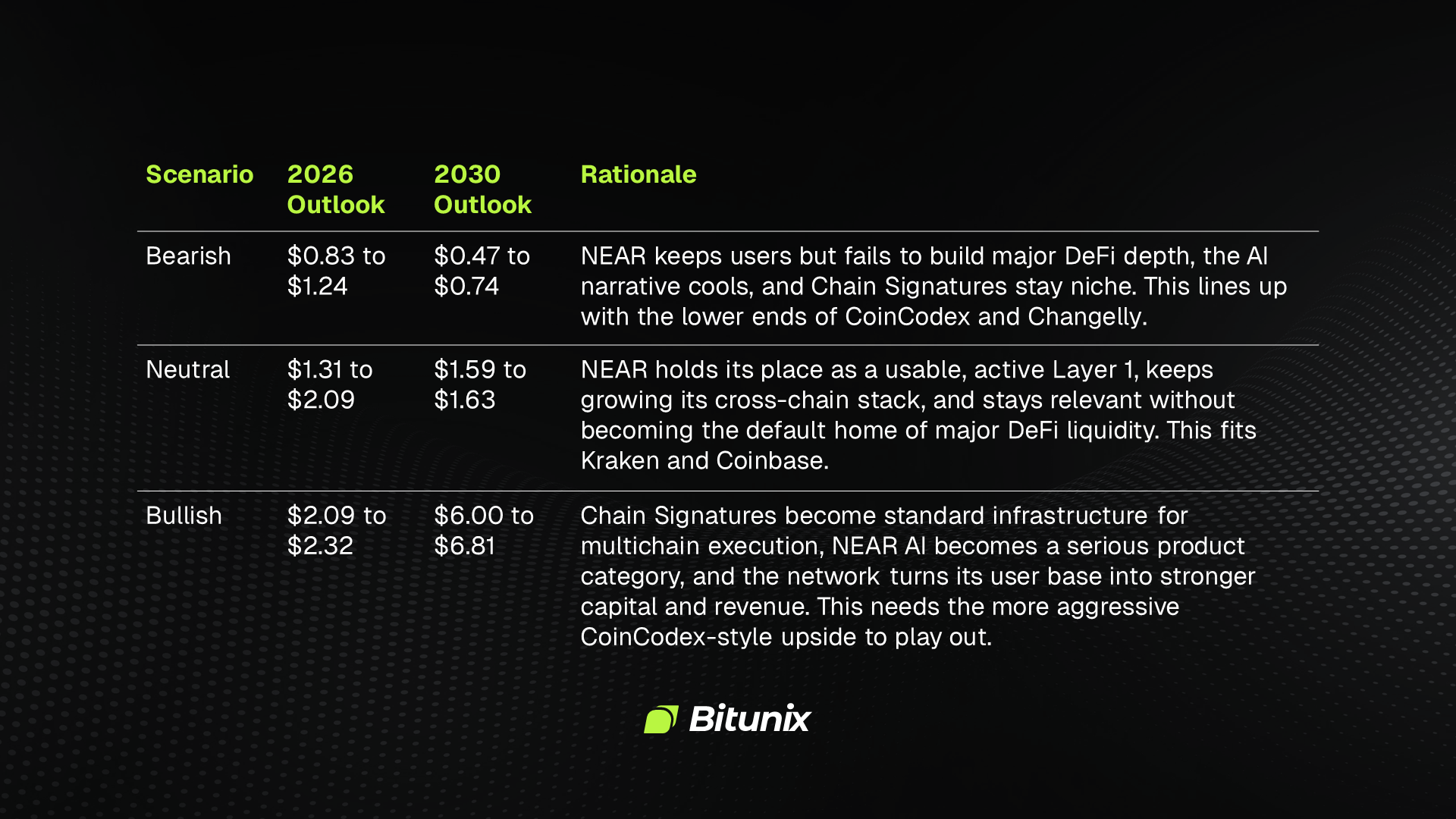
NEAR outlook table comparing bearish, neutral, and bullish scenarios for 2026 and 2030 based on user growth, DeFi depth, AI adoption, and cross-chain execution.
Conclusion: A Bet on the Future of Web3
NEAR is trying to become a clean operating layer for cross-chain apps, user-owned AI, and smoother consumer crypto experiences. That gives it a broader ambition than many competitors, and the technology stack supports that ambition better than most people assume. Nightshade sharding, human-readable accounts, gas sponsorship, and Chain Signatures all point toward making crypto feel less like infrastructure work.
The investment case is still a bet, though. You are betting that usability beats complexity, that abstraction beats tribal chain politics, and that NEAR's AI strategy becomes useful enough to matter economically. If that happens, today's market cap can look light. If it does not, NEAR can stay an interesting chain with modest token performance.
To trade that view directly, start by downloading the Bitunix app, then register to access NEAR/USDT spot and NEAR/USDT futures while tracking NEAR alongside the wider market.
FAQ Section
What is NEAR Protocol?
NEAR Protocol is a proof-of-stake Layer 1 blockchain built for scalability, developer access, and easier user onboarding. It supports smart contracts, named accounts, sharding, and cross-chain execution tools, with a growing focus on AI-native applications and chain abstraction.
How does Nightshade sharding work?
Nightshade splits network work across shards so validators do not all process every transaction. The protocol then combines shard output into one chain experience. NEAR's docs describe this as linear throughput scaling as validator count grows, which is the core of its scalability design.
What are NEAR Chain Signatures?
Chain Signatures allow a NEAR account, including a smart contract, to sign and execute transactions on other blockchains such as Bitcoin, Ethereum, and Solana. They use MPC and distributed node operators, so developers can build multichain apps without standard bridge patterns or wrapped tokens.
Why is NEAR associated with Artificial Intelligence?
NEAR's AI link comes from both the team and the product direction. Co-founder Illia Polosukhin co-authored Attention Is All You Need, and NEAR now positions itself as infrastructure for user-owned AI, private AI workloads, and AI agents that can transact across networks.
Is NEAR faster than Solana?
Not usually in raw performance terms. NEAR advertises about 1 to 2 seconds of deterministic finality and scalable sharding, while Solana still carries the stronger throughput narrative and much larger transaction volume.
What is the utility of the NEAR token?
NEAR is used for transaction fees, storage, staking, and exchange inside the network. The docs also describe it as the token that secures the network through staking, while 2026 tokenomics updates show new fee-sharing mechanisms around Intents denominated in NEAR.
How do human-readable account names work on NEAR?
NEAR supports named accounts rather than forcing users to rely solely on long hex-style addresses. The current docs use names like yourname.testnet as the default pattern, and the account model explains that users interact through these accounts, plus access keys and permissions.
What are the risks of investing in NEAR?
The biggest risks are weak DeFi depth relative to its user story, brutal competition from Solana and Ethereum L2s, and the chance that AI and Chain Signatures stay promising but niche. High usage does not automatically become high liquidity or stronger token demand.
Can I stake NEAR tokens?
Yes. NEAR is a proof-of-stake network, and holders can delegate tokens to staking pools to earn rewards while helping secure the network. Current guides and validator documentation still show staking through the wallet and delegation to available validators.
Where can I buy NEAR Protocol?
You can buy NEAR on centralized exchanges and then use it on-chain through NEAR wallets and apps. Bitunix currently offers both NEAR/USDT spot and NEAR/USDT futures, which gives traders direct market access from one platform.
Glossary
- NEAR crypto: The native token of the NEAR network, used for fees, staking, storage, and transfers.
- Nightshade sharding: NEAR’s sharding design, which spreads work across shards and scales throughput as validator count grows.
- Chain Signatures: A NEAR feature that lets NEAR accounts sign transactions for external blockchains.
- Ethereum Layer 2: A scaling network built on top of Ethereum that improves throughput and lowers costs while using Ethereum for settlement.
- MPC: Multi-Party Computation, the distributed signing method NEAR uses for Chain Signatures.
- Meta transactions: Transactions where a relayer can pay gas on behalf of the user.
- Human-readable accounts: NEAR account names like yourname.testnet that are easier to use than long wallet strings.
- Proof-of-Stake: The consensus model where validators secure the network by staking tokens instead of mining.
- DAU: Daily active users or addresses, a metric used to measure ongoing user activity on a network.
- TVL: Total value locked, the capital deposited into DeFi protocols on a chain.
- Deterministic finality: A transaction confirmation model where transactions become final within a defined timeframe without reorg uncertainty.
- Chain abstraction: NEAR's model for letting one account coordinate actions across multiple blockchains.
- Intents: A NEAR product layer where users specify a desired outcome and the system handles execution and routing.
- Storage staking: The mechanism that requires tokens to be locked according to the amount of contract data stored on NEAR.
- NEAR AI: The network's broader push into user-owned AI, verifiable AI infrastructure, and agent-based applications.
Disclaimer
This article does not provide:
(i) investment advice or investment recommendations;
(ii) an offer or solicitation to buy, sell, or hold digital assets;
(iii) financial, accounting, legal, or tax advice.
Digital assets, including stablecoins and NFTs, involve high risk and may fluctuate significantly. Consider whether trading or holding digital assets is appropriate for you given your financial situation. Consult a qualified legal, tax, or investment professional when needed. You are responsible for understanding and complying with applicable local laws and regulations.
About Bitunix
Bitunix is a global cryptocurrency derivatives exchange trusted by over 3 million users across more than 100 countries. At Bitunix, we are committed to providing a transparent, compliant, and secure trading environment for every user. Our platform features a fast registration process and a user-friendly verification system supported by mandatory KYC to ensure safety and compliance. With global standards of protection through Proof of Reserves (POR) and the Bitunix Care Fund, we prioritize user trust and fund security. The K-Line Ultra chart system delivers a seamless trading experience for both beginners and advanced traders, while leverage of up to 200x and deep liquidity make Bitunix one of the most dynamic platforms in the market.
Bitunix Global Accounts
X | Telegram Announcements | Telegram Global | CoinMarketCap | Instagram | Facebook | LinkedIn | Reddit | Medium