1. What Is LayerZero?
ZRO is the governance token of LayerZero, a cross-chain interoperability protocol. As one of the most representative cross-chain communication infrastructures in the Web3 ecosystem, LayerZero aims to solve the challenge of direct communication between different blockchains by providing developers with a universal framework for cross-chain message transmission.
Unlike traditional cross-chain bridges, which primarily focus on asset transfers, LayerZero emphasizes omnichain messaging capabilities. It enables different blockchains to transmit various types of information, including token transfers, smart contract calls, data synchronization, and cross-chain application interactions. This allows decentralized applications (dApps) to operate beyond the limitations of a single blockchain environment.
The creation of LayerZero was closely tied to the rapid growth of the multichain ecosystem. In 2021, LayerZero was founded by Canadian entrepreneurs Bryan Pellegrino, Ryan Zarick, and Caleb Banister. Before founding LayerZero, Bryan Pellegrino had been involved in artificial intelligence and machine learning projects. While exploring blockchain gaming and NFT applications, the team identified a major challenge: different blockchains lacked efficient communication capabilities, forcing developers to deploy applications separately across multiple networks while fragmenting user assets and liquidity.
Instead of creating another standalone blockchain, LayerZero took a different approach by building a communication protocol designed to connect existing blockchains and enable seamless interaction across networks.
Driven by growing demand for multichain infrastructure, LayerZero quickly attracted significant attention from the investment community. In 2022, LayerZero completed a Series A funding round led by a16z Crypto, followed by investments from major institutions including Sequoia Capital, FTX Ventures, and Binance Labs. The project raised more than $250 million in total funding and reached a valuation of approximately $3 billion at its peak.
These investments highlighted the market's recognition of the importance of cross-chain infrastructure and established LayerZero as one of the most closely watched foundational protocols in the evolving multichain ecosystem.

2. Omnichain Messaging Architecture: Redefining Cross-Chain Communication
LayerZero's core innovation lies in its Omnichain Messaging Protocol. Unlike traditional cross-chain bridges that rely on intermediary chains or liquidity pools to facilitate asset transfers, LayerZero adopts a lightweight communication model that enables information verification and transmission between different blockchains through three key components: Endpoints, Oracles, and Relayers.
Within the LayerZero architecture, each supported blockchain deploys an Endpoint, which serves as the entry point for on-chain applications to interact with the LayerZero protocol. When a user initiates a cross-chain request on one blockchain, the Endpoint generates the message that needs to be transmitted. The Oracle is responsible for providing block header information, while the Relayer delivers transaction data. Together, these two components enable cross-chain message verification.
This design differs significantly from early cross-chain bridges that relied on single validation nodes or multisignature mechanisms. LayerZero does not directly custody user assets; instead, it focuses on providing a messaging layer for cross-chain communication. In theory, this approach reduces security risks associated with centralized asset pools.
In addition, LayerZero introduced the Ultra Light Node (ULN) architecture, which aims to balance security and cost efficiency. Unlike traditional light nodes that require synchronization of large amounts of blockchain data, ULN only verifies essential information required for cross-chain communication. This allows LayerZero to reduce operational costs while maintaining security guarantees.
Through this architecture, LayerZero expands cross-chain functionality from simple "asset bridging" to "omnichain application communication," providing foundational infrastructure for a wide range of use cases, including DeFi, NFTs, gaming, and Real-World Assets (RWA).

Source: MetaLamp
3. LayerZero and the Multichain Ecosystem: Web3's Communication Layer
The rise of the multichain ecosystem has been a key factor behind LayerZero's rapid development. In the early stages of blockchain adoption, the market was primarily centered around individual Layer 1 networks. However, with the rapid growth of Layer 2 scaling solutions, application-specific chains, and specialized blockchain networks, the Web3 ecosystem has become increasingly fragmented.
Different blockchains offer unique advantages in terms of performance, security models, and user bases. However, many of these networks lack native communication capabilities, resulting in fragmented assets, liquidity, and application ecosystems across separate chains. LayerZero's core value lies in providing a universal communication layer that connects these independent blockchain networks.
At the application level, LayerZero has gradually become a key infrastructure component for multichain applications. DeFi protocols can leverage LayerZero for cross-chain liquidity management, NFT projects can use it for cross-chain asset transfers, and gaming projects can build unified player asset systems through cross-chain communication.
The Omnichain application model enabled by LayerZero allows developers to avoid building completely independent products on each blockchain. Instead, they can use cross-chain messaging to connect resources and users across multiple networks, reducing the complexity of multichain deployment while improving application composability.
This development model is reshaping the traditional view of blockchain networks as isolated ecosystems and pushing Web3 toward a more interconnected future. Rather than competing with individual blockchains, LayerZero positions itself as an underlying communication protocol serving the broader multichain ecosystem.
As more Layer 1 networks, Layer 2 solutions, and application-specific blockchains join the ecosystem, the importance of cross-chain communication infrastructure is expected to continue growing. LayerZero may play an increasingly important role in the emerging era of omnichain applications.
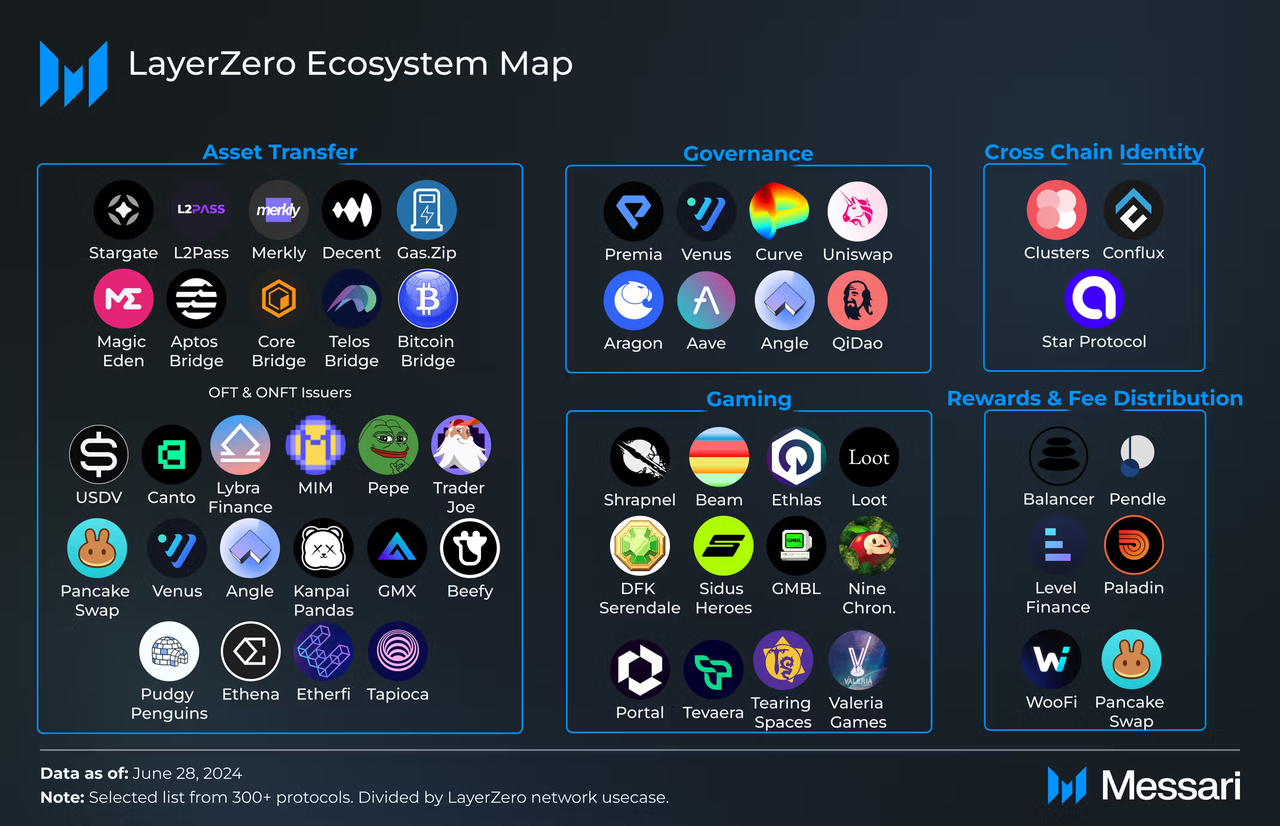
Source: Messari
4. ZRO Tokenomics: Governance and Protocol Value Capture
ZRO is the governance token of the LayerZero ecosystem. Its primary functions include participating in protocol governance, supporting community decision-making, and contributing to the long-term development of the LayerZero ecosystem.
Unlike some early cross-chain projects that relied on token incentives to attract liquidity and users, LayerZero's token model is more focused on infrastructure protocol governance. Since LayerZero does not directly manage asset pools, the value capture mechanism of ZRO is primarily linked to protocol adoption, network effects, and the development of future business models.
In terms of token distribution, ZRO has a total supply of 1 billion tokens. The allocation is distributed among different participants, including the community, ecosystem development initiatives, core contributors, and investors, supporting the long-term growth of LayerZero.
The community and ecosystem allocation represents a significant portion of the total supply, with the goal of encouraging developers, users, and ecosystem partners to participate in building the LayerZero network. As more applications adopt LayerZero for cross-chain communication, the protocol's network effects may continue to strengthen.
Additionally, LayerZero introduced the Proof of Donation mechanism as part of its governance design. This mechanism allows users to participate in token distribution through donations, linking token allocation with community contributions. The design aims to reduce short-term speculative behavior often associated with traditional airdrops while encouraging more long-term ecosystem participation.

Source: Datawallet
5. How to Acquire ZRO
Unlike some blockchain projects that generate tokens through mining or staking mechanisms, ZRO is not distributed through validator participation or on-chain consensus rewards. Instead, ZRO is allocated by LayerZero Labs according to its predefined token distribution model.
In June 2024, LayerZero officially launched the ZRO token and opened claims through a community distribution program for eligible users. The initiative was designed to reward early participants who contributed to the growth of the LayerZero ecosystem, including developers, users, and community contributors. For general investors, the most convenient way to acquire ZRO remains purchasing it directly through cryptocurrency exchanges.
By purchasing ZRO through centralized cryptocurrency exchanges such as Bitunix, users can access a trusted trading environment and buy crypto assets directly using fiat currencies or stablecoins such as USDT. Some platforms also support instant purchases via credit cards, further lowering the entry barrier for new users.
Before trading, users typically need to register an account and complete Know Your Customer (KYC) verification to comply with global Anti-Money Laundering (AML) and Counter-Terrorist Financing (CTF) requirements. Bitunix provides a comprehensive compliance and risk management framework, using measures such as cold and hot wallet separation, multi-signature security, and real-time monitoring systems to help protect user assets.
6. LayerZero Milestones Timeline
Date | Event | Description |
March 2021 | LayerZero Labs Founded | LayerZero was founded by Bryan Pellegrino, Ryan Zarick, and Caleb Banister to build a universal communication protocol designed for the emerging multichain ecosystem. |
March 2022 | Completed Series A Funding at a $1 Billion Valuation | LayerZero completed a $135 million funding round led by a16z Crypto, with participation from institutions including Sequoia Capital. The funding highlighted growing market interest in cross-chain communication infrastructure. |
December 2023 | LayerZero Supports More Than 50 Blockchains | With major networks such as Ethereum, BNB Chain, Arbitrum, Avalanche, and Polygon integrated into the ecosystem, LayerZero became an important communication layer for the multichain landscape. |
May 2024 | LayerZero V2 Officially Launches | LayerZero V2 introduced new architecture components, including Permissionless Executors and the Decentralized Verifier Network (DVN), improving the security, flexibility, and scalability of cross-chain message delivery. |
June 2024 | ZRO Token Officially Launched | LayerZero introduced its native governance token, ZRO, and opened claims through a community distribution program for early users and ecosystem contributors, marking the beginning of token-based governance. |
August 2025 | LayerZero Foundation Proposes Stargate Acquisition | LayerZero Foundation proposed acquiring Stargate, a cross-chain bridge protocol, along with its governance token STG, in a deal valued at approximately $110 million. |
May 2026 | LayerZero Upgrades Multi-Layer Security Mechanism | LayerZero Labs identified an internal RPC-related attack that affected certain DVN endpoints. The incident impacted approximately 0.14% of applications and 0.36% of asset value, leading to further improvements in its multi-layer security framework. |