RAY is the native token of Raydium, a decentralized trading and liquidity protocol built on Solana. As one of the largest DEXs in the Solana ecosystem, Raydium has evolved significantly since its launch in 2021 as an automated market maker (AMM) integrated with OpenBook. Today, the protocol offers a broader range of DeFi products and services, including token swaps, liquidity pools, concentrated liquidity, token launches, and perpetual futures.
Raydium is built on permissionless, non-custodial smart contracts, allowing users to trade tokens, provide liquidity, and access DeFi markets directly from their wallets without relying on a centralized intermediary. The protocol has also expanded beyond traditional crypto assets, participating in the growing market for tokenized stocks and other real-world assets on Solana.
Data Source: Dune
What Is Raydium? Understanding the Solana DEX
Raydium is a decentralized exchange (DEX) and automated market maker built on Solana. Unlike a centralized exchange, Raydium does not maintain a traditional custodial trading system where users deposit assets with a company. Instead, its smart contracts facilitate swaps and liquidity management directly on the blockchain.
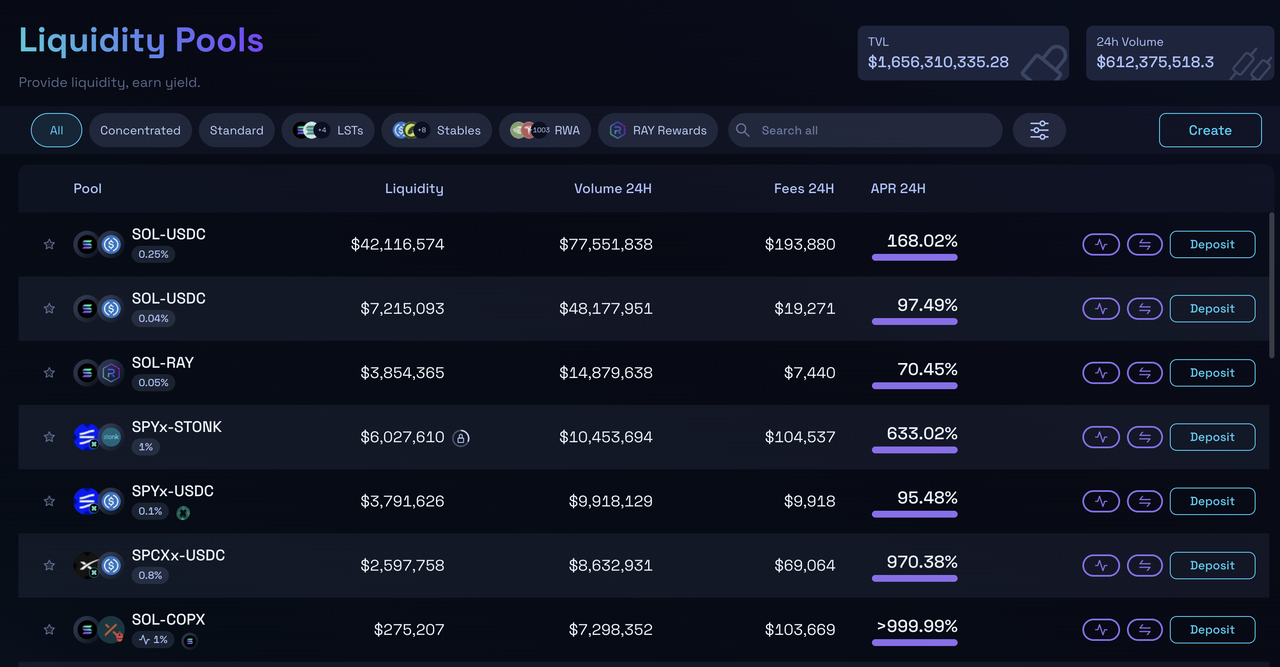
The protocol began with its original AMM in 2021 and has since added several pool designs. Today, Raydium supports AMM v4, CPMM and CLMM, each designed for different liquidity and trading requirements. CPMM has become the recommended default for many new pools, while CLMM allows liquidity providers to concentrate capital within specific price ranges.
Raydium is also more than a simple swap interface. Its ecosystem includes liquidity pools, token launches through LaunchLab and a perpetual futures interface powered by Orderly Network. This broader product suite has helped Raydium remain deeply integrated with the Solana DeFi ecosystem.
Data Source: Raydium
How Does Raydium Work?
Raydium uses automated market-making algorithms to determine prices and execute swaps. Instead of matching individual buyers and sellers through a traditional centralized order book, users trade against liquidity held inside smart-contract-controlled pools.
When a user swaps SOL for another token, for example, the transaction interacts with the relevant liquidity pool. The pool's pricing mechanism determines how many tokens the trader receives based on the pool's reserves, the selected fee tier and the size of the trade.
Liquidity providers contribute assets to these pools and receive a share of trading fees generated by the pool. This creates a market in which liquidity can be supplied without requiring a traditional market maker.
Raydium AMM and CPMM
Raydium's original AMM v4 uses constant-product pricing, based on the familiar x × y = k model. The amount of one asset in the pool and the amount of the other determine the exchange rate, with the invariant changing as trades and fees affect the pool.
AMM v4 originally integrated with OpenBook, allowing liquidity to interact with the Solana order-book ecosystem. However, that integration has since been deactivated. Current AMM v4 pools effectively operate as constant-product AMMs, while Raydium has shifted new development toward CPMM and CLMM.
CPMM, or Constant Product Market Maker, is Raydium's newer standard pool design. It retains the constant-product model while providing a more flexible and modern architecture, including native support for Token-2022 and configurable fee structures.
Concentrated Liquidity with CLMM
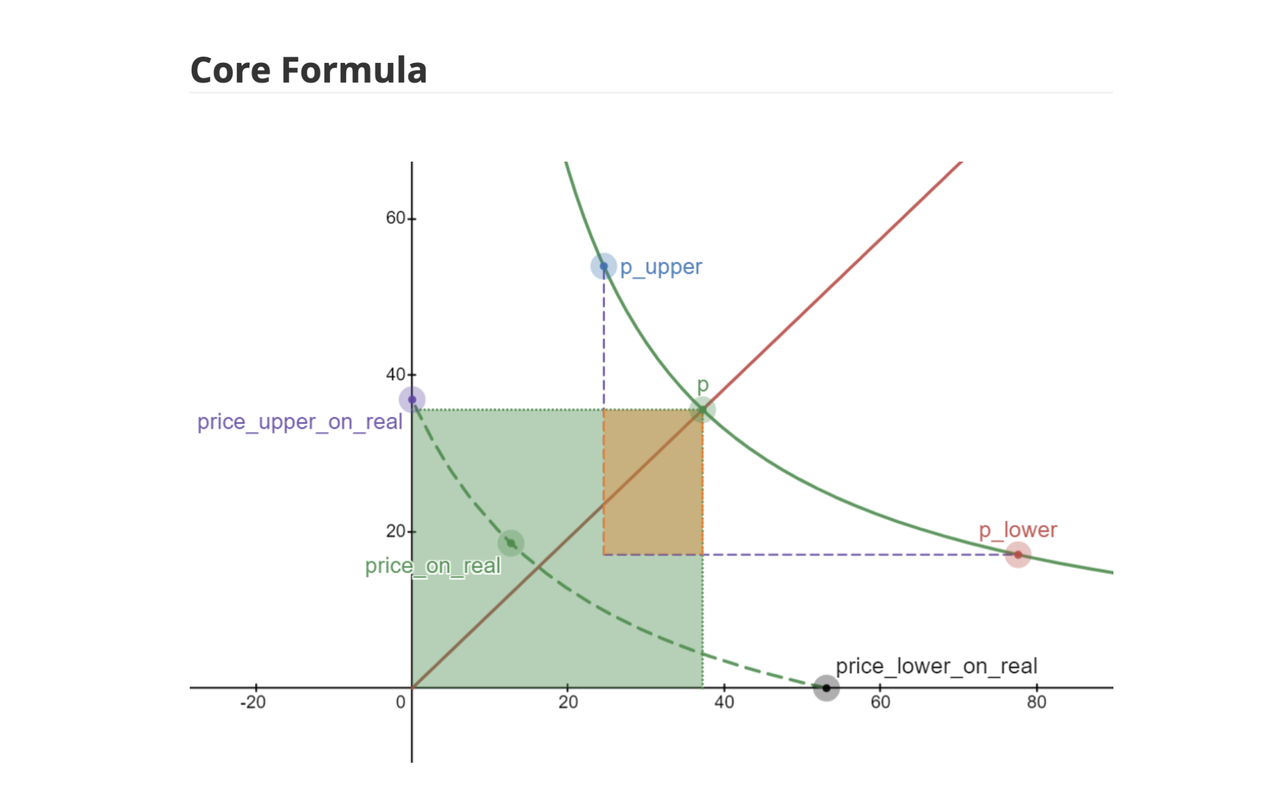
Raydium's CLMM, or Concentrated Liquidity Market Maker, takes a different approach to capital efficiency. In a traditional constant-product pool, liquidity is distributed across the entire possible price curve. Much of that liquidity may never be used if the asset trades within a relatively narrow range.
CLMM allows liquidity providers to select a specific price range. For example, an LP providing liquidity to a SOL/USDC pool could choose to concentrate capital around the price range where SOL is currently trading. This can make capital more efficient, although it also introduces additional management risks.
If the market moves outside an LP's selected range, that liquidity position may become inactive and stop earning trading fees until the price returns to the range or the LP adjusts the position.
Raydium Liquidity Pools and Swaps
Liquidity pools are the foundation of Raydium's trading infrastructure. Anyone can interact with permissionless pools, while liquidity providers can deposit supported assets and receive exposure to the fees generated by trading activity.
For traders, the process is relatively straightforward: connect a Solana-compatible wallet, select the token pair, enter the amount to swap and confirm the transaction. The Raydium interface then routes the transaction through the appropriate liquidity pool.
For liquidity providers, the economy is different. LPs earn a share of trading fees, but they also face risks such as impermanent loss, smart-contract risk and the possibility that a token becomes illiquid or loses value.
Data Source: Github
Raydium and Stonks: Bringing Tokenized Stocks Onchain
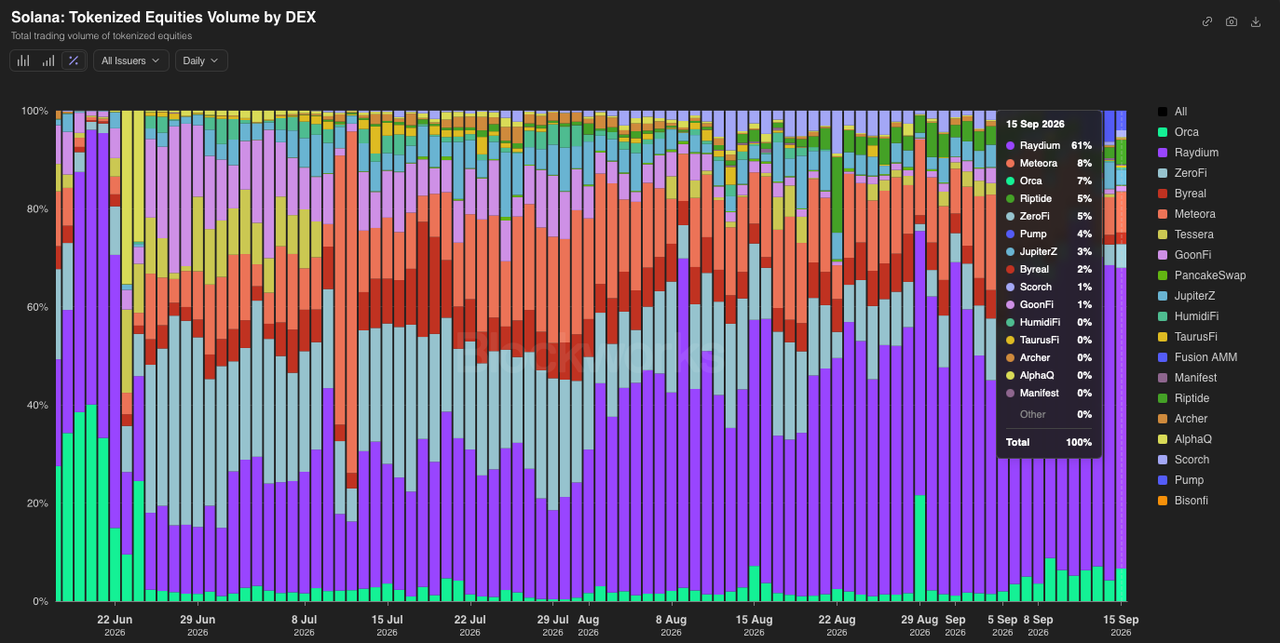
Raydium has also become part of the infrastructure connecting traditional financial assets with onchain markets through its collaboration with Stonks.
Stonks is a tokenized-stock platform focused on bringing equities and other real-world assets onto public blockchains. Its expansion into Solana has created a new use case for Raydium's liquidity infrastructure: allowing tokenized stocks to trade alongside crypto assets through decentralized liquidity pools.
The Stonks ecosystem has gained additional attention as the market for tokenized U.S. equities have expanded on Solana. Instead of restricting stock exposure to traditional brokerage hours and settlement systems, tokenized versions can be represented as blockchain assets and integrated with decentralized trading infrastructure.
For Raydium, this creates another potential source of trading activity and liquidity demand. Tokenized stocks can be paired with stablecoins or other crypto assets, allowing users to access equity-related markets through familiar DeFi interfaces.
Data Source: X
RAY Tokenomics: Supply, Utility, and Buybacks
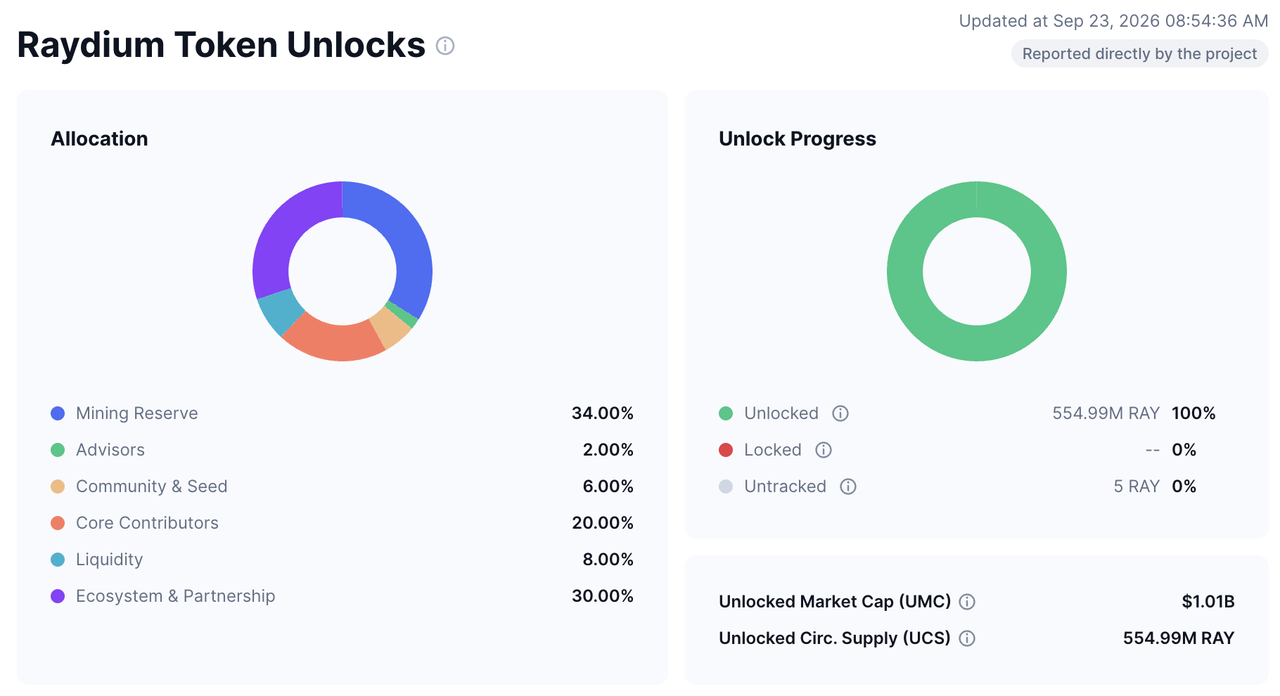
RAY is the native SPL token of the Raydium ecosystem. It has a maximum supply of 555 million RAY, and its mint authority has been disabled. RAY is used within the Raydium ecosystem for staking and governance-related functions, while its token economics are also directly connected to protocol trading activity.
The most important mechanism for RAY holders is the protocol's buyback program. A portion of trading fees generated by Raydium pools is used to purchase RAY on the open market.
Under the current fee structure, 12% of trading fees from CPMM and CLMM pools are allocated to RAY buybacks. The remaining fees are distributed between liquidity providers and the protocol treasury.
This creates a direct connection between Raydium's trading activity and RAY demand. Higher trading volume generates more fees, which can result in more RAY being purchased through the buyback mechanism. However, buybacks do not guarantee an increase in the RAY price, which remains subject to broader market conditions and token supply-demand dynamics.
Data Source: Coinmarketcap
RAY Price and Market Performance
RAY has experienced several major market cycles since its launch. The token reached an all-time high of approximately $16.83 on September 12, 2021, during the first major expansion of the Solana ecosystem. It subsequently suffered a prolonged decline during the 2022 bear market, reaching an all-time low of approximately $0.13 in December 2022.
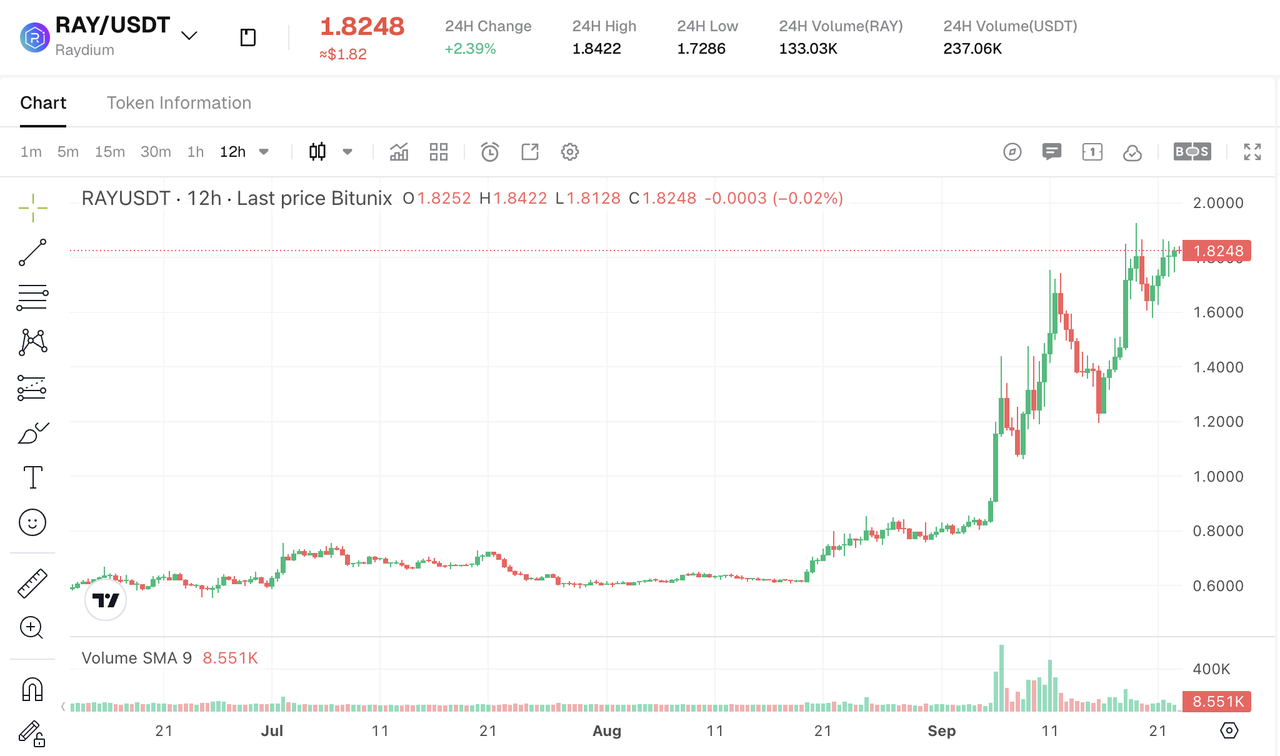
RAY recovered alongside the broader crypto market in 2023 and 2024. It closed 2024 at approximately $4.85 after gaining more than 250% during the year, before falling sharply in 2025 as the broader market weakened. The token has shown renewed volatility in 2026. RAY began September 2026 at around $0.82 and climbed rapidly during the first half of the month. It closed at approximately $1.29 on September 6 after gaining more than 40% in a single day, then reached a daily close of approximately $1.67 on September 11.
The rally coincided with increased activity across the Raydium ecosystem, including strong Solana DEX volume, increased meme-coin activity and growing interest in tokenized assets. RAY subsequently pulled back as market conditions changed. RAY therefore remains sensitive to both Solana ecosystem activity and broader crypto market conditions. Trading volume, liquidity growth, token launches, tokenized-stock activity and the protocol's buyback mechanism are among the factors that can influence its market performance.
Data Source: Bitunix
How to Buy RAY
Individual users can participate in the Raydium ecosystem by trading tokens, providing liquidity or using other onchain products. However, interacting with DeFi protocols carries smart-contract, liquidity and market risks, making these activities more suitable for users familiar with onchain trading. For users who prefer self-custody, RAY can be acquired through Solana-based decentralized exchanges such as Raydium. This approach requires a compatible Solana wallet and SOL to pay network fees. Users should always verify the official RAY mint address before making an onchain transaction.
Alternatively, users can purchase RAY via centralized exchanges like Bitunix, which acts as a trusted intermediary, supporting purchases with fiat or stablecoins such as USDT. Some platforms also allow instant credit card purchases, lowering the investment threshold. First-time users must register and complete identity verification (KYC) to comply with applicable anti-money laundering (AML) and counter-terrorism financing requirements. Before purchasing RAY, users should also verify the trading pair, deposit network and withdrawal network to avoid sending assets to an incompatible address.