You’ve made a successful trade, and now you want to move your crypto. Then you hit the withdrawal screen and see a fee. Annoying, confusing, and sometimes higher than you expected. If you’ve ever stared at that number like it personally insulted you, you’re not alone.
This is a common pain point on any crypto exchange. Fees look small until you withdraw often, withdraw on the wrong network, or move stablecoins through an expensive chain.
In this guide, you’ll learn how withdrawals work on Bitunix, what drives the cost, and three simple ways to shrink that cost on future transfers. You’ll also get a real table of current withdrawal fees so you can compare options quickly.
The Basics - What Are Bitunix Withdrawal Fees?
Trading Fees vs. Withdrawal Fees
First, separate two things that people mix up. Trading fees are what you pay to execute trades. They are usually a percentage, and they depend on your market, order type, and fee tier.
Withdrawal fees are different. They exist because moving funds on-chain is not free. Bitunix describes on-chain withdrawals as charging a network gas fee based on network conditions, and the calculation varies by blockchain. In other words, the withdrawal cost is mainly about paying the chain to process your transaction, not about paying for trading.
This is why Bitunix fees can feel low while trading, but withdrawals still cost something. Here’s a clean mental model: trading fees are platform costs; withdrawals are network costs.
To put the network part in a way easy to understand, BVNK explains it like this: "Network fees, often referred to as transaction fees, are essential payments made to incentivise miners or validators in the processing of transactions on the blockchain network."
What Determines the Fee?
Two big variables decide what you pay in crypto withdrawal fees.
Factor 1: The cryptocurrency itself
Withdrawing BTC won’t match withdrawing USDT. Different chains have different fee markets and different transaction sizes.
Factor 2: The network you choose
This is the lever you control most often. Many assets can be withdrawn on multiple networks. USDT is the classic example. You might see options like Ethereum (ERC-20), Tron (TRC-20), BSC (BEP-20), Arbitrum, and more. Each one has its own fee level.
The Strategy - How to Minimize Your Withdrawal Fees
Strategy 1: Choose the Right Network
This is the fastest way to save money. If you withdraw stablecoins, ERC-20 is often the priciest option. TRC-20 and BEP-20 are frequently cheaper, and L2 networks like Arbitrum or Optimism can also reduce costs depending on the asset. The comparison table below makes this difference obvious.
One warning that matters more than any fee tip: the receiving wallet must support the same network you select. If you send USDT on TRC-20 to an ERC-20-only address, you can lose access to those funds. Bitunix explicitly tells users to double-check the asset, network, and address before confirming.
If you want a refresher on where to select the network in the interface, use the withdrawal form.
Strategy 2: Withdraw Larger Amounts, Less Frequently
Most withdrawal fees are flat amounts for the asset you withdraw. That means the fee hurts more when you withdraw tiny amounts.
Simple math with a flat 1 USDT fee:
Withdraw 100 USDT, your effective cost is 1%
Withdraw 1,000 USDT, your effective cost is 0.1%
This is one of the easiest answers to how to reduce crypto fees without changing anything about your trading.
Strategy 3: Withdraw During Off-Peak Hours
Some networks, especially Ethereum, get more expensive when they are busy. Bitunix publishes fixed withdrawal fees for clarity, but it also notes that on-chain withdrawals depend on current network conditions and that the final fee should match what you see on the withdrawal page.
So while you won’t always see minute-by-minute changes inside the platform, it’s still smart to avoid times when the network is clogged, particularly if you’re deciding between Ethereum and an L2 alternative.
A Practical Comparison
The table below is based on the published fee schedule, last updated on January 15, 2026.
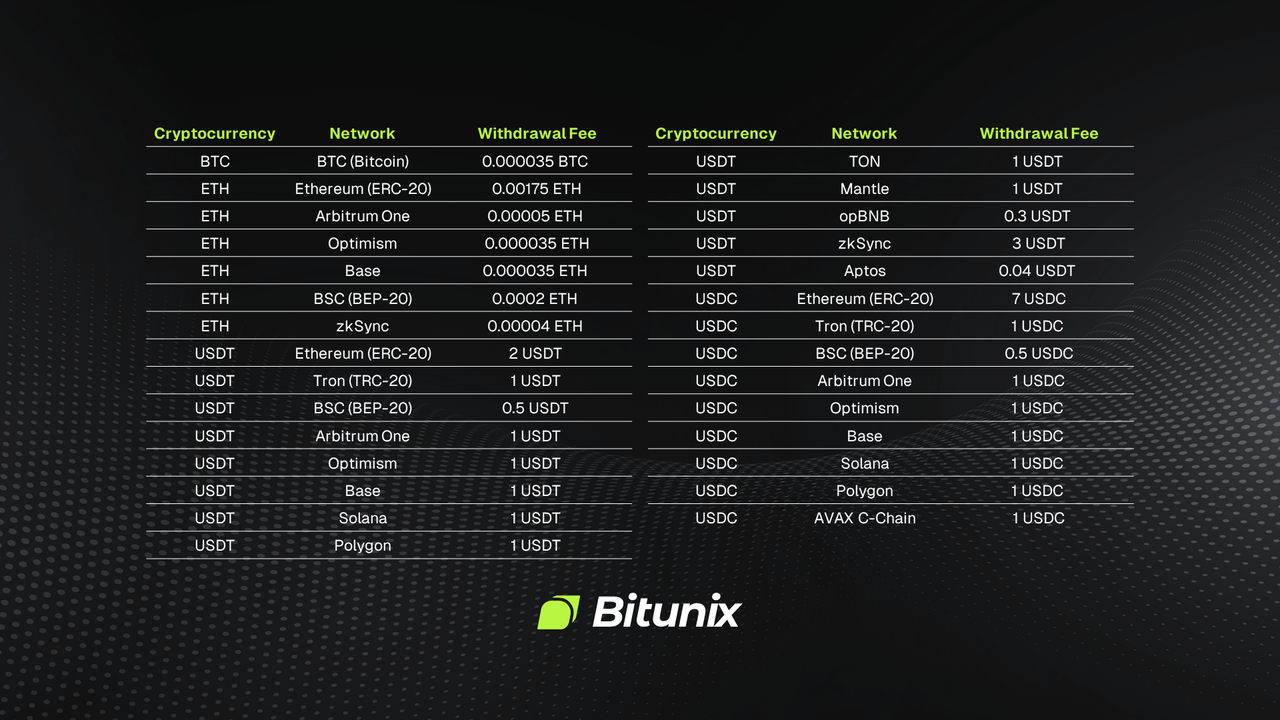
Bitunix also notes that the actual fee should be the one shown on the withdrawal page at the time you make the transfer.
The pattern is clear. The network choice often matters more than the coin, especially for stablecoins.
Conclusion: Withdraw Smarter, Not Harder
Understanding Bitunix withdrawal fees is a simple way to protect your balance. Most of the time, the cost is driven by the network you pick, and you can lower it by choosing a cheaper chain, withdrawing less often, and timing transfers when networks are quieter.
Before your next transfer, check the network options, confirm the receiving wallet supports that network, and keep more of your crypto.
Before your next transfer, check the network options. Make the smart choice and keep more of your crypto. Download the app, log in to Bitunix to see the withdrawal options for your favorite assets.