AI Bitcoin trading uses artificial intelligence and machine learning to analyze Bitcoin market data, identify potential trading patterns, generate forecasts, and support trading decisions. Depending on the system, AI may assist with market research, evaluate strategy performance, or work alongside automated software that places orders.
Notably, AI analysis, automated execution, and profitable trading are three different things. A model can identify a pattern without predicting the next price move correctly, and an automated strategy can lose money even when it follows its rules perfectly.
What Is AI Bitcoin Trading?
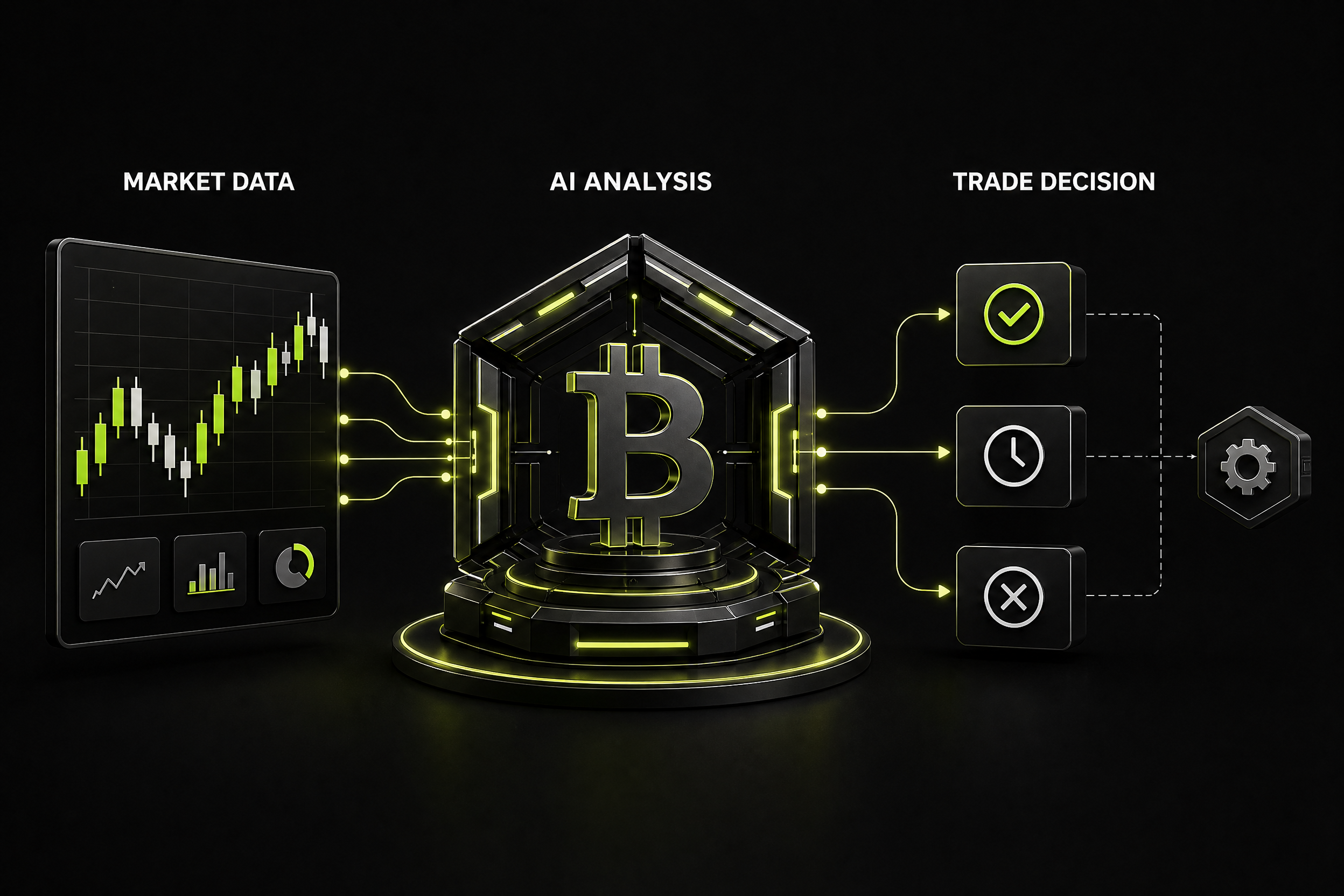
AI Bitcoin trading uses computational models to analyze market data and support trading decisions.
AI Bitcoin trading involves using computational models to analyze BTC market information and support decisions about when, how, or whether to trade. These systems range from analytical tools that produce forecasts to more complex workflows that connect model outputs with predefined execution rules.
The term covers several technologies, and not every tool marketed as an AI trading solution uses machine learning to make trading decisions.
How AI and Machine Learning Are Used in BTC Trading
Machine learning is a branch of AI in which models learn statistical patterns from data rather than relying exclusively on manually written rules. Depending on the application, a model might classify market conditions, estimate the probability of a price movement, identify unusual trading activity, or evaluate relationships between market variables.
For example, a model trained on historical BTC data could examine changes in trading volume, volatility, and momentum to estimate the likelihood of a particular short-term market condition. The output would be a model estimate, not a reliable prediction of what Bitcoin must do next.
Different approaches serve different purposes:
Supervised learning: Uses labeled historical examples to estimate outcomes, such as the probability that BTC returns will be positive over a defined period.
Unsupervised learning: Looks for clusters, recurring structures, or unusual observations without requiring predefined outcome labels.
Natural language processing (NLP): Processes text from news reports, announcements, and other sources to classify sentiment or extract relevant information.
The usefulness of these methods depends on the quality of their inputs, the way they are trained, and whether their assumptions remain valid in live markets.
AI Trading vs. Traditional Bitcoin Trading Bots
A conventional trading bot executes instructions written by a developer or trader. An AI-assisted system may use a learned model to evaluate data or adjust part of its decision process.
Feature | Rule-Based Bot | AI-Assisted Trading System |
Decision process | Follows predefined conditions | May use model-generated estimates or classifications |
Adaptability | Changes when rules or parameters are updated | May adapt through retraining or model updates |
Data requirements | Depends on the strategy | Often requires additional training and validation data |
Interpretability | Rules are generally easier to inspect | Model decisions may be difficult to explain |
Main limitation | Fixed rules can fail in new conditions | Model errors and overfitting can undermine performance |
These categories can overlap. An AI model might identify a potential trading opportunity, while a conventional algorithm handles order placement and position limits. A bot that uses technical indicators and automatic orders is not necessarily AI-powered.
AI-Assisted Analysis vs. Automated Trade Execution
AI analysis and trade execution are separate stages.
An analytical model can generate a market assessment without placing an order. An automated execution system can then use an approved signal to submit an order, subject to predefined rules. Alternatively, a trader can review the analysis and decide whether to act manually.
Separating these functions makes it easier to identify errors. A weak trading result might come from an inaccurate model, an unsuitable strategy, poor order execution, or a combination of factors.
How AI Analyzes Bitcoin Market Data
AI models need relevant inputs to produce useful outputs. For BTC trading, these inputs may include historical prices, market activity, order book information, public sentiment, and blockchain data. The value of each input depends on the trading horizon and the question the model is designed to answer.
Price History, Volume, and Technical Indicators
Historical market data provides a foundation for identifying patterns and testing trading hypotheses. Common inputs include:
Price returns: Measure how BTC changes over a defined period.
Trading volume: Helps assess the level of market activity accompanying a price move.
Volatility: Measures the magnitude of price fluctuations over a particular window.
Moving averages: Summarize price trends over selected periods.
Relative Strength Index (RSI): Measures recent price momentum and can help classify market conditions.
AI models can combine these variables to identify statistical relationships that may be difficult to evaluate manually across large datasets.
However, a historical relationship is not proof of a repeatable trading opportunity. Technical indicators are derived from market data, so combining several indicators does not necessarily provide independent confirmation. A strategy still needs to be tested against unseen data and realistic trading costs.
Order Book Data and Market Liquidity
Order book data shows outstanding buy and sell orders at different price levels. Depending on the data available, a model can examine bid-ask spreads, displayed liquidity, order book imbalances, and changes in market depth.
For example, a substantial imbalance between displayed bids and asks may indicate short-term buying or selling pressure. Yet the order book represents available orders at a particular moment, not guaranteed future demand. Orders can be canceled, liquidity can disappear, and large trades can move prices.
Execution conditions also matter. A strategy that appears effective using historical closing prices may perform differently when actual orders encounter spreads, slippage, partial fills, or limited liquidity.
News, Social Sentiment, and On-Chain Metrics
Bitcoin prices can respond to regulatory developments, macroeconomic announcements, exchange-related news, and shifts in market expectations. AI can help process large volumes of text and classify information by topic or sentiment.
On-chain data provides another perspective. Depending on the metric, it may help describe wallet activity, transaction flows, or movements of BTC between addresses and services.
These sources require careful interpretation:
Positive sentiment does not necessarily lead to higher prices.
Social media posts can be misleading, duplicated, coordinated, or published after a market move has already begun.
Blockchain addresses do not automatically reveal the identities or intentions of their owners.
Large transfers do not, by themselves, establish whether an investor intends to buy or sell.
Sentiment and on-chain indicators are most useful when treated as contextual inputs rather than standalone trading signals.
Machine Learning Models and BTC Price Forecasts
A predictive model estimates an outcome based on patterns in its training data. For Bitcoin, this might involve forecasting a return range, estimating volatility, or classifying the probability of an upward or downward move over a specified horizon.
The forecast must be evaluated against an appropriate benchmark. A model that predicts the general direction of BTC correctly may still produce poor trading results if it reacts too slowly, generates excessive trades, or fails to account for transaction costs.
Model accuracy also depends on the evaluation method. A model can perform well on historical data because it has learned patterns specific to that period. Its results may deteriorate when liquidity, volatility, market participants, or broader economic conditions change.
Common Applications of AI in Bitcoin Trading
AI can support different parts of a trading workflow. The appropriate application depends on whether the goal is to understand the market, develop a strategy, or automate an established process.
Trend and Volatility Analysis
AI models can classify market conditions using variables such as price momentum, realized volatility, volume, and trend strength.
A system might distinguish between trending and range-bound periods, then help a trader assess whether a trend-following or range-based strategy is worth testing. Such classifications are estimates rather than guarantees, and a market can change conditions before the model detects the transition.
Strategy Development and Backtesting
AI assistants can help traders explain technical indicators, generate code drafts, organize historical data, or review strategy logic. Machine learning can also be used to develop models that generate signals from historical observations.
Backtesting evaluates how a strategy would have performed on historical data under specified assumptions. It can help identify weaknesses, but its results are only as reliable as the data and execution assumptions used.
A useful test should account for fees, slippage, funding costs where applicable, and the possibility that historical data contains information that would not have been available at the time of a simulated trade.
Trade Execution and Position Monitoring
Automated execution systems can submit orders when predefined conditions are met. Depending on their configuration, they may also monitor open positions, apply stop-loss or take-profit rules, and record trading activity.
AI may contribute by classifying market conditions or adjusting model-generated signals. The execution layer still needs explicit controls for order size, maximum exposure, API failures, and unexpected market behavior.
Automation reduces the need for continuous manual order entry, but it does not remove the need to monitor the system.
Market Sentiment Analysis and Scenario Assessment
AI tools can summarize news, organize information by subject, and compare possible market scenarios. For example, a trader might use an AI assistant to examine how a macroeconomic announcement could affect market expectations, then verify the underlying facts using primary sources.
This is different from allowing a language model to invent a price target or make an unsupported trading recommendation. Generated summaries and interpretations can contain errors, so material claims should be checked against reliable sources before they influence a trading decision.
How to Build and Test an AI-Assisted BTC Trading Strategy
A practical AI trading workflow begins with a testable hypothesis, not a prediction that Bitcoin will move in a particular direction.
Define the Strategy and Its Inputs
First, specify the market condition the strategy is intended to identify. For example, the hypothesis might be that a combination of momentum and volume helps distinguish sustained price moves from short-lived fluctuations.
Document the following:
The BTC market and trading timeframe.
The data inputs and how frequently they are updated.
The model output or entry condition.
The rules for entering and exiting a position.
The maximum position size and acceptable risk exposure.
Keep the initial design simple enough to evaluate. Adding more indicators or model parameters can make a strategy harder to interpret without necessarily improving its performance.
Backtest Against Historical Data
Apply the strategy to historical observations and simulate its decisions using consistent rules. Check whether the results remain plausible after accounting for trading fees, spreads, slippage, and other relevant costs.
Avoid look-ahead bias, which occurs when a strategy uses information that would not have been available at the time of a simulated decision. Also avoid data leakage between training and evaluation datasets.
A backtest is useful for finding weaknesses, not for proving that future returns will match historical results.
Validate With Out-of-Sample Data and Paper Trading
After developing the strategy on one dataset, evaluate it on data that was not used to train or tune the model. This helps test whether the model has learned a more general relationship rather than memorized historical patterns.
Paper trading can provide an additional check of how the workflow behaves under current market conditions without placing live orders. It can reveal issues involving data updates, signal timing, order logic, and monitoring.
Simulated execution still differs from live trading. Paper trading may not fully reproduce actual slippage, liquidity constraints, partial fills, or the psychological pressures of trading real funds.
Evaluate Drawdown, Fees, Slippage, and Execution
Win rate alone is not a sufficient measure of a strategy's quality. Review several metrics together:
Net return: Performance after applicable trading costs.
Maximum drawdown: The largest peak-to-trough decline in the evaluated period.
Profit factor: Gross profits divided by gross losses, where the metric is appropriate to the dataset.
Trade frequency: The number of trades and the costs generated by that activity.
Execution quality: Differences between assumed and actual fill prices, including slippage.
Compare results across different market conditions. A strategy that performs well during a sustained uptrend may struggle during a sideways market or a sharp sell-off.
Monitor Performance and Set Risk Controls
If a strategy progresses to live use, define the controls before enabling automated execution. These may include position limits, maximum loss thresholds, stop conditions, API permission restrictions, and alerts for unexpected behavior.
Monitor both the trading results and the system itself. Missing data, stale signals, API errors, or unexpected order behavior should trigger investigation rather than automatic continuation.
A model that once performed well may need to be recalibrated, paused, or retired when its assumptions no longer hold.
Example: Applying AI to a BTC Trading Strategy
Consider a hypothetical BTC scalping strategy that uses a five-minute chart. Its purpose is to evaluate whether a combination of momentum and price behavior around a volume-weighted average price (VWAP) can identify potential short-term setups.
The following example illustrates a testing process. It does not represent a validated or recommended trading strategy.
Combine Market Signals Into a Trading Hypothesis
The strategy begins with three inputs:
RSI to measure recent momentum.
MACD to assess changes in momentum.
VWAP to compare the current price with a volume-weighted reference price.
A model could evaluate these variables alongside recent volatility and trading volume to classify potential market conditions. The output might indicate that a setup meets the strategy's predefined criteria, but it does not establish that the next price move will be profitable.
Define Entry, Exit, and Risk Rules
Before testing, specify the exact conditions for opening a position, invalidating a setup, and closing a trade. If leverage is included in the simulation, define the maximum exposure and account for liquidation risk, trading costs, and funding costs where applicable.
Do not assume that an indicator combination automatically creates an advantage. The rules must be evaluated against historical data and realistic execution assumptions.
Test the Strategy and Interpret the Results
Run the strategy on historical BTC data, then evaluate it on a separate period. Compare net returns, drawdowns, trade frequency, and execution assumptions with a suitable baseline.
If the model performs poorly outside its training period, the result may indicate overfitting or a relationship that does not persist across market conditions. The appropriate response is to investigate the weakness, not simply add more parameters until the historical results improve.
The key lesson is that AI can help formalize and evaluate a trading hypothesis. Whether that hypothesis has practical value depends on evidence from testing, costs, and ongoing monitoring.
Benefits and Limitations of AI Bitcoin Trading
AI can improve the efficiency of market research and strategy evaluation, but its usefulness depends on how the technology is designed and deployed.
Where AI Can Improve Trading Workflows
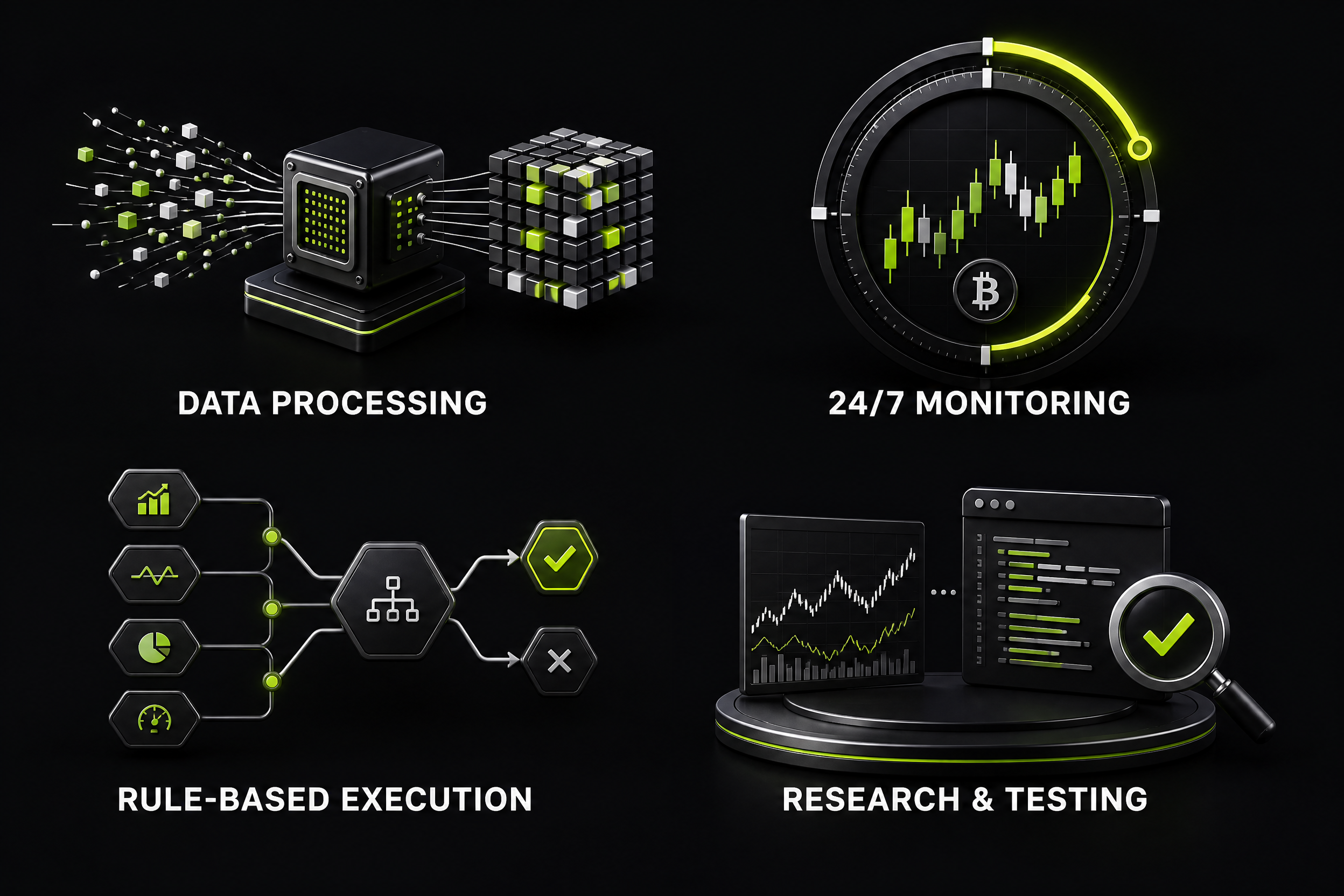
Four ways AI can improve crypto trading workflows, from data processing to research and testing.
Processing large datasets: Models can evaluate many observations and variables more consistently than manual review alone.
Continuous monitoring: Software can monitor markets around the clock, although its reliability depends on data feeds, connectivity, and system availability.
Consistent rule application: Automated systems can apply predefined conditions without the same emotional impulses that affect human traders. They can still make systematic errors when the rules or model outputs are flawed.
Faster research and testing: AI assistants can help organize research, explain technical concepts, and draft code for further review. Generated code and analysis still require testing.
These benefits concern workflow and decision support. They do not establish that an AI-based strategy will outperform a human trader or a simpler algorithm.
Prediction Errors, Overfitting, and Changing Market Conditions
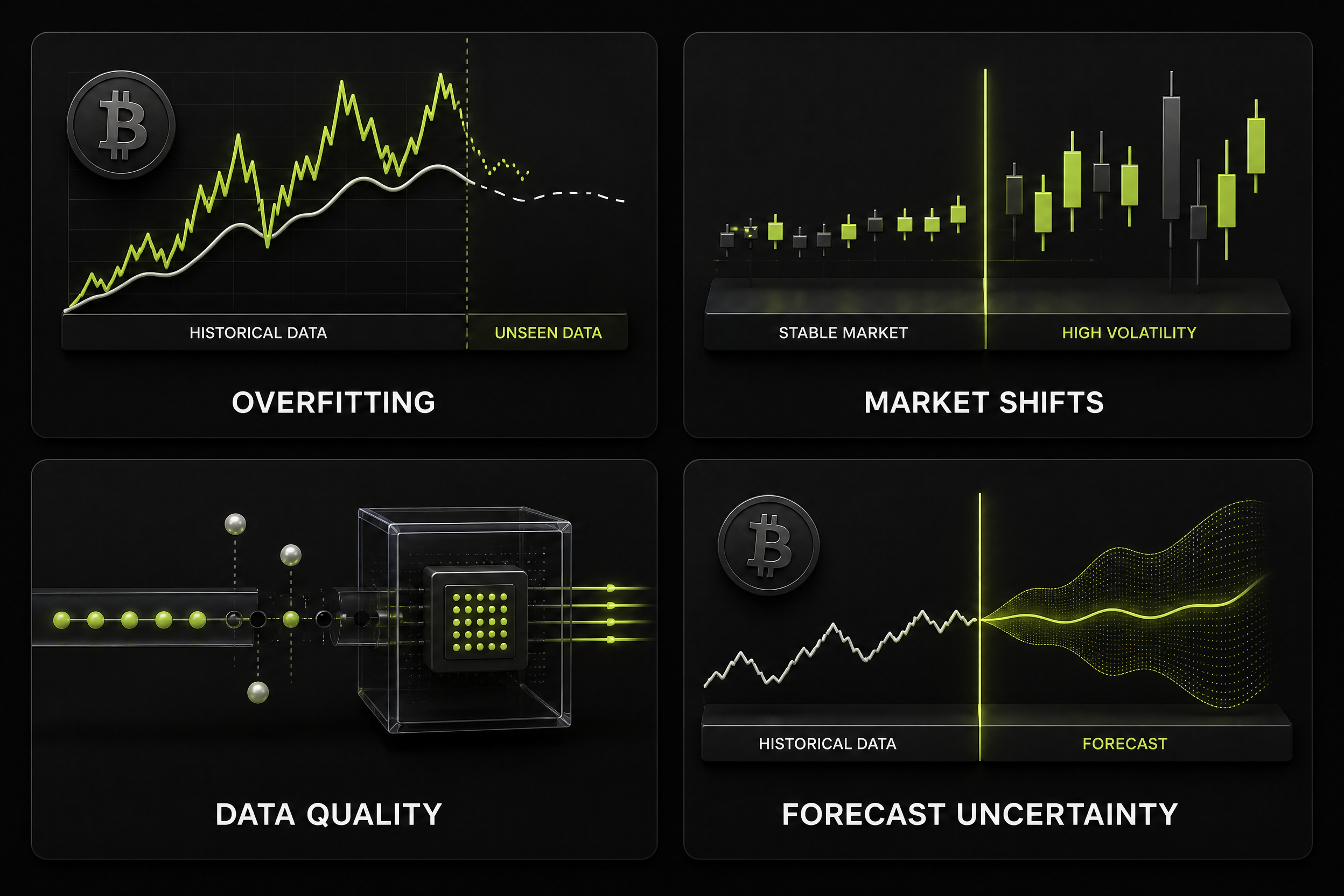
Four factors that can undermine AI Bitcoin price predictions, from overfitting to changing market conditions.
AI systems can fail for several reasons.
Overfitting: A model learns noise or patterns specific to historical data rather than relationships that persist.
Regime changes: Market behavior changes as volatility, liquidity, regulation, and macroeconomic conditions evolve.
Unreliable inputs: Incorrect, delayed, or incomplete data can distort the model's output.
False confidence: A precise-looking forecast may create the impression of certainty even when its underlying evidence is weak.
No model can reliably account for every unexpected market event. Predictions should be interpreted as estimates under specific assumptions, not as promises about future BTC prices.
API Failures, Slippage, and Model Security
Automated systems also face operational risks. An exchange connection may fail, an order may be rejected, or a rapidly moving market may produce a fill far from the expected price. An API integration may also expose an account to security risks if its credentials are mishandled.
Third-party services introduce additional considerations, including data access, software reliability, account permissions, and the transparency of the provider's strategy.
Never grant withdrawal permissions to a trading bot unless there is a specific, independently justified need and the associated risks are understood. For ordinary trading integrations, use the minimum permissions required and protect API credentials.
Why Human Oversight Still Matters
Human oversight is needed to evaluate assumptions, review unusual results, and decide when a strategy should be paused. A trader should understand what the model is intended to do, what evidence supports its use, and which conditions could make its output unreliable.
AI can assist with analysis and execution, but responsibility for system configuration, account security, and risk limits remains with the person or organization operating it.
How to Evaluate AI Bitcoin Trading Tools
Choosing an AI trading tool requires more than comparing advertised returns or counting available indicators.
Data Quality and Model Transparency
Check which data the tool uses, how frequently it updates, and whether it explains its outputs. If the provider does not disclose enough information to evaluate the model's methodology, treat performance claims cautiously.
A tool should not be considered reliable solely because it uses terms such as machine learning, deep learning, or predictive analytics.
Testing Features and Performance Reporting
Look for meaningful testing capabilities, clearly defined performance metrics, and explanations of the assumptions behind reported results. Determine whether the figures are based on backtests, paper trading, or live performance.
Be cautious of claims that cannot be independently evaluated, especially promises of guaranteed income or unusually consistent returns.
API Permissions and Account Security
For tools that connect to an exchange, review the required API permissions, credential storage practices, and available account security controls. Use restricted API keys where supported and avoid sharing account credentials directly.
Also establish how the system responds to connection failures, rejected orders, or missing market data.
Fees, Supported Markets, and Platform Compatibility
Check whether the tool supports the BTC markets you intend to analyze, which exchanges and order types it can access, and whether it charges subscription or execution-related fees.
Compatibility should be confirmed using current product documentation. A tool that supports a particular exchange in general may not support every market, feature, account type, or region.