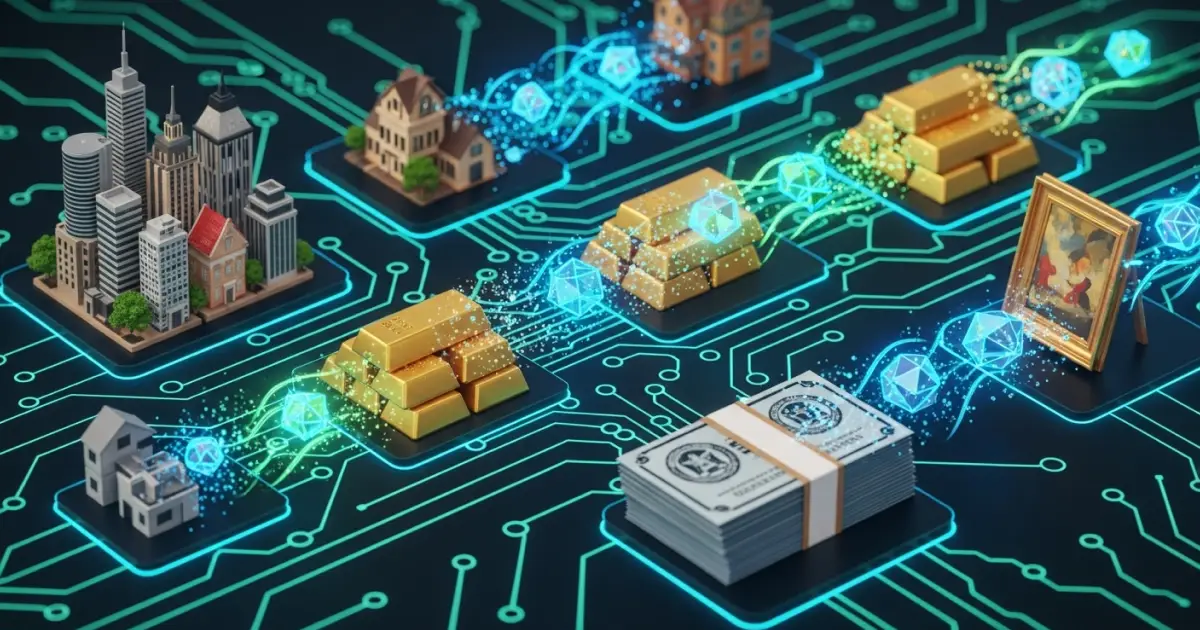
Traditional finance and blockchain are moving closer together as more real world assets (RWA) are being represented on-chain. Through tokenization, assets such as government bonds, real estate, commodities, private credit, and funds can be converted into blockchain-based tokens that represent ownership rights or financial claims.
RWA tokenization creates a connection between traditional asset markets and decentralized infrastructure. By bringing real-world value onto blockchain networks, tokenized assets can improve transparency, automate transactions, and create new ways to access financial products.
The growth of RWA has accelerated as financial institutions, asset managers, and blockchain protocols explore how tokenization can modernize existing financial systems. At the same time, challenges around regulation, custody, liquidity, and smart contract security remain important factors for long-term adoption.
This guide explains what RWA tokenization is, how it works, which assets can be tokenized, why institutions are exploring the sector, and what risks users should understand before participating.
What Is Real World Asset (RWA) Tokenization?

Real world asset (RWA) tokenization is the process of representing a physical or traditional financial asset as a digital token on a blockchain.
These assets exist outside blockchain networks but can be represented digitally through tokens that record ownership rights, claims, or participation in the underlying asset.
Examples of assets that can be tokenized include:
Unlike cryptocurrencies such as Bitcoin or Ethereum, which are created and operate natively on blockchain networks, RWAs connect blockchain technology with existing financial markets.
RWA Tokenization vs Traditional Assets vs Crypto Assets

Understanding the difference between asset types helps explain why RWA has attracted attention from both financial institutions and blockchain developers.
Asset Type | Source of Value | Ownership Record | Market Access |
|---|
Traditional Assets | Physical or financial value outside blockchain | Legal documents and traditional systems | Often limited by market hours and intermediaries |
Crypto Native Assets | Blockchain networks and digital scarcity | On-chain ownership records | 24/7 digital markets |
Tokenized RWAs | Real-world assets represented through blockchain tokens | Combination of legal rights and blockchain records | Potentially broader digital access |
A tokenized asset does not automatically remove all traditional financial processes. The legal relationship between the token and the underlying asset depends on the structure created by issuers, custodians, and regulators.
How Does RWA Tokenization Work?

RWA tokenization requires coordination between legal frameworks, financial structures, and blockchain technology.
The token itself is only one part of the system. A successful tokenization model must ensure that the digital representation accurately reflects the underlying asset.
The 6-Step RWA Tokenization Process
1. Asset Selection and Legal Structuring
The process begins by selecting an asset suitable for tokenization.
Before creating tokens, issuers need to define:
What rights the token represents
Who legally owns the underlying asset
How investors receive economic benefits
What obligations apply to each party
Legal clarity is one of the most important foundations of RWA projects.
2. Asset Due Diligence and Valuation
The underlying asset must be reviewed and valued before token issuance.
This process may involve:
Asset verification
Ownership confirmation
Professional valuation
Risk assessment
The valuation determines important factors such as token supply and pricing structure.
3. Token Creation and Smart Contract Deployment
Once the legal structure is established, blockchain infrastructure is used to create digital tokens.
Smart contracts can define:
Token ownership records
Transfer rules
Distribution mechanisms
Compliance requirements
The design depends on the type of asset and regulatory requirements.
4. Oracle Integration and Data Verification
Many RWA systems require external data to connect blockchain records with real-world information.
Oracles can provide data such as:
Asset prices
Interest rates
Market information
Valuation updates
Reliable data feeds help maintain consistency between the token and the underlying asset.
5. Distribution and Secondary Markets
After issuance, tokens can be distributed to eligible participants.
Depending on the structure, tokenized assets may become available through:
Digital asset platforms
Institutional markets
Secondary trading venues
Liquidity depends on market demand, regulatory permissions, and available trading infrastructure.
6. Ongoing Asset Management and Compliance
Tokenization does not end after issuance.
Ongoing management may include:
Regulatory reporting
Asset monitoring
Investor communication
Corporate actions
Redemption processes
The quality of these operational systems can directly affect investor confidence.
What Types of Assets Can Be Tokenized?

The range of potential RWAs continues to expand, but several categories have gained significant attention.
Tokenized Treasury Bills and Government Bonds
Government securities are among the most discussed RWA categories.
Tokenized Treasury products aim to bring traditional fixed-income assets onto blockchain networks, allowing eligible users to access digital representations of government-backed debt instruments.
Potential benefits include:
Real Estate Tokenization
Real estate is one of the most commonly discussed use cases for RWA.
Traditional property markets often involve:
Tokenization can divide ownership interests into smaller digital units, potentially allowing broader participation.
Important factors include:
Commodity-Backed Tokens
Commodities such as gold and other physical assets can also be represented through blockchain tokens.
These products aim to combine:
Users should evaluate custody arrangements and verification methods before considering any commodity-backed token.
Private Credit and Business Loans
Private credit has become another major RWA category.
Tokenized private credit products can connect investors with lending opportunities backed by real-world business activity.
Key considerations include:
Tokenized Funds and Securities
Investment funds and securities are increasingly being explored for tokenization.
Potential advantages include:
The regulatory treatment of these products varies significantly across jurisdictions.
Intellectual Property and Collectibles
Some projects are exploring tokenization of:
These markets often require additional attention because valuation and ownership verification can be more complex.
Benefits of RWA Tokenization

RWA tokenization aims to address some limitations of traditional asset markets by combining real-world value with blockchain infrastructure.
However, the actual benefits depend on factors such as regulatory frameworks, market adoption, asset structure, and supporting infrastructure.
Improved Accessibility and Fractional Ownership
Many traditional assets require significant capital to access.
For example:
Real estate often requires large upfront investments.
Private credit opportunities may be limited to institutional investors.
Certain financial products have high participation barriers.
Tokenization can divide ownership interests into smaller digital units, potentially allowing broader participation.
However, accessibility still depends on:
Tokenization improves the technical ability to represent ownership, but it does not automatically remove legal or regulatory restrictions.
Greater Transparency Through Blockchain Records
Blockchain networks provide publicly verifiable records of transactions and ownership activity.
Potential advantages include:
Easier transaction tracking
Improved record management
Reduced dependence on manual reconciliation
More transparent asset movements
For institutions managing complex assets, blockchain-based records may improve operational efficiency.
Faster Settlement and Operational Efficiency
Traditional financial transactions often involve multiple intermediaries, manual processes, and settlement delays.
Blockchain-based systems can potentially streamline:
Asset transfers
Ownership updates
Payment distribution
Reporting processes
Smart contracts may automate certain functions, such as:
Dividend distribution
Interest payments
Compliance checks
The actual efficiency improvement depends on how blockchain systems integrate with existing financial infrastructure.
Increased Market Liquidity Potential
Some assets, such as real estate and private credit, are traditionally difficult to trade.
Tokenization may create new possibilities for:
Secondary markets
Smaller ownership units
Digital settlement
However, tokenization alone does not guarantee liquidity.
A tokenized asset still requires:
Programmable Financial Assets
One of blockchain’s unique advantages is programmability.
Tokenized assets can potentially support automated financial functions, including:
This creates possibilities for new financial products that combine traditional assets with blockchain-based services.
Institutional Adoption of RWA
RWA has attracted growing attention from financial institutions because tokenization may improve how traditional assets are issued, managed, and distributed.
Several major players have explored blockchain-based financial products.
Tokenized Treasury and Fund Products
Institutional interest has focused heavily on tokenized government securities and money market products.
These products aim to provide digital access to traditional fixed-income assets while maintaining connections with regulated financial markets.
Potential advantages include:
Asset Managers Exploring Tokenization
Large asset managers have investigated tokenized funds as part of broader digital asset strategies.
The focus has generally been on:
The goal is not necessarily to replace traditional finance, but to improve existing financial processes.
Blockchain Networks Supporting RWA Growth
Multiple blockchain ecosystems are positioning themselves as infrastructure layers for tokenized assets.
Key requirements include:
The long-term success of RWA depends not only on token creation but also on the supporting financial ecosystem.
Top RWA Platforms and Protocols in 2026
The RWA ecosystem includes blockchain protocols, asset issuers, and infrastructure providers focused on bringing traditional assets on-chain.
Different platforms specialize in different asset categories, including tokenized funds, private credit, real estate, and institutional financial products.
Platform / Protocol | Focus Area | Key Role |
|---|
Ondo Finance | Tokenized Treasury products | Provides blockchain-based access to traditional fixed-income assets |
Centrifuge | Asset financing and private credit | Enables businesses to bring real-world assets on-chain |
MakerDAO | RWA-backed collateral | Uses real-world assets as part of its collateral strategy |
Goldfinch | Credit markets | Focuses on lending models connected to real-world borrowers |
Maple Finance | Institutional credit | Provides blockchain-based lending infrastructure |
BlackRock BUIDL | Tokenized fund products | Represents institutional exploration of tokenized assets |
How to Evaluate an RWA Project
Not all tokenized assets have the same structure or risk profile.
Before evaluating an RWA project, consider the following factors.
1. Understand What the Token Represents
The most important question:
What rights does the token actually provide?
A token may represent:
Direct ownership
A legal claim
Revenue participation
Debt exposure
Fund participation
The relationship between the token and underlying asset should be clearly documented.
2. Review Legal Structure
Legal design is one of the most important differences between RWA projects.
Check:
A technically advanced token does not replace the need for clear legal ownership.
3. Verify Asset Backing
For asset-backed RWAs, evaluate:
Asset existence
Custody arrangements
Verification process
Valuation methods
Transparency around the underlying asset is critical.
4. Evaluate Issuer Credibility
Review:
Team background
Institutional partners
Operating history
Regulatory approach
Security practices
A strong technical product still depends on reliable operators.
5. Understand Liquidity Conditions
A tokenized asset may not have the same liquidity as major cryptocurrencies.
Consider:
Trading venues
Market participants
Redemption options
Transfer restrictions
Liquidity should always be evaluated before entering a position.
Risks and Challenges of RWA Tokenization
Although RWA offers new opportunities, several challenges remain.
Understanding these risks is essential for evaluating the sector.
Regulatory Uncertainty
RWA sits at the intersection of traditional finance and blockchain.
Regulatory questions include:
How should tokenized securities be classified?
Which jurisdictions apply?
What compliance requirements are necessary?
Who is responsible for investor protection?
Regulations continue to develop, and requirements may vary significantly between regions.
Asset Verification Risk
A token’s value depends on the relationship between the blockchain representation and the underlying asset.
Potential issues include:
Strong verification processes are necessary to maintain trust.
Smart Contract Risk
Even when the underlying asset is traditional, blockchain components introduce technical risks.
Potential issues include:
Contract vulnerabilities
Incorrect logic
Access control failures
Upgrade risks
Security reviews and transparent development practices remain important.
Custody and Counterparty Risk
Many RWAs rely on external entities for:
Asset custody
Legal administration
Valuation
Redemption services
Users should understand who controls the underlying asset and what protections exist if an intermediary fails.
Liquidity Risk
Tokenization may improve market access, but liquidity is not guaranteed.
Factors affecting liquidity include:
Market size
Investor demand
Trading restrictions
Redemption mechanisms
Some tokenized assets may remain difficult to sell quickly.
Market and Valuation Risk
Real-world assets can still experience price fluctuations.
Examples:
Interest rate changes affecting bonds
Property market changes affecting real estate
Credit events affecting private loans
Blockchain representation does not eliminate traditional asset risks.
Security and Infrastructure Risk
RWA ecosystems depend on multiple components:
Blockchain networks
Smart contracts
Custodians
Oracles
Market platforms
A failure in any part of the system may affect the overall structure.
Getting Started with RWA Investing
At Bitunix, our mission is to empower our users with the necessary tools and knowledge to confidently engage with this new era of financial innovation. For users exploring tokenized real world assets, understanding the entry process is an important first step. Unlike crypto-native assets, RWAs are connected to traditional financial systems, meaning platform selection, compliance requirements, and asset structure all play important roles.
Choosing the Right RWA Platform
Selecting a reliable platform is one of the most important steps when exploring tokenized assets.
Consider:
Track record and operational history
Legal and compliance framework
Security practices
Available asset categories
Transparency of underlying assets
Custody and redemption mechanisms
A platform’s infrastructure and governance can significantly affect the overall user experience and risk exposure.
KYC/AML Requirements and Compliance
Because RWAs are connected to traditional assets, many platforms require users to complete identity verification procedures.
Common requirements may include:
Know Your Customer (KYC) verification
Anti-Money Laundering (AML) screening
Investor eligibility checks
Regional compliance requirements
These processes help platforms meet regulatory obligations and maintain compliance with applicable financial regulations.
Portfolio Diversification With Real World Assets
RWAs can provide another way to diversify a digital asset portfolio by introducing exposure to assets linked to traditional markets.
Potential benefits include:
Exposure to different asset categories
Reduced dependence on crypto-native market cycles
Access to tokenized financial products
However, diversification does not eliminate risk. Tokenized assets still involve factors such as market volatility, liquidity constraints, regulatory changes, and platform-specific risks.
Investors should evaluate how RWAs fit within their broader portfolio strategy rather than treating them as a guaranteed source of stability.
Navigating the RWA Investment Landscape

While RWA tokenization creates new opportunities, investors should evaluate tokenized assets with the same discipline applied to traditional financial products.
A tokenized asset is not automatically lower risk simply because it exists on blockchain. Understanding the underlying asset, legal structure, issuer, and liquidity conditions remains essential.
Evaluate the Underlying Asset
Before considering any RWA opportunity, understand what supports the token’s value.
Key questions include:
What real-world asset backs the token?
Who owns and manages the underlying asset?
How is the asset valued?
How often is verification performed?
A tokenized bond, real estate asset, and private credit product may have completely different risk profiles.
Conduct Due Diligence on the Issuer
The issuer or platform plays an important role in maintaining the connection between the token and the underlying asset.
Review:
Team experience
Regulatory approach
Asset management process
Security practices
Transparency reports
A reliable issuer should clearly explain how assets are created, managed, and redeemed.
Understand Liquidity and Exit Conditions
Not all tokenized assets can be traded like major cryptocurrencies.
Before participating, consider:
Liquidity conditions can significantly affect the ability to exit a position.
Choose Established Platforms
When evaluating RWA platforms, prioritize:
Transparent asset structures
Clear legal frameworks
Security reviews
Strong operational history
Reliable custody arrangements
Established infrastructure does not eliminate risk, but it can reduce uncertainty.
Start Small and Diversify
Because RWA combines traditional asset risks with blockchain-related risks, position sizing is important.
A conservative approach may involve:
Starting with smaller allocations
Avoiding concentration in one asset type
Diversifying across platforms and categories
Maintaining sufficient liquidity
Monitor Your Positions Regularly
RWA investments may change over time due to:
Regulatory updates
Asset valuation changes
Platform upgrades
Liquidity conditions
Regular reviews help ensure that the original investment assumptions remain valid.
RWA in 2026: Key Trends to Watch
1. Institutional Tokenization Growth
Financial institutions are expected to continue exploring tokenized:
Funds
Bonds
Treasury products
Credit instruments
Institutional participation may help improve standards and infrastructure.
2. Integration Between TradFi and DeFi
One major trend is the connection between traditional financial products and blockchain applications.
Potential developments include:
The boundary between traditional finance and decentralized systems may continue to become more connected.
3. Improved Compliance Infrastructure
As RWA adoption grows, projects are likely to place greater emphasis on:
Compliance infrastructure will remain a key factor for broader adoption.
4. Expansion Beyond Financial Assets
While bonds and funds currently receive significant attention, future applications may include:
Real estate
Commodities
Intellectual property
Alternative assets
The growth of these categories depends on whether legal and market structures can support tokenized ownership.
Conclusion: The Future of Real World Assets
Real world asset (RWA) tokenization represents one of the most important connections between traditional finance and blockchain technology.
By bringing assets such as bonds, real estate, commodities, and private credit onto blockchain networks, tokenization creates new possibilities for digital ownership, faster settlement, and more efficient financial infrastructure.
However, the long-term success of RWA will depend on more than blockchain technology alone. Clear legal frameworks, reliable asset verification, secure infrastructure, and sustainable liquidity are essential for building trust in tokenized markets.
For users exploring RWA opportunities, the most important step is understanding what each token represents, how the underlying asset is managed, and what risks are involved.
Rather than viewing RWA as a replacement for traditional finance, it is better understood as a bridge between established financial systems and blockchain-based innovation.
As institutional adoption continues and infrastructure improves, real world assets may become an increasingly important part of the broader digital asset ecosystem.
About Bitunix
Bitunix is a global cryptocurrency derivatives exchange trusted by over 5 million users across more than 150 countries/districts. The platform is committed to providing a transparent, compliant, and secure trading environment for every user. Bitunix offers a fast registration process and a user-friendly verification system supported by mandatory KYC to ensure safety and compliance.
With global standards of protection through Proof of Reserves (POR) and the Bitunix Care Fund, Bitunix prioritizes user trust and fund security. The K-Line Ultra chart system delivers a seamless trading experience for both beginners and advanced traders, while leverage of up to 200x and deep liquidity make Bitunix one of the most dynamic platforms in the market.
Bitunix Global Accounts
X | Telegram Announcements | Telegram Global | CoinMarketCap | Instagram | Facebook | LinkedIn | Reddit | Medium