Tracking whale movements and comparing your portfolio to the broader market is a natural part of cryptocurrency investing. If you hold XRP, you have probably wondered how your wallet compares to everyone else's. This guide breaks down the latest XRP rich list 2026 statistics, revealing the exact token distribution among top entities and everyday retail wallets.
Read on to discover what is the XRP rich list, how much capital is required to reach the elite top 1%, and what these on-chain metrics ultimately mean for your long-term investment strategy.
What is the XRP Rich List?
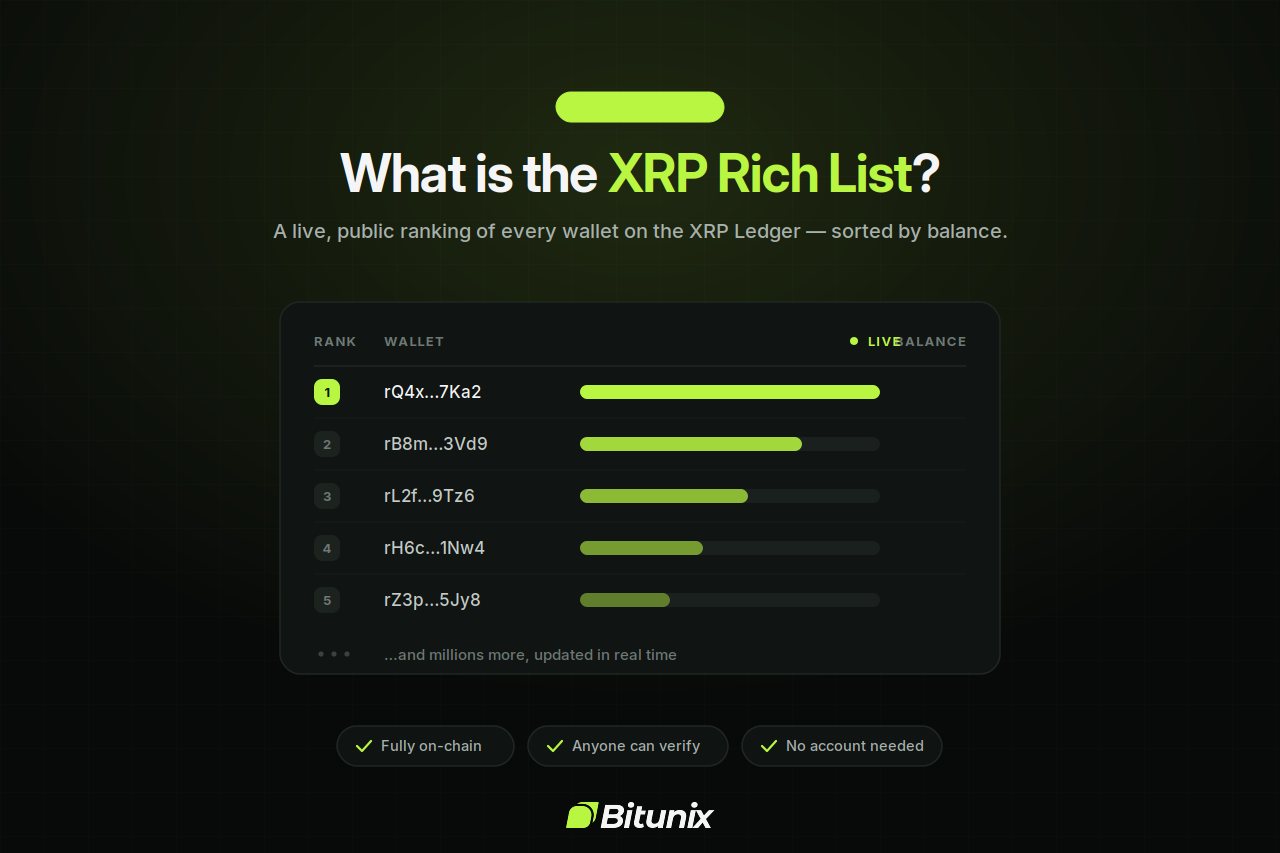
XRP Rich List is a live, public ranking of every wallet on the XRP Ledger
The XRP rich list is a real-time, on-chain metric that tracks and ranks the balances of all public wallets on the XRP Ledger (XRPL). Because XRPL is a transparent public blockchain, data aggregators can freely monitor the network's token distribution. As of early 2026, the ledger has surpassed 7.7 million activated wallets.
This list categorizes every network participant by their holding size. It clearly distinguishes between massive centralized entities, such as Ripple's corporate escrow accounts and major exchange wallets, and individual self-custody investors.
Understanding what is the XRP rich list gives you a transparent view of network decentralization. It ensures that anyone can independently verify circulating supply limits and monitor heavy whale accumulation at any given time.
What the XRP Rich List Means for Investors?
For traders and analysts, the rich list serves as a supply intelligence tool. Watching large wallets move XRP toward exchanges can signal selling intent.
Watching exchange wallets grow can indicate accumulation by institutional custodians or incoming retail demand. Similarly, watching wallets that have been dormant for years suddenly activate can precede market volatility. In 2025 and 2026, dormant wallets originally funded between 2017 and 2018 began showing activity again, coinciding with regulatory clarity and the launch of spot XRP ETFs.
For regular holders, the rich list provides something more personal: an honest answer to the question "Am I actually a significant XRP holder?" Given how concentrated the top of the list is, the answer is often more encouraging than people expect.
XRP's Supply Structure
To fully grasp the dynamics of the XRP rich list, investors must first understand the asset's unique tokenomics. Unlike Bitcoin, XRP is not mined; its entire supply was pre-created at the inception of the XRP Ledger (XRPL).
This fixed-supply model directly shapes token distribution, governing how XRP moves between retail holders, institutional whales, and exchanges over time.

XRP's Supply Structure
Five core mechanics control how this supply operates across the network:
100 Billion Fixed Cap: The XRPL protocol enforces an absolute ceiling of 100 billion XRP. No additional tokens can ever be minted, eliminating the risk of arbitrary inflation.
The Escrow System: To maintain market predictability, Ripple placed 55 billion XRP into cryptographic, on-chain escrow accounts with automated release schedules.
Monthly Unlocks: On the first day of every month, the ledger automatically unlocks 1 billion XRP. Ripple uses a fraction of this for operational expenses and institutional liquidities.
The Re-Escrow Loop: Unused tokens from the monthly release are locked back into new escrow contracts, extending their release date further into the future.
Deflationary Fee Burning: Every XRPL transaction permanently destroys a tiny fraction of XRP to prevent spam attacks, gradually decreasing the total token supply over time.
Because the maximum supply is mathematically capped and escrow releases follow a predictable rhythm, tracking the XRP rich list provides an exceptionally accurate measure of global accumulation. As tokens gradually move from Ripple's escrow into circulating supply, network distribution broadens, giving both retail and institutional holders a progressively larger footprint on the ledger.
Decoding the XRP Rich List 2026: Wallet Distribution Tiers
The XRP Ledger's transparency means anyone can pull a live snapshot of exactly how ownership is spread across its wallets. As of mid-2026, the network counts for more than 7.6–7.8 million funded accounts, and the gap between "average holder" and "whale" is wide - but the entry point to the upper tiers has been getting more accessible, not less.
Independent trackers (XRPScan, rich-list.info) and recent market coverage put the 2026 percentile thresholds in the following ranges. Because these figures shift daily with new wallet activations and balance changes, treat them as directional rather than exact:
XRPL Rank (Percentile) | Approx. XRP Balance Required | Holder Profile |
Top 10% | ~2,150 – 2,500 XRP | Mid-tier retail holders |
Top 5% | ~7,500 – 8,400 XRP | High-conviction retail |
Top 1% | ~45,000 – 50,000 XRP | Early investors & heavy accumulators |
Top 0.5% | ~80,000 – 100,000 XRP | Serious long-term accumulators |
Top 0.1% | ~295,000 – 369,000 XRP | Whales & high-net-worth individuals |
Top 0.01% | ~3.7M – 5.7M XRP | Major exchanges & institutions |
One thing to keep in mind: A wallet is not the same as a person. Large holders often split their balance across several wallets. At the same time, millions of retail owners keep their XRP inside one large exchange wallet and never show up on the list individually. So concentration at the top may be understated, while the "average investor" tiers may be easier to reach than the raw numbers suggest.
How Many XRP Holders Have 10,000?
Holding 10,000 XRP is a highly competitive milestone. With the top 5% threshold sitting near 7,700 XRP, a 10,000 XRP balance places a wallet comfortably within the top 3% to 4% of all funded accounts globally. The segment between 10,000 and 50,000 XRP has been one of the fastest-growing bands on the ledger through 2025–2026, making it an increasingly popular tier for retail-scale accumulators rather than a rare outlier position.
How Many Wallets Have 25,000 XRP?
Moving further up the ladder, a balance of 25,000 XRP secures an exceptionally exclusive position on the ledger. This amount easily eclipses the top 5% cutoff and pushes the holder dangerously close to the elite top 1% ranking.
Wallets holding 25,000 XRP represent high-conviction investors who have likely accumulated their positions over several market cycles. Because balances between 10,000 and 50,000 XRP are expanding, this tier is becoming the ultimate battleground for serious retail participants.
As network adoption grows and wallets holding under 500 XRP multiply rapidly, retaining a 25,000 XRP balance ensures an outsized footprint. Holders at this level command significantly more influence over the circulating supply than the vast majority of network participants.
Unveiling the XRP Rich List Top Holders 2026
The upper end of the XRP Ledger is still dominated by the protocol's founding entity and a handful of major exchanges. Here's who controls the largest share of supply as of 2026:

Unveiling the XRP Rich List Top Holders 2026
1. Ripple Labs
Ripple remains the single largest entity on the network. Combining its escrow and operational wallets, the company controls roughly 38–40 billion XRP - close to 40% of total supply. Of that, approximately 33.9 billion XRP sits in the original 2017 escrow structure, with the remainder held in operational/treasury wallets used for On-Demand Liquidity (ODL) corridors and, more recently, to seed the RLUSD stablecoin ecosystem.
The escrow releases up to 1 billion XRP on the first of each month, but Ripple typically re-locks 70–80% of that release into a fresh escrow contract. The practical effect is that the net new supply entering circulation from escrow runs closer to 200–300 million XRP per month, not the full billion - a detail that matters to anyone using the rich list to gauge near-term sell pressure.
2. Centralized Exchanges
Exchange wallets dominate the top visible non-Ripple addresses, but these balances represent pooled retail deposits, not proprietary exchange wealth. As of early-to-mid 2026, the largest exchange wallets are led by Bithumb (~1.79B XRP), followed by Binance (~1.68B XRP), Uphold (~1.5B XRP), and UPbit (~1.36B XRP), with Bitbank (~572M XRP), Coincheck (~553M XRP), and Kraken (~385M XRP) rounding out the next tier. The concentration of Korean (Bithumb, UPbit) and Japanese (Bitbank, Coincheck) exchange balances reflects XRP's outsized retail popularity across those two markets specifically.
Collectively, the top 10 addresses on the ledger - Ripple's wallets plus these exchange wallets, account for close to a fifth of circulating supply.
3. Chris Larsen
Ripple co-founder and Executive Chairman Chris Larsen is the largest identified individual holder, with balances spread across at least eight tagged wallets. Several of his oldest wallets, dating back to his 2013 founding allocation, have never moved. One of his more active wallets sent XRP to exchanges in 2025, around the time of XRP's multi-year price highs. His total holdings sit in the low billions of XRP - a meaningful share of total supply, and enough to make him one of the largest individual crypto holders overall, not just on the XRP Ledger.
4. Jed McCaleb
Jed McCaleb, who co-founded Ripple before departing in 2014 to build Stellar, was originally granted roughly 9 billion XRP under a settlement that governed a structured, court-monitored sell-down. That program is now substantially complete: by 2026, McCaleb's remaining balance is estimated to be well under 500 million XRP. His years-long, scheduled disposals were a persistent - but well-telegraphed - source of sell pressure that has now largely worked its way out of the market.
5. Brad Garlinghouse and Arthur Britto
Current CEO Brad Garlinghouse and ledger co-architect Arthur Britto both received substantial funding allocations, but neither appears as a single top-10 address - their holdings are reportedly fragmented across multiple wallets and institutional custody arrangements, so exact current balances aren't independently verifiable on public trackers.
A New, Largely Invisible Layer: ETF and Institutional Holders
Two events in 2025 changed who "owns" XRP in ways the on-chain rich list cannot fully show. Ripple's SEC case closed in August 2025, and the first US spot XRP ETFs launched that November.
XRP held inside an ETF sits in one large custodial wallet on the ledger - but that wallet represents thousands of individual institutional and retail shareholders. This means the rich list is best read as a floor, not the full picture, of real-world XRP ownership.
How Many XRP Do You Need to Be Rich? (Find Your Rank)
There's no official definition of "rich" on the XRP Ledger, but the on-chain percentile data gives every holder an honest, real-time answer to "Where do I actually stand?" Using the latest tier thresholds, here's what each bracket requires in both XRP and approximate USD terms:
Tier | XRP Required | Approx. USD Value (*) |
Top 10% | ~2,150 – 2,500 XRP | ~$2,400 – $2,900 |
Top 5% | ~7,500 – 8,400 XRP | ~$8,300 – $9,700 |
Top 1% | ~45,000 – 50,000 XRP | ~$50,000 – $57,500 |
Top 0.5% | ~80,000 – 100,000 XRP | ~$88,000 – $115,000 |
Top 0.1% | ~295,000 – 369,000 XRP | ~$325,000 – $425,000 |
Top 0.01% | ~3.7M – 5.7M XRP | ~$4.1M – $6.6M |
(*) USD values are illustrative at ~$1.10–$1.15/XRP and will shift with the live market price.
A few things worth understanding before chasing a specific rank:
The bar keeps moving: Because thresholds are recalculated continuously against total wallet count, the XRP needed to hold a given percentile shift as the network grows - recent updates show the entry point for most tiers trending lower, meaning ownership is broadening rather than concentrating further.
Rank isn't a price signal: A high percentile reflects accumulated conviction over time, not a prediction of where XRP's price is headed. Wallet rankings are a distribution metric, not investment advice.
You can check your own wallet in real time: Public XRPL explorers such as XRPScan and rich-list.info let anyone enter a wallet address and see its exact balance rank against the rest of the network - no account or personal information required.
Consider what a wallet doesn't show: Holdings inside an exchange account, ETF, or brokerage product don't appear as your own address on the ledger, so your effective percentile (across all your XRP exposure, not just self-custodied balances) may differ from what a single wallet lookup shows.
Large positions moving between wallets or onto exchanges can affect short-term liquidity and price. This article is for information only and is not financial advice. Base your decisions on your own research and risk tolerance, not on rich list rank alone.
Conclusion
The XRP rich list 2026 shows a network that's growing more distributed, not less - entry into the top ownership tiers requires less XRP today than it did a year ago, even as Ripple and a handful of exchanges still anchor the largest wallets. Understanding the XRP rich list isn't about chasing a percentile; it's a transparency tool for gauging where supply sits and how conviction is building across the ledger. Check your own rank anytime via XRPScan or rich-list.info - and remember, wallet rankings reflect distribution, not investment advice.
>>> See more: Why XRP Crashed in 2026 and Why Altcoins Fell Even Harder