Bitcoin reaching a new all-time high (ATH) can attract fresh buyers, accelerate momentum trading, and increase expectations of further gains. But a breakout does not guarantee that prices will keep rising. Profit-taking, changing liquidity conditions, and crowded leveraged positions can all contribute to sharp reversals. For futures traders, even a temporary move against their positions can trigger margin pressure or forced liquidation.
The key is to distinguish a confirmed breakout from a sustainable trend and to manage exposure before volatility increases. Understanding how market structure, leverage, and liquidation risk interact can help traders make more disciplined decisions when Bitcoin approaches or surpasses a previous record.
What Does a Bitcoin All-Time High Mean?
A Bitcoin all-time high is the highest price BTC has reached on a particular market or according to a particular data provider. When Bitcoin trades above its previous record, it establishes a new ATH.
An ATH is a historical price milestone rather than a standalone trading signal. It tells traders that BTC has entered previously uncharted price territory, but it does not establish whether the market is overvalued, whether demand will continue, or how far prices might move next.
How Bitcoin Sets a New ATH
Bitcoin can reach a new record when demand exceeds the available supply offered for sale at prevailing prices. Several factors may contribute to that demand, including institutional investment, spot Bitcoin exchange-traded product flows, improving market sentiment, macroeconomic expectations, and increased trading activity.
These drivers do not always move in the same direction. Strong demand may support a breakout while uncertainty over monetary policy or a sudden shift in investor sentiment puts pressure on prices.
A new ATH can also attract momentum traders and media attention, drawing additional participants into the market. That activity may reinforce an existing rally, but it can also increase the risk of crowded positioning and rapid reversals if expectations change.
Why a Breakout Above the Previous High Matters
When Bitcoin approaches a previous high, some traders watch for selling pressure around that level. A sustained move above it can suggest that buyers are willing to transact at higher prices.
However, a brief move above resistance is not necessarily a confirmed breakout. Traders may look for supporting evidence, such as a sustained close above the former high, continued trading activity, and a successful retest of the breakout area.
If the price falls back below the previous high, the breakout may have failed. Traders who entered on the initial move can then face losses, particularly if they used leverage or placed stops too close to the entry price.
There is also an important distinction between identifying a failed breakout and predicting a market reversal. One failed move does not prove that a broader uptrend has ended.
Why Bitcoin Can Become More Volatile After an ATH

A new Bitcoin all-time high can signal strong momentum, but it does not guarantee that the rally will continue.
A breakout can reflect genuine demand, speculative momentum, or a combination of both. The difficulty is that price alone does not reveal which factor is driving the move. Traders need to consider the conditions supporting the rally and the risks that could undermine it.
Profit-Taking and Shifting Market Sentiment
Investors who accumulated Bitcoin at lower prices may sell some of their holdings after a new ATH. If selling pressure increases faster than new demand, the market can retrace even while its longer-term outlook remains positive.
Sentiment can also change quickly. Optimism about institutional adoption or monetary policy may support a rally, but disappointing economic data, regulatory developments, or weaker demand can alter expectations.
A useful distinction is between a change in sentiment and a confirmed change in trend. Neither a sharp pullback nor a burst of positive news, by itself, establishes what Bitcoin will do next.
Liquidity Conditions and Breakout Reversals
Liquidity affects how easily an asset can be bought or sold without substantially moving its price. When market depth is limited, relatively large orders can produce outsized price movements.
A breakout can also attract traders who place stop orders around the previous resistance level. If the price reverses through that area, their exits may add to selling pressure. In leveraged markets, forced position closures can amplify the move further.
Watch for several conditions rather than relying on one signal:
Breakout acceptance: Does BTC remain above the previous resistance level, or quickly fall back below it?
Trading activity: Is the move supported by sustained participation, or does activity fade after the initial surge?
Retest behavior: If the price returns to the breakout area, do buyers step in, or does the former resistance fail to hold?
Market depth: Could a relatively small order move the price sharply under current conditions?
These observations can help traders evaluate a breakout, but none guarantees that a particular price level will hold.
Leverage and Crowded Positions
Leverage allows traders to control a position larger than the margin they commit. This can magnify returns on the capital allocated to a trade, but it also makes the position more sensitive to adverse price movements.
Suppose a trader opens a long BTC futures position with 10x leverage. A 5% decline in the underlying asset would represent an approximately 50% loss relative to the initial margin, before fees, funding, and other adjustments, assuming the position size remains constant and liquidation has not occurred.
At higher leverage, the available margin cushion is generally smaller. A relatively modest reversal may therefore put a position under pressure.
If many traders hold similar leveraged positions, a price move against them can trigger a series of liquidations. Those forced closures may intensify volatility, although the extent of any amplification depends on market conditions and the exchange's liquidation mechanisms.
Macro Events, ETF Flows and Regulatory Developments
Bitcoin trades within a broader financial environment. Interest-rate expectations, inflation data, changes in risk appetite, regulatory announcements, and institutional investment flows can all influence demand.
Spot Bitcoin exchange-traded products can provide useful information about investor flows, but their flows should not be interpreted in isolation. A single day of inflows or outflows does not establish the direction of the next price move.
Likewise, expectations of monetary easing do not automatically translate into higher Bitcoin prices. Markets respond to the difference between what investors expected and what actually happens, as well as to how developments affect liquidity and risk appetite.
For traders assessing a breakout, the practical question is not whether a particular headline sounds bullish or bearish. It is whether the underlying conditions support the current price move and how quickly those conditions could change.
Key Risks to Watch After Bitcoin Breaks Its ATH

Leverage magnifies trading exposure, while adverse price movements can increase margin pressure and trigger forced liquidation.
Understanding why Bitcoin can become volatile is only the first step. Traders also need to identify how that volatility can affect their positions.
False Breakouts and Sharp Price Reversals
A false breakout occurs when the price moves above a previous resistance level but fails to sustain the move. Traders who enter immediately may find themselves holding a losing position when the market returns to its earlier range.
One way to assess a breakout is to define the conditions that would support or invalidate the trade before entering. These might include a sustained close above resistance, a successful retest, or a predefined exit if the price returns below a key level.
No confirmation method eliminates false signals. Waiting for confirmation can also mean entering at a less favorable price, so traders need to weigh the risk of acting too early against the risk of missing part of a move.
Overleveraging and Liquidation Risk
Liquidation is one of the most important risks in leveraged crypto futures trading. When a position no longer meets the exchange's maintenance margin requirements, the exchange may automatically close it under its applicable rules.
The exact trigger depends on the platform, contract, margin mode, and account structure. A rising market does not remove this risk. Traders holding leveraged long positions may still face liquidation if BTC reverses sharply, while short positions can face similar pressure during a rapid rally.
Before opening a futures position, understand:
Initial margin: The collateral required to open a position.
Maintenance margin: The minimum margin required to keep the position open.
Liquidation price: The estimated price at which the platform's liquidation conditions may be met.
Mark price: A reference price used by many futures platforms to assess unrealized profit and loss or trigger liquidation.
Margin mode: Whether margin is allocated to an individual position or shared across multiple positions.
These terms are related, but they are not interchangeable. The displayed liquidation price may also change as margin, fees, position size, or risk parameters change.
For a deeper explanation of the process, see the Bitcoin liquidation and futures margin guide.
Slippage and Liquidity Gaps During Fast Markets
Slippage occurs when an order executes at a different price from the one expected. It can become more pronounced during sudden price movements, when order-book liquidity changes quickly or the market moves faster than orders can be filled.
A stop-market order is designed to trigger a market order once its specified condition is met, but it does not guarantee execution at the stop price. A stop-limit order can provide more control over the minimum or maximum execution price, but it may not fill if the market moves beyond the limit.
The choice depends on the trade and the risks the trader is prepared to accept. During an extreme BTC move, execution certainty and price certainty are not always available at the same time.
Treating Historical Cycles as Guaranteed Signals
Bitcoin's past price cycles can provide context for understanding market behavior, but they should not be treated as a precise calendar for future highs and lows.
In its March 2026 review, Fidelity explained Bitcoin's four-year cycles and noted that the historical pattern is influenced by factors such as halvings, monetary policy, and investor psychology. It also cautioned that the timing is imprecise and that historical data is limited.
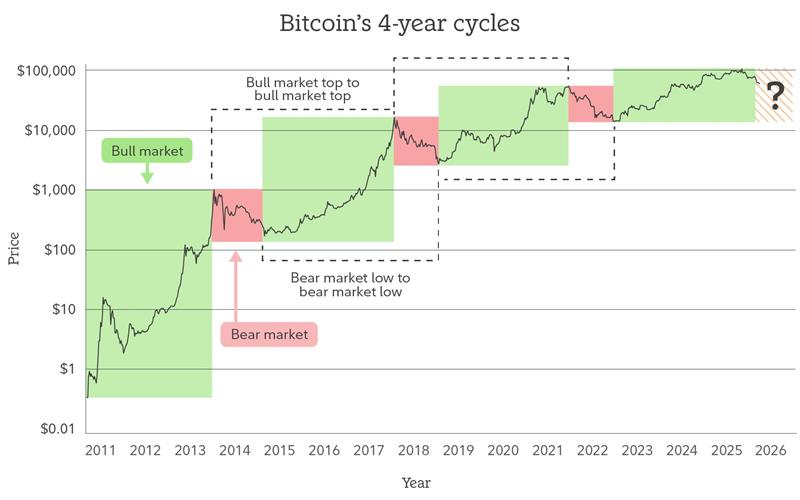
Source: Fidelity
A cycle-based view may help traders frame possible scenarios, but it cannot establish that a rally must end or that a correction must begin on a particular date. Market conditions can change, and historical patterns may not repeat.
How to Manage Risk in a Bitcoin ATH Market

A structured risk management plan helps traders define entries, control exposure, set exit conditions, and reassess changing market risks.
Risk management starts before a trade is opened. Instead of trying to predict the exact peak or bottom, traders can establish limits for the amount they are willing to lose, the size of the position they will hold, and the conditions under which they will exit.
Define Entry Conditions Before Chasing a Breakout
When Bitcoin rises quickly, the fear of missing out can encourage traders to enter without a clear plan. A more disciplined approach is to define what would make the setup valid and what would invalidate it.
Depending on the strategy, entry conditions might include:
A close above a previously identified resistance level.
A retest that holds above the breakout area.
Trading activity consistent with the intended setup.
A clear exit condition if the breakout fails.
These are possible criteria, not a universal checklist. A short-term momentum strategy may require different confirmation than a longer-term investment approach.
If the price has already moved too far from the planned entry, waiting for another setup may be more appropriate than increasing the risk simply to participate.
Set Position Sizes and Leverage Limits
Position size determines how much a price move affects the account. It should be considered alongside the entry price, the planned exit, and the potential loss if the trade goes wrong.
For example, a trader who is prepared to risk $100 on a trade should calculate the position size based on the distance between the entry and the planned stop, while accounting for fees and possible slippage. A wider stop generally requires a smaller position to keep the planned loss within the same limit.
Leverage is a separate but related consideration. Higher leverage reduces the initial margin required for a given position size, but it leaves less room for adverse price movement before margin requirements become a problem.
A useful rule is to choose position size based on the risk budget first, rather than selecting maximum leverage and building the position around it.
Understand Margin Requirements and Liquidation Prices
Before opening a leveraged position, check the estimated liquidation price and the margin requirements that apply to the contract.
The liquidation price is not a substitute for a risk-management exit. Liquidation may result in the position being closed under unfavorable market conditions, and the final execution may differ from the displayed estimate.
Margin modes also matter:
Isolated margin: Margin is allocated to a specific position. Under the platform's applicable rules, losses and liquidation exposure are generally contained to the margin allocated to that position, including any additional margin added.
Cross margin: Eligible account collateral may be shared across positions. This can provide a larger margin buffer, but it can also expose more of the available account balance to losses.
The precise rules differ across platforms and account types. Cross margin does not eliminate liquidation risk, and isolated margin does not guarantee that a trade will close at a desired price.
Traders should also account for funding payments, trading fees, maintenance margin tiers, and other applicable charges when assessing the distance between their position and liquidation.
Use Stop-Loss Orders With an Awareness of Execution Risk
A stop-loss can help define an exit point and limit the intended loss on a trade. It should be set according to the trade's invalidation conditions and the amount of risk the trader is willing to accept.
Placing a stop too close to the entry may result in repeated exits caused by ordinary price fluctuations. Placing it too far away can increase the potential loss unless the position size is adjusted accordingly.
Most importantly, a stop-loss does not guarantee a maximum loss under every market condition. Gaps, rapid price changes, and slippage can lead to execution at a worse price than expected.
Traders should know whether their chosen order is a stop-market or stop-limit order, which price triggers it, and what happens if the market moves rapidly through the trigger level.
Reassess Exposure When Market Conditions Change
A trading plan should not remain fixed when the assumptions supporting it no longer hold.
If Bitcoin falls below a level that was expected to act as support, volatility rises sharply, or the market's liquidity deteriorates, reassess whether the original position still fits the plan. Reducing exposure may be more appropriate than adding margin or increasing leverage to defend a losing trade.
Risk management also includes avoiding excessive concentration. Traders who hold several correlated crypto positions may be taking more aggregate market risk than their individual positions suggest.
The objective is not to react to every price fluctuation. It is to recognize when a material change in conditions affects the original risk calculation.
Spot Bitcoin vs. Leveraged Futures After an ATH
Spot trading and leveraged futures have different risk profiles. The distinction matters when prices are moving rapidly around a new high.
Key Differences in Exposure and Liquidation Risk
Factor | Spot Bitcoin | Leveraged BTC Futures |
Exposure | Direct ownership of BTC when purchased outright | Exposure through a derivative contract |
Leverage | No leverage when buying entirely with available funds | Leverage may allow a position larger than the initial margin |
Liquidation | No futures-style liquidation for an unleveraged spot holding | Possible when margin requirements are no longer met |
Main price risk | The value of BTC can decline substantially | Adverse price moves can produce amplified losses and forced liquidation |
Additional costs | Trading fees and any applicable custody or withdrawal costs | Trading fees, possible funding payments, and margin-related costs |
Spot trading is not risk-free. Bitcoin's price can fall substantially, and an investor can lose much or all of the amount invested. Borrowing to buy spot assets can also introduce liquidation risk.
Futures trading introduces additional complexity because the position's survival depends not only on the direction of the market but also on margin, leverage, contract terms, and the platform's liquidation rules.
Which Trading Approach Fits Different Risk Tolerances?
The appropriate approach depends on the trader's objectives, experience, time horizon, and capacity to absorb losses.
Someone seeking long-term BTC exposure may prefer to avoid leverage and the associated liquidation mechanics. A futures trader may use contracts for short-term speculation or hedging, but must understand the additional risks before opening a position.
Neither approach guarantees a better outcome. Spot holders remain exposed to price declines, while futures traders must manage both market exposure and the mechanics of their contracts.
During an ATH breakout, the important question is not simply which instrument offers greater potential returns. It is whether the position's risk structure is understood and appropriate for the intended trade.
How to Evaluate a Bitcoin Breakout Without Relying on Price Predictions
Rather than trying to forecast an exact ATH or market top, traders can assess whether the evidence supports their current market scenario. The aim is to make a decision under uncertainty, not eliminate uncertainty altogether.
Confirming Price Structure and Support Retests
Previous resistance levels can help frame a breakout, while subsequent price action can show whether buyers continue to defend the area.
For example, a move above a previous high followed by consolidation above that level may be consistent with continued strength. A quick return below the breakout level may suggest that buyers have not established durable support.
Neither pattern is conclusive. Traders should identify what would invalidate their interpretation and avoid treating a single candle or price level as proof of a sustained trend.
Monitoring Volume, Liquidity and Market Conditions
Price should be evaluated alongside other information relevant to the trading strategy.
Useful observations may include spot trading volume, order-book depth, derivatives open interest, funding rates, and relevant macroeconomic developments. Each indicator has limitations: high volume does not necessarily mean buying pressure will continue, and elevated open interest does not by itself indicate whether the market is excessively bullish or bearish.
The value comes from combining evidence. If price rises while leverage and speculative positioning increase rapidly, a trader may decide to examine downside exposure more carefully. That does not mean a reversal is inevitable.
Using Historical Cycles as Context, Not a Trading Clock
Bitcoin's four-year cycle is commonly discussed in relation to its halving schedule and historical market peaks and troughs. The pattern can help explain how supply dynamics and investor behavior have interacted in previous cycles.
However, Bitcoin's market structure continues to change, and historical intervals are not precise enough to establish a reliable date for the next top. Institutional participation, macroeconomic conditions, liquidity, and market expectations can all differ from earlier cycles.
For readers interested in historical price movements and longer-term scenarios, Bitunix also provides a Bitcoin price history guide and a Bitcoin price prediction analysis for 2026–2030.