
Article Summary
- This article provides a foundational explanation of the terms "on-ramp" and "off-ramp" in the context of cryptocurrency.
- On-ramping is defined as the process of converting traditional fiat currency (like USD) into cryptocurrency.
- Off-ramping is defined as the process of converting cryptocurrency back into fiat currency.
- It identifies centralized exchanges (CEXs) as the most common and user-friendly platforms for both on-ramping and off-ramping.
- The guide breaks down the most popular methods for each process, including bank transfers (ACH), credit/debit cards, and peer-to-peer (P2P) platforms.
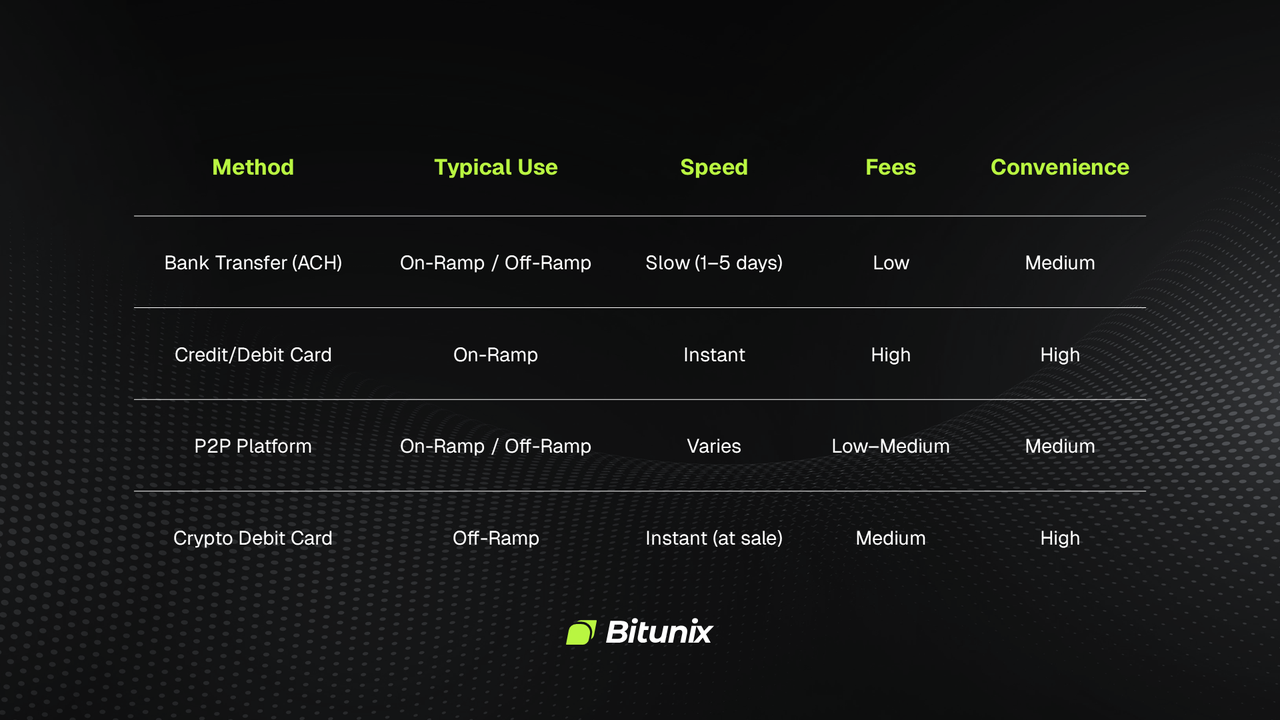
- A clear table is used to compare the different methods based on speed, fees, and convenience.
You have heard about Bitcoin, and you are ready to buy your first piece of the digital economy. But how do you actually turn your dollars into crypto? And more importantly, how do you turn it back? The answer sits in two ramps that connect regular money to crypto.
Think of crypto like a highway system. You do not teleport onto a highway. You take an entrance ramp, and when you want to leave, you take an exit ramp. In crypto, those ramps are on-ramps and off-ramps.
You will often use a crypto exchange for trading once you already have crypto. Some platforms, including Bitunix, also have ways to buy crypto through supported payment methods in their apps, but beginners still benefit from understanding the bigger picture: which ramp you are using, what it costs, and what you give up in speed or privacy.
This guide will simply and clearly define what on-ramps and off-ramps are, explain the most common methods for each, and help you choose the best option for your needs.
What Are On-Ramp And Off-Ramp In Crypto
Many beginners never see the words on-ramp or off-ramp inside an app. Instead, the app quietly sends you to a third-party ramp provider to handle the payment part. This is common in wallets and some exchanges, because running card payments and bank rails is a specialized business.
Here is how MoonPay describes what its ramp product does:
"MoonPay Ramps combines onramp and offramp together in one integration, so customers can buy crypto in seconds and cash out to fiat"
That single sentence is the whole idea, an on-ramp gets you from fiat to crypto, and an off-ramp gets you back to fiat. You will often use a third-party service like this even if you start from an exchange interface, because the exchange can route the transaction through a ramp partner behind the scenes.
What is an On-Ramp? (Getting In)
An on-ramp is any service or method that lets you swap fiat money like USD or EUR for cryptocurrency like BTC, ETH, or USDT. The goal is to enter the market, so if you are searching for how to buy crypto with USD, you are really choosing a crypto on-ramp that fits your budget, your timing, and your comfort level with sharing personal details.
That is the basic idea, and it leads straight into the next question: which on-ramp method should you use, and what do you give up in fees, speed, or verification?
Common On-Ramp Methods
Before we list methods, remember that every on-ramp is a trade-off between speed, fees, and how much personal information you need to share. If someone promises instant buying, no fees, and no verification, treat that with caution. It can happen, but you should be cautious.
Centralized Exchanges (The Main Hub)
Platforms like Bitunix, Coinbase, or Kraken are popular on-ramps because they combine buying, selling, and trading in one place. You create an account, choose a payment method, buy crypto, and store it on the platform or withdraw it to your own wallet.
These are the main methods to fund your account on a centralized exchange:
- Bank Transfer (ACH): A bank transfer is usually one of the cheapest options. In the US, ACH transfers commonly take 1 to 3 business days to complete, depending on timing and bank schedules.What that means for you: It saves money on fees, but you wait longer before your funds fully settle.
- Credit or Debit Card: Card buys are usually fast and convenient, but you pay for that convenience. Many third-party providers and exchanges support major cards, and MoonPay lists Visa and Mastercard support, along with bank transfers and mobile payment options.What that means for you: You can buy quickly, but fees tend to be higher than bank transfers.
Peer-to-Peer (P2P) Platforms
A P2P platform connects you with another person who wants to sell you crypto. You pay them using an agreed payment method like bank transfer, PayPal, or sometimes cash, and they release the crypto to you.
Many beginners like P2P because it often supports more payment methods than a traditional exchange, and fees can stay in the low-to-medium range depending on the platform and the specific offer. The main risk shows up when you move payment outside the platform or rush the trade without checking the seller's reputation and protection rules, which makes scams much more likely.
Crypto ATMs
Crypto ATMs are physical machines that let you insert cash and receive cryptocurrency into a wallet address you provide. The convenience is real, but so are the costs. Recent research on Bitcoin ATM economics often notes total fees that can reach around 20 percent in some cases. For many beginners, that fee level makes crypto ATMs a last resort.
What is an Off-Ramp? (Getting Out)
An off-ramp is any service or method that lets you exchange cryptocurrency for fiat money. The goal is to turn your crypto into cash you can use in the real world, usually by sending it to your bank account after the conversion.
Most beginners off-ramp by selling crypto on an exchange, moving the proceeds to a cash balance, and withdrawing to a linked bank account. Fees and timing depend on the method, and many services connect bank accounts and cards to crypto platforms to make these conversions possible.
Common Off-Ramp Methods
Off-ramps come with their own trade-offs. The big one is timing; some methods give you money in days, some give you spending power instantly, and some depend on finding a buyer.
Centralized Exchanges (Again, the Main Hub)
This is the reverse of on-ramping. You sell crypto (for example, BTC/USDT) on the exchange, then withdraw the fiat balance to your linked bank account. Many beginners like this because it feels similar to withdrawing money from a brokerage.
If your goal is USDT to USD, you typically sell USDT for USD (or another fiat balance if supported) and then withdraw to your bank. The exact steps and availability depend on the platform and your region.
Peer-to-Peer (P2P) Platforms
You sell your crypto directly to another person who pays you via bank transfer or another agreed method. If you do it inside a platform with escrow, it can be smooth. If you do it informally with strangers, you are taking a bigger risk.
A good habit is to treat P2P like meeting someone from a marketplace listing. Use the platform, verify details, and do not rush because someone is pressuring you.
Crypto Debit Cards
A crypto debit card lets you spend a crypto balance anywhere that accepts Visa or Mastercard. The conversion to fiat happens automatically at the point of sale. This is convenient when you want spending power without moving funds back to your bank first. The trade-offs are usually spreads, card fees, and limits that can change based on your verification level.
Comparing Your Options
Here is the simple way to think about it: bank transfers usually save money, cards usually save time, P2P gives flexibility but needs extra caution, and debit cards are built for day-to-day spending.
In most beginner setups, you start with a centralized exchange as your main hub, then add other ramps only when you have a specific need.
The Importance of KYC
If a ramp touches the banking system, identity checks are the norm. That is where KYC comes in. KYC stands for Know Your Customer, and it is a set of identity verification steps designed to reduce fraud and help prevent money laundering and terrorist financing.
What you should expect:
- You share basic personal details.
- You upload an identity document.
- Sometimes you provide proof of address or a selfie check.
If you hate the idea of sharing ID, you are not alone, but regulated services usually require it, and avoiding it often pushes you toward riskier methods or higher costs.
Conclusion: Your Gateway to Digital Finance
On-ramps and off-ramps are the essential bridges that make cryptocurrency accessible. By using a centralized exchange, you can convert your dollars into crypto to start your investment journey (on-ramp) and convert your crypto back into cash (off-ramp) when you need it.
Bitunix provides a platform for crypto-to-crypto trading. Some users will still rely on third-party ramp services or supported purchase methods to get money in and out, depending on where they live and what payment rails are available. If you are starting today, pick a regulated on-ramp you understand, start with a small test amount, and keep notes on fees and timelines.
Download the app, register your account, get started by exploring a regulated on-ramp service, and then trade with deep liquidity on Bitunix.
FAQ
What is the cheapest way to buy cryptocurrency?
Globally, the cheapest way to buy crypto is usually a bank transfer to a low-fee centralized exchange, then a spot purchase, or a P2P trade where platform fees are often 0% and you only pay the seller spread.
What is the fastest way to cash out my crypto?
The fastest cash-out is an instant off-ramp: sell crypto via P2P or an exchange that supports real-time bank payouts (SEPA Instant, Faster Payments), so funds arrive in minutes. If unavailable, use Visa Direct-style card payouts that convert and send fiat within minutes often.
Do I need to pay taxes when I use an off-ramp?
In many countries, selling crypto or swapping it into fiat can trigger a taxable event. Tax rules depend on where you live and how long you held the asset. If you are unsure, keep records and ask a local tax professional.
Is it safe to use my credit card to buy crypto?
It can be safe if you use a reputable provider and you protect your account with strong security. The bigger issue is cost, card purchases often have higher fees and some card issuers treat crypto buys as cash-like transactions.
What is a decentralized exchange, and does it have on-ramps?
A decentralized exchange (DEX) is a crypto-to-crypto marketplace run by smart contracts, where you trade directly from your own wallet, and no company holds your funds. Most DEXs do not offer fiat on-ramps, so you usually buy crypto elsewhere first, then trade on the DEX.
Why do I need to provide my ID to buy Bitcoin?
Services that connect to banks often must verify customers to reduce fraud and money laundering risks. Regulators and compliance frameworks commonly require customer identification and verification.
Can I on-ramp directly from my bank mobile app?
Some banks and fintech apps offer crypto purchases or integrations in certain regions. Availability depends on your bank and local rules. If your bank offers it, compare the fees and the withdrawal options before you buy.
What is the difference between an on-ramp and a crypto wallet?
An on-ramp is a method to buy or sell crypto using fiat. A wallet is where you store and control crypto assets (either on an exchange or in a self-custody app). You can have a wallet without an on-ramp, and you can use an on-ramp that delivers crypto directly into your wallet.
Are P2P platforms safe?
They can be safe when the platform uses escrow, and you follow the rules inside the platform. Risk rises fast when you take payments off-platform, accept reversible payment methods without safeguards, or skip reputation checks.
What are the limits for on-ramping and off-ramping?
Limits vary by method and by verification level. Card buys often have lower caps at first. Bank transfers can allow higher amounts after full verification. P2P limits depend on platform policies and seller liquidity.
Glossary
- On-ramp: Service that converts fiat money into crypto using bank transfers, cards, or local payment rails.
- Off-ramp: Service that converts crypto back to fiat and pays out to your bank or card.
- Fiat currency: Government-issued money like USD or EUR, used for salaries, bills, and bank balances worldwide daily.
- Cryptocurrency: Digital money that runs on networks, letting people send value online without a central authority.
- Stablecoin: Cryptocurrency pegged to a reserve asset, like the US dollar, to reduce price swings overall.
- USDT: A stablecoin issued by Tether that aims to stay near one US dollar in trading.
- Centralized exchange: Company-run platform where you buy, sell, and store crypto, with accounts and support tools included.
- Crypto wallet: Software or hardware that holds your private keys, letting you send and receive crypto safely.
- Private key: Secret code that proves ownership and authorizes crypto transactions, losing it can mean losing access.
- KYC: Identity checks required by many financial services to reduce fraud and money laundering risks globally.
- Bank transfer: Electronic bank-to-bank payment method, often low-fee but slower than cards in practice for US users.
- P2P trading: Buying or selling crypto directly with other users, usually with escrow and ratings for safety.
- Bid-ask spread: Gap between the highest buyer bid and lowest seller ask, acting like a trading cost.
- Crypto debit card: Payment card that converts crypto to local currency at checkout, so merchants receive fiat instantly.
- Crypto ATM: A physical kiosk where you buy or sometimes sell crypto using cash, usually with high fees.
About Bitunix
Bitunix is a global cryptocurrency derivatives exchange trusted by over 3 million users across more than 100 countries. The platform is committed to providing a transparent, compliant, and secure trading environment for every user. Bitunix offers a fast registration process and a user-friendly verification system supported by mandatory KYC to ensure safety and compliance. With global standards of protection through Proof of Reserves (POR) and the Bitunix Care Fund, Bitunix prioritizes user trust and fund security. The K-Line Ultra chart system delivers a seamless trading experience for both beginners and advanced traders, while leverage of up to 200x and deep liquidity make Bitunix one of the most dynamic platforms in the market.
Bitunix Global Accounts
X | Telegram Announcements | Telegram Global | CoinMarketCap | Instagram | Facebook | LinkedIn | Reddit | Medium
Disclaimer: Trading digital assets involves risk and may result in the loss of capital. Always do your own research. Terms, conditions, and regional restrictions may apply.