
Article Summary
- This article provides a price prediction and fundamental analysis for the STRK token.
- It explains StarkNet's role as a Validity Rollup (ZK-Rollup) that provides massive scalability to Ethereum without compromising security.
- The bull case focuses on StarkNet's superior STARK cryptographic proofs, its custom Cairo programming language optimized for ZK-rollups, and its potential to become the dominant execution layer for complex dApps.
- The bear case highlights the intense competition in the Layer 2 space (Arbitrum, Optimism, zkSync), the steep learning curve of Cairo for developers, and concerns regarding token unlocks and decentralization.
- It presents detailed price prediction scenarios (bearish, neutral, bullish) for both 2026 and 2030, based on ecosystem adoption and the broader success of Ethereum Layer 2s.
Ethereum still owns the smart-contract mindshare, but success has a cost. When demand piles up, fees rise, confirmations feel slower, and some applications stop making economic sense on Layer 1. StarkNet deals with that bottleneck with its permissionless, decentralized validity rollup, often called a ZK-Rollup, that runs as an Ethereum Layer 2 and pushes computation off-chain while keeping settlement tied to Ethereum. If you want to follow or trade the asset through a centralized venue, Bitunix is a crypto exchange that offers the STRK/USDT trading pair and a mobile app alongside broader spot and futures access.
But, does that technical edge turn into long-term token value, or does StarkNet remain a respected product with a weak token? The answer depends on three things: whether its STARK-based design keeps attracting developers, whether Cairo becomes less of a hurdle, and whether STRK can hold up under a heavy unlock schedule while fighting in one of crypto’s most crowded sectors.
This analysis will examine StarkNet's underlying technology, its competitive positioning in the crowded L2 landscape, and the tokenomics of STRK to provide data-driven price predictions for 2026 and 2030.
The Technology: STARKs and Cairo
A ZK-Rollup works by processing transactions off-chain, generating a validity proof, and then posting that proof back to Ethereum. StarkNet’s official explainer says the network lets dApps scale massively without compromising security. The stack is built around Cairo smart contracts, ZK technology, and scaling for Ethereum and Bitcoin.
StarkNet's technical edge comes from STARK proofs. StarkWare's current STARK overview states that the proof system relies on minimal, post-quantum-secure assumptions. A December 2025 comparative analysis found that zk-SNARKs generated proofs much faster, but zk-STARKs verified faster, avoided trusted setup, and produced much larger proofs. This is important because StarkNet's architecture prioritizes transparency and scalability, but it comes at the cost of larger proof sizes and a more demanding technical stack.
Cairo is the other major part of the design. The Cairo Book describes it as a general-purpose language designed specifically for creating provable programs, and it is purpose-built for provable computing. That gives StarkNet an edge for STARK-friendly execution, but it also means developers cannot just copy-paste Solidity contracts and call it a day. Cairo is powerful, but it asks builders to learn a new toolchain, new syntax, and a new mental model.
The Bull Case: The Ultimate Execution Layer
On April 7, 2026, CoinGecko showed STRK at around $0.032, with roughly $183.5 million in market cap, about $322.4 million in fully diluted valuation, and roughly 5.7 billion tokens in circulation.
However, forecasts vary a lot. Kraken's model points to about $0.032 by the end of 2026 and $0.039 by 2030. CoinCodex's forecast is higher, at about $0.0403 for 2026 and $0.0831 for 2030. Changelly's price prediction is much more aggressive, with a 2026 average near $0.152 and a 2030 average near $0.643, with a 2030 upper target of $0.755.
Any StarkNet price prediction worth taking seriously has to start by admitting that the spread is wide because the market is still deciding whether StarkNet is premium infrastructure or just another L2 with good branding.
1. Unmatched Scalability
L2Beat is one of the best places to compare rollups side-by-side. Its StarkNet page shows about $617 million in total value secured, Stage 1 rollup status, and roughly 6.95 past-day UOPS. It describes the network this way:
"Each update to the system state must be accompanied by a ZK proof that ensures that the new state was derived by correctly applying."
That quote gets to the heart of the bull case. StarkNet is designed for computation-heavy use cases that are painful on Ethereum L1, and it did ship real performance gains in 2025. StarkNet's year-in-review says pre-confirmations cut latency from about 2 seconds to roughly 0.5 seconds, while block times dropped from 30 seconds to 4 seconds. In plain trader terms, that is the kind of improvement that makes perps, games, and complex DeFi feel more like actual software.
2. Account Abstraction
Account abstraction is one of StarkNet's strongest advantages because it makes apps easier to use. On StarkNet, wallets can work more like smart products than basic crypto accounts. That allows features like social login, session keys, and smoother app interactions, which are especially useful for gaming and consumer apps.
If the network becomes easier for normal users to use, it has a better chance of attracting more activity, developers, and demand across the ecosystem. That is why account abstraction supports a more positive long-term view for StarkNet. Fees are still paid in STRK, so the user experience can improve without weakening the token's role in the network.
3. The StarkWare Pedigree
StarkWare is not an anonymous group shipping a whitepaper without a name behind it. The current StarkEx docs list deployments for ImmutableX, dYdX, Sorare, Rhino.fi, and others.
Cairo powers Starknet and StarkEx, including mainnet applications such as dYdX, Sorare, and ImmutableX, and in November 2025, StarkNet upgraded to the open-source S-two prover, which its official blog says can generate proofs up to an order of magnitude faster than the previous prover.
The Bear Case: Competition and Friction
The bearish view starts with a less flattering fact: some forecast models are still barely moving from current prices. Kraken’s simple model stays near $0.032 by the end of 2026 and $0.039 by 2030. Coinbase’s 5% growth tool stays around $0.04 in 2030. Those are not disaster numbers, but they do reflect a market that is not willing to hand StarkNet a premium multiple without proper adoption.
1. The L2 Bloodbath
StarkNet is up against giants. L2BEAT currently shows Arbitrum at about $13.58 billion in TVS, OP Mainnet at about $1.39 billion, zkSync Era at about $310 million, and StarkNet at about $617 million. That puts StarkNet above some ZK rivals, but still far behind the biggest Ethereum Layer 2 leaders.
2. The Developer Moat
Cairo gives StarkNet a language built for provable execution, but it also forces developers to learn something outside the Ethereum Virtual Machine (EVM) mainstream. The Cairo Book describes it as a language designed for provable programs, while zkSync Era is often framed as easier for Solidity developers because it offers full EVM compatibility. That creates a clear tradeoff. Cairo may be better for Stark-proof design, but EVM-equivalent systems are usually easier to adopt because developers can migrate with less effort.
3. Tokenomics and Unlocks
Unlock pressure is still a real headwind for the STRK token. Starknet docs say up to 127 million tokens, or 1.27% of total supply, have been and will be unlocked monthly from April 15, 2025 through March 15, 2027. Tokenomist shows about 56.92% of the supply unlocked already, with the next unlock scheduled for April 15, 2026. Even if the network grows, that regular supply release can weigh on price by feeding steady sell pressure into the market.
4. Decentralization Timeline
StarkNet is not fully decentralized yet, and L2BEAT classifies it as a Stage 1 ZK rollup, saying that the project does not pass the walkaway test because users cannot exit if malicious operators remain and the Security Council disappears.
L2Beat also recorded an incident on January 5, 2026, when StarkNet reverted 18 minutes of history after an outage. StarkNet's roadmap says the final phase of decentralization still requires decentralizing the proving mechanism. So the long-term vision is strong, but the trust model is still unfinished.
StarkNet Price Prediction Scenarios For 2026 And 2030
A realistic StarkNet price prediction for 2026 and 2030 should sit somewhere between the conservative models from Kraken and Coinbase, the moderate model from CoinCodex, and the much higher range from Changelly. The table below turns those outside forecasts into practical scenarios:
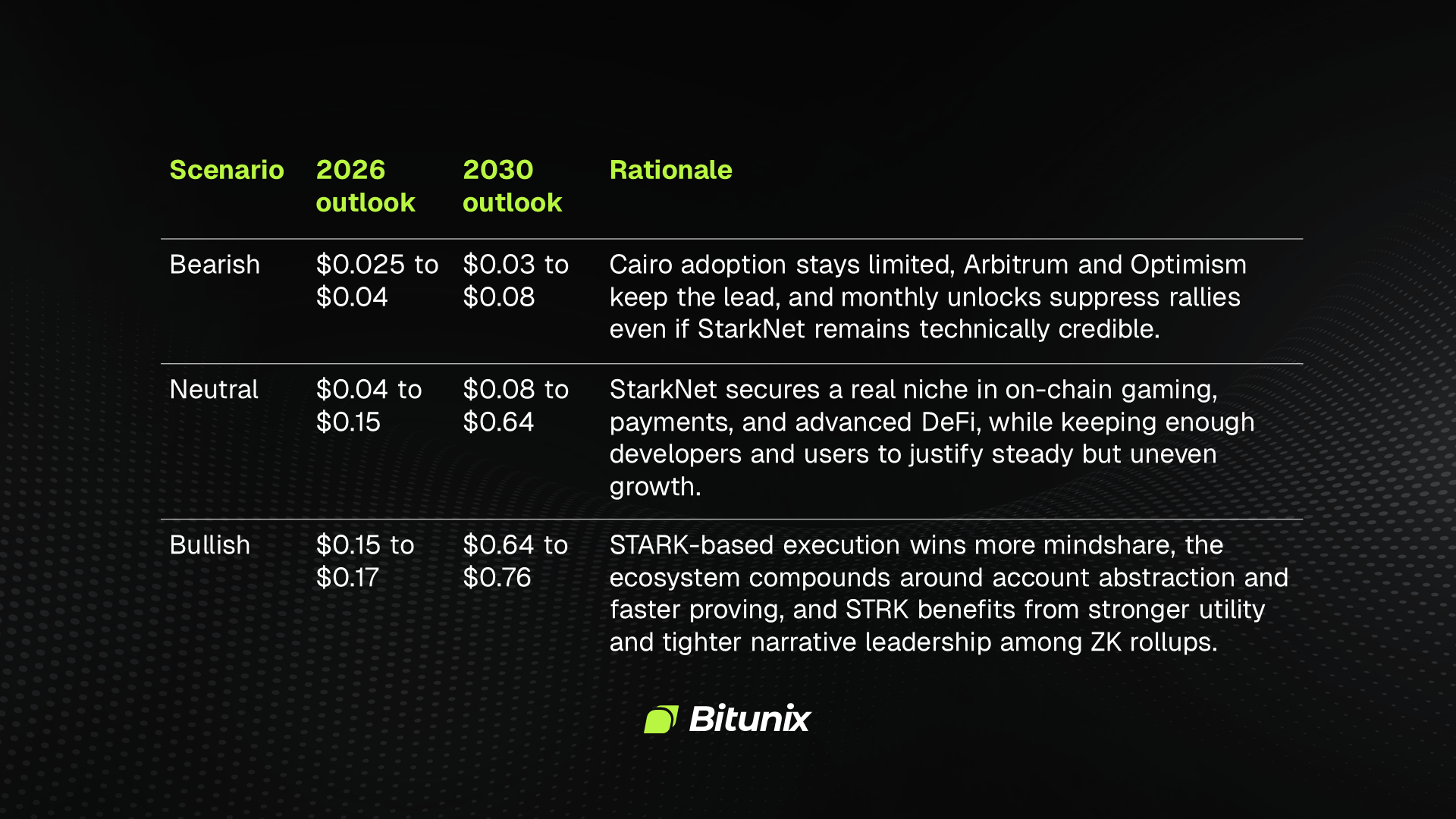
StarkNet outlook table comparing bearish, neutral, and bullish scenarios for 2026 and 2030 based on adoption, ecosystem growth, and competition in the Layer 2 market.
Conclusion: A Bet on Cryptographic Superiority
StarkNet remains one of the most technically serious scaling projects in crypto. Its STARK-based design, native account abstraction, current ZK-Rollup architecture, and Cairo-first approach give it real differentiation inside the Ethereum Layer 2 market.
But the investment case still has sharp edges. Competition is brutal, Cairo is harder to adopt than EVM-equivalent tooling, and token unlocks are still a heavy weight on price.
If you want exposure to the trade, Bitunix offers STRK markets and many other trading pairs. To join, download the Bitunix app and register there to follow STRK and other Layer 2 assets more closely.
FAQ Section
What is StarkNet (STRK)?
StarkNet is a ZK-Rollup on Ethereum that uses STARK proofs to scale transactions off-chain and settle them on Ethereum. STRK is the network's native token and is used for fees, staking, and governance-related functions inside the ecosystem.
What is the difference between StarkNet and StarkEx?
StarkNet is a general-purpose public network. StarkEx is StarkWare's application-specific scaling engine, used by projects such as ImmutableX, dYdX, and Sorare. One is an open network for many apps, and the other is more like specialized infrastructure for individual applications.
What is a ZK-Rollup?
A ZK-Rollup processes transactions off-chain, generates a cryptographic proof showing the new state is valid, and submits that proof to Ethereum. That lets the network scale while still inheriting Ethereum's settlement layer and security model.
Why does StarkNet use Cairo instead of Solidity?
StarkNet uses Cairo because it is designed for provable computation and works naturally with STARK-based execution. Solidity is easier for current Ethereum developers, but Cairo gives StarkNet more direct control over performance and proof-friendly design.
What is the utility of the STRK token?
STRK is used for transaction fees, staking, and governance. Current Starknet docs say that since September 2025, fees on StarkNet are paid in STRK. The token also plays a role in staking and long-term network decentralization.
How does StarkNet compare to Arbitrum and Optimism?
StarkNet is more technically differentiated because it uses STARK proofs and Cairo, but Arbitrum and Optimism are far larger in terms of the value secured today. L2Beat shows Arbitrum at about $13.58 billion in TVS and OP Mainnet at about $1.39 billion, versus StarkNet at about $617 million.
What is Account Abstraction on StarkNet?
On StarkNet, every account is a smart account by design. That makes advanced wallet behavior easier, including session keys, social-login style onboarding, and more flexible UX patterns than the old externally owned account model usually allows.
Are STARKs better than SNARKs?
Not in every category. STARKs avoid trusted setup and are more attractive for post-quantum security assumptions, but they usually produce larger proofs. A 2025 comparative study found SNARKs generated proofs faster, while STARKs verified faster and avoided a trusted setup.
What are the risks of investing in STRK?
The main risks are competition, slow Cairo adoption, recurring unlock pressure, and incomplete decentralization. There is also execution risk. L2Beat recorded a January 2026 outage, and the project still does not pass the walkaway test under its current operator and governance structure.
Where can I buy the STRK token?
You can buy STRK on centralized exchanges and use it on-chain through StarkNet wallets and bridges. Bitunix offers STRK futures markets, while CoinGecko also tracks STRK market data and liquidity across the broader market.
Glossary
- ZK-Rollup: A rollup that proves off-chain state transitions with validity proofs and settles them on Ethereum.
- Validity proof: A cryptographic proof that shows a state update was produced correctly from valid transactions.
- STARK: A proof system used by StarkNet that avoids trusted setup and offers strong scalability properties.
- SNARK: Another zero-knowledge proof system, often smaller in proof size but dependent on different tradeoffs.
- Cairo programming language: StarkNet's native language for writing provable programs and smart contracts.
- Ethereum Layer 2: A network built on top of Ethereum to improve speed and lower costs while relying on Ethereum for settlement.
- Account abstraction: A wallet model where accounts are programmable smart contracts instead of simple externally owned accounts.
- Session keys: Temporary delegated keys that let apps perform limited actions without repeated user signatures.
- TVS: Total Value Secured, L2Beat's measure of the value held or represented by a Layer 2 network.
- UOPS: User operations per second, an activity metric tracked by L2Beat for Layer 2 networks.
- Sequencer: The operator or service that orders transactions on a rollup before they are finalized and proven.
- Prover: The system that generates the cryptographic proof showing the rollup state transition is valid.
- Stage 1 rollup: L2Beat's maturity classification for a rollup that has made meaningful decentralization progress but is not fully decentralized.
- Token unlock: A scheduled release of previously locked tokens into the circulating supply.
- FDV: Fully diluted valuation, the market value implied if the total token supply were circulating.
Disclaimer
This article does not provide:
(i) investment advice or investment recommendations;
(ii) an offer or solicitation to buy, sell, or hold digital assets;
(iii) financial, accounting, legal, or tax advice.
Digital assets, including stablecoins and NFTs, involve high risk and may fluctuate significantly. Consider whether trading or holding digital assets is appropriate for you given your financial situation. Consult a qualified legal, tax, or investment professional when needed. You are responsible for understanding and complying with applicable local laws and regulations.
About Bitunix
Bitunix is a global cryptocurrency derivatives exchange trusted by over 3 million users across more than 100 countries. At Bitunix, we are committed to providing a transparent, compliant, and secure trading environment for every user. Our platform features a fast registration process and a user-friendly verification system supported by mandatory KYC to ensure safety and compliance. With global standards of protection through Proof of Reserves (POR) and the Bitunix Care Fund, we prioritize user trust and fund security. The K-Line Ultra chart system delivers a seamless trading experience for both beginners and advanced traders, while leverage of up to 200x and deep liquidity make Bitunix one of the most dynamic platforms in the market.
Bitunix Global Accounts
X | Telegram Announcements | Telegram Global | CoinMarketCap | Instagram | Facebook | LinkedIn | Reddit | Medium