
Article Summary
- This article provides a balanced price prediction for the SPELL token, the governance and fee-sharing token for the Abracadabra.money decentralized finance (DeFi) platform.
- It explains the core function of Abracadabra: a cross-chain lending protocol that allows users to deposit interest-bearing assets (like yvUSDT) as collateral to mint a USD-pegged stablecoin, Magic Internet Money (MIM).
- The bullish case is built on Abracadabra's innovative "degenbox" strategy, its multi-chain presence, and the utility of the SPELL token for governance and fee accrual. Staking SPELL (as sSPELL) allows holders to earn a portion of the protocol's revenue.
- The bearish case focuses on the high risks associated with the protocol, including its history of being linked to controversial figures (Wonderland/Sifu), the inherent smart contract risks of its complex strategies, and intense competition from other DeFi lending platforms like MakerDAO.
Abracadabra.money built a following with a simple pitch. Users deposit yield-bearing collateral, mint MIM against it, and keep that collateral productive while they borrow. SPELL sits at the center of that system. It handles incentives, governance, and fee capture for stakers. If you first see SPELL/USDT on a crypto exchange, including Bitunix, it's helpful to remember that the token tracks a single lending machine, not the entire DeFi market.
For readers asking what is SPELL Token, the short answer is that SPELL is Abracadabra's protocol token. sSPELL is the staked version used for fee-sharing and governance. MIM is the USD-pegged stablecoin minted against collateral.
This analysis will weigh the bullish and bearish arguments for the SPELL token, examining its utility, the risks of its underlying protocol, and its potential future value.
The Bullish Case for SPELL
The bullish case starts with utility. Abracadabra still offers a lending design that many DeFi users find attractive because it lets collateral keep earning while it backs a loan. And the token still has a real job inside that system.
Innovative Lending Model
Abracadabra's core idea remains strong. Users post interest-bearing assets and mint MIM against them. That creates a more capital-efficient setup than plain collateral that sits idle.
The official docs still describe the token stack clearly:
"sSPELL: obtained by staking SPELL tokens and used for fee-sharing and governance!"
That matters for valuation because SPELL is tied to platform usage. When borrowers use cauldrons and stakers share fees, the token has a measurable role inside the protocol.
Multi-Chain Presence
Abracadabra is much smaller than it used to be, but it still operates across several chains. DeFi Llama currently shows $11.72 million in TVL, with Arbitrum at $6.77 million, Ethereum at $2.47 million, and Blast at $2.13 million.
The docs also list SPELL and MIM deployments across Ethereum, Arbitrum, Optimism, BSC, Fantom, Avalanche, and other EVM networks. That cross-chain footprint keeps the project relevant to users who move liquidity across ecosystems instead of staying on one chain forever.
Real Utility For SPELL
SPELL still has more use than many small governance tokens. CoinMarketCap lists the token at about $0.000174, with a market cap of 29.85 million, 24-hour volume of 4.05 million, and 171.51 billion tokens in circulation. Abracadabra's updated docs still present sSPELL as the fee-sharing and governance layer, which means token demand depends on whether holders believe fees can recover.
The DegenBox Strategy
DegenBox remains one of Abracadabra's most important differentiators. The developer docs describe it as the token vault powering Abracadabra and explain that cauldrons built on top of it can reduce transaction costs and support multiple strategies for assets held inside.
In practice, that gave the protocol its reputation among advanced yield farmers. It lets users batch actions, loop positions, and push capital efficiency harder than standard lending interfaces usually do. When risk appetite returns, that design can still attract sophisticated users.
Bullish Price Signals For 2026
A realistic upside case needs numbers. CoinCodex now projects SPELL to be around $0.0001876 by the end of 2026. Cryptopolitan models a wider 2026 band and places the top of that range at $0.00035. Those forecasts are not moonshots, and that is a good thing.
They suggest the market still sees room for upside if the protocol stabilizes, MIM holds its peg, and borrowing activity improves. Even a move to $0.00035 would only place SPELL near a circulating market cap of roughly $60 million at current supply, which is ambitious but not absurd.
The Bearish Case Against SPELL
The bearish case is easier to make, and that says a lot. Abracadabra is still alive, but current data shows a small protocol with weak recent fee generation, fresh exploit history, and a token supply profile that leaves little room for optimism. The question is not whether the risks exist. They do. The real question is whether the reward still covers them.
Reputational Damage
That reputational overhang still follows SPELL because Abracadabra and Wonderland belonged to the same Daniele Sestagalli ecosystem. A 2025 Binance Square explainer says Abracadabra was founded by a team that included Sestagalli, the developer behind Wonderland, and that SPELL is Abracadabra's governance, staking, and fee token. When Sifu at Wonderland was identified as Michael Patryn, the trust shock spread beyond TIME, and investors treated it as a problem for the wider Sestagalli network.
That association still weighs on SPELL because DeFi users price governance risk fast. The scandal raised two ugly questions at once: who was really running treasury decisions, and how much due diligence the ecosystem leadership had done. Later security failures kept that old doubt alive. In October 2025, Binance Square reported another Abracadabra exploit and noted that SPELL fell nearly 8% right after the news. Once a project gets tagged as risky on both governance and security, the label sticks.
Smart Contract and Systemic Risk
Security is the bigger problem. Halborn documented a roughly $13 million exploit in March 2025 and another roughly $1.8 million exploit in October 2025. MetaMask's October 2025 security report described the October incident as Abracadabra's third major breach since early 2024 and said the platform lost roughly $1.7 million in that attack alone. DefiLlama's hack tracker also lists the January 2024, March 2025, and October 2025 incidents directly on the Abracadabra page. That is a rough record for a leveraged lending protocol.
Intense Competition
Abracadabra does not compete with small experimental lenders anymore. It competes with the biggest names in on-chain credit, and that changes the whole risk-reward setup for SPELL. DeFi Llama shows Abracadabra at about $11.9 million in TVL, with zero fees and zero revenue over the last 30 days. By contrast, Aave sits at roughly $25.1 billion in TVL and generated about $21.6 million in gross profit in Q1 2026, with revenue coming from core lending activity such as borrow interest, liquidation fees, flash loan fees, and GHO-related income. That tells users that traders and borrowers already trust Aave at a scale Abracadabra is nowhere near.
Sky Lending creates a different kind of pressure. It focuses on stablecoin credit and large-scale collateralized borrowing, which overlaps more directly with Abracadabra's MIM-based model. DeFi Llama shows Sky Lending at about $7.35 billion in TVL, $34.45 million in fees over the last 30 days, and $17.22 million in 30-day revenue. Its fee engine is also more diversified, drawing from stability fees, liquidation income, and Peg Stability Module fees. So the issue is not just that Abracadabra is smaller. It is that competitors already offer deeper liquidity, stronger revenue generation, and more established user trust in the exact markets SPELL needs to win back.
MIM Stability Risk
SPELL also depends on MIM crypto staying credible. DeFi Llama currently shows MIM at about $0.99 with a market cap of $34.27 million and 34.53 million circulating. That is not a collapse, but it is a modest base for a stablecoin that once had much bigger ambitions. The tokenomics docs still state that MIM is a USD-pegged stablecoin backed by interest-bearing collateral. If that peg weakens again, confidence in the whole Abracadabra stack weakens with it.
Supply Pressure and Thin Liquidity
Supply is another headache. CoinMarketCap lists 171.51 billion SPELL circulating and 196 billion total supply, while Abracadabra's updated tokenomics page still describes a 210 billion total supply after the burn. CoinMarketCap's March 2026 analysis also flagged a 2.395 billion SPELL transfer to DWF Labs in September 2025, noting that the movement came from vested tokens rather than a new purchase. That kind of unlock does not guarantee selling, but it hangs over a token with a relatively small market cap and daily turnover near 13.6% of market value.
SPELL Token Price Prediction: Three Scenarios
Any SPELL Token price prediction for 2026 should start with the live base case. SPELL currently trades around $0.000174 with a $29.85 million market cap. Abracadabra's TVL is $11.72 million; fees and revenue over the last 30 days both show zero on DefiLlama, and MIM remains a small stablecoin with a market cap of about $34.27 million. CoinCodex models $0.0001876 by year-end 2026, while Cryptopolitan places the 2026 high at $0.00035. Those numbers set a sensible range for scenario building.
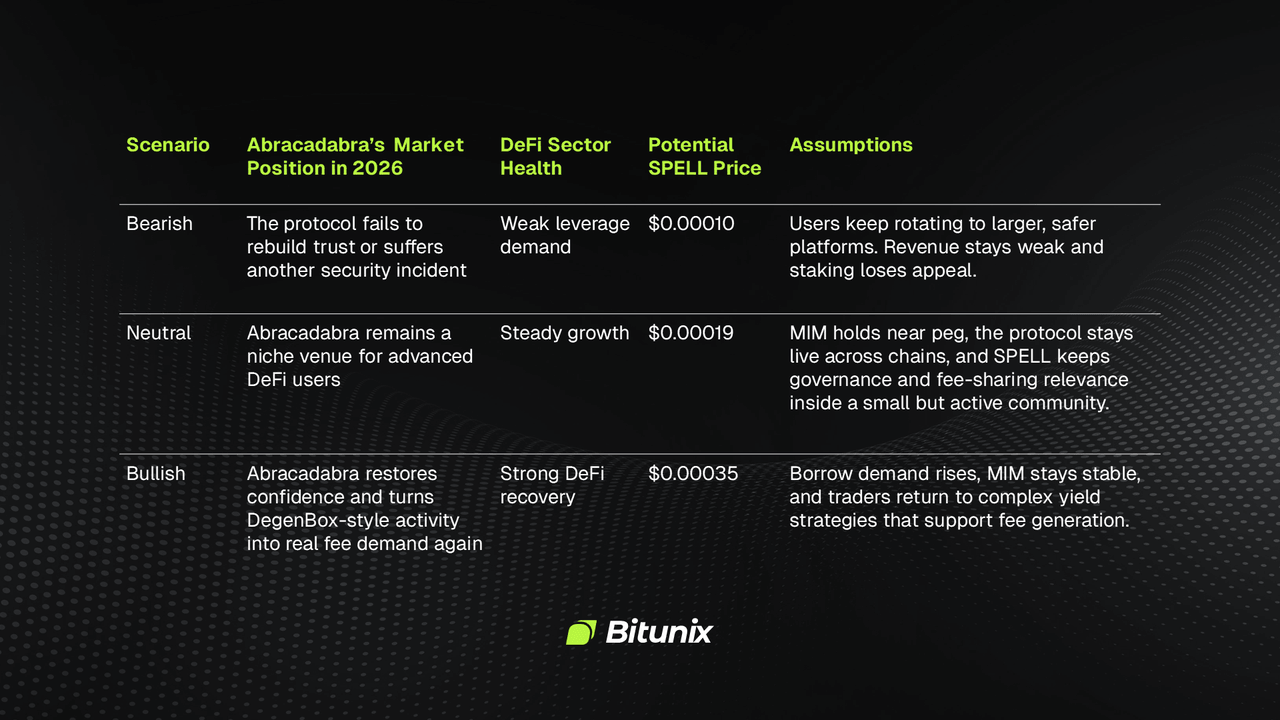
SPELL price outlook for 2026, comparing bearish, neutral, and bullish scenarios based on protocol recovery, DeFi conditions, and fee generation.
Those price bands stay grounded. At the current circulating supply, $0.00010 implies a market cap of roughly $17.15 million. $0.00019 implies about $32.59 million. $0.00035 implies about $60.03 million. That is why this SPELL Token price prediction stays conservative. It reflects today's thin protocol scale, recent exploits, and large token supply.
A quick note on extreme forecasts is useful here. Some 2026 models still print numbers far above the current price. But once the market cap math is applied, those targets look hard to defend unless Abracadabra posts a major turnaround in TVL, fee generation, and user trust.
Conclusion: A High-Risk, High-Reward DeFi Play
SPELL gives direct exposure to one of DeFi's more unusual lending systems. The design still has merit. Yield-bearing collateral, cross-chain deployment, and fee-linked staking are useful features. But the protocol is also smaller than the leading lenders by a huge margin, and the 2025 exploit record speaks for itself. That leaves a clear verdict. SPELL remains a high-risk token whose upside depends on security, MIM stability, and real fee recovery.
For readers asking is SPELL Token a good investment, the answer depends on risk tolerance and time horizon. It fits a small speculative DeFi allocation better than a core long-term position. Traders may like the volatility. Long-term holders need patience and a strong stomach.
If you want a simple way to access SPELL markets, Bitunix is one great option. Download the Bitunix app, register, and set clear risk limits before trading.
FAQ
What is the relationship between SPELL, sSPELL, and MIM?
SPELL is the protocol token. sSPELL is the staked version used for governance and fee-sharing. MIM is the stablecoin minted against collateral in Abracadabra's lending markets.
Who is the founder of Abracadabra.money?
Abracadabra.money was co-founded by Daniele Sestagalli, the public face of the project, and a pseudonymous developer known as Squirrel. Daniele is also known for Wonderland and Popsicle Finance, while Squirrel handled technical work and has never revealed their real identity.
Is Abracadabra.money safe?
Abracadabra is live and functional, but recent security history makes it a high-risk protocol. DefiLlama lists major incidents in January 2024, March 2025, and October 2025. Halborn and MetaMask both documented the 2025 exploits, including losses of nearly $13 million in March and about $1.8 million in October.
What is a DegenBox strategy?
DegenBox is Abracadabra's token vault layer. The developer docs say it powers the protocol and supports multiple strategies for assets held inside. In practice, users use it to batch actions, reduce transaction costs, and loop positions for more aggressive yield and leverage strategies.
How can fees be earned by holding SPELL?
Holding raw SPELL does not route fees automatically. Users usually stake SPELL into sSPELL, which the tokenomics docs describe as the fee-sharing and governance layer. Protocol fees, including borrow fees and part of liquidation fees in certain markets, feed that staking structure when activity exists.
What was the Wonderland and Sifu controversy?
The controversy centered on the disclosure that Michael Patryn, tied to the pseudonym Sifu, had been involved in the wider ecosystem around Daniele Sestagalli's projects. Recent 2025 coverage still frames that revelation as the event that triggered a community trust crisis and lasting reputational damage.
What is Magic Internet Money?
Magic Internet Money, or MIM, is Abracadabra's crypto-backed stablecoin. Users mint it by posting collateral in cauldrons and repay it to close loans. DefiLlama currently shows MIM near $0.99 with about $34.27 million in market cap, which makes it active but still relatively small.
How does Abracadabra compare to MakerDAO?
Abracadabra focuses on yield-bearing collateral and more complex leverage strategies. Sky Lending, the successor protocol in the Maker ecosystem, wins on scale by a mile. DefiLlama shows Abracadabra at $11.72 million in TVL versus Sky Lending at $7.352 billion, with much stronger fee and revenue generation.
What is the total supply of SPELL?
Two numbers appear in current sources. CoinMarketCap lists a total supply of 196 billion and a circulating supply of 171.51 billion. Abracadabra's updated tokenomics page still states a 210 billion total supply after the burn event. That mismatch is a reminder to check both market trackers and protocol docs.
On which blockchains is Abracadabra available?
Current TVL sits mainly on Arbitrum, Ethereum, and Blast, according to DefiLlama. The updated docs also list official SPELL and MIM deployments across Ethereum, Arbitrum, Optimism, BSC, Fantom, Avalanche, Polygon, Base, Linea, Blast, and other EVM networks. That keeps Abracadabra firmly multi-chain.
Glossary
- Abracadabra.money: Cross-chain lending protocol that lets users mint MIM against interest-bearing crypto collateral.
- SPELL: Abracadabra's incentive and governance token, used to align liquidity, voting, and fee exposure.
- sSPELL: Staked SPELL token that gives holders governance rights and access to protocol fee-sharing.
- MIM: Magic Internet Money, a crypto-backed stablecoin minted against collateral in Abracadabra cauldrons.
- Cauldron: Isolated lending market where users deposit collateral and borrow MIM against it.
- DegenBox: Vault layer that powers batching, leverage loops, and strategy execution inside Abracadabra.
- Yield-bearing collateral: Collateral that continues earning yield while also backing a loan position.
- Fee-sharing: Mechanism that routes part of protocol income to stakers such as sSPELL holders.
- Governance: Token-holder voting process used to influence protocol rules, incentives, and upgrades.
- TVL: Total value locked, the dollar value of assets sitting inside a protocol's smart contracts.
- Protocol revenue: Portion of fees that the protocol actually retains after distributions and costs.
- Stablecoin peg: Price target that aims to keep a stablecoin trading near one U.S. dollar.
- Liquidation: Forced position close used when collateral value falls below required thresholds.
- Circulating supply: Number of tokens currently available to the market and included in valuation math.
- Vesting overhang: Future sell pressure risk created by large token allocations unlocking over time.
Disclaimer
This article does not provide:
(i) investment advice or investment recommendations;
(ii) an offer or solicitation to buy, sell, or hold digital assets;
(iii) financial, accounting, legal, or tax advice.
Digital assets, including stablecoins and NFTs, involve high risk and may fluctuate significantly. Consider whether trading or holding digital assets is appropriate for you given your financial situation. Consult a qualified legal, tax, or investment professional when needed. You are responsible for understanding and complying with applicable local laws and regulations.
About Bitunix
Bitunix is a global cryptocurrency derivatives exchange trusted by over 3 million users across more than 100 countries. At Bitunix, we are committed to providing a transparent, compliant, and secure trading environment for every user. Our platform features a fast registration process and a user-friendly verification system supported by mandatory KYC to ensure safety and compliance. With global standards of protection through Proof of Reserves (POR) and the Bitunix Care Fund, we prioritize user trust and fund security. The K-Line Ultra chart system delivers a seamless trading experience for both beginners and advanced traders. At the same time, leverage of up to 200x and deep liquidity make Bitunix one of the most dynamic platforms in the market.
Bitunix Global Accounts
X | Telegram Announcements | Telegram Global | CoinMarketCap | Instagram | Facebook | LinkedIn | Reddit | Medium