
Article Summary
- This article provides a detailed price prediction and fundamental analysis for the Propy (PRO) token.
- It explains Propy as a blockchain-based real estate platform designed to automate the property purchasing process, making it faster, more secure, and entirely digital.
- The bull case focuses on the massive potential of the Real-World Asset (RWA) narrative, the inefficiency of traditional real estate transactions, and Propy's first-mover advantage in property tokenisation.
- The bear case highlights immense regulatory hurdles, the slow adoption of blockchain technology by traditional real estate institutions, and the illiquidity of property markets.
- It presents detailed price prediction scenarios (bearish, neutral, bullish) for both 2026 and 2030, based on RWA market growth and platform adoption.
Buying a home is still slow, document-heavy, and packed with intermediaries, even though most other financial processes have already gone digital. Propy was built to attack that problem with blockchain-based closings, on-chain deed recording, and crypto-native financing tools that aim to make property transfers faster and easier to verify. For anyone who follows real-world assets (RWA) on a crypto exchange, Propy is one of the clearest attempts to connect blockchain infrastructure with a real-world transaction that people already understand. Bitunix also offers PRO/USDT trading, so the token is accessible once the thesis starts to look credible enough to trade.
At a functional level, Propy uses smart contracts to automate stages of the real estate process, from offer management to closing, while also enabling NFT-linked and on-chain property records. That makes it more than a token with a real estate label attached. It is trying to become a blockchain property workflow for title, escrow, financing, and real estate tokenization.
This analysis will examine Propy's technology, its position within the growing RWA crypto sector, and provide data-driven price predictions for 2026 and 2030.
The Technology and Ecosystem
Propy's technology stack is built around the goal to reduce the friction, paperwork, and manual coordination that slow down traditional property transactions. The platform uses blockchain to support deed recording, transaction workflows, and tokenized real estate structures. Propy is trying to become a working layer for blockchain property transfers, title handling, and digital settlement.
The platform's own documentation describes the token side clearly:
"The PRO token is an ERC-20 utility token on the Ethereum blockchain. It is required to access Propy services, including minting Address NFTs."
According to Propy's 2025 whitepaper, the token is used for service fees related to deed recording, tokenization, education, and Web3 property listings. The same document also makes clear that PRO does not grant ownership, profit rights, or governance rights.
Its transaction model is designed to move buyers, sellers, agents, and service providers through a digital closing process with smart contracts handling parts of the workflow that would normally depend on slower manual coordination. This can reduce closing time significantly, with some recent cases moving from the traditional 30 to 40 day range to as little as 3 days.
Property tokenization is the second major pillar of the ecosystem. Its Tier 3 tokenization model allows full property ownership to be represented through an LLC or comparable legal wrapper tied to an NFT-linked title. It suggests that Propy is trying to connect legal ownership structures with real estate tokenization in a way that still functions within established property law.
The business around that infrastructure also appears more developed than many blockchain real estate projects. Propy has said it has processed more than $4 billion in transactions, and its recent acquisition strategy shows that, by acquiring title and escrow capacity, it aims to expand deeper into the real estate workflow it seeks to modernize. That gives the platform a more practical structure, but it also means the company now has to prove it can scale both the technology and the operational side of the business simultaneously.
The Bull Case: The RWA Narrative
For PRO, the bullish case depends on a market that still has not decided whether the token belongs in the category of small utility assets with limited upside or in the much larger real estate tokenization trend.
CoinGecko currently puts PRO around $0.35, with a market cap of $20.3 million, roughly 57.9 million tokens in circulation, and about $4.78 million in 24-hour trading volume. From there, forecast models spread out sharply. CoinCodex's price prediction sees a 2026 range of $0.3487 to $0.8969, Kraken's model and MEXC's forecast stay much more conservative around $0.35 to $0.36 for 2026 and roughly $0.43 by 2030. TradersUnion's price prediction projects a 2026 range of $0.8276 to $0.8614, while CoinLore's forecast gives the most aggressive stretch case with a 2026 range of $0.2087 to $1.02 and a 2030 target of $4.03.
1. The RWA Megatrend
Growth in real-world asset tokenization is one of the main reasons Propy still has a credible long-term upside story. As more capital moves toward tokenized versions of off-chain assets, real estate stands out as one of the largest markets blockchain can modernize. That gives Propy a clear narrative tailwind, because it is focused on a category with real size rather than a niche use case.
For PRO to grow, it needs the platform to secure a meaningful role inside a growing RWA market. If institutions, property platforms, and crypto-native buyers keep moving toward on-chain property infrastructure, Propy has a stronger chance of turning that broader RWA trend into actual platform usage and more durable demand for the PRO token.
2. Solving Real Inefficiencies
A second bullish point is that Propy is targeting a real problem. Real estate closings are slow, expensive, and often repetitive across title, escrow, compliance, and document verification. Propy's January 2026 update says its integrated workflow is already pushing some closings from 30 to 40 days down to as little as 3 days, with escrow and deposits moving within minutes of signing.
The August 2025 Morpho partnership strengthens that point because it pushed Propy into a more complete on-chain transaction model. Propy said the collaboration would support licensed property sales executed entirely on-chain with the same legal finality as a traditional closing, while also unifying compliance, title transfer, settlement, and financing in one workflow.
3. First-Mover Advantage
Propy's first-mover advantage comes from the fact that it has already done the kind of blockchain-based property transactions that many competitors still discuss mostly in theory. The platform has processed more than $4 billion in transactions, facilitated Hawaii's first on-chain real estate sale, and kept expanding its role in title, escrow, and tokenized property workflows.
That track record matters for the bullish case because investors usually assign more credibility to a platform that has already moved real properties through blockchain rails than to one that is still proving the concept. It does not remove execution risk, but it does give Propy a stronger position as the real estate tokenization market grows. If adoption keeps expanding, that early experience can help Propy win more users, more partnerships, and more trust than newer platforms starting from scratch.
The Bear Case: The Regulatory Mountain
Current forecast models already show why the bearish case cannot be dismissed. Kraken and MEXC both keep PRO close to current levels through 2026 and only slightly higher by 2030, while Coinbase's 5% growth tool also lands near the same general range for the end of the decade. Even the more optimistic projections from CoinCodex and TradersUnion still do not look like forecasts for a token that has become the default standard for blockchain-based property transfers. Taken together, those estimates suggest the market sees the concept, but still has real doubts about whether Propy can scale far enough to justify a much larger valuation.
1. Regulatory Hurdles
Real estate law is local, fragmented, and full of state-level, county-level, and country-level differences. Propy has made real progress in a few jurisdictions, but the same progress also shows how much custom legal integration is needed. Its August 2025 Morpho announcement emphasized licensed property sales with legal finality and unified compliance, which is encouraging. Still, it also reveals how much legal structure has to sit around the on-chain piece for the transfer to matter in the real world.
EY's 2026 tokenization overview adds the warning that tokenized assets require careful review of contract terms, legal ramifications, and the precise legal interests a token represents. That is especially relevant for real estate tokenization, where a token may reflect ownership, a contractual right, or some legal wrapper rather than the direct title itself.
2. Institutional Resistance
Traditional real estate also has incumbents with strong reasons to protect the status quo. Title companies, escrow agents, broker networks, and closing-service vendors already earn fees from a process that is slow and fragmented. Propy's own strategy partly acknowledges that reality. Instead of trying to bypass the whole system from the outside, it is buying title operations and building a $100 million rollup. That is probably smart, but it also suggests that institutional resistance is real enough that pure software disruption was not going to be sufficient on its own.
That resistance can slow adoption even when the product works. Q1 2025 education efforts across Florida, Colorado, and Arizona showed that Propy still has to train hundreds of agents on blockchain deals and smart-contract workflows. In other words, part of the business is changing how real estate professionals think and work, and that takes time.
3. Market Illiquidity
Real estate remains less liquid than most crypto assets, harder to price continuously, and more exposed to local market conditions than a typical altcoin. Deloitte emphasizes the long-term size of the opportunity, while real estate tokenization industry coverage still frames improved liquidity as a potential benefit rather than a solved outcome.
During weak property cycles or broader risk-off conditions, illiquidity can limit transaction volume and slow fee generation. Propy may be better positioned than a generic RWA platform because it touches actual title and escrow processes. However, the asset class itself still moves more slowly than most crypto markets. That keeps a cap on how fast the platform can expand, even in a bullish tokenization environment.
Propy (PRO) Price Prediction Scenarios (2026 & 2030)
Looking across the forecast models, the evident pattern is that there is still no strong agreement on how large Propy's upside really is. Kraken, MEXC, and Coinbase sit near the conservative end and keep PRO relatively close to current levels. CoinCodex and TradersUnion allow for more meaningful growth if adoption improves, while CoinLore stands out as the most aggressive long-term case in the group.
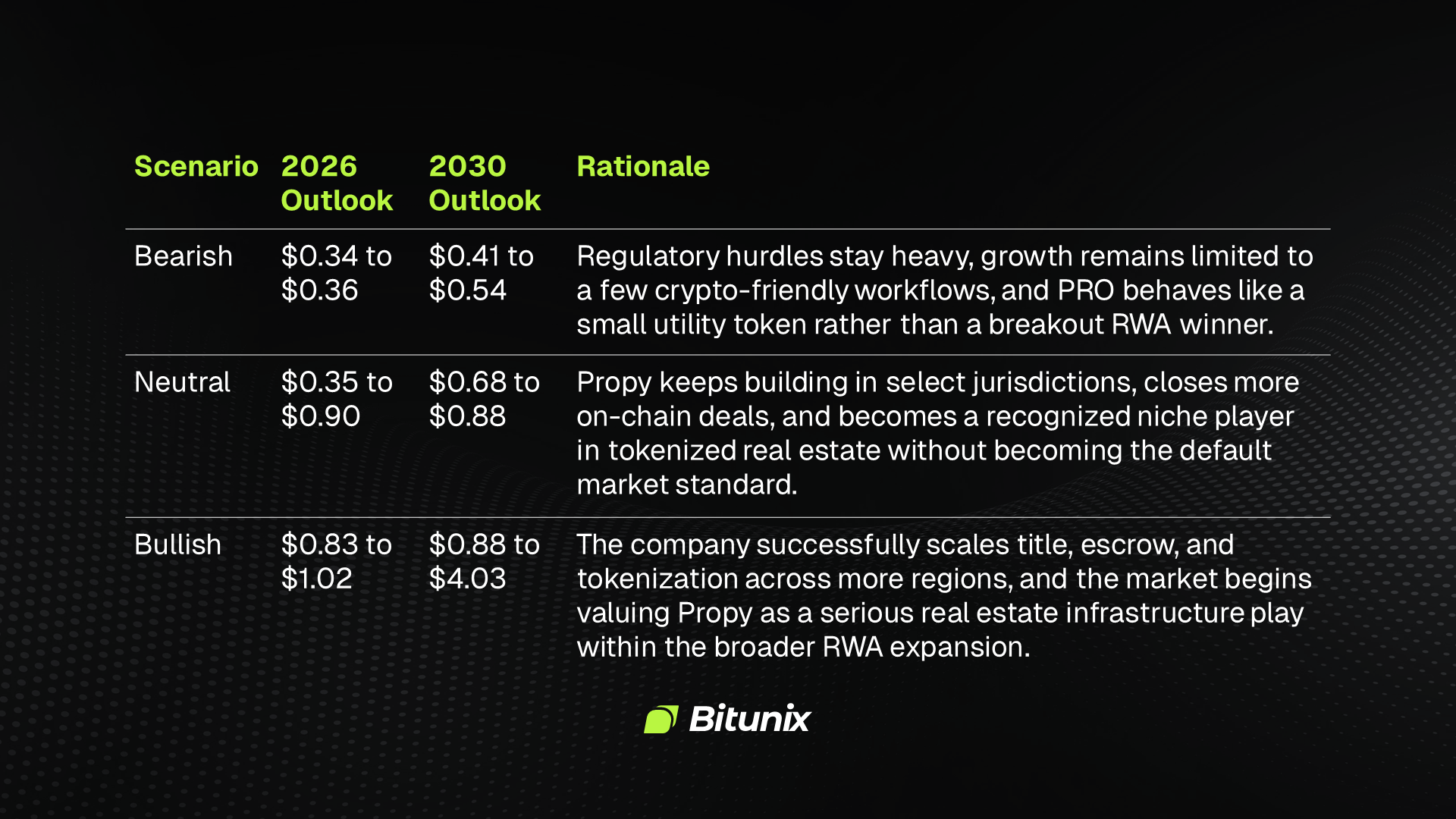
Propy price prediction scenarios for 2026 and 2030, comparing bearish, neutral, and bullish outcomes based on regulation, adoption, and real estate tokenization growth.
Conclusion: A Bet on Tokenized Property
Propy represents one of the most serious attempts to bridge blockchain and traditional real estate because it aims to automate title, escrow, financing, deed recording, and on-chain settlement within a real operating business. The platform has already processed more than $4 billion in transactions, facilitated Hawaii's first on-chain sale, and continued expanding into institutional real estate in 2026.
Investing in PRO is still a long-term bet on digitization, real estate tokenization, and the idea that legal property transfers eventually become more programmable and more transparent. That trend has real upside, but it comes with legal complexity, institutional resistance, and the basic illiquidity of property markets.
If you want exposure, Bitunix offers PRO/USDT trading, so you can download the Bitunix app, register, and decide whether the current setup looks compelling enough for an RWA bet.
FAQ
What is Propy (PRO)?
Propy is a blockchain-based real estate platform that uses smart contracts and on-chain records to help buyers, sellers, agents, and deal partners close transactions online. PRO is the platform's utility token used for access to specific services.
How does Propy use blockchain for real estate?
Propy uses blockchain to record deeds, manage transactions, support on-chain listings, and connect title, escrow, financing, and settlement in a more automated workflow. The goal is to reduce delays, manual handoffs, and fraud risk in property transfers.
What is a Real-World Asset (RWA) in crypto?
An RWA in crypto is an on-chain representation of an off-chain asset, such as property, credit, or other legally recognized value. In Propy's case, the relevant RWA is real estate that can be recorded or tokenized through blockchain-linked legal structures.
Can I buy a house using cryptocurrency on Propy?
Yes. Propy supports some blockchain-based home purchases using crypto such as Bitcoin, Ethereum, and stablecoins like USDC. For eligible listings, buyers can connect a wallet, complete compliance checks, pay on-chain, and finalize title transfer through smart contracts. Availability still depends on the property and jurisdiction.
What is the utility of the PRO token?
The PRO token is used to access Propy services such as minting Address NFTs, recording deeds on-chain, tokenizing real estate assets, enrolling in courses, and creating Web3 property listings.
How does Propy handle legal title transfers?
Propy handles legal title transfers through a hybrid process. It still files deeds with local government offices to keep ownership legally enforceable, while also recording transaction data on blockchain for transparency and fraud protection. Smart contracts, escrow, compliance checks, and title agents help automate and secure the process.
What is property tokenization?
Property tokenization is the process of turning real estate ownership or related rights into blockchain-based tokens. Those tokens can represent full ownership, partial ownership, equity, or income rights. The goal is to make property easier to divide, transfer, and, in some cases, trade more efficiently.
Who are Propy's main competitors?
Propy competes with other tokenized property platforms, RWA infrastructure providers, and traditional real estate technology vendors in title, escrow, and closing services. In practice, the harder competition often comes from incumbent real estate processes rather than from crypto-native rivals alone.
What are the regulatory risks of investing in PRO?
The biggest risks are jurisdictional complexity, uncertainty about the legal treatment of tokenized property structures, and the need to align blockchain records with local title and escrow laws. Those factors can slow growth even if the technology itself works well.
Where can I buy PRO tokens?
You can buy PRO on centralized exchanges such as Bitunix, MEXC, KuCoin, Gate.io, Coinbase, Kraken, and Revolut. It is also available on decentralized platforms like Uniswap, since PRO is an ERC-20 token.
Glossary
- PRO token: Propy's ERC-20 utility token used to access platform services such as deed recording, tokenization, and listings.
- Propy real estate: The broader Propy platform and ecosystem focused on blockchain-enabled property transactions.
- Blockchain property: A property workflow or ownership record that uses blockchain rails for verification, settlement, or transfer.
- RWA crypto: A crypto category focused on tokenizing real-world assets such as property, credit, and other off-chain value.
- Real estate tokenization: The conversion of real estate ownership or rights into blockchain-based tokens or NFTs.
- Smart contracts: Self-executing code used to automate transaction steps once predefined conditions are met.
- On-chain deed recording: Recording deed-related metadata on a blockchain so ownership evidence becomes more transparent and tamper-resistant.
- Title and escrow: The legal and operational process of verifying ownership, holding funds, and completing a property transfer.
- Address NFT: A Propy on-chain asset representing a property address that can later be linked to deed or tokenization features.
- LLC wrapper: A legal entity used to package property ownership for tokenized transfer or NFT-linked representation.
- Property settlement: The final process where funds, documents, and title transfer complete a real estate transaction.
- KYC: Know Your Customer checks used to verify identity and meet compliance requirements.
- Utility token: A token used to access services or features on a platform rather than representing equity.
- Circulating supply: The number of tokens currently available to the market and tradable by the public.
- Market cap: The value of a token's circulating supply at its current market price.
Disclaimer
This article does not provide:
(i) investment advice or investment recommendations;
(ii) an offer or solicitation to buy, sell, or hold digital assets;
(iii) financial, accounting, legal, or tax advice.
Digital assets, including stablecoins and NFTs, involve high risk and may fluctuate significantly. Consider whether trading or holding digital assets is appropriate for you given your financial situation. Consult a qualified legal, tax, or investment professional when needed. You are responsible for understanding and complying with applicable local laws and regulations.
About Bitunix
Bitunix is a global cryptocurrency derivatives exchange trusted by over 3 million users across more than 100 countries. At Bitunix, we are committed to providing a transparent, compliant, and secure trading environment for every user. Our platform features a fast registration process and a user-friendly verification system supported by mandatory KYC to ensure safety and compliance. With global standards of protection through Proof of Reserves (POR) and the Bitunix Care Fund, we prioritize user trust and fund security. The K-Line Ultra chart system delivers a seamless trading experience for both beginners and advanced traders, while leverage of up to 200x and deep liquidity make Bitunix one of the most dynamic platforms in the market.
Bitunix Global Accounts
X | Telegram Announcements | Telegram Global | CoinMarketCap | Instagram | Facebook | LinkedIn | Reddit | Medium