What if you could get exposure to a decentralized network for artificial intelligence, without needing a PhD or a GPU farm? That is the appeal of Bittensor (TAO). It sits in the AI crypto category, and it tends to move when the AI narrative moves.
If you want to trade it on a reliable crypto exchange, the simplest route is futures. You buy TAO, you own TAO, and you can convert it back to USDT when your plan says it is time. This guide explains what Bittensor is, why traders watch it, and how to approach TAO/USDT on Bitunix with a strategy instead of vibes.
What is Bittensor (TAO)? A simple explanation
Bittensor’s core idea is straightforward: build an open network where machine learning models compete and cooperate, and reward useful work with tokens. In the project’s own words, it is “a market where intelligence is priced by other intelligence systems peer-to-peer across the internet.”
A decentralized brain
Think of Bittensor as a coordination layer. Different participants contribute models, evaluate outputs, and push the network toward better performance over time. You do not need to understand every detail to trade TAO, but you do need a mental model that is accurate enough to explain why the token can trend hard in both directions.
A market for intelligence
The “market” part matters because it shapes trader behavior. When people believe decentralized AI is gaining traction, TAO often gets treated like a proxy bet on that theme. When that belief weakens, it can unwind fast.
The TAO token
TAO is the network’s native token. It is used for incentives and, in practice, it is also the asset markets use to price expectations about the ecosystem.
TAO/USDT price: What actually moves it?
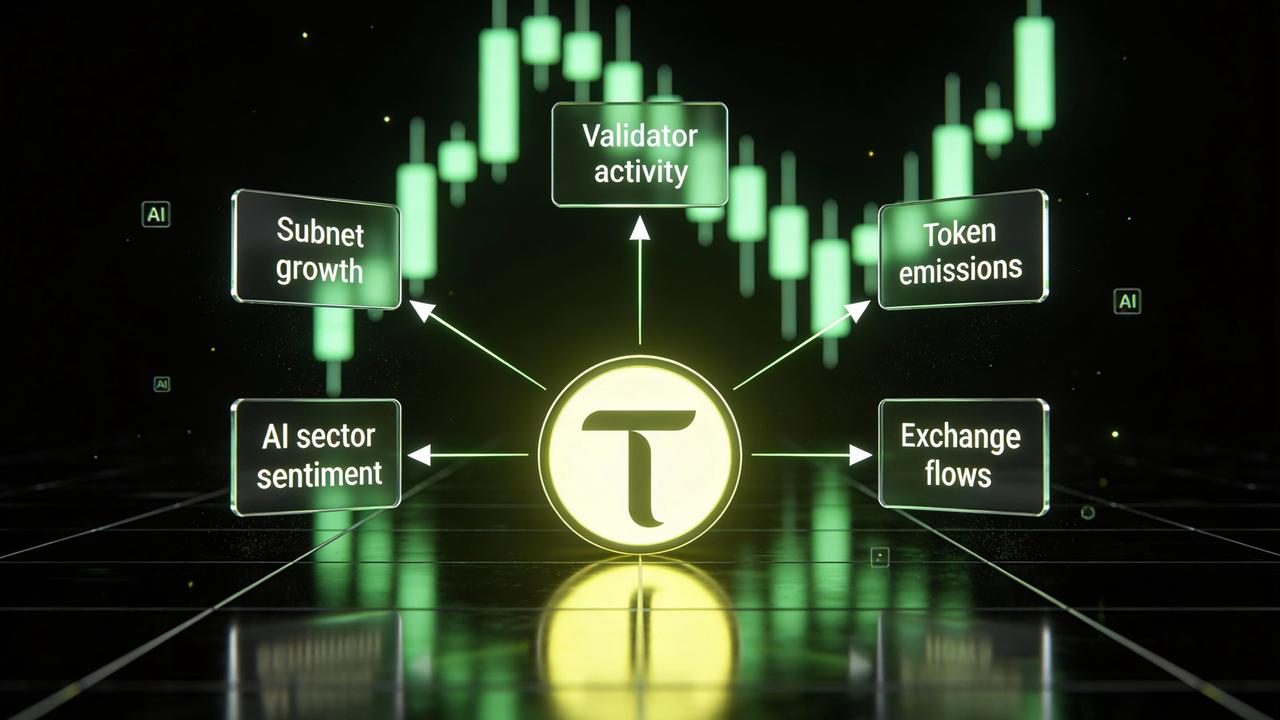
When traders talk about the TAO/USDT price, they are usually reacting to a few repeat drivers. Some are crypto-native, some are AI-news-driven, and some are simple market plumbing.
First, narrative flow matters. Big AI headlines can pull attention toward AI-linked crypto assets as a group. This is not mystical. It is just how capital rotates when a theme becomes the topic of the week.
Second, token economics matter. TAO is built around scarcity, which is easy for traders to understand. In its Dynamic TAO document, the project explains how new TAO is issued (emissions) and how subnets affect the system. It also states that the long-term supply trends toward an upper limit of 21,000,000 TAO. That “limited supply” idea shapes how many traders think about upside, especially in bull markets.
Third, ecosystem structure matters. Dynamic TAO introduces subnet tokens and subnet pools, and describes the upgrade as “an upgrade to the Bittensor chain that replaces the previous emission logic with an intelligent, market-driven mechanism.” Even if you are not trading subnets directly, this kind of design can change sentiment because it changes how people think rewards and value flow through the network.
One practical way to use this: if you see strong attention on decentralized AI combined with strong crypto risk appetite, the TAO/USDT price usually gets more sensitive to momentum trades. If the broader market turns defensive, TAO can de-risk like a high-beta asset.
Market opportunities: Why trade TAO/USDT at all?
The AI narrative
TAO is often traded as part of the AI crypto trading basket, which has reached approximately $3.7 billion in 2024 and is projected to expand to $46.9 billion by 2034. When the market wants “AI exposure,” TAO is frequently on the shortlist because it is one of the oldest, most discussed projects in the category.
Limited supply plus staking dynamics
A capped long-term supply narrative can tighten available float during periods where more holders choose to stake or hold. That does not guarantee higher prices, but it can amplify moves when demand spikes.
Complexity creates mispricing
TAO is not a simple meme coin. The learning curve is real. That complexity can create periods where price lags understanding, and then catches up quickly when attention returns.
Three strategies for trading TAO/USDT (Futures)
Strategy 1: Narrative-based trading
This is the most common approach. You trade the AI theme, not just a chart. When major AI news hits, and crypto markets are risk-on, TAO often gets pulled into the move.
Execution idea: decide your entry trigger before the headline arrives. For example, you may only enter after a clean break above a key resistance level on rising volume. Then you define your exit rules the same way. No improvising mid-trade.
Strategy 2: Long-term holding based on fundamentals
This is closer to investing than trading. If you believe decentralized AI markets will matter, you can accumulate gradually and reduce timing risk.
Use a dollar-cost averaging approach so your exposure builds over time instead of betting on one perfect entry.
Strategy 3: Technical range trading
TAO can consolidate for long stretches after big moves. Range trading can work well if you stay disciplined.
Execution idea: map support and resistance, then use confirmation tools like RSI and volume. If the range breaks, you stop range-trading and switch to a trend plan. Do not argue with the chart.
Why Bitunix Is a Strong Platform For TAO Futures Trading
When you trade a token that can move quickly, execution and clarity matter more than slogans.
Bitunix supports futures trading workflows with features that help you plan entries and manage exits. If you want a refresher on the basics, start with a futures trading guide and then practice with a small size.
Fees (TAO/USDT)
On Bitunix, TAO/USDT futures trades use your account’s futures maker/taker rate. At VIP0, futures fees start at 0.08% (maker) and 0.10% (taker), and your rate can improve with higher VIP tiers.
VIP0 is the default fee tier on Bitunix. It applies when your account doesn’t meet the requirements for a higher VIP level yet, so it’s the starting point for most new users. VIP tiers work like a ladder (VIP0, VIP1, VIP2, and higher). As you move up, your futures fees usually drop, based on factors like trading volume and/or asset balance.
Risk control tools
TAO can punish overconfidence. Use stop-loss and take-profit orders, and keep position sizing boring. If you want a practical walkthrough, Bitunix's risk management guide shows how to set TP/SL directly in the futures interface.
Conclusion: A practical way to approach AI-powered crypto
Bittensor is not a “set it and forget it” asset. It is a complex project with a clear narrative tailwind when AI dominates headlines, and a real downside when markets turn defensive.
If you want exposure without making things complicated, futures trading TAO/USDT is the clean starting point. Pick one strategy, define your risk, and follow your rules. That is not exciting, but it is how you stay solvent long enough to catch the exciting moves.
Explore the intersection of AI and crypto. Log in or sign up to Bitunix to start trading TAO/USDT today.
FAQ
Is Bittensor related to Bitcoin?
No. TAO is a separate network and token. The relationship is more about market perception: TAO borrows a familiar scarcity framing and often trades with broader crypto risk sentiment, but it is not part of Bitcoin’s protocol.
How is the price of TAO determined?
Markets set it. TAO’s price reflects supply and demand across exchanges, plus investor expectations about adoption, emissions, and the strength of the AI narrative.
What are the biggest risks associated with investing in Bittensor?
Volatility and narrative risk are big ones. TAO can move sharply on sentiment shifts. There is also an ecosystem and design risk, because the system has moving parts that can evolve over time.
How can I stake my TAO tokens?
Staking mechanics depend on the Bittensor ecosystem and tooling. If staking is part of your plan, treat it as a separate workflow from trading, since it changes liquidity and how quickly you can exit.
Who are the main competitors to Bittensor?
Competitors are other projects trying to tokenize AI infrastructure, model marketplaces, or decentralized compute. The category changes quickly, so focus on what each project actually enables, not just the label.
What is a subnet in the Bittensor ecosystem?
A subnet is a specialized part of the network tied to a specific incentive and valuation path. Dynamic TAO expands this idea with subnet tokens and market-based valuation mechanics.
Where can I follow the latest news and developments about Bittensor?
Use official Bittensor channels first, then cross-check major crypto news coverage. For trading, consistency matters more than speed. You want fewer, higher-quality inputs.
Is TAO an ERC-20 token?
TAO is native to its own network rather than an ERC-20 on Ethereum. Always verify deposit and withdrawal networks before sending funds.
What is the maximum supply of TAO?
Dynamic TAO materials anchor TAO’s long-term supply trajectory at 21,000,000 in the asymptotic limit.
How does Bittensor prevent malicious AI models from joining the network?
The system relies on incentive design and evaluation mechanisms. In simple terms, it aims to reward useful outputs and reduce rewards for low-value or manipulative behavior over time.
Glossary
futures trading: Buying or selling the actual asset for immediate settlement.
Trading pair: Two assets quoted against each other, like TAO/USDT.
Base asset: The first asset in a pair (TAO).
Quote asset: The second asset in a pair (USDT).
Order book: The list of active buy and sell orders on an exchange.
Market order: An order that executes immediately at the best available price.
Limit order: An order that executes only at your chosen price or better.
Liquidity: How easily you can buy or sell without moving price much.
Slippage: The gap between expected price and actual execution price.
Volatility: How much price moves over a given period.
Support: A price zone where buying interest often appears.
Resistance: A price zone where selling interest often appears.
Stop-loss: An order that closes a position if price hits a defined loss level.
Take-profit: An order that locks gains at a predefined target.
Dollar-Cost Averaging: Buying at regular intervals to reduce timing risk.
About Bitunix
Bitunix is a global cryptocurrency derivatives exchange trusted by over 3 million users across more than 100 countries. The platform is committed to providing a transparent, compliant, and secure trading environment for every user. Bitunix offers a fast registration process and a user-friendly verification system supported by mandatory KYC to ensure safety and compliance. With global standards of protection through Proof of Reserves (POR) and the Bitunix Care Fund, Bitunix prioritizes user trust and fund security. The K-Line Ultra chart system delivers a seamless trading experience for both beginners and advanced traders, while leverage of up to 200x and deep liquidity make Bitunix one of the most dynamic platforms in the market.
Bitunix Global Accounts
X | Telegram Announcements | Telegram Global | CoinMarketCap | Instagram | Facebook | LinkedIn | Reddit | Medium