
Article Summary
- This article explains the concept of "whales" in the context of the Cardano (ADA) market.
- A Cardano whale is defined as an address or entity that holds a very large amount of ADA, giving them the potential to influence the market price through their buying or selling activity.
- It breaks down the different types of whale addresses, distinguishing between exchanges, DeFi protocols/smart contracts, and individual large holders.
- The guide provides a practical, step-by-step introduction to using on-chain analysis tools (like blockchain explorers or specialized analytics platforms) to track whale activity.
- It analyzes what whale behavior can indicate, such as accumulation (potentially bullish) or distribution to exchanges (potentially bearish).
In the crypto market, size changes the rules. Most traders move the price by inches, but a few players can move it by feet. When you track those big players, you stop guessing based only oncandles and start reading the behavior underneath.
You will also see this dynamic on any crypto exchange, including Bitunix. Big holders exist everywhere, and the question is not whether they exist; rather, it is how they impact the market.
This guide will define what constitutes a Cardano whale, explore the different types of whale entities, and show you how to use on-chain tools to track their activity and gain a deeper insight into the ADA market.
What is a Cardano Whale?
A Cardano whale is an address or entity that holds enough ADA to influence liquidity and price when it moves funds or trades in size. There is no official cutoff, so analysts use practical thresholds that are easy to track over time. One common benchmark is 1 million ADA, because acohort at that size can change supply dynamics quickly when it accumulates or distributes.
The best way to understand whales is to look at what large cohorts do during key periods. In February 2025, Santiment reported that wallets holding at least 1 million ADA added about 1.41 billion ADA over a 15-day stretch, which it described as roughly 2.35% of the total supply. In the same note, it also pointed to a long-run price gain during that broader period.
If you want a second angle, look at concentration. In September 2025, FXStreet cited data that put 29.6% of ADA supply in the top 100 addresses, described as the highest level since 2021. It also cited long-term holders at around 19 billion ADA, or 54% of the circulating supply. These are not tiny numbers, and they help explain why whale behavior gets so much attention.
Whales matter for two practical reasons. First, a large sell can push price down fast, especially when order books are thin, or sentiment is fragile. Second, whale behavior can show intent earlier than price does, because on-chain transfers often happen before a trade shows up on a chart.
The Different Types of Whales
Not every huge ADA address belongs to a single person making one big decision. If you do not separate whale types, you will misread the market. Think of whales as categories, then decide which category you are actually tracking.
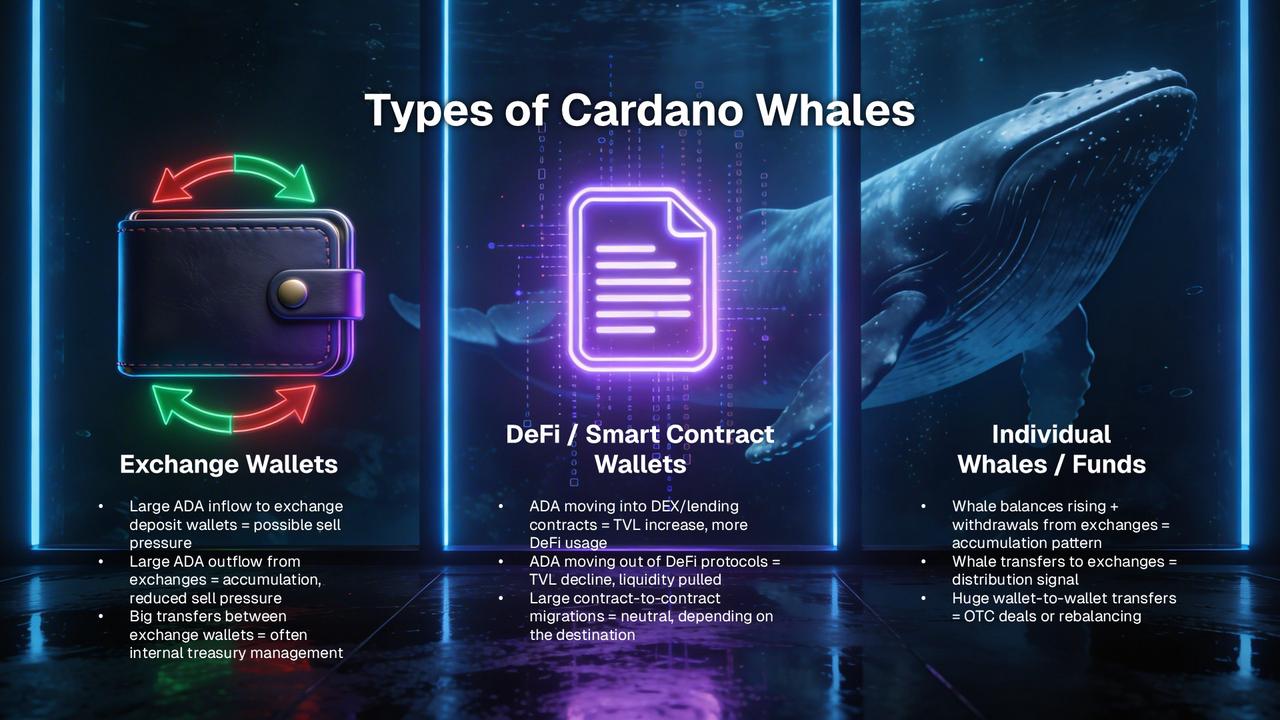
Exchange Wallets
These can be enormous because they custody ADA for many users. When an exchange wallet moves funds, it often reflects internal custody operations, hot-to-cold transfers, or reorganizing deposit pools. A single transfer can look dramatic on-chain while meaning nothing for market direction.
Smart Contract and DeFi Wallets
These addresses hold ADA because a protocol needs liquidity or collateral. If you want a quick snapshot of ecosystem activity, DeFiLlama’s Cardano page shows chain-level metrics like TVL, stablecoin market cap, and DEX volumes. For example, at the time of this snapshot, it showed TVL around $119.86M and stablecoin market cap around $36.91M, along with chain fees and DEX volume figures.
This is also where the Cardano vs Solana comparison shows up in real life. People argue about throughput and developer mindshare all day, but on-chain liquidity and derivatives access often shape how institutions participate. A related example is how quickly Solana got regulated futures attention, with Reuters covering CME’s Solana futures launch in 2025. That context helps you understand why new venues matter for ADA, too.
Individual Whales And Investment Funds
These are the addresses you usually mean when you ask who owns the most Cardano. They can buy, sell, hedge, and rotate with few constraints. They are also the hardest to identify, because an address is not a name, and one entity can split holdings across many wallets.
If you want a concrete view of concentration, a rich list can help. CoinCarp’s Cardano rich list shows the top addresses and their balances. In one snapshot, the top address held about 1,871,132,230 ADA, listed as 4.16%. That does not tell you who it is, but it tells you the size you are dealing with.
Finally, watch how big cohorts behave in aggregate. In January 2026, TradingView’s Key Facts noted that large holders in the 100,000 to 100,000,000 ADA range held 67.53% of supply, and that the same cohort accumulated about 454.7 million ADA over roughly two weeks.
How to Track Cardano Whale Activity (On-Chain Analysis)
On-chain tracking is simple to start and easy to mess up. Cardano uses an eUTXO model, so a single transaction can have many inputs and outputs. It also uses stake addresses, so one owner can control multiple payment addresses that roll up under one staking identity in explorers like cexplorer.
Before you open tools, set expectations. You can usually see balances, transfers, staking activity, and timing. You usually cannot see the real-world identity, and you should not pretend you can.
The core toolkit has two layers. First, you use a block explorer to inspect specific addresses and transactions. Second, you use analytics platforms to track cohorts, net deposits to exchanges, and how whale counts change over time.
Tool 1: Blockchain Explorers
Blockchain explorers, such as Cardanoscan and cexplorer, let you inspect single addresses and build a watchlist. They also help you navigate the Cardano rich list concept in a hands-on way: identify big addresses, check whether they tie to a stake address, and review recent activity.
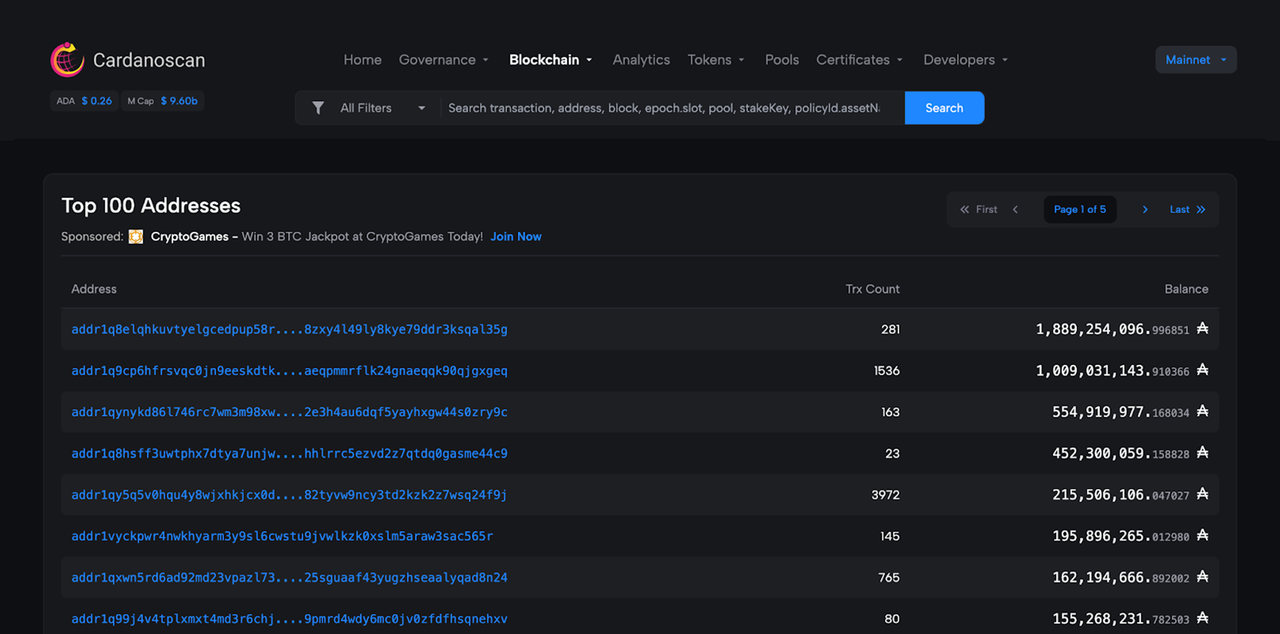
That number alone does not tell you intent, but it gives you a starting point. From there, you can click through transaction history and answer concrete questions. Did the balance change because the wallet received ADA, or because it consolidated UTXOs? Did the wallet send to one address, or to many? Did it move funds to an exchange cluster or to another private wallet?
If your goal is to determine who owns the most Cardano, the honest answer is that you can identify the largest addresses, not the identity behind them, meaning that rich lists help you measure concentration and track changes.
Tool 2: Specialized Analytics Platforms
Specialized analytics platforms, such as Santiment and IntoTheBlock, aggregate the chain into interpretable charts, so you can track cohorts like the number of addresses holding more than 1M ADA, exchange deposit trends, and whale cohort accumulation over time. Santiment is a common reference point in this area, and it frequently reports on whale cohort behavior in ADA.
This is where the cohort view pays off. TradingView’s Key Facts example above is a good illustration: it talks about a defined cohort (100k to 100m ADA) and quantifies accumulation over a window. That is more useful than staring at one address and guessing whether it is an exchange wallet.

To make this practical, use a routine that forces you to check context before you react:
- Start with a cohort chart (for example, addresses above a threshold like 1M ADA). Track whether the count rises steadily over weeks, and whether the cohort’s total balance rises too. If both rise together, accumulation is more plausible than random reshuffling.
- Cross-check with exchange-related behavior. When large amounts move toward known exchange clusters, that often increases near-term sell readiness. When large amounts move away from exchange clusters into private staking wallets, it often signals longer holding intent. Use explorers for the transaction path and analytics for the aggregate view.
- Anchor your interpretation in ecosystem conditions. If DeFi liquidity and stablecoin activity are flat, whale accumulation can still happen, but you should be careful with big conclusions. Chain-level metrics like TVL and DEX volume give you that background.
Interpreting Whale Signals
Accumulation is the cleanest bullish signal. You see it when the number of large addresses rises, balances rise, and net movement away from exchange clusters stays consistent.
Distribution is the bearish cousin. You see it when large wallets increase deposits into exchange clusters, or when cohort balances fall while price struggles. News reports often frame this as whales offloading, even when the underlying data is only a partial proxy. For example,CoinDesk reported ADA moving lower amid reports of whale wallets offloading around $100 million worth of tokens over a short period in October 2025.
Whale moves can mislead you because whales also do wallet hygiene. They consolidate UTXOs, rotate deposit addresses, split holdings for security, and rebalance between custody providers. If your method is only watching single transfers, you will overreact.
A quick discipline helps. Before you treat a whale move as a signal, ask whether the transaction resembles a trade setup or a maintenance action. You can often tell by patterns like repeated outputs to fresh addresses, timing during low activity hours, or links to known exchange clusters that repeatedly reuse formats.
Conclusion: Following the Smart Money
Large holders are part of ADA’s structure, not a weird edge case. When you track them thoughtfully, you get a clearer read on supply pressure and conviction. That is why you should watch the holders alongside the price, not after it.
Cardano whales are measurable. If you distinguish exchange custody from DeFi locks and from independent holders, you can build a cleaner view of sentiment. And if you want to trade, pick venues that match your needs, whether that is spot pairs like ADA/USDT on an exchange such as Bitunix.
Bitunix provides a secure and regulated platform for all market participants, from the smallest fish to the largest whales. Download the app, register, and trade ADA with confidence, knowing you are part of a deep and liquid market.
FAQ Section
Who is the single biggest Cardano whale?
The biggest Cardano whale is an anonymous wallet address holding about 1.93 billion ADA (around $1.1B in January 2026 reports), roughly 5% of the circulating supply. It first became active on Aug 18, 2020, has been mostly dormant, and its identity remains unknown.
Can I see the identity of a whale from their wallet address?
In most cases, no. Cardano addresses are pseudonymous, and one entity can control many addresses under one stake key. You can sometimes infer an exchange or protocol wallet using labels and patterns, but you should treat identity claims as uncertain without strong attribution.
Is it good or bad if whales own a large percentage of the supply?
It depends on behavior and time horizon. Concentration can increase volatility if big holders sell into thin liquidity. It can also reduce the circulating supply when large holders stake and hold. Use cohort balance trends and exchange deposit trends, not concentration alone, to judge risk.
How much ADA do you need to be considered a whale?
There is no official cutoff. Analysts often use 1 million ADA as a practical threshold, since it is large enough to matter and common enough for cohort tracking. Other studies use ranges, such as 100,000 to 100,000,000 ADA, to capture large-holder behavior.
Do whales manipulate the market?
Sometimes they can influence price, especially with coordinated selling or thin liquidity, but not every big move is manipulation. Many large transfers are custody operations, rebalancing, or staking changes. Your best defense is context: check whether funds move toward exchange clusters and whether cohort balances actually fall.
What is on-chain data?
On-chain data is information recorded directly on the blockchain, like transactions, balances, and staking activity. It is transparent and timestamped. The limitation is that it reflects addresses, not verified identities, so you analyze behavior patterns rather than relying on personal attribution.
Are there whales for other cryptocurrencies like Bitcoin and Ethereum?
Yes. Any asset with unequal distribution will have whales. The difference is the chain’s account model, data tooling, and market structure. Bitcoin and Ethereum also have rich lists and cohort metrics, and they also show exchange net deposits as a key signal for sell readiness.
What is a Cardano shark or dolphin?
These are informal labels for mid-sized holders. Analysts use them to segment supply into cohorts. A common approach treats sharks as large but not dominant holders and dolphins as smaller still, then compares how each cohort accumulates or distributes.
Does Charles Hoskinson own a lot of ADA?
Charles Hoskinson likely holds a meaningful personal amount of ADA as Cardano’s founder, but not whale-sized relative to supply. Public statements suggest his exact holdings are private, and estimates place them in the millions to low tens of millions of ADA, far below top whales.
Where can I find the Cardano rich list?
You can find rich-list style rankings through explorers and aggregators. CoinCarp provides a Cardano rich list view of top addresses and their balances, which is useful for monitoring concentration over time. Explorers like cexplorer also help you inspect addresses directly.
Glossary
- Whale: A holder with enough ADA to move markets. Size depends on liquidity and behavior.
- ADA whales: Large ADA holders tracked as a cohort. Analysts watch their accumulation and distribution.
- Address: A public identifier that can hold and send ADA. It does not reveal identity.
- Stake address: A staking identity that can link multiple payment addresses. It helps cluster holdings.
- eUTXO: Cardano’s transaction model using spendable outputs. Transactions can have many inputs and outputs.
- UTXO consolidation: Combining many small outputs into fewer ones. It often looks like activity without trading intent.
- Rich list: A ranking of addresses by balance. It helps measure concentration and track changes.
- Exchange wallet: Custody addresses used by exchanges for many users. Transfers can reflect internal operations.
- Deposit address: An address used to receive funds for an exchange account. It can change frequently.
- On-chain analytics: Aggregated chain metrics and cohort charts. It turns raw transactions into trends.
- Cohort: A grouped set of wallets by balance range. It helps compare behavior across holder sizes.
- Net deposits to exchanges: A measure of funds moving into exchange clusters. It often correlates with sell readiness.
- Accumulation: Persistent net buying by a cohort. It often shows rising balances and rising whale counts.
- Distribution: Persistent net selling or increasing exchange deposits. It often shows falling balances in large cohorts.
- TVL: Total value locked in DeFi protocols. It is a rough proxy for on-chain liquidity and usage.
About Bitunix
Bitunix is a global cryptocurrency derivatives exchange trusted by over 3 million users across more than 100 countries. The platform is committed to providing a transparent, compliant, and secure trading environment for every user. Bitunix offers a fast registration process and a user-friendly verification system supported by mandatory KYC to ensure safety and compliance. With global standards of protection through Proof of Reserves (POR) and the Bitunix Care Fund, Bitunix prioritizes user trust and fund security. The K-Line Ultra chart system delivers a seamless trading experience for both beginners and advanced traders, while leverage of up to 200x and deep liquidity make Bitunix one of the most dynamic platforms in the market.
Bitunix Global Accounts
X | Telegram Announcements | Telegram Global | CoinMarketCap | Instagram | Facebook | LinkedIn | Reddit | Medium
Disclaimer: Trading digital assets involves risk and may result in the loss of capital. Always do your own research. Terms, conditions, and regional restrictions may apply.