
Article Summary
- This article explains that USDT, the popular stablecoin, exists on multiple blockchains, and that TRC-20 refers to the version issued on the TRON blockchain.
- It highlights the two primary advantages of using TRC-20 USDT: very low transaction fees and fast confirmation times compared to the more common ERC-20 (Ethereum) version.
- A clear comparison table is used to break down the differences between TRC-20 USDT and ERC-20 USDT in terms of fees, speed, and address format.
- The guide provides a step-by-step process for how to buy or withdraw TRC-20 USDT on an exchange like Bitunix, emphasizing the critical importance of selecting the correct network (TRON/TRC-20).
- It warns users about the consequences of sending USDT to the wrong network address, which can result in the permanent loss of funds.
You want to send some USDT to a friend or another exchange, but you're hit with a high network fee on crypto exchanges. There’s a better way. Meet TRC-20 USDT—the version of Tether that runs on the TRON network, built for speed and low costs.
Here’s the key idea. USDT is a token that can live on different blockchains, like Ethereum or TRON. The blockchain you choose controls the fee you pay, how long you wait, and what the address looks like. Pick the wrong network and your funds can end up stuck or lost.
This guide explains what is TRC-20 USDT, why it’s popular, for example, in early 2026, TRON’s stablecoin supply sat around $84.7B, and USDT made up about 98.9% of that total, and how to use it in a way that lowers costs and stress.
What Does TRC-20 Mean?
TRC-20 is a token standard, a shared set of rules that wallets and apps use so tokens behave in predictable ways, on TRON. On Ethereum, the common standard is ERC-20, and on TRON, it’s TRC-20.
TRON’s developer docs describe it this way: "TRC20 is a technical standard used for smart contracts on the TRON blockchain for implementing tokens." That means a TRC-20 token follows a standard interface for basics like sending tokens, checking balances, and approving a smart contract to spend on your behalf.
TRC-20 USDT is just USDT issued on TRON using that standard. One detail you’ll notice right away is the address format. TRON addresses usually start with a capital T. Ethereum addresses start with 0x. That single difference saves people from a lot of expensive mistakes when they actually look at it.
TRC-20 vs. ERC-20: The Key Differences
People pick TRC-20 because it’s often the cheapest way to send USDT when you’re moving funds between exchanges, paying someone, or doing small transfers. Here’s a practical comparison:
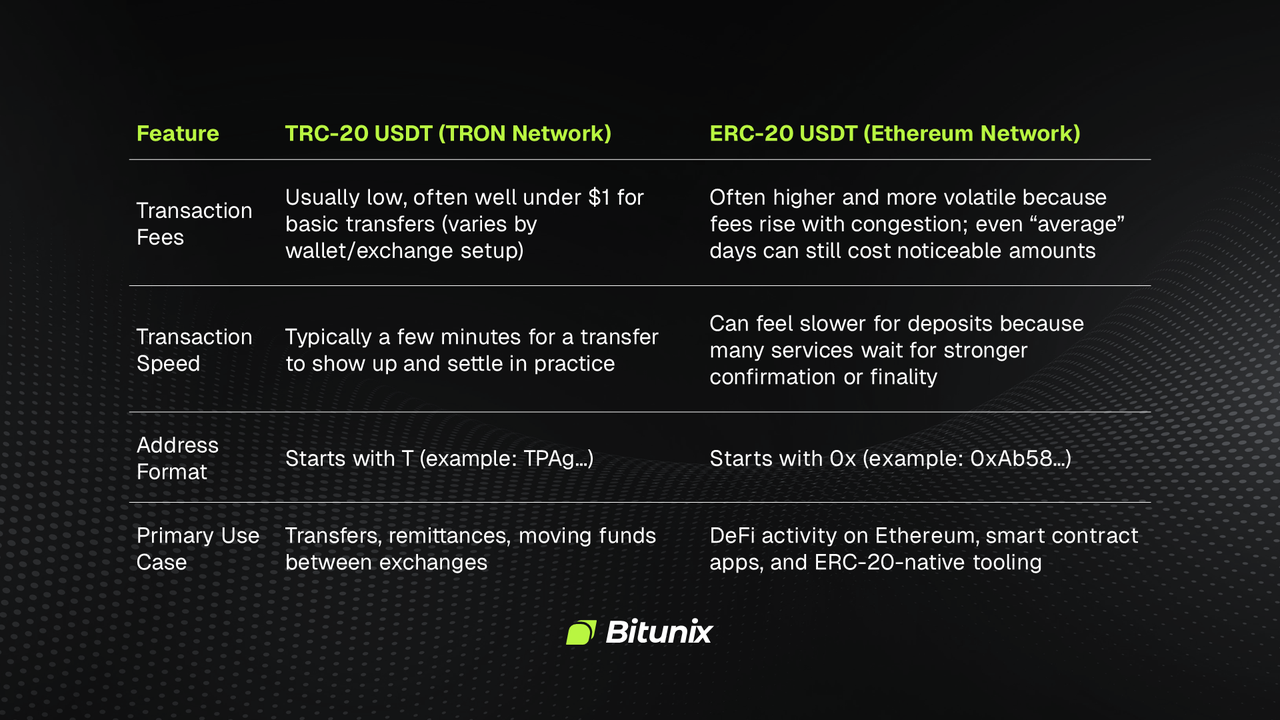
Ethereum’s on-chain activity is huge, and that competition for block space drives fees. In early 2026, Etherscan showed roughly around 1.9 million transactions over 24 hours and an average transaction fee of around $0.17 at that moment. That average includes simple transfers and doesn’t guarantee what your token transfer will cost during a busy spike. When Ethereum gets crowded, token transfers can jump fast.
TRON has its own resource model and network economics, but the end result many users notice is simple: everyday USDT transfers on TRON often stay cheap enough that people stop thinking about fees. That is a big reason TRON became such a dominant USDT venue.
Now the trade-off. Ethereum’s ERC-20 version plugs you into the largest DeFi ecosystem. If your goal is Uniswap swaps, lending protocols, or DeFi automation, ERC-20 is usually the preferred choice. If your goal is to move stablecoins from A to B with minimal cost, TRC-20 often wins.
Why Use TRC-20 USDT?
Before you choose a network, it helps to be clear about the job you’re trying to get done. Most people pick TRC-20 because transfers feel cheaper and faster when you’re sending USDT to another person, moving funds between exchanges, or doing frequent top-ups. If your goal is everyday payments or inter-exchange transfers, TRC-20 often makes the most sense.
Cost Savings You Actually Feel
If you send USDT once a month, you might shrug at fees. If you send it weekly, or you run arbitrage, or you top up accounts across platforms, fees become a recurring tax. Over a year, small fees add up like subscriptions you forgot you had.
A simple example is that you send $200 USDT to a family member every week. If you pay even $3 in network and platform fees each time, that’s over $150 a year. If you keep the network fee closer to pennies or cents, you keep more of your money doing the job you intended.
Speed for Transfers and Trading
People sometimes confuse fast chain activity with instant money. Even on fast networks, exchanges may require confirmations, internal reviews, and deposit processing. Still, a network that confirms quickly helps reduce total waiting time, especially when you combine it with good operational handling.
TRC-20 USDT also fits common trading behavior. Traders often want to move USDT to where liquidity is best right now. That’s when cheap and quick transfers matter most, because the market does not wait for your deposit.
Adoption and Liquidity Across Platforms
TRON’s stablecoin footprint is not niche anymore. In 2025, reporting showed USDT supply on TRON overtaking Ethereum at points in time, highlighting how much stablecoin activity moved to TRON rails for transfers. By early 2026, DeFi Llama still showed TRON as a major stablecoin hub.
This broad adoption matters because it lowers challenges. The more exchanges and wallets support the same network, the less time you spend hunting for compatible routes.
How to Buy TRC20 With USDT on Bitunix
First, a small clarification that saves confusion. You don’t buy TRC-20 as a separate asset. You buy USDT, then you choose the TRC-20 network when you withdraw or deposit, so the USDT you move uses TRON rails.
Step 1: Buy USDT Inside Your Account
You can buy USDT on the spot market by trading from another asset pair like BTC/USDT or ETH/USDT. At this point, your USDT is held in your exchange balance. It hasn’t become TRC-20 or ERC-20 yet, since the network only matters when you move funds on-chain.
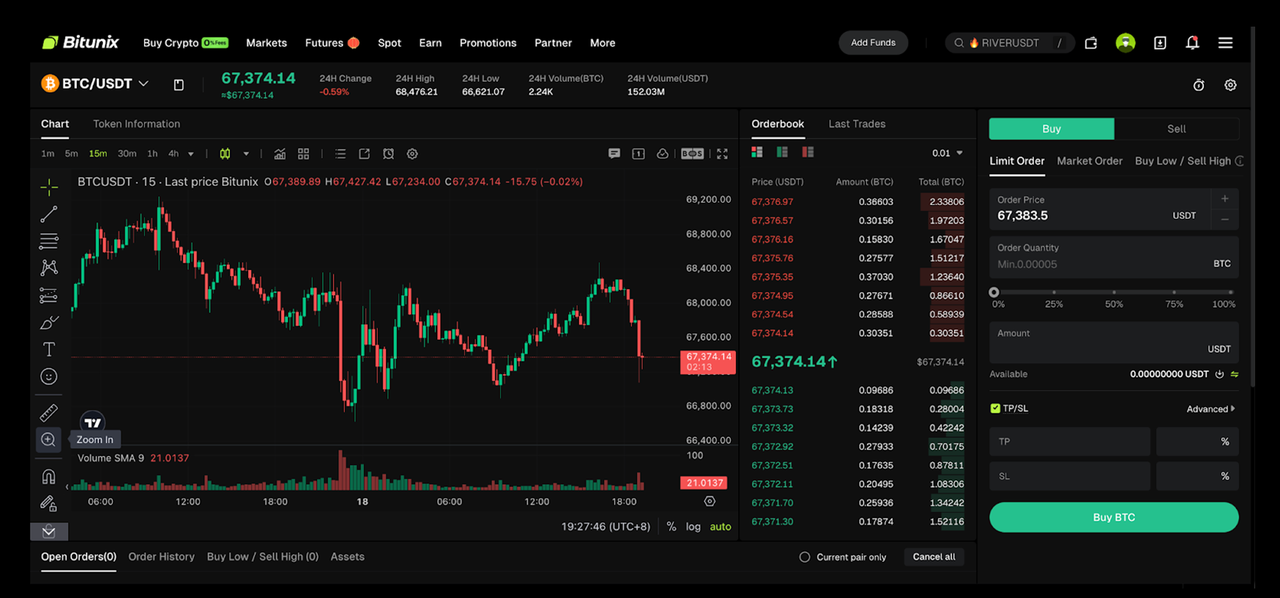
Step 2: Withdraw USDT Using the TRC-20 Network
When you withdraw USDT, Bitunix will ask you to choose a network. This is the critical decision point.
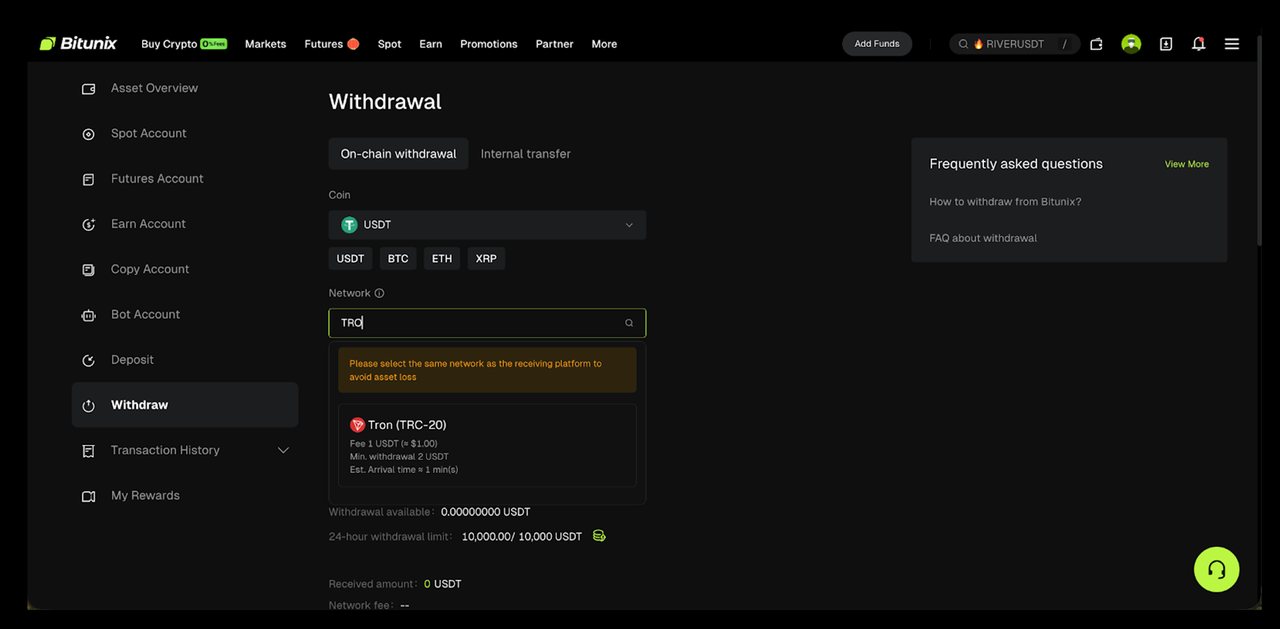
Select TRC-20 (TRON) and then paste the recipient TRON address. A TRON address usually starts with T. If you see 0x, stop and reassess because that is usually an Ethereum address.
Critical warning: If you send TRC-20 USDT to an ERC-20 address (or the other way around), you can lose funds. Some recipients can recover it, but many can’t.
Step 3: Confirm Details
Before you confirm, check three things:
- Network selected matches the recipient’s supported network
- Address format matches the network
- Memo or tag requirement (some services require it)
Conclusion: The Smart Choice for Fast, Cheap Transactions
While ERC-20 USDT remains essential for DeFi on Ethereum, TRC-20 USDT has emerged as the superior choice for everyday payments and inter-exchange transfers due to its low fees and high speed. By understanding the difference and learning to select the correct network, you can save money and time on your crypto transactions.
Bitunix fully supports TRC-20 USDT for both deposits and withdrawals. Experience the speed and low cost for yourself. Download the app, register, and start to buy, sell, or transfer your USDT on Bitunix today.
FAQ
Is TRC-20 USDT as safe as ERC-20 USDT?
TRC-20 USDT and ERC-20 USDT represent the same peg goal, but they run on different networks with different security assumptions and tooling. Your main risk is operational. If you pick the wrong network or address format, recovery can be hard.
What happens if I send TRC-20 USDT to a Coinbase account that may not support it?
If the receiving platform does not support TRC-20 deposits, your funds may not be credited automatically. Sometimes support teams can recover funds, sometimes they can’t, and the process can take time. The safest move is to confirm supported networks in the deposit screen before you send.
How can I be sure I’m selecting the right network?
Match three signals. The exchange or wallet deposit page must explicitly say TRC-20. The address should start with T. And the receiving platform should list TRON as the network for USDT. If any of these don’t match, stop and verify before sending.
Are there other types of USDT besides TRC-20 and ERC-20?
Yes. USDT exists on several blockchains. The exact list changes over time as Tether expands support and as ecosystems grow. The important takeaway is simple. USDT is the token name, but the network behind it controls fees, speed, and address formats.
Why are TRON network fees so much cheaper than Ethereum’s?
Fees come from block space economics and network design. Ethereum’s fee market often spikes during congestion because many users compete for limited block capacity, which pushes up costs. TRON’s design and typical usage patterns often keep transfer costs low for everyday stablecoin movement.
Do I need to own TRON (TRX) to send TRC-20 USDT?
It depends on where you are sending from. If you withdraw from a centralized exchange, the exchange usually deducts a withdrawal fee in USDT and handles the network resources. If you send from a self-custody wallet on TRON, you may need TRX for fees or resources.
Is the value of 1 TRC-20 USDT the same as 1 ERC-20 USDT?
They aim to track the same $1 peg, because they are both USDT. The network does not change the peg target. What changes are the transfer cost and where the token can be used. ERC-20 USDT is more DeFi-native on Ethereum, and TRC-20 USDT is often cheaper to move.
Which wallets support TRC-20 USDT?
Many non-custodial wallets support TRC-20 USDT on the TRON network. Common options include TronLink, Trust Wallet, Atomic Wallet, Guarda, and TokenPocket. For cold storage, Ledger and Trezor can hold TRC-20 USDT through TronLink integration.
Can I use TRC-20 USDT on Uniswap?
Uniswap runs on Ethereum and Ethereum-compatible networks. TRC-20 USDT is on TRON, so you can’t use it directly on Uniswap without bridging to an Ethereum network and receiving an ERC-20 version. Bridging adds steps, fees, and risk, so plan it carefully.
How do I know if a receiving address is TRC-20 or ERC-20?
Start with the prefix, TRON addresses usually start with T, and Ethereum addresses start with 0x. Then confirm in the receiving app’s deposit page which network it expects.
Glossary
- USDT (Tether): A stablecoin designed to track the U.S. dollar.
- Stablecoin: A crypto asset that targets a stable price, often pegged to fiat.
- TRON: A blockchain network where TRC-20 tokens run.
- Ethereum: A blockchain network where ERC-20 tokens run.
- TRC-20: Token standard for smart contract tokens on TRON.
- ERC-20: Token standard for fungible tokens on Ethereum.
- Address Format: The visible structure of a blockchain address (T vs 0x).
- Network Fee: Cost paid to process a transaction on a blockchain.
- Withdrawal Network Selection: Choosing the chain (TRC-20, ERC-20, etc.) when withdrawing USDT.
- Deposit: Sending crypto into an exchange wallet address.
- On-Chain Transfer: A transaction recorded on the blockchain.
- DeFi: Financial apps built on blockchains, common on Ethereum.
- Bridge: Tool that moves assets between blockchains, often with added risk.
- Confirmation: Additional blocks after a transaction that increase settlement confidence.
- Peg: The target price relationship of a stablecoin to an asset like USD.
About Bitunix
Bitunix is a global cryptocurrency derivatives exchange trusted by over 3 million users across more than 100 countries. The platform is committed to providing a transparent, compliant, and secure trading environment for every user. Bitunix offers a fast registration process and a user-friendly verification system supported by mandatory KYC to ensure safety and compliance. With global standards of protection through Proof of Reserves (POR) and the Bitunix Care Fund, Bitunix prioritizes user trust and fund security. The K-Line Ultra chart system delivers a seamless trading experience for both beginners and advanced traders, while leverage of up to 200x and deep liquidity make Bitunix one of the most dynamic platforms in the market.
Bitunix Global Accounts
X | Telegram Announcements | Telegram Global | CoinMarketCap | Instagram | Facebook | LinkedIn | Reddit | Medium
Disclaimer: Trading digital assets involves risk and may result in the loss of capital. Always do your own research. Terms, conditions, and regional restrictions may apply.