What Is Monero? Understanding Privacy-Focused Cryptocurrency
Monero is a decentralized, open-source cryptocurrency built to provide private and censorship-resistant digital payments. Its native asset, XMR, can be transferred directly between users without requiring banks or other financial intermediaries. Unlike many cryptocurrencies that prioritize transparent transaction records, Monero is designed to prevent outside observers from easily identifying who sent funds, who received them, or how much was transferred.
Monero was launched in April 2014 under the original name BitMonero, before becoming known as Monero. The project was developed through an open-source community and had no initial coin offering (ICO), premine, or presale. Its development philosophy emphasizes decentralization, privacy, and accessibility, allowing individuals to participate in the network without relying on central authority.
Privacy is not an optional feature in Monero. Every standard transaction automatically uses its built-in privacy mechanisms, meaning users do not need to activate special privacy settings or choose between transparent and confidential transactions. This default approach helps maintain consistent privacy across the network and supports XMR's role as a digital payment asset.
Monero Technology: How Do Ring Signatures, Stealth Addresses, and RingCT Work?
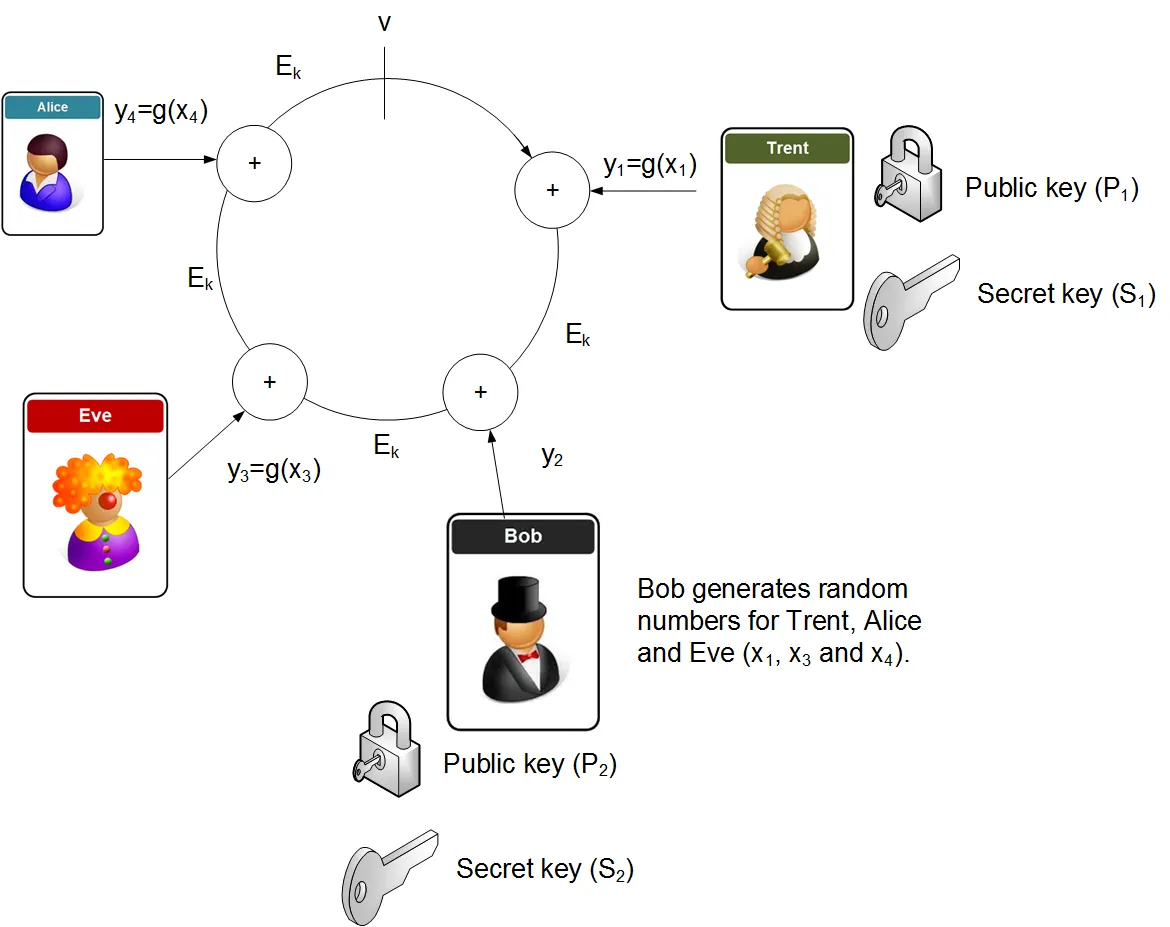
Monero's privacy model relies on three core cryptographic technologies: Ring Signatures, Stealth Addresses, and Ring Confidential Transactions (RingCT). Each technology protects a different part of a transaction, working together to conceal the sender, recipient, and transferred amount. This layered design makes it significantly more difficult for outside observers to reconstruct transaction histories.
Ring Signatures: Ring signatures protect the sender's identity by combining the actual transaction input with several decoy outputs from the blockchain. In Monero's current protocol, a ring contains 16 possible signers, including one real output and 15 decoys. Although the network can verify that the transaction is valid, outside observers cannot directly determine which output represents the actual source of the funds.
Stealth Addresses: Stealth addresses protect the recipient's identity. Whenever someone sends XMR, the protocol automatically generates a unique, one-time destination address for that transaction. This means the recipient's publicly shared wallet address does not appear directly on the blockchain, making it difficult to connect multiple incoming payments to the same person.
Ring Confidential Transactions (RingCT): RingCT conceals the amount transferred in each transaction. Instead of displaying transaction values publicly, it uses cryptographic commitments and proofs to verify that the transaction follows the network's rules without revealing the actual amounts. This prevents external observers from examining payment values while still allowing the network to verify that no unauthorized XMR has been created.
Together, these technologies provide comprehensive transaction privacy. Rather than relying on a single encryption mechanism, Monero protects multiple dimensions of transaction information, making blockchain analysis considerably more challenging.
Data Source: Medium
Monero Privacy Features: Transaction Confidentiality, Fungibility, and Network Anonymity
Monero's privacy features extend beyond hiding individual transaction details. One of its most important characteristics is fungibility, which means that every unit of XMR is interchangeable and should carry the same monetary value regardless of its transaction history. On transparent blockchains such as Bitcoin, certain coins may be associated with previously flagged transactions, potentially resulting in different treatment by exchanges or service providers.
Because Monero conceals transaction amounts and makes the origins of spent outputs difficult to identify, it is harder for third parties to distinguish between individual XMR coins based on their previous usage. This helps preserve the fungibility of the currency and reduces the risk of certain coins being rejected simply because of their transaction history. However, privacy does not eliminate every possibility of external tracking or regulatory scrutiny.
Monero also incorporates Dandelion++, a network-level mechanism designed to make it more difficult to identify the original IP address broadcasting a transaction. It works by initially relaying transactions through a randomized path before wider network propagation. Nevertheless, Dandelion++ does not guarantee complete network anonymity, and additional precautions, such as using Tor or I2P, may be necessary depending on the user's network configuration.
Data Source: Xmrscan
Monero vs. Bitcoin and Zcash: Key Differences in Privacy and Transaction Transparency
Monero, Bitcoin, and Zcash are all decentralized cryptocurrencies, but they take different approaches to transaction transparency and financial privacy. Bitcoin maintains a fully transparent public ledger, while Monero makes transaction privacy mandatory by default. Zcash offers both transparent and shielded transactions, allowing users to choose between different privacy levels.
Feature | Monero (XMR) | Bitcoin (BTC) | Zcash (ZEC) |
Privacy Model | Private by default | Public and transparent | Optional privacy |
Sender Privacy | Ring Signatures | Public transaction inputs | Shielded transactions |
Recipient Privacy | Stealth Addresses | Public addresses | Shielded addresses |
Transaction Amounts | Hidden | Public | Hidden in shielded transactions |
Fungibility | Strong privacy-based fungibility | Transaction history is traceable | Depends on transaction type |
Consensus | Proof of Work | Proof of Work | Proof of Work |
The biggest difference is how these networks handle transaction information. Bitcoin allows anyone to examine transaction histories, balances, and wallet activity through public blockchain explorers, although wallet addresses do not automatically reveal their owners' real-world identities. Monero conceals key transaction details by default, while Zcash uses zero-knowledge proofs to support private transfers through its shielded pool.
Each model involves different trade-offs. Bitcoin prioritizes public verifiability and transparent transaction records, Zcash provides flexibility through optional privacy, and Monero places financial confidentiality at the center of its protocol. For users who prioritize default transaction privacy and fungibility, Monero offers a distinct approach to decentralized digital payments.
XMR Tokenomics: Supply Model, Tail Emission, and Mining Rewards
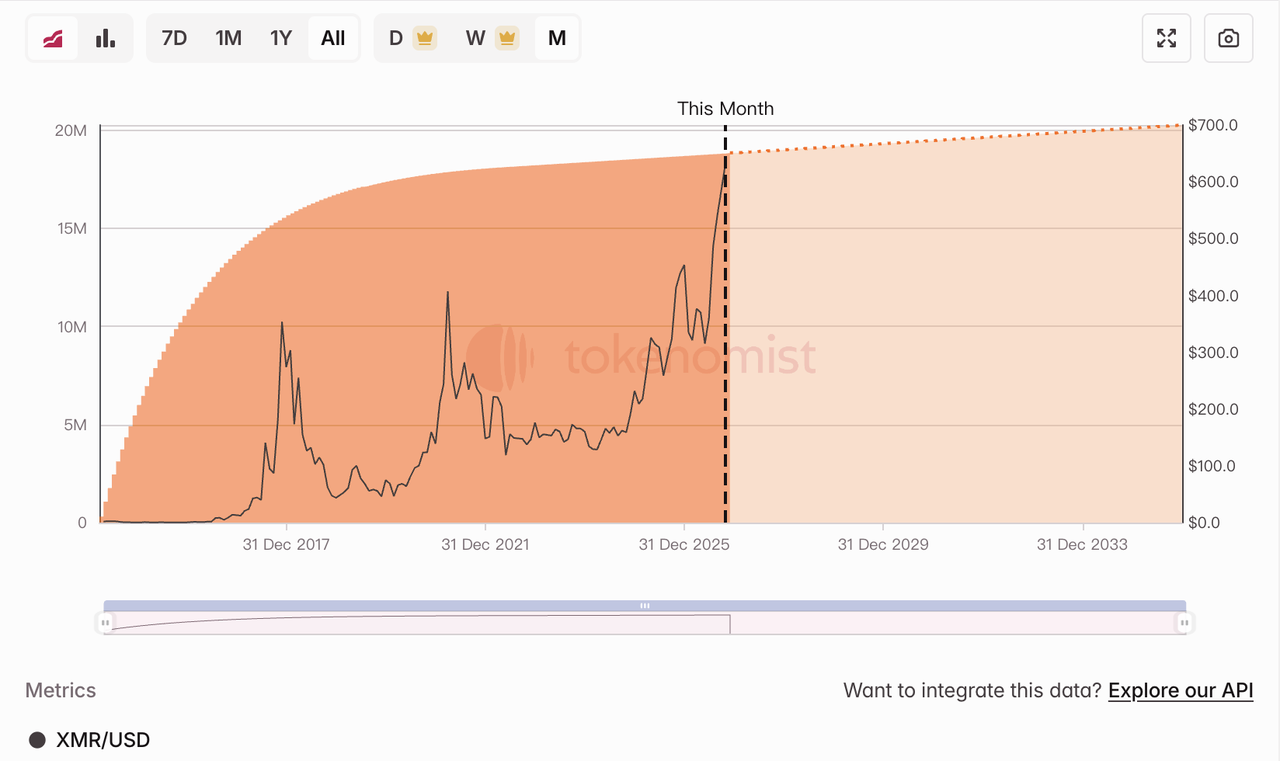
Unlike Bitcoin, which has a fixed maximum supply of 21 million coins, Monero does not have a predetermined supply cap. Its issuance follows a declining emission schedule, with the main emission curve distributing most of the initial supply before transitioning to a permanent Tail Emission mechanism. This design aims to maintain long-term incentives for miners rather than relying entirely on transaction fees.
Monero's Tail Emission began in June 2022, following the completion of its main emission schedule. Under this mechanism, the network permanently issues 0.6 XMR per block, with an average block time of approximately two minutes. This translates to around 432 XMR in new issuance per day, assuming the target block interval remains unchanged.
The purpose of Tail Emission is to provide miners with a predictable source of block rewards over the long term. As the total XMR supply increases, the percentage inflation rate gradually declines because the fixed issuance represents a smaller proportion of the circulating supply. This approach helps maintain mining incentives even if transaction fee revenue is insufficient to cover network security costs on its own.
Data Source: Tokenomist
Monero Mining: RandomX Algorithm, ASIC Resistance, and Decentralization
Monero uses a Proof of Work (PoW) consensus mechanism to secure its blockchain and validate transactions. Its mining algorithm, RandomX, was introduced in November 2019 and specifically designed to favor general-purpose CPUs over specialized mining hardware. Unlike Bitcoin mining, which is dominated by ASIC machines, Monero aims to keep mining more accessible to individual participants and reduce the concentration of computing power among large-scale mining operations.
Despite RandomX's ASIC-resistant design, specialized Monero mining hardware has entered the market. Bitmain, one of the world's leading cryptocurrency mining hardware manufacturers, is a major player in this segment, with its Antminer X-series machines specifically designed for RandomX-based mining. These devices demonstrate that specialized hardware can still be developed for Monero mining, although RandomX's memory-intensive architecture makes achieving a significant performance advantage more challenging than with algorithms designed specifically for ASICs.
RandomX achieves its ASIC resistance through memory-intensive computations and a virtual machine that executes randomly generated programs, making general-purpose CPUs more competitive. Miners can participate independently, join mining pools, or use P2Pool, a decentralized mining pool that allows participants to coordinate without relying on a centralized pool operator. Combined with Tail Emission, this mining model aims to maintain long-term incentives for network security while supporting Monero's broader decentralization goals.
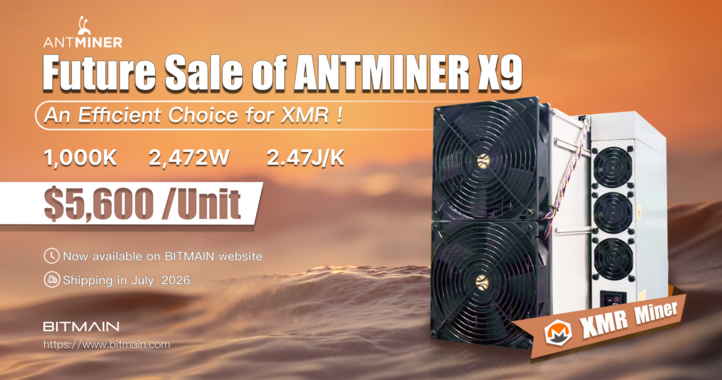
Data Source: Bitmain
How Investors Trade XMR
Investors typically have two common ways to obtain Monero: purchasing through a cryptocurrency exchange or using peer-to-peer (P2P) trading to transact directly with other users. These methods have different characteristics, but beginners generally find centralized exchanges easier to use because they provide a structured trading environment and established account management processes.
A common approach is to use a centralized cryptocurrency exchange such as Bitunix. Depending on regional availability and supported trading products, these platforms may allow users to access XMR markets through available trading pairs or derivatives. Before using an exchange, investors should check whether XMR spot trading and withdrawals are supported in their jurisdiction, as access to privacy-focused assets may be restricted in certain regions. Account registration and identity verification (KYC) may also be required to comply with applicable Anti-Money Laundering (AML) and Counter-Terrorist Financing (CTF) regulations.