Before a crypto exchange lets you move money, KYC rules require you to verify your identity, usually with a government ID and a live face check. AML (anti-money laundering) is the broader system that tracks how funds move after you get approved. KYC asks "who is this customer?" at the door. AML keeps asking "does this activity make sense?" for as long as the account stays open.
When you are the one uploading a passport, a few practical questions matter right away: what actually gets checked, what happens to your documents, what you get in return, and where self-custody still fits.
What Is KYC in Crypto? Beyond Basic Definitions
KYC stands for Know Your Customer. It is how a financial platform verifies that an account belongs to a real, identifiable person. On a crypto exchange, this usually means uploading a government ID and completing a quick liveness check before you can deposit, trade, or withdraw.
Once approved, that KYC record becomes the baseline for every ongoing security and compliance check on the account. Just as importantly, it is your proof of ownership when things go wrong, such as losing access to your 2FA device or needing to recover a locked account. Need the full list of accepted IDs and basic terms first? Check out What Does KYC Mean in Crypto?
Quick Summary: KYC vs. AML in Digital Assets
KYC (Know Your Customer) is the upfront identity check, using a government ID and liveness scan, before you can deposit or withdraw.
AML (anti-money laundering) is the broader compliance program that runs for the life of the account, covering transaction monitoring, sanctions screening, and suspicious activity reporting. In short, KYC is just the front door of AML.
How Know Your Customer Evolved from Banking to Digital Assets
For crypto's first decade, KYC was mostly a banking problem. Plenty of early exchanges let you sign up with just an email address and start trading right away. That window closed in 2019, when the Financial Action Task Force (FATF), the global anti-money laundering watchdog, extended its rules to virtual assets and virtual asset service providers (VASPs). Overnight, centralized exchanges were put on the same hook as banks: verify users, score risk, watch on-chain and fiat flows, and retain records.
Global rollout still varies by country, yet enforcement has tightened steadily. According to FATF's seventh targeted update published on 16 July 2026, 83% of surveyed jurisdictions have passed laws to enforce the Travel Rule, up from 73% in 2025. Under the Travel Rule, sender and recipient details must travel alongside qualifying transfers between platforms. An exchange cannot pass along your identity data unless it has verified you first, which is why unverified accounts have largely disappeared from regulated platforms.
Why Identity Verification Is Essential at Fiat-to-Crypto Gateways
On-chain, value moves between addresses with no names attached. The banking system works the opposite way: every account has an identified owner. The fiat gateway (card purchases, bank transfers, P2P trades, and withdrawals back to a bank) is where those two systems meet. It is also the point stolen or laundered funds have to cross to become spendable, which makes it the natural checkpoint.
Payment partners draw the same line. Banks and card networks will not process transactions for an exchange that cannot verify who its customers are, which is why KYC verification sits right before any funds move. On Bitunix, for example, Basic Verification (KYC Level 1, requiring a valid ID and facial verification) is mandatory before you can deposit or withdraw crypto on-chain, transfer fiat, or use P2P trading.
KYC and AML in Crypto: Structural Differences and Synergy
The two terms are often written as one ("AML/KYC"), which hides how differently they behave. KYC is an event with a clear start and finish. AML is a continuous process that most users never see.
KYC vs. AML Comparison: Timing, Objectives, and User Benefits
The following table compares KYC and AML across timing, purpose, and what each one means for the user:
Dimension | KYC | AML |
When it happens | At onboarding, and again when ID documents expire or risk tiers change | Continuously, for the life of the account |
Core objective | Confirm the account holder is a real, identifiable person | Detect and deter money laundering, fraud, sanctions evasion, and terrorist financing |
What it examines | Government ID, face match, and liveness; proof of address at higher tiers | Transaction patterns, counterparties, on-chain exposure, and sanctions lists |
What the user experiences | A few minutes of document upload and a selfie check | Usually nothing; occasionally a temporary withdrawal hold or a source-of-funds review |
User protection value | Stops impersonators from opening accounts in your name and anchors account recovery | Keeps stolen and scam-linked funds from circulating on the venue you trade on |
In practice, neither system works on its own. Monitoring a transaction only means something if the platform knows who sits behind the account, so AML without KYC has no identity to attach its findings to. At the same time, KYC without AML is just a one-time photo check that tells the exchange nothing about what happens after sign-up.
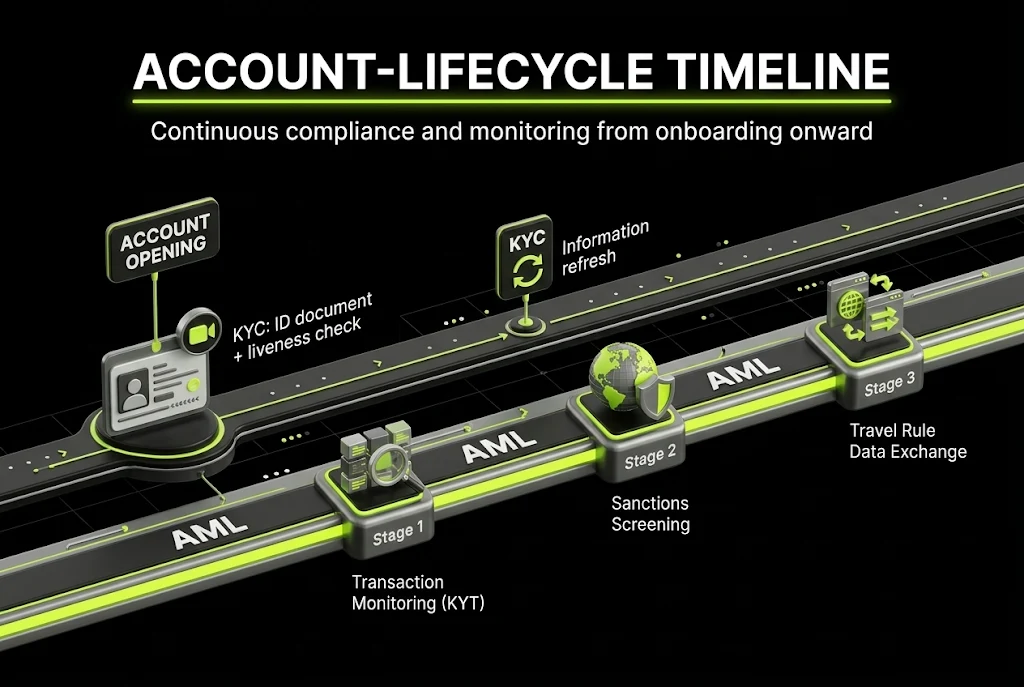
KYC is a point-in-time identity check at onboarding; AML controls run continuously for as long as the account is open.
How AML Frameworks Deter Illicit Fund Flows Without Disrupting Honest Traders
AML programs follow a risk-based approach, meaning scrutiny concentrates on higher-risk activity rather than treating every user like a suspect. If you deposit, trade, and withdraw using your own verified accounts, these checks stay out of your way.
Three layers handle most of the screening:
Transaction monitoring (KYT). Know Your Transaction tools trace on-chain flows for exposure to wallets linked to hacks, scams, or sanctioned entities.
Sanctions and watchlist screening. Both account holders and their counterparties are checked against global watchlists.
Travel Rule data exchange. Identifying sender and recipient details travel alongside qualifying transfers between regulated platforms.
The real deterrent is the cash-out. Criminals need a liquid venue to convert stolen crypto into spendable money, and an exchange that verifies its users and screens incoming deposits is a terrible place to try it. FATF's July 2026 update notes that most identified illicit activity on-chain now involves stablecoins, the exact same assets everyday traders use for margin and settlement.
Strong crypto AML compliance keeps those tainted flows out of the platform's liquidity pool. That protects ordinary users too: receiving funds with a dirty on-chain history can get your assets frozen when you later try to move them to another regulated exchange or a bank.
Occasionally, a platform will pause a transfer and ask for extra documentation, such as proof of where a large deposit came from. That is standard enhanced due diligence (EDD), not an accusation. Like banks, exchanges do not publish the exact triggers behind these reviews so bad actors cannot game the thresholds. If you want to see how these safeguards work on a live venue, read through Bitunix's compliance standards, KYC, and risk controls.
Data Privacy Standards: How Modern Platforms Encrypt Verification Records
Handing over a passport scan is the part of KYC most users hate, and that hesitation makes complete sense. If an exchange handles sensitive data properly, five baseline safeguards should be in place:
Encryption in transit and at rest. Files are encrypted both during upload and while stored on servers, keeping intercepted or copied files unreadable without the decryption keys.
Restricted, logged access. Only vetted staff with a clear operational need can open verification records, and every single lookup leaves an audit trail.
Data minimization. Platforms should collect only what your verification tier requires. Proof of address, for example, usually stays off the table unless you apply for higher limits.
Retention set by law. FATF standards require exchanges to hold customer records for at least five years after an account closes. That legal mandate is why platforms cannot simply wipe your documents on request.
Independent certification. ISO/IEC 27001 is the main international benchmark for information security management. Bitunix, for instance, holds ISO/IEC 27001:2022 certification.
Encryption is rarely the weak link. During a widely reported 2025 breach at a major US exchange, attackers did not crack any cryptography; they bribed overseas support contractors who already had legitimate system access. That incident made one thing clear: strict internal access controls and staff vetting matter just as much as the cipher itself.
On your end, one simple habit closes most of the remaining risk. Only upload ID documents inside the official website or app. No legitimate exchange will ever ask for passport photos over email, Telegram, or direct message.
Why KYC Verification Matters More in 2027: The AI Fraud Reality
The tools for faking an identity have become cheap, and recent data shows the effect:
Scam losses. Chainalysis estimates that $17 billion was stolen in crypto scams and fraud in 2025. Impersonation scams grew roughly 1,400% year over year, and operations with on-chain links to AI vendors took in 4.5 times more per operation than those without (published 13 January 2026).
Deepfake volume. Entrust's 2027 Identity Fraud Report, covering 1 September 2025 to 31 August 2026, recorded deepfake detections up 165% year over year, about one every three minutes. Crypto remained the most targeted industry.
What the fakes look like. In Shufti's H1 2026 data, deepfaked documents made up about 80% of AI-enabled identity fraud and synthetic identities about 12%, with injected video and face swaps accounting for the rest.
These figures come from each vendor's own verification traffic, so they are not directly comparable. The direction is consistent across all three.
One number in the Entrust data points the other way. The fraud rate it measured in the crypto sector fell from 9.5% in 2024 to 5.8% in 2026, even as attacks became more sophisticated, and Entrust notes that stronger industry controls may be part of the reason. Crypto KYC verification has had to evolve fast to keep pace, and so far, the defenses are holding.
Defending Against AI Deepfakes and Synthetic Identity Attacks
Attackers come at identity verification in three main ways:
Presentation attacks. Holding a printed photo, a screen, or a mask up to the camera.
Injection attacks. Bypassing the physical camera altogether and feeding a deepfake video stream directly into the verification pipeline. Entrust reports injection attack rates rose 40% year over year.
Synthetic identities. Combining real data, such as a leaked ID number, with fabricated details and an AI-generated face to build a persona that does not exist.
Automated liveness detection is the main countermeasure, and it solves a different problem than basic face matching. Instead of just checking whether your face looks like your passport photo, it verifies that a real, living person is physically in front of a genuine camera right now.
Modern systems analyze depth, skin texture, and light reflection, sometimes prompt for random head movements, and inspect the device feed for virtual cameras or emulators. Document forensics run in parallel, scanning fonts, holograms, and subtle traces of image tampering.
Why should an everyday trader care whether someone else's fake account gets blocked?
First, fake and mule accounts form the cash-out pipeline for the exact scams targeting retail traders.
Second, with millions of ID photos already circulating from past data leaks, an exchange without a liveness check would let a stranger open an account in your name using your stolen documents, leaving you on the hook if illicit funds move through it. A live face scan is the one hurdle a leaked photo cannot clear.
No detection system catches everything. The real goal of automated checks is economic: making fake accounts too slow and expensive to spin up at scale.
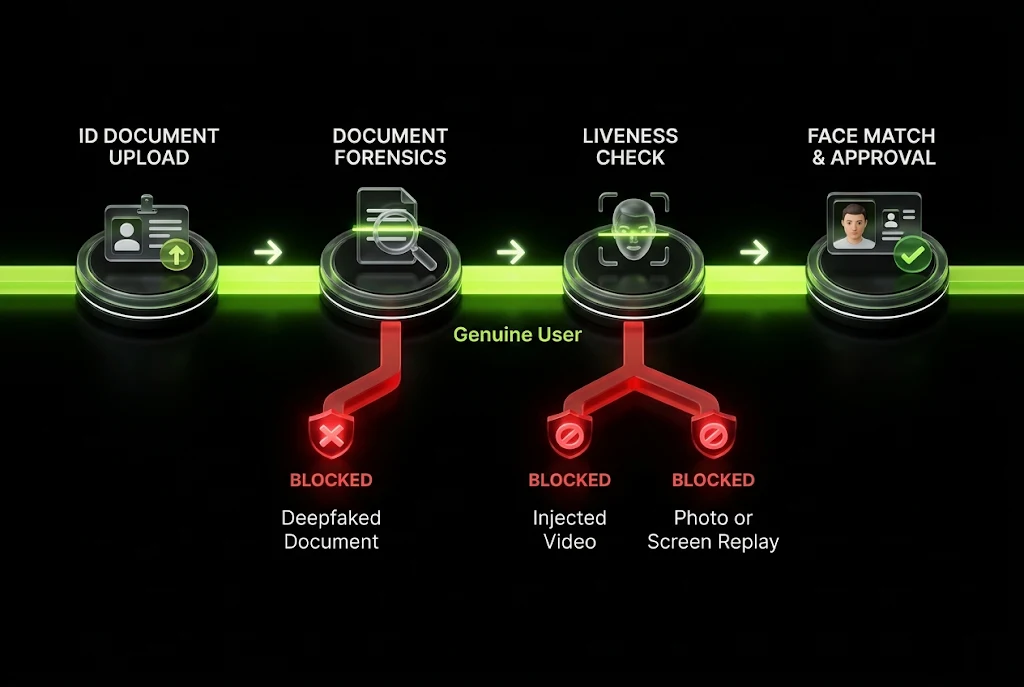
Automated KYC verification checks the document and the live person separately, so a forged ID and a deepfake video are stopped at different stages.
Establishing Verifiable Ownership for Fast Account Recovery
An unverified account belongs to whoever holds the login credentials. If your email gets compromised and you lose your 2FA device, there is no independent way to prove you are the real owner.
A verified account gives you an anchor outside those credentials: your ID document and your face. When you get locked out or report an account takeover, the platform can run a fresh liveness check against the record on file. What would otherwise be a dead-end support ticket becomes a dispute with a verifiable answer.
Still, KYC is not a security shield. It will not stop phishing, malware, or a SIM swap, and it is never a substitute for two-factor authentication. What it does is shorten the path back into your account after something has already gone wrong.
Reducing Counterparty Risks in Peer-to-Peer (P2P) Markets
P2P trading means sending money to, or receiving it from, a stranger. Without guardrails, that goes wrong in predictable ways:
Fake payment screenshots sent to pressure a seller into releasing crypto
Payments reversed after the crypto has already left escrow
Third-party payments sent from a bank account that does not belong to the counterparty, which can pull your own bank account into a fraud freeze or investigation
Requiring verification on both sides changes that dynamic. The platform can require the sender's payment account name to match their verified identity, blocking third-party transfers before they happen. A user who scams once cannot simply spin up a fresh account and start again, and when a trade is disputed, support has real identities and records to work from. On Bitunix, P2P services are available only after Basic Verification.
Verification lowers the risk, though it does not replace common sense. Confirm receipt inside your own banking app instead of trusting a screenshot, release crypto only after the funds have actually settled, and keep all communication inside the platform's order chat so support can step in if a dispute comes up.
KYC Exchange vs. Non-Custodial Wallets: Navigating KYC Bitcoin Choices
Choosing between a KYC exchange and a self-custody wallet is not an all-or-nothing decision. Custody (who controls the keys) and identity (whether an account is verified) are two separate issues. Most active traders simply use both for different jobs.
Custodial KYC Exchanges vs. Self-Custody Wallets: Control and Trade-Offs
The table below sets out what changes between holding assets on a KYC exchange and holding them in a wallet you control:
Factor | Custodial KYC exchange | Self-custody (non-custodial) wallet |
Who controls the keys | The exchange, on your behalf | You, through a seed phrase or private keys |
Identity verification | Required | None to create or use the wallet |
Fiat deposits and withdrawals | Available | Not available directly |
Trading tools | Order books, spot and futures markets, alerts, deep liquidity | On-chain swaps only |
If you lose access | Identity-based account recovery | No recovery without the seed phrase |
Main risks | Platform solvency and security; account takeover | Lost or stolen seed phrase; malicious contract approvals; phishing |
Typical use | Active trading and moving between fiat and crypto | Long-term storage and on-chain activity |
People often talk about "KYC bitcoin" as if the coins themselves get stamped with your name. They do not. The Bitcoin protocol has no identity layer; KYC attaches to the service provider, not the asset. When you buy BTC on a KYC exchange, the platform logs that purchase and your withdrawal address against your profile. Moving those coins to a self-custody wallet changes who controls the keys, though it does not erase the transaction history at the exchange.
Global regulators are drawing that exact boundary: banning anonymous accounts at the platform level while leaving self-custody intact. Under the EU's Anti-Money Laundering Regulation (Regulation (EU) 2024/1624), which takes effect on 10 July 2027, crypto-asset service providers are barred from keeping anonymous accounts. That prohibition targets regulated businesses, not individuals holding their own keys.
Dividing funds by purpose is the cleanest way to handle that split. Keep a verified exchange account for fiat ramps, deep liquidity, and active execution, and move long-term holdings that do not need to sit on a venue into self-custody. If you use an exchange for futures or other leveraged products, keep in mind that margin trading carries liquidation risk and is not suitable for every trader.
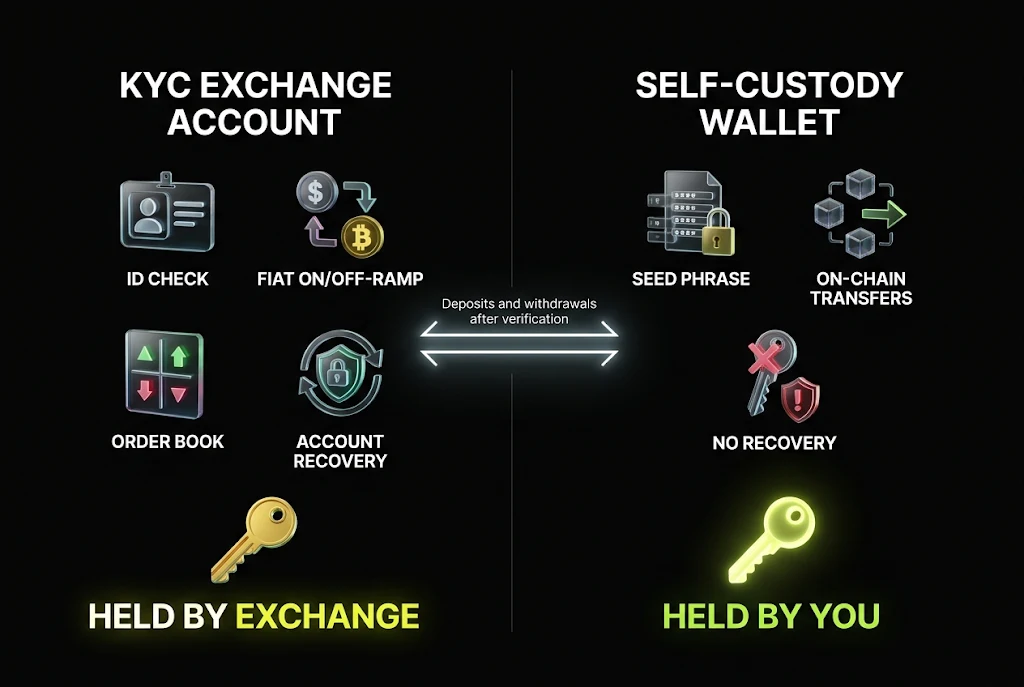
A KYC exchange and a self-custody wallet solve different problems: one provides fiat access, trading tools and recovery, the other provides direct control of keys.
Streamlined Onboarding and Post-KYC Account Hardening
Basic verification on a major exchange only takes a few minutes. On Bitunix, the process comes down to three steps: select your issuing country and document type, upload the front and back of a valid government ID, and complete a live face scan. You can follow the step-by-step walkthrough in How to Complete Your KYC on Bitunix, or pull up the web instructions in the Help Center.
Passing verification proves the account belongs to you. Before you deposit or start trading, three account settings are worth configuring right away: two to lock down security, and one to keep tabs on the market.
1. Google Authenticator 2FA. App-based codes generate locally on your device, making them far more resilient against SIM-swap attacks than SMS codes.
2. Anti-Phishing Code. You choose a personal phrase or code that appears inside every genuine Bitunix email. Any message missing that code is a fake. With impersonation scams surging, this quick check makes spoofed support emails easy to spot.
3. Super Alert. Bitunix's alert system tracks price levels, technical indicators, chart drawings, candlestick patterns, and large on-chain transfers. While it is a trading tool rather than a security lock, setting it up early lets you react to volatility without staring at charts all day.
Two basic habits round out your defense. Stick strictly to the official website and mobile app, and never share your password or 2FA codes with anyone. Bitunix staff will never ask for either.
Looking Beyond Onboarding: Verifying Platform Asset Safety
KYC is the platform verifying you. When using a custodial exchange, you should apply that same scrutiny in reverse, because the biggest risk of a custodial account is the custodian itself.
On Bitunix, you can verify two safeguards independently:
Proof of Reserves: The November 2026 update shows reserve ratios of 161% for BTC, 105% for ETH, and 106% for USDT, totaling roughly $269 million in reserves. Because the snapshot uses a Merkle Tree structure, you can cryptographically verify that your own account balance is included.
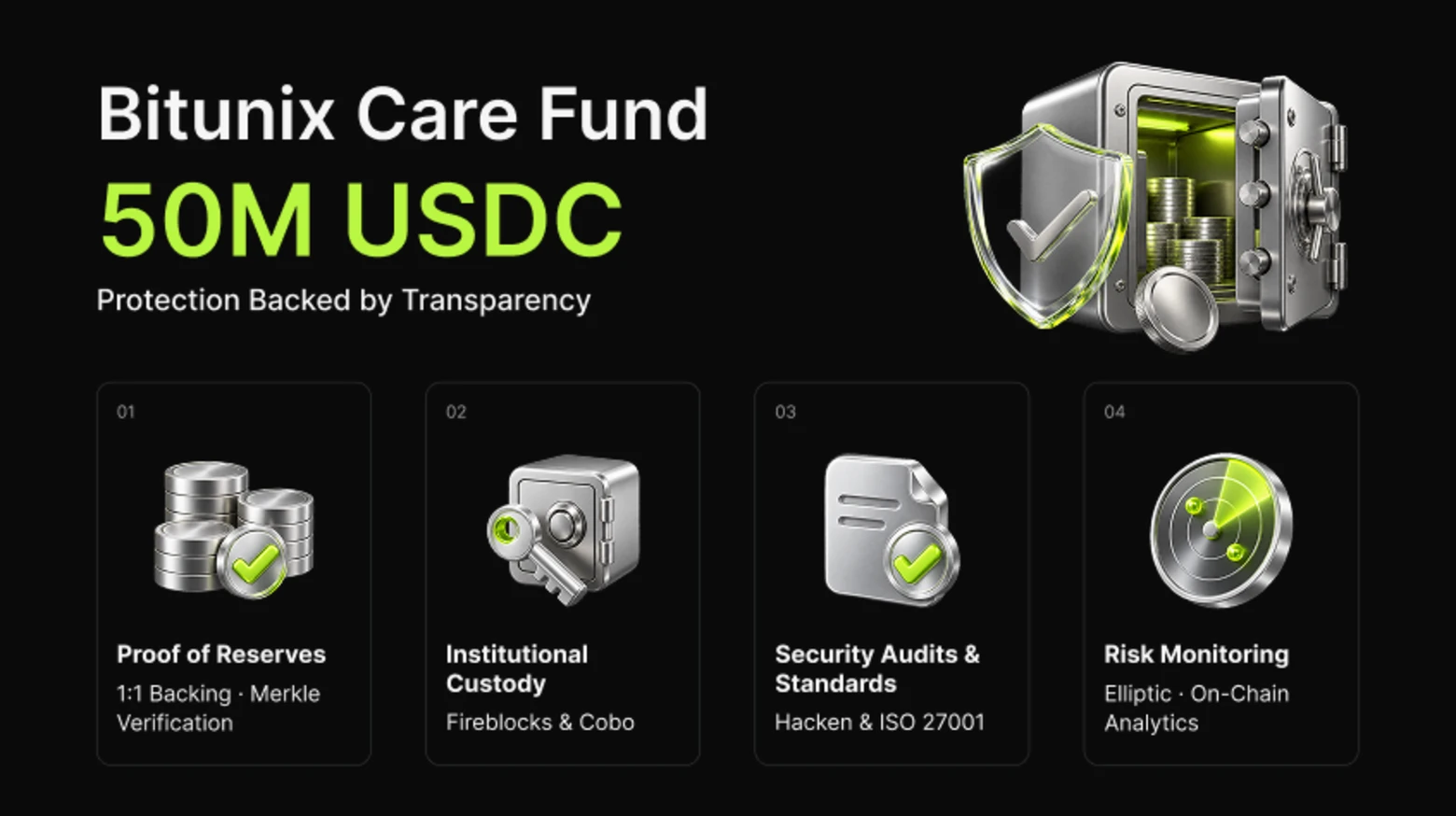
Care Fund: This separate $50 million USDC reserve launched in 2025 at $30 million and has since been expanded. It sits at a public on-chain address anyone can inspect, and according to Bitunix, it is large enough to cover the full value of the platform's hot wallets. The fund is built for rare, exchange-level incidents assessed case by case, and does not cover trading losses from normal market swings.
Neither safeguard is an absolute guarantee. Proof of Reserves is only a snapshot at a specific point in time, and the Care Fund operates within a defined scope. Still, both give you verifiable on-chain evidence to inspect yourself rather than empty promises you have to take on faith.
Making KYC Crypto Rules Work for Your Own Security
KYC crypto verification ties an exchange account to a real, verified person, while AML provides the ongoing monitoring that keeps illicit funds off the platform. For everyday traders, the practical value comes down to three things: a live identity check designed to block stolen photos and deepfakes, an account recovery path that does not rely on login credentials alone, and accountable counterparties in P2P markets.
Self-custody remains an essential part of the picture alongside centralized exchanges, each with its own trade-offs. Whichever mix you choose, treat verification as a two-way process: complete your own checks, harden your account security, and inspect your exchange's reserves with the same care it applies to you.
Disclaimer: This article is for general educational purposes only and does not constitute legal, financial, or investment advice, or any guarantee of asset security. KYC requirements, verification procedures, and service availability are subject to applicable laws, official Bitunix announcements, and the relevant terms of service. Trading digital assets, including leveraged products, involves risk and may result in loss of capital.