How Does Ravencoin Work?
Ravencoin operates on a blockchain architecture similar to Bitcoin’s, but with several key differences that enable the creation and transfer of tokens. Although its code originated from a Bitcoin fork, Ravencoin has developed its own distinct network, assets, and protocols. To lower mining barriers, it uses KAWPOW—a variation of the Proof of Work consensus mechanism , which secures the network, validates transactions, and distributes new RVN tokens to computers running Ravencoin software.What are the Key Features of Ravencoin?
- ASIC-Resistant Mining: Uses the KAWPOW algorithm (formerly X16R), which shuffles 16 hashing functions to prevent ASIC dominance, enabling GPU mining for broader participation. Block time of 1 minute (vs. Bitcoin’s 10 minutes) and a block size of 2MB for faster transactions.
- Asset-Centric Design: Full Asset Aware Protocol ensures tokens (representing real-world assets, NFTs, etc.) cannot be accidentally destroyed, unlike Bitcoin-based token systems. Simplified token issuance without smart contracts, reducing complexity compared to Ethereum.
- Decentralization Focus: No pre-mine or ICO, with fair distribution via open mining from launch. Community-driven governance via the Ravencoin Foundation (established 2020)
How to Mine Ravencoin?
To mine Ravencoin (RVN), start by building your mining rig with a powerful GPU from NVIDIA or AMD, a reliable 80+ Gold-rated power supply, and proper cooling to keep temperatures in check. Next, download mining software, such as T-Rex Miner, TeamRedMiner, or Kawpowminer, and set up a secure wallet—options include Ravencoin Core Wallet, Electrum-RVN, or Trust Wallet—to to store your tokens. Then, join a mining pool like Flypool, RavenMiner, 2Miners, Flockpool, or WoolyPooly by configuring the pool's server address, worker ID, and port number in your software. Finally, launch your mining program, monitor your hash rate, power consumption, and temperature using tools like HWMonitor, and remember to keep your system secure and evaluate profitability by considering electricity costs and hardware efficiency.Ravencoin Tokenomics
Ravencoin's tokenomics are centered around its native token, RVN, which serves as both the gas token and the reward token for activities on the blockchain. Here are key aspects of Ravencoin's tokenomics:- Maximum Supply: 21 billion RVN, which is 1,000 times more than Bitcoin's supply of 21 million BTC
- All RVN tokens are distributed through mining activities, ensuring a fair and decentralized distribution.
- Block Reward: Initially set at 5,000 RVN per block, but as of recent updates, the block reward is 2,500 RVN per block.
- Halving Schedule: The block reward halves approximately every 4 years, similar to Bitcoin's halving schedule
- Transaction Fees: Users pay fees in RVN to confirm transactions on the network1.
- Asset Creation: To create new assets on the Ravencoin blockchain, users must burn RVN tokens. For example, creating a token requires burning 500 RVN18.
- Reward Distribution: Rewards for asset holders are distributed in RVN, allowing for dividend payments and other financial applications
- Token Burning: The requirement to burn RVN for asset creation acts as a deflationary mechanism, potentially increasing the value of remaining RVN tokens by reducing their supply
- Binance Smart Chain Integration: RVN tokens can be bridged to the Binance Smart Chain, enabling their use in DeFi applications like yield farming and staking
How is Ravencoin Different From Other POW Cryptocurrencies?'
Ravencoin is optimized for tokenized asset creation and transfer, allowing users to issue tokens representing real-world assets like securities, collectibles, or loyalty points. This feature is not native to Bitcoin or most PoW cryptocurrencies. Token creators can send messages directly to holders and distribute RVN rewards (e.g., dividends), features not typically found in other PoW chains.| Feature | Ravencoin | Bitcoin | Ethereum (Pre-Merge) |
| Consensus | PoW (KAWPOW) | PoW (SHA-256) | PoW (Ethash) |
| ASIC Resistance | Yes | No | Partial |
| Asset Layer | Native protocol support | Requires Layer 2 (e.g., Counterparty) | Smart contracts |
| Block Time | 1 minute | 10 minutes | 15 seconds |
Ravencoin Price and Technical Analysis
 As of March 17, 2025, Ravencoin's price is approximately 0.01216297 USD with a market capitalization of about 172.94 million USD. The current market sentiment for Ravencoin is bearish, with technical indicators suggesting a weakening trend. The Fear & Greed Index is at 30, indicating fear in the market.
Analysts predict that Ravencoin's price might fluctuate around 0.0123 to 0.0131 USD in March 2025, with a potential average price of 0.0127 USD. For April, the price is expected to stabilize around 0.0124 USD.
The support levels are around the recent lows, such as 0.01197116 USD, which could provide a floor for the price if it continues to drop.
As of March 17, 2025, Ravencoin's price is approximately 0.01216297 USD with a market capitalization of about 172.94 million USD. The current market sentiment for Ravencoin is bearish, with technical indicators suggesting a weakening trend. The Fear & Greed Index is at 30, indicating fear in the market.
Analysts predict that Ravencoin's price might fluctuate around 0.0123 to 0.0131 USD in March 2025, with a potential average price of 0.0127 USD. For April, the price is expected to stabilize around 0.0124 USD.
The support levels are around the recent lows, such as 0.01197116 USD, which could provide a floor for the price if it continues to drop.
Who Founded Ravencoin?
Ravencoin was founded by Bruce Fenton, Tron Black, and Joel Weight, who published the Ravencoin whitepaper in 2017. These founders are seasoned businessmen and developers, with Bruce Fenton being a member of the Bitcoin Foundation, Tron Black being a core developer and president of the Ravencoin Foundation, and Joel Weight serving as the CTO at Overstock. The project was announced on October 31, 2017, and launched on January 3, 2018, as a fork of the Bitcoin codebase, with a focus on asset tokenization and decentralized mining. There is also mention of other contributors and supporters, such as Ivan Jolicic and others involved in the broader Ravencoin community. However, the primary founders are recognized as Bruce Fenton, Tron Black, and Joel Weight.How to Buy/ Sell $RVN Ravencoin Crypto?
To buy $RVN, you need to create an account on Bitunix. If you are already a registered user, you can skip this step. Next, you need to deposit USDT in your Bitunix account. Simply head to your profile and click on the wallet icon. Next, click on deposit and follow the steps to deposit crypto in your account. To trade in RVN/USDT, navigate to the main menu and click on the Markets tab and select 'Marketplace'. Next, click on the search icon and look for RVN.
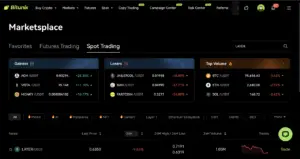 Next, click on Trade to open the trading window for RVN/USDT.
 You can choose to place a limit or a market order for buying and selling Ravencoin tokens.
Watch our detailed tutorial on How to use Crypto Limit and Market Orders on Bitunix Futures?
You can choose to place a limit or a market order for buying and selling Ravencoin tokens.
Watch our detailed tutorial on How to use Crypto Limit and Market Orders on Bitunix Futures?