Bitunix Crypto Market Report: World Cup Fuels Prediction Market Boom, Robinhood Chain Emerges as July’s Public Chain Focus

Reporting Period: July 1 – July 31, 2026
Data Cutoff Date: July 31, 2026
Executive Summary
BTC traded within a narrow range of $63,000–$67,000 throughout July, while the BIP-110 proposal failed to gain broad consensus.
ETH became one of the best-performing major crypto assets in July, gaining 22% during the month.
Robinhood Chain’s average daily trading volume surpassed Ethereum in July.
Driven by the World Cup effect, Kalshi’s monthly trading volume exceeded $40 billion in July.
Ondo Perps officially launched, pushing on-chain derivatives toward a new stage of capital efficiency.
JPMorgan: The probability of the Clarity Act passing within 2026 has declined, potentially weakening the outlook for the crypto market.
Coldcard hardware wallets were targeted in an offline brute-force attack, with estimated losses exceeding $100 million.
Bitcoin July Price Trend Analysis& Crypto Market Recap
In July 2026, BTC gradually recovered after falling below the $60,000 level at the beginning of the month. For most of July, Bitcoin traded within a relatively tight range between $63,000 and $67,000. Meanwhile, market capital flows were heavily concentrated in U.S. equities, with sectors including AI infrastructure, commercial aerospace, and memory chips experiencing significant volatility. As investors rotated capital into these high-performing stock sectors, some funds flowed out of the crypto market and into traditional equities. As a result, BTC lacked clear momentum in either direction throughout July. The asset continued to consolidate around the $65,000 level, building a potential bottoming structure.

Data Source: Bitunix
Bitcoin Futures Market in July — Lower Liquidations Amid Continued Consolidation
As BTC remained locked in a narrow trading range throughout July, some leveraged traders reduced their exposure, a trend that was particularly visible in the futures market. At the beginning of July, daily BTC futures liquidations generally remained between $100 million and $200 million. However, as Bitcoin continued trading between $63,000 and $67,000, with monthly price fluctuations staying below 10%, lower-leverage positions under 10x became increasingly difficult to trigger liquidation. By July 25, daily BTC futures liquidations had dropped to approximately $7 million, marking the lowest level in recent months. This decline reflects a reduction in overall market leverage, increasing risk awareness among traders, and weaker activity across the derivatives market.

Data Source: Coinglass
In July, the funding rate for the BTC futures market remained positive for most of the month, briefly turning negative only on July 21. This indicates that long positions dominated market positioning during most trading sessions, with long traders paying funding fees to short traders. One possible explanation is that after BTC briefly declined toward $58,000 at the beginning of the month—marking its lowest level in nearly two years—some investors viewed downside risk as limited and began accumulating BTC at lower prices, increasing bullish futures exposure.

Data Source: Coinglass
Bitcoin Institutional Holdings — Exchange Reserves Recover as Strategy Raises Cash for Debt Obligations
In July 2026, Strategy, the world’s largest corporate Bitcoin treasury holder, did not increase its BTC holdings further. Instead, the company raised additional U.S. dollar reserves through common stock sales to cover interest expenses related to its outstanding convertible bonds. Strategy’s cash reserves have now increased to $3.75 billion. In the Bitcoin spot ETF market, IBIT increased its holdings by approximately 6,505 BTC in July. In contrast, FBTC and GBTC collectively reduced their holdings by around 7,400 BTC during the same period, highlighting divergent institutional capital flows. Exchange reserves showed a different trend. Binance’s BTC reserves continued their multi-month recovery. Compared with the April low of 608,067 BTC, Binance’s Bitcoin reserves had climbed to 658,293 BTC by the end of July, representing an increase of more than 50,000 BTC. This shift suggests that some retail and institutional investors may have transferred BTC back to exchanges, indicating a recovery in market demand for accumulation.


Data Source: BiTBO
Understanding Bitcoin’s Key Proposal: BIP-110
BIP-110 is a Bitcoin improvement proposal introduced in October 2025 by early Bitcoin developer Luke Dashjr. With the proposal expected to enter a voting process in August, BIP-110 has become one of the most closely watched governance discussions within the Bitcoin ecosystem. The proposal aims to prevent arbitrary data embedding in Bitcoin transactions by restricting methods that insert more than 256 bytes of continuous arbitrary data into transactions. Luke Dashjr has long opposed Ordinals and inscription technology. He argues that Bitcoin’s limited block space should primarily support BTC payments and value transfer rather than function as a general-purpose data storage platform.
However, BIP-110 has yet to achieve broad consensus among Bitcoin miners and ecosystem participants. F2Pool co-founder Wang Chun publicly expressed opposition to BIP-110 as early as February. Foundry USA Pool, one of Bitcoin’s largest mining pools, also began soliciting feedback from its mining customers on July 16 regarding signaling support for the proposal. Strategy, currently the institution with the largest Bitcoin holdings, has also taken a negative stance toward BIP-110. Michael Saylor, Executive Chairman of Strategy, argued that BIP-110 could invalidate currently valid transactions that have already paid fees by changing Bitcoin’s consensus rules. He noted that the Bitcoin protocol itself cannot determine the intent behind transaction data. Saylor further warned that introducing purpose-specific restrictions at the consensus layer could establish a new governance precedent. Although the proposed restriction would expire after approximately one year, the governance framework created through such a process could have long-lasting implications for Bitcoin’s future development.

Data Source: BIP-110
Ethereum July Price Trend & Market Analysis
ETH delivered a strong performance in July, becoming one of the best-performing major crypto assets during the month. Ethereum gained 22% in July, significantly outperforming many other major assets across the broader crypto market. From a technical perspective, the $2,000 level remains a key resistance zone for ETH. During previous recovery attempts, ETH repeatedly faced selling pressure after approaching this critical price level, before pulling back and consolidating around $1,900. This suggests that while buying momentum has improved, market demand has not yet been strong enough to overcome the psychological resistance at the $2,000 threshold.

Data Source: Bitunix
July Ethereum Derivatives Market Insights— Short Liquidations Surge at the Beginning of the Month
In the derivatives market, ETH experienced a large-scale short liquidation event at the beginning of July. On July 2, ETH short liquidations reached $143 million, marking the highest single-day liquidation volume for Ethereum during the month. The main driver behind this move was ETH’s sharp rebound after briefly falling toward $1,570 at the start of July. The asset quickly recovered and reclaimed the $1,900 level within a short period of time. During this rapid price recovery, a large number of highly leveraged short positions were forcibly liquidated due to insufficient margin, resulting in a significant increase in short-side liquidations.

Data Source: Coinglass
ETH funding rates followed a trend similar to the BTC futures market in July. Long positions remained dominant for most of the month, with funding rates staying positive for more than 95% of the time. This indicates that long traders were consistently paying funding fees to short traders. One possible explanation is that after ETH dropped below $1,600, some market participants viewed the downside risk as limited and considered the price to be approaching a potential bottom. As a result, traders gradually increased long futures exposure, reinforcing bullish sentiment across the derivatives market.

Data Source: Coinglass
Ethereum Institutional Holdings — ETF Inflows Continue as Institutions Accelerate ETH Accumulation
Institutional interest in Ethereum continued to strengthen in July. Bitmine (BMNR) increased its ETH holdings by approximately 55,000 ETH during the month. The company has now staked around 4.8 million ETH, further expanding its Ethereum treasury allocation. In the spot ETF market, BlackRock’s Ethereum spot ETF, ETHA, accumulated more than 200,000 ETH in July. Additionally, during the final week of July, Ethereum spot ETFs recorded consecutive days of net inflows, suggesting that continued institutional capital allocation may have become an important driver behind ETH’s price appreciation. On the exchange reserve side, Binance’s ETH holdings declined by more than 90,000 ETH in July, indicating that some users may have withdrawn ETH from centralized exchanges and moved assets into long-term holdings or on-chain positions. However, considering overall exchange liquidity trends, the market has yet to develop a strong consensus regarding ETH’s continued upside potential.


Data Source: strategicethreserve.xyz
Ethereum Improvement Proposal EIP-8222: Enhancing Privacy for Staking Infrastructure
On July 22, Ethereum Improvement Proposal EIP-8222 was introduced, proposing a STARK-based zero-knowledge proof solution to separate the staking deposit and withdrawal processes while improving validator anonymity. The goal is to reduce the traceability of validator activity on-chain. Currently, approximately one-third of all ETH is staked. As institutions and large holders increasingly participate in Ethereum staking, the transparency of blockchain data has introduced potential privacy concerns. Thibault Dubuis, Head of Staking and Decentralized Finance Products at Sygnum Bank, noted that Ethereum currently maintains traceable on-chain links between deposit addresses, validator identities, and withdrawal credentials. As a result, institutional staking positions, entry timing, and staking strategies can become partially visible to external observers.
EIP-8222 aims to reduce these on-chain connections through cryptographic techniques, enhancing privacy protections for institutional participants while maintaining Ethereum’s network security. Currently, the proposal remains in the community discussion phase, and no specific deployment timeline has been announced. If EIP-8222 is adopted in the future, it could further improve Ethereum’s privacy capabilities as an institutional-grade financial infrastructure layer and potentially encourage greater participation from large-scale capital in the ETH staking ecosystem.
July 2026 On-Chain Data Overview
Major Public Chains — Robinhood Chain’s Average Daily Transactions Surpass Ethereum in July
Robinhood Chain emerged as one of the most closely watched public chains in July. As an Ethereum Layer 2 network launched by U.S. brokerage platform Robinhood, Robinhood Chain, is built on the Arbitrum Orbit framework and focuses primarily on on-chain applications involving Real-World Assets (RWA), AI-related assets, and Meme tokens. By the end of July, several Meme projects launched on Robinhood Chain, including Cash Cat, DogBull, and pipedog, had reached market capitalizations exceeding $20 million. In addition, multiple stock token trading pairs powered by Uniswap V4 on Robinhood Chain recorded cumulative trading volumes of more than $500,000.
Driven by growing interest in tokenized stocks and Meme asset trading, Robinhood Chain achieved an average daily transaction volume of 6.86 million transactions in July, surpassing Ethereum’s mainnet average of approximately 2.58 million daily transactions for the first time.This milestone highlights Robinhood Chain’s potential in consumer-focused on-chain trading applications. However, in terms of network revenue and overall economic activity, Robinhood Chain remains in an early growth stage. Its average gas revenue in July was approximately $115,900, still significantly below more mature ecosystems such as Hyperliquid, Ethereum, and Solana.


Data Source: Artemis
DEX & Perp DEX — On-Chain Trading Volume Declines More Than 10% Month-over-Month
As major crypto assets including BTC, ETH, and SOL remained in a prolonged consolidation phase throughout July, overall on-chain trading activity weakened, leading to noticeable declines across both decentralized exchanges (DEXs) and perpetual decentralized exchanges (Perp DEXs). In the DEX sector, Uniswap continued to maintain its dominant market position. However, its average daily trading volume declined to $1.736 billion in July, representing a month-over-month decrease of more than 10% compared with June. PancakeSwap, Meteora, and Aerodrome ranked second, third, and fourth in terms of trading volume, with each platform recording average daily trading volumes exceeding $100 million in July.
In the Perp DEX market, Hyperliquid recorded an average daily trading volume of $7.178 billion in July. However, due to reduced market volatility, trading activity also declined significantly compared with June. Meanwhile, Apex Protocol and Aster both maintained strong momentum, with average daily trading volumes exceeding $1 billion, keeping them among the leading platforms in the Perp DEX sector.


Data Source: Artemis
Prediction Markets — World Cup Effect Drives Kalshi’s July Trading Volume Above $40 Billion
Fueled by the popularity of the 2026 FIFA World Cup, the prediction market sector experienced a significant increase in trading activity during July. Among major prediction platforms, Kalshi, which focuses heavily on sports event markets, recorded the strongest growth. Its total trading volume exceeded $40 billion in July, reaching a new all-time high. However, following the conclusion of the World Cup on July 20, trading volumes across Kalshi, Polymarket, and Rothera declined to varying degrees, highlighting that sports-related events remain a major short-term driver of prediction market activity.
According to data released by blockchain analytics firm Chainalysis, blockchain-based prediction markets generated approximately $20 billion in cumulative trading volume during the 2026 FIFA World Cup. The event also drove around $24 million in digital collectible trading activity, with more than 400,000 wallet addresses participating in on-chain betting activities. These figures further demonstrate the potential of prediction markets to capture significant user engagement during major global sporting events.

Data Source: Artemis
Crypto Infrastructure & Product Evolution: From Multi-Chain Expansion to Financial Innovation, DeFi Infrastructure Enters a New Phase of Growth
Uniswap V4 Integrates with Robinhood Chain, Driving Significant Growth in Trading Volume
On July 2, Uniswap announced on X that Uniswap v2, v3, v4, and UniswapX had officially been deployed on Robinhood Chain, the Layer 2 network launched by Robinhood. As one of the key public automated market makers (AMMs) within the Robinhood Chain ecosystem, Uniswap received support across multiple access points, including the Uniswap Web App, Wallet, and API, on its first day of deployment, further expanding its trading accessibility within the emerging blockchain ecosystem. According to CoinGecko data, following the deployment of Uniswap v4 on Robinhood Chain, trading volume on July 30 exceeded $450 million. The integration with Robinhood Chain not only strengthens Uniswap’s multi-chain expansion strategy but also introduces new trading activity to the protocol, helping improve overall platform liquidity and user engagement.

Data Source: Coingecko
Ondo Perps Goes Live, Bringing On-Chain Derivatives into a New Era of Capital Efficiency
On July 7, Ondo Perps officially launched and became available to non-U.S. Investors. As a perpetual futures platform that supports tokenized stocks and stablecoins as collateral, Ondo Perps aims to push the on-chain derivatives market into a new phase focused on capital efficiency.
Its key advantages include:
Tokenized stocks can be used as collateral without requiring investors to maintain separate capital reserves across multiple platforms.
Enhanced market liquidity enables tighter spreads and lower slippage.
Order routing, margin updates, and liquidation processes are handled in real time while maintaining decentralization.
Currently, Ondo Perps supports a wide range of assets, including stocks, indices, and commodities such as SPCX, MU, NVDA, TSLA, AAPL, gold, and crude oil. The platform offers up to 20x leverage and provides global investors with 24/7 trading access. As of July 25, Ondo Perps had accumulated $4 billion in total trading volume, with open interest reaching $50 million.

Data Source: Ondo Perps
Aave Selects Chainlink CCIP as Its Cross-Chain Infrastructure Standard
On July 15, Aave announced that it had selected Chainlink CCIP as its standard cross-chain infrastructure solution. CCIP is currently integrated through Aave’s delivery infrastructure layer, a.DI, where it facilitates cross-chain GHO transfers and multi-chain governance execution. In the future, CCIP will also support cross-chain functionality within the Aave App through Stable Vaults, covering use cases such as vault rebalancing, yield optimization, deposits, and transfers.
These cross-chain operations will be deployed across networks including Ethereum, Base, and Arbitrum. The partnership highlights Aave’s accelerating multi-chain expansion strategy. By adopting standardized cross-chain infrastructure, Aave aims to improve interoperability between different blockchain networks and enhance asset mobility across the DeFi ecosystem.
TRON Advances v4.8.2 Upgrade, Adding Ethereum Compatibility Features and AI Agent Tool Support
On July 31, the TRON community held its 67th Core Developer Meeting, focusing on progress updates for the GreatVoyage-v4.8.2 (Pyrrho) upgrade. A total of 19 Super Representatives have already completed the upgrade, with the network operating smoothly. Community nodes are encouraged to complete the update before August 17. The meeting also discussed proposals to activate related network parameters that would improve compatibility with Ethereum’s Prague and Osaka upgrade features. Specific creation and activation timelines will be determined in future developer meetings.
Additionally, TRON Solidity Compiler v0.8.28 was officially released. Based on compatibility with Ethereum Solidity v0.8.28, the new version further enhances support for TRON-native features, including TRX, TRC-10 assets, resource delegation, and voting mechanisms. The updated wallet-cli introduces a TypeScript-based architecture and provides dual-output modes designed for both machines and developers, improving compatibility with AI Agent workflows.
Macro & Smart Money Flow Metrics - Long-Term and Short-Term Capital Rotation Intensifies as Market Focus Shifts Toward Sentiment and Liquidity Trends
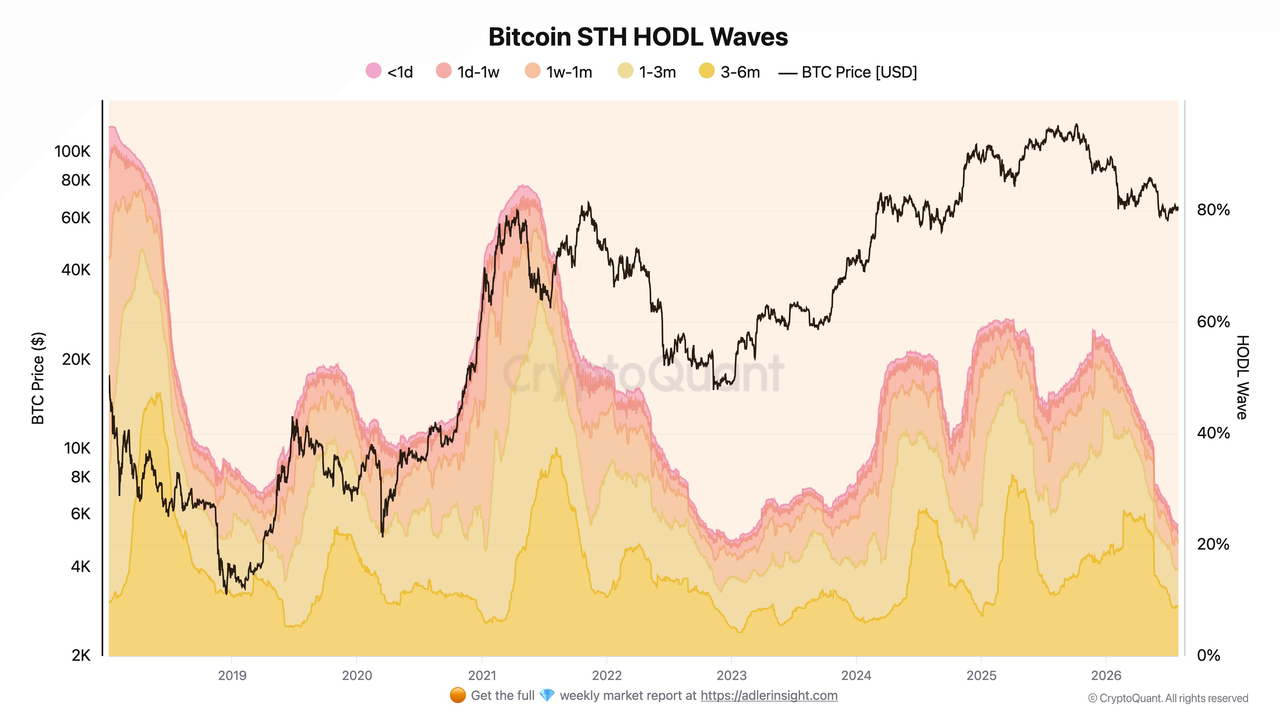
Bitcoin Short-Term Holder Supply Ratio Falls to 23.5%, Reaching Multi-Year Low
On July 31, CryptoQuant analyst Axel Adler Jr. reported that Bitcoin short-term holders’ share of realized market capitalization had declined to 23.5%, marking a multi-year low. Historically, the metric has remained below the current level for only 4% of the time. Meanwhile, the share held by long-term holders increased to 52.5%, approaching the historical peak of 55% recorded in 2018.
Three months ago, these two figures stood at 40% and 42%, respectively, indicating a significant shift in Bitcoin ownership from short-term speculators toward long-term holders. Axel Adler Jr. noted that the decline in short-term holder participation suggests reduced speculative turnover and limited inflows of new capital, while the rising proportion of long-term holders indicates that Bitcoin supply is increasingly becoming dormant and concentrated among stronger holders. However, this market structure alone does not represent a direct buy signal. If demand fails to recover, low market activity could persist, potentially leading to further price weakness, similar to the accumulation period observed between 2022 and late 2023.
Data Source: X
Ansem: Bought PUMP Token, Betting on a Recovery in Solana Retail Activity and Potential Airdrop Impact
On July 20, crypto influencer Ansem stated on X that he had purchased PUMP tokens at approximately $0.001675. Ansem highlighted that pump.fun continued generating monthly revenue of around $30 million to $40 million even during the bear market. He believes Solana could once again become a major platform for retail trading activity during the current market cycle.
He further suggested that if pump.fun uses an airdrop to stimulate the Meme coin trading ecosystem, a distribution exceeding $300 million could significantly boost market trading volume, attention, and user activity. However, Ansem also noted that his investment thesis would be invalidated if PUMP’s price falls below the previous low of approximately $0.0014 reached during the token unlock selling period.
James Wynn Closes Part of S&P 500 Short Position, Securing Only $45 in Profit
According to monitoring data from Onchain Lens, well-known derivatives trader James Wynn (0x507...edb6) closed part of his S&P 500 short position, generating a profit of just $45. The trader initially opened an S&P 500 short position worth approximately $599,000, consisting of 80.44 contracts. He later closed 42.19 contracts, valued at around $312,600.
Wynn currently maintains an S&P 500 short position worth approximately $857,600, consisting of 115.68 contracts, with an unrealized loss of $192. Over the past month, Wynn has suffered multiple liquidations on his S&P 500 short positions but continued increasing his exposure. His cumulative historical losses from these trades have now reached approximately $23.4 million.
Crypto Regulation & Institutional Policy: U.S., Japan, and South Korea Accelerate Digital Asset Strategies as Regulatory Competition Enters a New Phase
JPMorgan: Probability of Clarity Act Passage This Year Declines, Potentially Weakening Crypto Market Outlook
On July 31, JPMorgan analysts stated that the likelihood of the U.S. Clarity Act—a proposed crypto market structure bill—passing the Senate by the end of the year, has declined, creating a potential headwind for the crypto market. Prediction market data shows that the probability of the bill passing this year has fallen to its lowest level, with Kalshi pricing the probability at 37% and Polymarket at 26%.
JPMorgan noted that the Senate has prioritized other legislative matters ahead of the summer recess, while several key issues—including ethics provisions, enforcement authority, stablecoin yield mechanisms, DeFi regulation, and illicit finance concerns—remain unresolved. These factors have increased uncertainty surrounding the bill’s progress.
Previously, JPMorgan had viewed the Clarity Act as a potential positive catalyst for the crypto market, as legislation would establish a clearer regulatory framework for digital assets.
Under the proposed framework:
Digital commodities would primarily fall under the jurisdiction of the Commodity Futures Trading Commission (CFTC).
Digital securities would continue to be regulated by the Securities and Exchange Commission (SEC).
Japan Plans to Launch Bitcoin ETF by 2028, With Retail Investors Expected to Become a Key Source of Capital Inflows
Japan is expected to launch Bitcoin ETFs as early as 2028. Following revisions to the Financial Instruments and Exchange Act, which bring crypto assets under the country’s financial product regulatory framework, Japan’s Financial Services Agency (FSA) plans to revise investment trust regulations to allow funds and ETFs to hold crypto assets as primary investment targets. Several asset management firms have already begun exploring potential participation. Institutional interest in crypto assets is also rising in Japan. A survey conducted by Nomura Holdings and Laser Digital found that approximately 79% of institutional investors and family offices plan to invest in crypto assets over the next three years. Unlike the U.S. Bitcoin ETF market, which has been primarily driven by institutional capital, Japan’s institutional investor base remains relatively limited. Additionally, Japanese household financial assets maintain a high allocation of cash. As a result, retail investor capital may become the primary source of inflows for Japan’s future Bitcoin ETF market.
South Korea’s FSC Plans Digital Asset Framework Law as Opposition Party’s Crypto Tax Abolition Bill Enters Review
South Korea’s Financial Services Commission (FSC) plans to work with the ruling Democratic Party of Korea to draft a unified Digital Asset Basic Act, aiming to establish a comprehensive regulatory framework for the country’s digital asset industry. The proposed legislation will cover key areas including stablecoin issuance and circulation, digital asset business regulations, exchange licensing requirements, disclosure standards, internal control systems, and operational resilience requirements. Currently, 10 separate digital asset and stablecoin-related bills are awaiting review in South Korea’s National Assembly, while the FSC has yet to finalize the timeline and submission process for the unified legislation. Major areas of debate include whether issuers of Korean won-denominated stablecoins should be required to have majority ownership by banks, as well as whether major crypto exchanges should be subject to additional ownership restrictions.
Security Firewall: Crypto Security Incidents Surge as Wallets and Infrastructure Become Primary Attack Targets
According to SlowMist statistics, the crypto industry experienced 32 security incidents in June 2026, resulting in total losses of $238 million, representing a month-over-month increase of more than 300%. Among these incidents, the most severe loss came from the Coldcard hardware wallet vulnerability. Coldcard, developed by Canadian company Coinkite, is a hardware wallet designed for offline storage of Bitcoin private keys. The vulnerability affected multiple generations of devices, including Mk2, Mk3, Mk4, Q, and Mk5 models. According to a report released by Block’s Bitcoin Engineering and Security team, the root cause of the vulnerability was an incorrect firmware build configuration. The issue caused affected devices to bypass their own hardware random number generator and instead rely on a weak software-based randomness mechanism derived from chip serial numbers and clock registers. Since these data points are not secret, attackers could easily obtain or predict them.

In July 2026, crypto security incidents became increasingly frequent, with attack targets expanding beyond traditional smart contract vulnerabilities to include DAO governance systems, oracle infrastructure, cross-chain bridges, and hardware wallets. As the on-chain financial ecosystem continues to expand, security risks are evolving from isolated protocol vulnerabilities into broader challenges involving technical architecture, access control, and asset custody. The Coldcard hardware wallet incident serves as another reminder that crypto security requires more than smart contract audits. Industry participants must also strengthen hardware security, private key management, and infrastructure protection to reduce asset loss risks and support the long-term development of the crypto ecosystem.
Market Outlook: U.S. Economic Data Shapes Rate Cut Expectations as Asian Crypto Events Highlight Industry Trends

August will bring a series of important market events, including U.S. labor market data releases, global crypto conferences, and major Web3 gatherings across Asia. Investors will closely monitor both macroeconomic policy developments and long-term industry trends. Among these events, U.S. nonfarm payroll data could significantly influence market expectations regarding the Federal Reserve’s September rate-cut path. Meanwhile, crypto industry conferences are expected to focus on institutional capital flows, Bitcoin ecosystem development, DeFi innovation, and computing infrastructure. With multiple catalysts emerging simultaneously, the market may enter a period of renewed information discovery and capital reallocation opportunities.
Conclusion
The crypto market in July displayed a clear pattern of “consolidation among major assets, rapid growth in emerging sectors.” BTC remained range-bound amid macroeconomic uncertainty and capital rotation, while ETH became a major market focus driven by institutional inflows and continued development of the staking ecosystem. At the same time, emerging sectors including Robinhood Chain, prediction markets, and on-chain derivatives experienced rapid expansion, highlighting the crypto industry’s transition from purely asset trading toward broader financial applications. As regulatory developments such as the U.S. Clarity Act, Asian digital asset frameworks, and institutional adoption trends continue to progress, future market competition will depend not only on token price performance but also on whether blockchain infrastructure can support the next stage of financial innovation.