Statistical Period: July 11, 2026 – July 17, 2026
Data Cutoff: July 17, 2026
Market Overview: Lower-than-Expected U.S. Inflation Data Boosts Rate Cut Expectations and Drives Crypto Market Recovery
This week, the core focus of global financial markets centered on changes in U.S. inflation data and adjustments in monetary policy expectations. The U.S. June non-seasonally adjusted CPI annual rate released in July came in at 3.5%, below market expectations of 3.8%. Meanwhile, seasonally adjusted CPI declined by 0.4% month-over-month, marking the largest monthly decline since April 2020. On the other hand, U.S. June PPI increased 5.5% year-over-year, while core PPI rose 4.7% year-over-year and 0.2% month-over-month. All major inflation indicators came in below market expectations, indicating that U.S. Inflationary pressures are gradually easing.
As inflation continued to cool, market expectations for the Federal Reserve to maintain restrictive monetary policy weakened, while expectations for future rate cuts strengthened further. Risk asset sentiment improved significantly as macro conditions stabilized. Supported by improving market confidence and a more favorable macro environment, major crypto assets entered a rebound phase. Although uncertainty remains regarding the future path of monetary policy, easing inflation pressures have provided greater flexibility for policy adjustments, allowing the crypto market to gradually enter a consolidation and recovery phase.
The Bitunix Token Pulse Weekly Report will continue monitoring the top 300 tokens by market capitalization on the Bitunix exchange, while tracking the performance of popular U.S. stock futures, providing investors with strategic insights and short-term trading references.
Crypto Asset Performance: Divergence Among Major Assets as Liquidity Concentrates in Large-Cap Tokens
Over the past week, the crypto market showed a clear divergence in performance, with capital and liquidity continuing to concentrate in major crypto assets. BTC gained 0.91%, maintaining a stable position above $63,000. ETH rose 6.47% over the week, becoming one of the strongest-performing major assets during the period. In contrast, tokens including SOL, HYPE, and XRP experienced varying degrees of decline. Across the broader market, approximately 40% of the top 300 tokens by market capitalization recorded gains this week, while the median decline stood at 0.77%.
Market performance indicates that under an environment of limited overall liquidity, capital is increasingly favoring high-market-cap assets such as BTC and ETH. Smaller-cap tokens continue to face liquidity differentiation, highlighting the market trend of “strong assets becoming stronger.”
Top Gainers - Fewer High-Multiple Rallies, AI Sector Shows Relative Strength
This week, the small-cap token market lacked significant high-return opportunities. KAITO, the top-performing token of the week, gained approximately 28%. Based on historical weekly market report standards, this level of growth would not even rank among the top weekly performers in previous cycles, reflecting a decline in speculative activity across the market.
From a sector perspective, AI-related tokens emerged as one of the relatively active themes this week. VIRTUAL, BEAT, and KAITO all recorded positive gains. Meanwhile, driven by ETH’s strong rebound, Ethereum ecosystem-related tokens also attracted renewed market attention. Tokens including LDO, UNI, and PEPE outperformed the broader market during the week.

Data Source: Bitunix Note: Price and performance data were collected at 1:30 AM UK time (UTC+0).
Top Losers - Meme Sector Remains Under Pressure as Market Sentiment Stays Cautious
The Meme coin sector experienced a notable correction this week. As an important indicator of market sentiment, multiple Meme tokens including BONK, H, and B recorded declines. The weakening momentum in the Meme sector suggests that short-term risk appetite has not fully recovered, and investor sentiment has yet to experience a clear reversal. Currently, capital is increasingly shifting toward major assets with stronger ecosystem foundations and clearer narratives. Overall, the market remains in a consolidation and recovery phase.

Data Source: Bitunix Note: Price and performance data were collected at 1:30 AM UK time (UTC+0).
Hot Token Deep Dive: Kaito — An AI-Powered Crypto Information Economy Platform
Kaito is an artificial intelligence (AI)-powered crypto information search and analytics platform designed to address key challenges in the Web3 industry, including fragmented information sources, excessive data noise, and inefficient market research processes. The project utilizes AI search models and natural language processing (NLP) technology to aggregate information from multiple sources, including Twitter (X), Discord, Medium, research reports, and on-chain data. This enables users to access and analyze crypto market intelligence more efficiently.
Beyond information aggregation, KAITO introduces the concept of an “attention economy”, using token incentive mechanisms to measure and distribute the value of community contributions. Through this model, content creators, researchers, and market participants can receive rewards for providing high-value information and insights.
KAITO Technical Analysis: Price Trends Higher Before Pulling Back After Reaching $0.56
The KAITO token officially completed its Token Generation Event (TGE) and began trading on February 20, 2025. Following its launch, KAITO experienced a rapid price increase driven by several factors, including growing interest in AI narratives, community airdrop activity, and rising demand for Web3 intelligence tools. The token reached an all-time high of approximately $2.9 on February 27. As market enthusiasm faded and the broader crypto market entered a correction phase, KAITO’s price subsequently declined significantly, reaching a low of around $0.28. On July 17, the 1-hour candlestick chart of KAITO formed a “golden cross” pattern, triggering a short-term rally of approximately 15%. Recently, supported by renewed interest in narratives such as AI Agents and Web3 data analytics, KAITO has continued to attract significant market attention.

Data Source: Bitunix
KAITO Fundamental Analysis: A Crypto Market Intelligence Analytics Platform
KAITO’s core business model focuses on using AI technology to analyze Web3 community information and provide market intelligence services for institutional users. The platform aggregates data from crypto influencers (KOLs), researchers, and community discussions on X, while also tracking information across multiple channels including Discord and online forums. It analyzes market trends, project attention levels, and industry developments, then provides processed data insights and analytics to enterprise users.
For retail users, KAITO uses the Yaps mechanism to encourage users to connect their social media accounts. Users are ranked based on their content contributions and market influence, with corresponding ecosystem incentives provided based on their performance. For enterprise customers, including project teams, investment institutions, and trading platforms, KAITO generates revenue through subscription fees for professional intelligence tools and data services. In simple terms, KAITO collects, organizes, and analyzes fragmented market information across social media platforms, then provides decision-makers with insights into “what the market is paying attention to.”

Data Source: Kaito
KAITO Market Structure Analysis: Limited Circulating Supply, Centralized Exchanges Dominate Trading Activity
KAITO currently has a market capitalization of approximately $340 million, with a fully diluted valuation (FDV) of around $830 million. More than 50% of KAITO’s total token supply remains locked. The uncirculated supply is primarily held by the Kaito project team and distributed across multiple Base network addresses. Due to the relatively limited circulating supply, KAITO’s token price may experience greater sensitivity when market capital flows in, resulting in relatively higher price volatility.
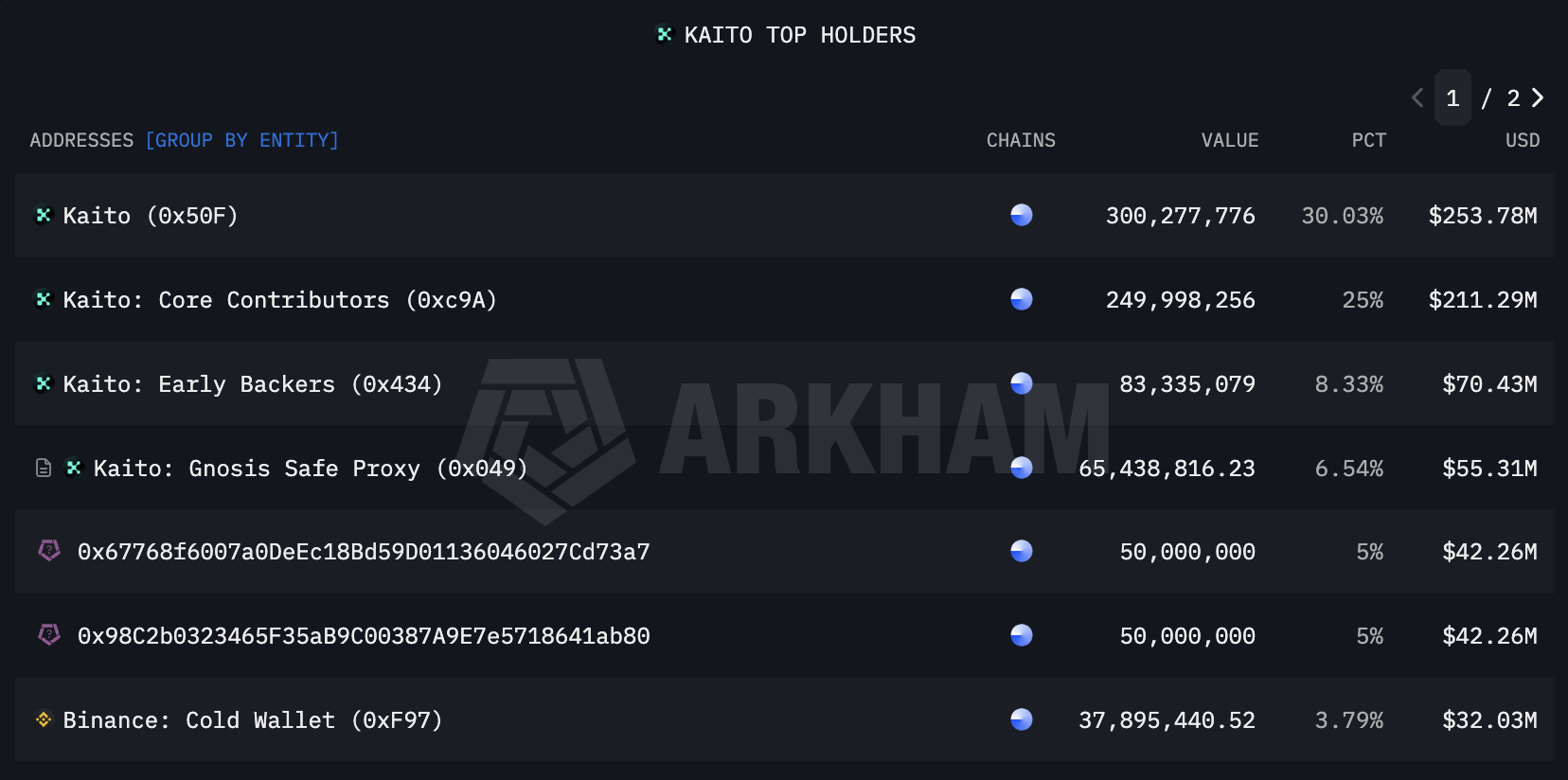
Data Source: Arkham
From both on-chain and off-chain trading perspectives, KAITO is an ERC-20 token, with on-chain activity primarily concentrated on decentralized exchanges (DEXs) within the Base ecosystem. However, after completing its TGE, KAITO was quickly listed on multiple major centralized exchanges (CEXs). As a result, the majority of current trading volume is concentrated on centralized exchanges, while on-chain trading activity remains relatively limited. At present, there are no clear signs of large-scale “smart money” accumulation ahead of market movements.
Over the past 24 hours, KAITO trading volumes on Binance, Upbit, and LBank reached approximately $6.9 million, $5.61 million, and $4.46 million respectively. Combined trading volume across these three platforms accounted for more than 30% of total market volume, indicating that KAITO’s current price discovery process relies primarily on centralized exchange liquidity.

Data Source: Coinmarketcap
Is It Too Late to Buy KAITO Now?
From a technical perspective, after breaking above the $0.70 level, KAITO has gained some short-term price support, while market sentiment has improved. However, from a fundamental perspective, KAITO’s core business model relies primarily on enterprise subscription services and data products. Therefore, its value growth may not be directly reflected through on-chain data, and investors should pay closer attention to product development and commercialization progress.
At the product level, on July 9, KAITO officially announced on X that its enterprise data analytics platform had added stock price data and AI analysis features covering more than 3,000 U.S. publicly listed companies. This expands KAITO’s service scope beyond crypto market intelligence toward broader financial market data analytics. Overall, while the AI sector has recently regained market attention, KAITO has not yet demonstrated a significant breakthrough in its business model or major product upgrades.
Investors should continue monitoring factors including token unlock pressure, circulating supply structure, and future product adoption, while fully assessing associated risks before making investment decisions.
Summary of KAITO Recent Trends
As a representative project in the AI + Web3 intelligence analytics sector, KAITO provides crypto market research services for institutional users by integrating social media information and market data, while exploring the business model of the “attention economy.” The recent recovery in AI-related narratives has supported a short-term rebound in KAITO’s token price. However, its future performance remains influenced by market liquidity conditions, token unlock schedules, and centralized exchange trading structures. Looking ahead, KAITO’s ability to expand enterprise data services and strengthen its commercialization capabilities will become a key factor determining its long-term value.
U.S. Stock Contracts Performance: Semiconductor Stocks Suffer Sharp Sell-Off, SpaceX Temporarily Falls Below IPO Price
The U.S. stock market witnessed the third-largest IPO in history on July 10, as South Korean memory semiconductor giant SK Hynix officially listed on Nasdaq, raising a total of $26.5 billion. However, driven by the combined impact of excessive gains in the AI sector and elevated market leverage, the semiconductor industry experienced a sharp correction this week. Memory chip and CPU-related stocks broadly declined, with the sector facing significant selling pressure. Meanwhile, SpaceX, the aerospace giant that went public in June, also fell below its IPO price of $135 intraday for the first time this week, as market enthusiasm and speculative demand gradually cooled.
In the Asia-Pacific region, equity markets, particularly South Korea’s stock market, have recently experienced heightened volatility due to the amplified impact of single-stock leveraged ETFs, with market fluctuations even triggering temporary circuit breakers. Bitunix provides trading instruments with up to 50x leverage, supporting both long and short strategies. The platform aims to help users improve capital efficiency in low-volatility environments, capture structural trading opportunities, and potentially enhance investment returns.

Featured Stock Contract Analysis — SK Hynix
On June 17, SK Hynix futures became available on the Bitunix platform. SK Hynix made a high-profile debut in the U.S. stock market this week, achieving a historic IPO milestone. However, following its strong pre-IPO rally and the “sell the news” effect after listing, the stock faced intense profit-taking pressure from both domestic and international investors, resulting in a significant correction.
During this period, leveraged single-stock ETFs tracking SK Hynix amplified downside volatility. As the stock price declined, forced liquidations triggered a cascading sell-off effect, which even contributed to temporary circuit breaker activation in South Korea’s domestic stock market. Additionally, as concerns increased regarding the short-term monetization potential of AI applications and expectations for HBM (High Bandwidth Memory) shipments underwent a technical adjustment, the sharp decline was largely viewed as a process of deleveraging and speculative excess correction rather than a fundamental deterioration.

Data Source: Bitunix
Commodities Contracts Analysis: Gold Declines More Than 2%, Brent Crude Prices Recover
Bitunix has launched various commodity futures products, including gold, silver, crude oil, and natural gas, providing users with broader cross-market trading opportunities. Commodity markets showed divergent performance this week. Affected by a stronger U.S. dollar and declining demand for safe-haven assets, gold prices came under pressure and declined more than 2% over the week. Meanwhile, shifting expectations regarding the Federal Reserve’s monetary policy outlook also created short-term adjustment pressure for precious metals. In contrast, international crude oil prices benefited from renewed uncertainty surrounding U.S.-Iran tensions. Concerns over potential supply disruptions increased, pushing Brent crude prices temporarily toward the $78 level during the week.

Data Source: Bitunix
Macro Catalysts: Key Focus Next Week — U.S. July Manufacturing PMI and June New Home Sales Data
Looking ahead to next week, market attention will focus on the preliminary U.S. July S&P Global Manufacturing PMI data and the June annualized new home sales figures scheduled for release on July 24. As an important leading indicator of U.S. economic activity, the Manufacturing PMI will provide insights into changes in corporate production, order demand, and business confidence. Meanwhile, new home sales data will reflect the resilience of the housing market in a high-interest-rate environment. Both indicators will provide important references for assessing the degree of U.S. economic slowdown and the Federal Reserve’s future monetary policy direction.
If manufacturing PMI and new home sales data come below market expectations, it may indicate that restrictive monetary policy is increasingly weighing on corporate activity and consumer demand. This could further strengthen market expectations for future Fed rate cuts and provide additional support for risk assets such as BTC and ETH.
Conclusion
This week, cooling U.S. Inflation data improved overall market risk appetite, allowing major crypto assets such as BTC and ETH to rebound. However, capital remains primarily concentrated in large-cap tokens, while smaller-cap assets continue to face significant liquidity divergence. The renewed momentum behind AI-related narratives brought increased attention to tokens such as KAITO, although their future performance will depend on further progress in product commercialization and the impact of token unlock schedules.
Meanwhile, U.S. equity markets came under pressure due to sharp corrections in semiconductor stocks and profit-taking in high-valuation assets. The technology sector declined, while market risk aversion increased. Going forward, investors should continue monitoring how volatility in the U.S. equities may transmit into broader risk asset markets.
Disclaimer
This article is not intended to provide:
(i) investment advice or investment recommendations;
(ii) an offer or solicitation to buy, sell, or hold digital assets; or
(iii) financial, accounting, legal, or tax advice.
Digital assets (including stablecoins and NFTs) involve high risk and may be highly volatile. You should carefully consider whether trading or holding digital assets is suitable for you based on your financial situation. For your specific circumstances, consult your legal, tax, or investment professionals. You are responsible for understanding and complying with all applicable local laws and regulations.
About Bitunix
Bitunix is a global cryptocurrency derivatives exchange trusted by over 3 million users across more than 100 countries. At Bitunix, we are committed to providing a transparent, compliant, and secure trading environment for every user. Our platform features a fast registration process and a user-friendly verification system supported by mandatory KYC to ensure safety and compliance. With global standards of protection through Proof of Reserves (POR) and the Bitunix Care Fund, we prioritize user trust and fund security. The K-Line Ultra chart system delivers a seamless trading experience for both beginners and advanced traders, while leverage of up to 200x and deep liquidity make Bitunix one of the most dynamic platforms in the market.
Bitunix Global Accounts
X | Telegram Announcements | Telegram Global | CoinMarketCap | Instagram | Facebook | LinkedIn | Reddit | Medium