
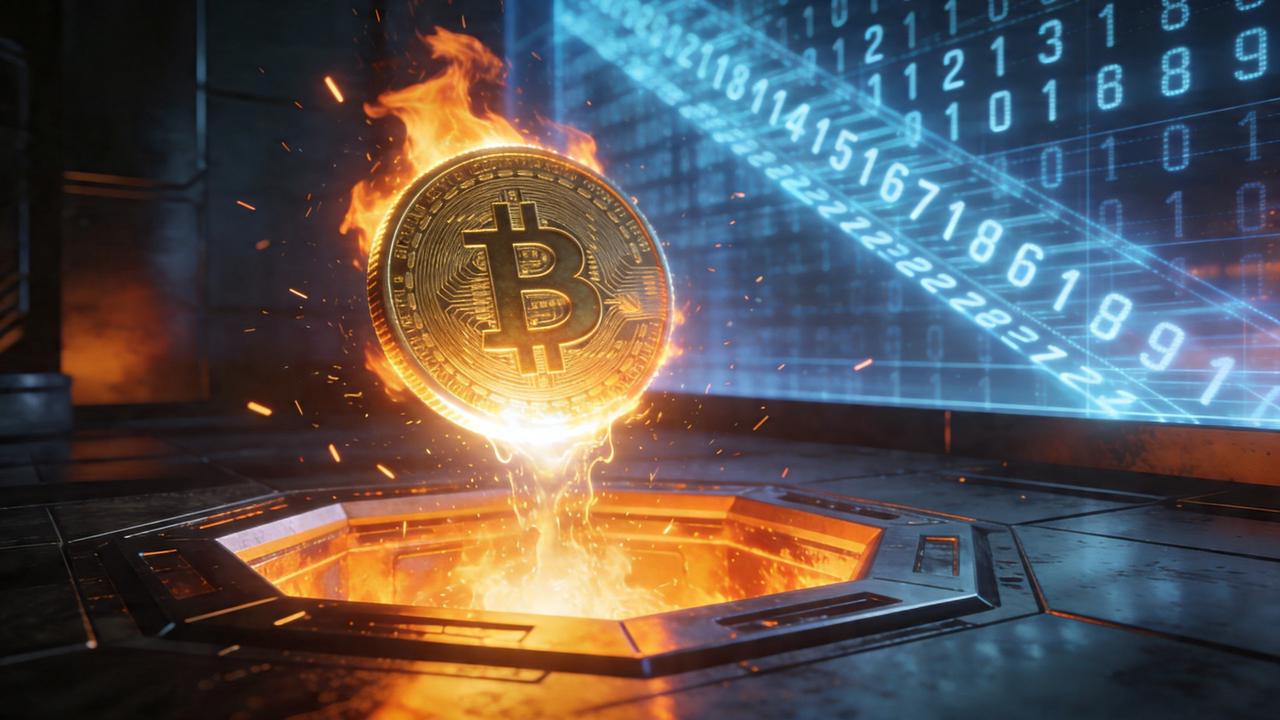
Article Summary
- This educational guide explains the concept of token burning, a mechanism used to permanently remove cryptocurrency tokens from circulation.
- It details how burning reduces the total supply of a token, potentially increasing scarcity and driving up the value of the remaining tokens.
- The article covers various burning methods, including sending tokens to dead addresses, protocol-level burns (like Ethereum's EIP-1559), and buyback-and-burn mechanisms.
- It provides real-world examples of token burning, such as Binance's quarterly BNB burns and the massive community-driven burns of Shiba Inu (SHIB).
- The guide also addresses the risks and criticisms of token burning, including market manipulation, false scarcity claims, and potential regulatory concerns.
In traditional finance, inflation often grows when central banks expand the money supply, which can weaken purchasing power over time. Crypto projects sometimes go in the opposite direction by intentionally removing tokens from circulation to make supply tighter, harder to replace, and easier to model. For anyone using a crypto exchange like Bitunix to trade assets with different supply structures, token burning is one of the clearest examples of how tokenomics can shape long-term value. Bitunix also offers direct access to assets such as ETH and BNB, which makes the concept relevant beyond theory.
At its core, token burning means permanently removing a specific number of cryptocurrency tokens from circulation. This guide explains how the process works, why projects use it, where it shows up in the real market, and why you should be careful before treating any burn event as automatic bullish news.
How Token Burning Works
The most common burn method is simple. A project or user sends tokens to an unusable wallet, usually a null or dead address, where nobody controls the private keys. Etherscan describes one of the best-known examples this way:
"This address is not owned by any user, is often associated with token burn & mint/genesis events, and used as a generic null address. The chart shows the daily amount of Ether burnt due to EIP-1559."
If you still wonder what is token burning at the wallet level, that quote is the cleanest answer. Tokens sent there are gone for good. On Ethereum, the null address 0x000...000 and the dead address 0x000...dEaD are the addresses most people mean when they talk about burns. BNB Chain uses the same black hole pattern for its quarterly and real-time burn system.
Some blockchains build burning directly into protocol rules instead of relying on manual transfers. Ethereum's EIP-1559 changed gas mechanics so part of the base fee is burned automatically. The Ethereum documentation explains gas fee structure in detail, and Etherscan's burn chart tracks the daily amount of ETH destroyed through that system. As of April 2026, Beaconcha.in's live EIP-1559 page showed more than 5.34 million ETH burned in total.
Public block explorers let you inspect the destination address, the transaction hash, and, in Ethereum's case, even the burned fee on a specific transfer. Etherscan transaction pages for type-2 EIP-1559 transfers explicitly show a Burnt field, including examples such as 0.000140898878893056 ETH on one March 2026 transaction and 0.0006800392298502 ETH on another.
Why Projects Burn Tokens
Supply is the first reason. If a project reduces circulating supply while demand stays flat or improves, each remaining unit becomes scarcer. Fewer tokens chasing the same demand can create stronger per-token value over time, which is why burning gets so much attention in crypto.
A burn mechanism also helps support the idea of a deflationary crypto asset. Fiat currencies usually expand in supply over time, while burn-enabled tokens try to push in the opposite direction, at least during certain periods. Ethereum is the clearest modern example, since network activity can destroy enough ETH via EIP-1559 to offset, or even exceed, issuance. That gives ETH a scarcer supply profile than many other major assets. BNB follows a different model, but the goal is to reduce supply over time through predictable burn rules.
Another reason projects use burns is to reward holders indirectly without making direct cash distributions. When a team buys back tokens and removes them from circulation, the market is left with fewer units overall. For investors trying to understand token burning in economic terms, the main idea is that it is usually a supply management tool designed to increase scarcity. A 2025 SSRN paper on platform-token buybacks makes a similar point from a regulatory perspective, noting that buyback pledges can support token values but can also raise concerns about manipulation and securities-style scrutiny if the design becomes too financially aggressive.
Real-World Examples of Token Burning
Looking at live projects helps because each major burn model works a little differently. Ethereum burns transaction-based fees through protocol rules, BNB combines scheduled and real-time burns, and SHIB relies heavily on community-driven destruction to chip away at a very large starting supply.
1. Ethereum (ETH) and EIP-1559
Ethereum's burn system is one of the clearest real-world examples of token burning in crypto. Under EIP-1559, the network burns the base fee instead of paying it to validators, which means the amount destroyed rises and falls with actual usage. Etherscan's daily burn chart makes that visible. It recorded a low of just 5.69379442680976 ETH burned on December 6, 2025, while Beaconcha, in its live tracker showed total burns above 5.34 million ETH by April 2026.
2. Binance Coin (BNB)
BNB follows a more structured burn model than many other tokens. According to BNB Chain, its Auto-Burn system is designed to reduce total supply to 100 million BNB, while a fixed share of gas fees is also burned in each block. The scale of that program is evident in recent burn events. The 32nd burn in July 2025 removed 1,595,599.78 BNB, the 33rd burn in October 2025 removed 1,441,281.413 BNB, and the 35th burn in April 2026 removed another 1,569,307.34 BNB, worth about $1.02 billion at the time. With total supply falling to roughly 134.79 million, BNB offers a clear example of a large public burn program that reduces supply over time through rules investors can track quarter by quarter.
3. Shiba Inu (SHIB)
SHIB offers a good example of how token burning works in meme coins, where the headline numbers can look dramatic, but the supply challenge remains huge. The Shibburn tracker shows that more than 410.84 trillion SHIB have already been burned, or about 41.08% of the original one quadrillion supply. Even so, around 589.16 trillion SHIB still remain in circulation. Recent updates also show that Shibarium has made the burn process more systematic by tying it to network activity and fees, and one January 2026 spike reportedly removed 173 million SHIB in a single day.
Token Burning vs. Other Supply Mechanisms
Token burning often gets mixed up with other supply mechanics, but the differences are that burning removes existing units permanently, staking usually locks tokens temporarily to help run a network, and halving reduces the rate of new issuance. They can all affect scarcity, but they do it in different ways and on different timelines.
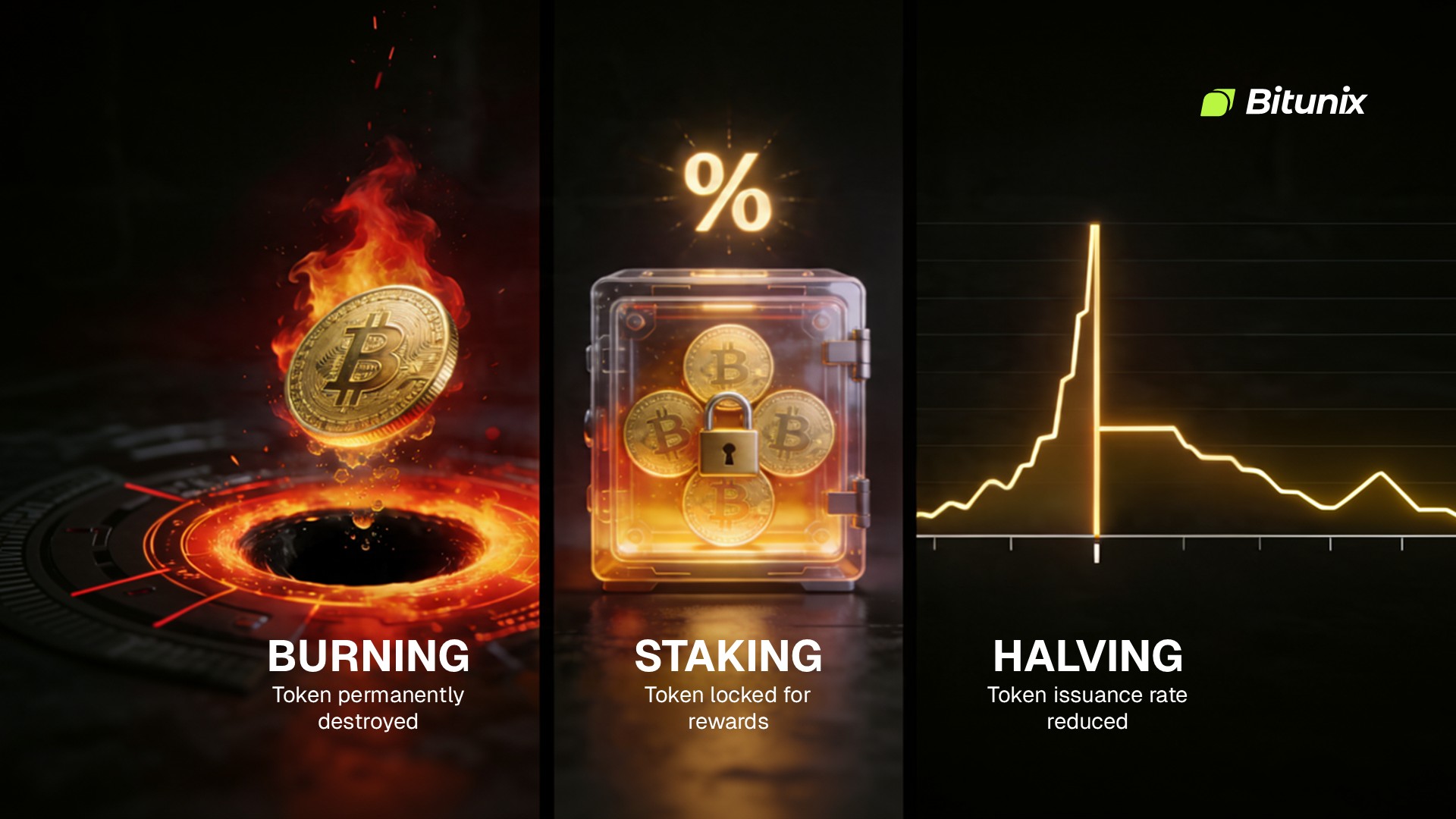
Visual comparison of token burning, staking, and halving, showing how each mechanism affects crypto supply in a different way.
1. Burning vs. Staking
Staking does not usually destroy anything; it means putting your crypto to work on a blockchain network to help it run smoothly and securely while you earn rewards. In other words, the tokens still exist, they are just locked or temporarily delegated. On the other hand, burning is permanent, once tokens go to a dead address, there is no unstake button later.
2. Burning vs. Halving
Halving changes issuance, not the existing stock. The Bitcoin halving, for example, is described as a pre-programmed event that reduces mining rewards by 50%. That slows the rate of new BTC entering the market, but it does not destroy coins already in circulation. Burning acts on the current supply, while halving acts on future supply growth.
Risks and Criticisms of Token Burning
The biggest mistake beginners make is assuming that a burn automatically lifts the price, but it does not. If demand is weak, utility is poor, or insiders keep selling, a lower supply alone will not save the token. SHIB is a good example: even after more than 410 trillion tokens have been burned, the remaining supply is still so large that daily burns rarely change the market in a significant way.
Some teams also use burns as a marketing strategy. A burn headline can make a token look disciplined, scarce, or holder-friendly even when the underlying project is not growing. That is why you should always check the actual transaction, the size of the burn compared with total supply, and whether the project has real utility.
Regulation adds another layer of risk. ESMA's MiCA summary states that the EU regime focuses on transparency, disclosure, authorization, and supervision of crypto-asset activity. In the United States, the SEC and CFTC issued a joint 2026 interpretation to clarify how federal securities laws apply to crypto assets and transactions involving them. On top of that, the 2025 SSRN paper on platform-token buybacks warns that sufficiently aggressive buyback pledges can trigger securities-style classification concerns. That means that buyback-and-burn designs can attract more scrutiny when they look too much like engineered investor returns.
Conclusion: A Powerful Tokenomics Tool
Token burning remains one of the most important supply tools in crypto because it gives projects a direct way to reduce circulating supply, shape scarcity, and signal long-term tokenomics intent. Ethereum shows how burning can happen automatically through network usage, BNB shows how a large ecosystem can combine scheduled burns with real-time gas-fee destruction, and SHIB shows that even very large burn totals can have limited near-term price impact when the base supply is massive.
Understanding burns helps you read a project more clearly. You can see whether the team is managing supply responsibly, whether the burn mechanism is verifiable, and whether demand is strong enough to make scarcity meaningful. If you want to trade assets with burn mechanics, Bitunix offers access to ETH and BNB, among others, so you can download the Bitunix app, register, and evaluate those tokenomics with real markets in front of you.
FAQ
How does crypto token burning work?
Crypto token burning involves sending tokens to an unusable wallet or destroying them per protocol rules. The effect is the same in both cases; the tokens leave circulation permanently and can no longer be spent, traded, or recovered.
Does burning tokens increase their price?
Not automatically. Lower supply can support price if demand stays steady or grows, but weak utility or weak demand can cancel that effect. Burns help scarcity, but they do not guarantee appreciation.
What is a dead address or burn address?
A dead address is a wallet with no usable private key, so tokens sent there become permanently inaccessible. Etherscan labels the null address as a generic burn-related address used for burn, mint, and genesis events.
How can I verify that tokens were actually burned?
Use a block explorer. Check the transaction hash, confirm the destination is a null or dead address, and review the token transfer details. On Ethereum, explorers also show EIP-1559 burn data directly on transaction pages and charts.
Why did Ethereum start burning ETH?
Ethereum burns ETH via EIP-1559 because the base fee is destroyed rather than paid out. The system improved fee mechanics and created a supply-reduction effect tied to network activity, which is why high-usage periods can make ETH more scarce.
What is a buyback-and-burn mechanism?
It is a model where a project repurchases its own tokens and then destroys them. The goal is usually to reduce circulating supply and indirectly support token value, though regulators and researchers watch these programs closely.
Is token burning the same as a stock buyback?
They are similar in intent because both can reduce available supply, but they are not identical. Tokens live within blockchain networks, and their legal treatment can vary significantly depending on their structure, disclosures, and control.
Can burned tokens ever be recovered?
No. If the burn is real, the tokens are permanently inaccessible. That is the point of using a dead address or a protocol-level destruction mechanism. Once completed, the transfer cannot be reversed.
What is the difference between token burning and the Bitcoin halving?
Burning destroys the existing supply. Bitcoin halving only reduces the rate of new issuance by cutting mining rewards in half. Both can create scarcity, but they affect different parts of supply mechanics.
Are there risks associated with token burning?
Yes. Burns can create false scarcity, be used as hype tactics, and lead to regulatory attention in buyback-style models. You should always compare the burn size with the total supply and with the real project demand.
Glossary
- Tokenomics: The economic design of a crypto asset, including supply, incentives, issuance, and burn rules.
- Circulating supply: The number of tokens currently available to the market and tradable by the public.
- Dead address: An inaccessible wallet used to remove tokens from circulation permanently.
- Burn address: Another term for a dead address used in token destruction.
- EIP-1559: Ethereum's fee mechanism that burns the base transaction fee.
- BNB burn: BNB Chain's system of scheduled and real-time token destruction to reduce supply over time.
- Deflationary crypto: A crypto asset whose supply can shrink or grow slowly enough to create scarcity pressure.
- Protocol-level burn: A burn built into a blockchain's code rather than done manually by users or teams.
- Block explorer: A public tool that lets you inspect blockchain addresses, transactions, fees, and token transfers.
- Base fee: The mandatory part of an Ethereum transaction fee that EIP-1559 burns.
- Buyback-and-burn: A model where a project repurchases tokens and then destroys them.
- Staking: Locking or delegating tokens to help secure a network and earn rewards.
- Halving: A programmed event, most famously in Bitcoin, that cuts new issuance by half.
- Scarcity: Reduced available supply relative to demand.
- Data integrity on-chain: The ability to verify a token movement or burn through public blockchain records.
Disclaimer
This article does not provide:
(i) investment advice or investment recommendations;
(ii) an offer or solicitation to buy, sell, or hold digital assets;
(iii) financial, accounting, legal, or tax advice.
Digital assets, including stablecoins and NFTs, involve high risk and may fluctuate significantly. Consider whether trading or holding digital assets is appropriate for you given your financial situation. Consult a qualified legal, tax, or investment professional when needed. You are responsible for understanding and complying with applicable local laws and regulations.
About Bitunix
Bitunix is a global cryptocurrency derivatives exchange trusted by over 3 million users across more than 100 countries. At Bitunix, we are committed to providing a transparent, compliant, and secure trading environment for every user. Our platform features a fast registration process and a user-friendly verification system supported by mandatory KYC to ensure safety and compliance. With global standards of protection through Proof of Reserves (POR) and the Bitunix Care Fund, we prioritize user trust and fund security. The K-Line Ultra chart system delivers a seamless trading experience for both beginners and advanced traders, while leverage of up to 200x and deep liquidity make Bitunix one of the most dynamic platforms in the market.
Bitunix Global Accounts
X | Telegram Announcements | Telegram Global | CoinMarketCap | Instagram | Facebook | LinkedIn | Reddit | Medium