

Article Summary
- This article explains that crypto custody is a third-party service that securely stores and manages large quantities of digital assets on behalf of institutions and high-net-worth individuals.
- It contrasts self-custody (where the user is solely responsible for their private keys) with third-party custody, highlighting the different security models and trade-offs.
- It details the core technologies used by qualified custodians, including cold storage (air-gapped hardware), multi-party computation (MPC) for key management, and multi-signature wallets.
- The guide emphasizes the importance of regulatory compliance, explaining what a "qualified custodian" is under regulations like the SEC's Custody Rule, and the role of regular audits and insurance.
- It outlines the key benefits for institutions, such as mitigating counterparty risk, ensuring operational security, and meeting regulatory requirements.
If you had a billion dollars in gold, you would not keep it in a spare room and hope for the best. You would use vaults, policies, audits, and people whose whole job is to prevent bad surprises. Crypto creates the same problem, just with private keys instead of metal bars.
So, what is crypto custody when you strip away the technical language? It is a specialized service that stores and manages digital assets for clients who prioritize security, governance, and recovery over doing everything themselves. If you use a crypto exchange like Bitunix for trading, this still matters. Trading access and long-term safekeeping solve different problems.
For high-net-worth investors, family offices, funds, and corporations, custody sits at the center of risk management. This guide explains how custody works, why institutions pay for it, how cold storage, MPC, multi-sig, and physical controls fit together, and why regulation, audits, and insurance decide whether a custody setup feels solid or shaky.
What Is Crypto Custody for an Institution
At the retail level, people often treat custody as a wallet choice. Institutions cannot think that way. They need separation of duties, approval rules, logs, recovery plans, and a legal structure that stands up in court and in an audit. That shift is already visible in the market. In Coinbase and EY's 2026 institutional investor survey, 66% of respondents said regulatory compliance was a key factor in choosing a custodian, up from 25% in 2025, and 66% also pointed to security and key-signing protocols, up from 8% a year earlier. That big jump tells you the market has moved from casual experimentation to operational discipline.
Self-custody still has a place. It gives you direct key control and maximum sovereignty. But it also makes you the disaster-recovery plan, the internal control team, and the last line of defense. Good crypto custody solutions add governance tools, policy controls, audit trails, and operational redundancy that are difficult to recreate with a few hardware wallets in a safe. That is why institutional crypto custody has become a distinct category rather than just a dressed-up wallet.
Self-Custody vs. Third-Party Custody
The difference is not only who holds the keys. It is also who carries the operational burden when something goes wrong, who approves transfers, and how easily your setup can survive a lost device, a rogue employee, or a legal review.
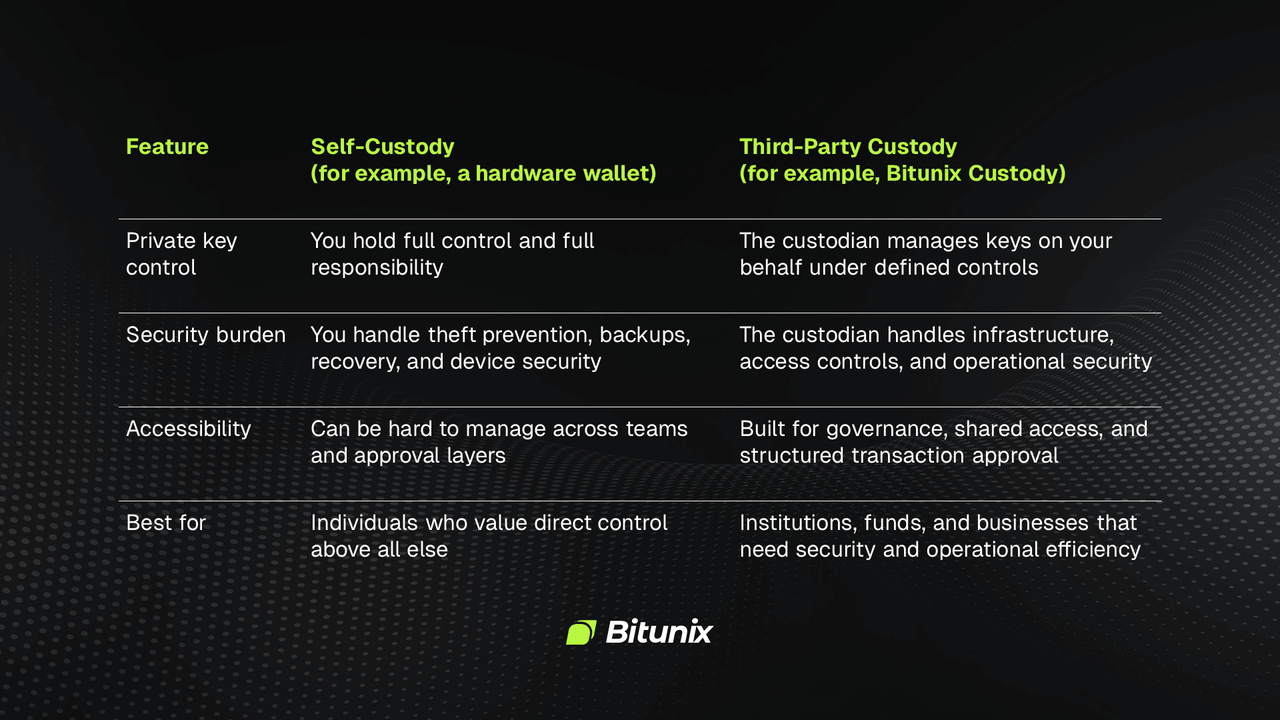
Self-custody gives you full control of your keys, while third-party custody shifts security, governance, and transaction management to a specialized provider.
In practice, many firms use both. They keep some assets in direct control for specific on-chain activity and place the core treasury with a qualified provider. That hybrid approach has become more common as banks, asset managers, and crypto-native firms build more mature digital asset custody stacks.
Reuters reported in early 2026 that Crypto.com won conditional OCC approval for a national trust bank charter, while the OCC said in December 2025 that Circle and Ripple received conditional approvals for new national trust banks, and BitGo, Fidelity Digital Assets, and Paxos received conditional approvals to convert to national trust banks. The direction is that regulated custody is becoming part of mainstream infrastructure.
The Technology Behind the Vault: How Custodians Secure Assets
Institutions trust custody when the design removes single points of failure, limits human discretion, and makes the whole system resilient under stress. That is also the direction Bitunix has taken. In December 2025, Bitunix upgraded its security infrastructure through Fireblocks for institutional-grade digital asset custody and MPC wallets, alongside Elliptic KYT for real-time transaction monitoring, AML oversight, and risk control.
That combination fits the broader custody model discussed in this section, where asset protection depends on both secure key management and continuous monitoring of how funds move.
Cold Storage
Cold storage remains the backbone of serious custody. The idea is to generate and store keys on systems that never touch the public internet. That air gap blocks a wide range of remote attacks before they even start. Fidelity says its custody platform uses offline cold-vaulted storage with 24x7 on-site security, hardened room structures, and multi-person, multi-organization access controls.
Multi-Party Computation
MPC solves a classic custody problem. A single complete private key is dangerous. Steal it once, and the game is over. MPC breaks the signing process into pieces, so no single party ever holds the whole secret in one place. Bitunix directly referenced this model in its December 2025 security upgrade, stating that Fireblocks brings institutional-grade custody and MPC wallets into its infrastructure.
Fireblocks describes MPC as a way to remove the single point of compromise across the full key lifecycle, and its bank-focused guidance from late 2025 says institutions increasingly expect custody infrastructure to support both MPC and hardware-backed protection. In February 2026, Fireblocks also said thousands of organizations, including BNY, Galaxy, and Revolut, trusted its platform to secure more than $10 trillion in digital asset transactions across 120-plus blockchains.
Multi-Signature Wallets
Multi-sig works differently from MPC, but it solves a related problem. It requires multiple approvals before a transaction goes through. This is useful for boards, treasury teams, and firms that want to separate initiation from approval. In December 2025, BitGo said enterprise-grade multi-signature wallet usage had reached 9 million wallets, up 47% year over year. That is a sign that controlled authorization is becoming standard practice.
For large portfolios, multi-sig also creates cleaner accountability. You know who signed, when they signed, and whether the policy was followed.
Physical Security
Crypto security still ends in the physical world. Servers exist somewhere. Hardware exists somewhere. Backup material exists somewhere. Good custodians spread that risk across secure sites with controlled access, monitoring, and geographic separation. Fidelity says its private keys must be accessed and authorized in different geographic locations by separate teams, with full redundancy even if one site is unavailable. That kind of design protects against theft, natural disaster, and operational chaos.
If you are wondering what crypto custody is in operational terms, this is the answer. It is not one tool. It is a stack of controls, people, and procedures designed so that one mistake does not become a catastrophe.
On top of custody architecture, Bitunix's security model is layered, with withdrawal safety controls, internal monitoring, compliance checks, and Proof of Reserves used as supporting safeguards around asset protection.
The Importance of Regulation and Insurance
Security tools matter, but they are only part of the picture. Large investors also want legal clarity, outside checks, and a backup plan if something goes wrong. That is where regulation, audits, Proof of Reserves, and insurance come in. They help distinguish a serious custody setup from a platform that simply says, 'trust us.'
What is a Qualified Custodian?
A qualified custodian is a specific legal term, especially in the United States, under SEC rules. It refers to a financial institution that is allowed to hold client assets on behalf of investors. In practice, that usually means a bank, broker-dealer, or trust company that operates under formal oversight.
In 2025, the SEC staff granted no-action relief that expanded the ability of certain state trust companies to custody crypto assets, and SEC Commissioner Hester Peirce said clearer rules could increase the number of qualified custodians. At the same time, more crypto firms have been trying to get there through trust company structures and bank charters. In February 2026, Reuters reported that Crypto.com received conditional OCC approval for a national trust bank charter, which would allow it to hold client assets in a regulated framework if final approval is granted.
For an investor, the takeaway is that a qualified crypto custodian is not just a tech provider with a wallet system. It is a regulated entity that is supposed to meet a higher legal and operational standard. Coinbase Custody, for example, says its custody trust company is a fiduciary under New York banking law and a Qualified Custodian.
Audits and Proof of Reserves
Good custody also needs verification. Reputable providers do not ask you to accept their balance sheet on faith. They use outside audits and similar checks to show they hold the assets they say they hold. Coinbase says its custody systems and processes are regularly audited, including SOC 1 Type II and SOC 2 Type II reviews. BitGo says qualified custodians should provide regular audit evidence and transparent security controls.
This is also where Bitunix is a helpful example: its Proof of Reserves system lets users verify that platform assets are backed 1:1, and that reserve transparency is tied to broader security measures, including third-party reviews (including a Hacken audit), Fireblocks custody infrastructure, and Elliptic KYT monitoring. That does not make Bitunix the same thing as a qualified custodian, but it does give users a concrete example of how an exchange can add transparency and third-party checks around asset protection.
Insurance Coverage
Insurance is the safety net people ask about most, and for good reason. Leading custodians often buy insurance from major underwriters to help cover losses from theft, including external hacks and some internal misconduct. BitGo says it carries up to $250 million in insurance coverage as a regulated qualified custodian. Coinbase also says it maintains a substantial commercial crime insurance policy for certain digital assets and fiat funds, though the company makes clear that coverage has limits and does not protect every kind of loss.
Bitunix publicly highlights a $30 million USDC Care Fund and Proof of Reserves as part of its protection model. That is helpful, but a care fund is not the same as a formal insurance policy issued by a third-party underwriter unless the company explicitly states otherwise. So the safer way to describe Bitunix is that it combines reserve transparency, security reviews, and a dedicated support fund.
Conclusion: The Foundation for Institutional Adoption
Crypto custody is far more than a digital wallet. It is a layered security model that combines cold storage, key fragmentation, shared approvals, physical safeguards, audit evidence, legal structure, and insurance. When it works well, it reduces the risk that a single stolen credential, an employee error, or a weak internal process can wreck a portfolio.
The bigger picture is that more institutions are demanding regulated custody, more banks are getting clearer permission to offer it, and more providers are building infrastructure that looks a lot more like capital markets.
While Bitunix focuses on active trading, it also highlights proof of reserves and layered account-security controls. Understanding institutional custody helps you see the wider security architecture behind the market you trade in. Explore Bitunix's security features, download the app, and register if you want trading access paired with a better understanding of how serious asset protection works.
FAQ
What is the difference between a custodian and an exchange?
A custodian focuses on safekeeping, governance, and asset administration. An exchange focuses on trading and market access. Some firms offer both under one umbrella, but the jobs are different. Custody is about protection and control. Exchange services are about execution, liquidity, and pricing.
What is MPC, and how does it work?
MPC splits transaction signing across multiple parties or devices so no one party holds the full private key. The signing result is valid, but the full secret never appears in one place. That reduces single-point-of-failure risk and supports stronger institutional approval controls.
What is the largest crypto custodian?
Coinbase Custody is generally seen as the largest crypto custodian by assets under custody. It reportedly holds over 80% of U.S. spot Bitcoin and Ethereum ETF assets and manages about $400 billion-plus in custody, ahead of major rivals such as Fidelity Digital Assets and BNY Mellon.
How much does crypto custody cost?
Pricing varies by provider and by service level. Fees usually depend on assets under custody, transaction activity, reporting needs, staking, governance support, and whether you want segregated or omnibus structures. Large institutional arrangements often use custom pricing rather than public flat rates.
What is a cold wallet?
A cold wallet stores keys offline, away from the public internet. That makes remote theft much harder. In institutional settings, it includes access controls, geographic redundancy, physical security, and formal approval procedures.
Is my crypto insured on an exchange?
Sometimes, but never assume full coverage. Coinbase says its crime insurance covers only a portion of assets across storage systems and does not cover losses caused by compromised customer credentials. Exchange protection is usually narrower than people expect, so read the policy details carefully.
What is the SEC's Custody Rule?
It is the SEC framework that generally requires registered advisers with custody of client assets to keep them with qualified custodians and maintain safeguards around control and reporting. In September 2025, the SEC staff issued limited crypto guidance in a no-action letter addressing certain state trust companies.
What is Proof of Reserves?
Proof of Reserves is a transparency method that shows whether a platform holds assets that match customer liabilities or published balances. It helps users verify solvency signals, but regulators and market participants still treat it as one tool, not a full substitute for audits and legal controls.
Can I stake my crypto while it is in custody?
Yes, sometimes. Some institutional custody providers support staking or governance while assets remain under custody controls. Coinbase Prime, for example, has discussed ways large clients can stake more of their assets under custody while keeping liquidity available. Availability depends on asset, jurisdiction, and custodian policy.
What happens if a crypto custodian gets hacked?
The outcome depends on the setup. A strong custodian uses cold storage, separation of duties, insurance, recovery procedures, and audited controls to reduce both the chance and the blast radius of an incident. If losses occur, legal structure, asset segregation, and policy coverage decide what happens next.
Glossary
- Air gap: A security separation between internet-connected systems and offline key storage.
- Assets under custody: The value of client assets that a custodian stores or administers.
- Cold storage: Offline storage for private keys designed to reduce remote attack risk.
- Crime insurance: Insurance that can cover certain theft losses, including some cyber incidents.
- Digital asset custody: The safekeeping and administration of crypto assets by a specialized provider.
- Hardware security module: A hardened device used to protect keys and sensitive cryptographic operations.
- MPC: A cryptographic method that splits signing across multiple parties without exposing the full key.
- Multi-signature wallet: A wallet that requires several approvals before a transaction can be executed.
- Omnibus wallet: A structure where client assets are pooled on-chain but separated in internal records.
- Private key: The secret cryptographic credential that controls access to digital assets.
- Proof of Reserves: A transparency method used to show that customer liabilities are backed by held assets.
- Qualified custodian: A regulated entity recognized under applicable rules to hold client assets.
- Segregation: The separation of client assets from the custodian's own assets or other client accounts.
- SOC 1 Type 2 audit: An independent audit focused on controls relevant to financial reporting over time.
- SOC 2 Type 2 audit: An independent audit of security and operational controls over a defined period.
Disclaimer
This article does not provide:
(i) investment advice or investment recommendations;
(ii) an offer or solicitation to buy, sell, or hold digital assets;
(iii) financial, accounting, legal, or tax advice.
Digital assets, including stablecoins and NFTs, involve high risk and may fluctuate significantly. Consider whether trading or holding digital assets is appropriate for you given your financial situation. Consult a qualified legal, tax, or investment professional when needed. You are responsible for understanding and complying with applicable local laws and regulations.
About Bitunix
Bitunix is a global cryptocurrency derivatives exchange trusted by over 4 million users across more than 100 countries. At Bitunix, we are committed to providing a transparent, compliant, and secure trading environment for every user. Our platform features a fast registration process and a user-friendly verification system supported by mandatory KYC to ensure safety and compliance. With global standards of protection through Proof of Reserves (POR) and the Bitunix Care Fund, we prioritize user trust and fund security. The K-Line Ultra chart system delivers a seamless trading experience for both beginners and advanced traders. At the same time, leverage of up to 200x and deep liquidity make Bitunix one of the most dynamic platforms in the market.
Bitunix Global Accounts
X | Telegram Announcements | Telegram Global | CoinMarketCap | Instagram | Facebook | LinkedIn | Reddit | Medium