
Article Summary
- This guide explains stablecoins, a type of cryptocurrency designed to maintain a stable value by pegging to a real-world asset, most commonly the U.S. dollar.
- It breaks down the three main types of stablecoins: fiat-collateralized (like USDT), crypto-collateralized (like DAI), and algorithmic, explaining the mechanism behind each.
- The article highlights the critical role stablecoins play in the crypto ecosystem, serving as a hedge against volatility, a medium for payments, and a foundational asset in DeFi.
- It discusses the key differences between major stablecoins like USDT and USDC, focusing on their reserves and transparency.
Bitcoin soars, then dives. Altcoins follow suit. Crypto volatility is the defining characteristic of this market. But what if there was a way to get the benefits of digital assets without the wild price swings? Enter the stablecoin, the bedrock of the crypto economy.
On a crypto exchange, such as Bitunix, stablecoins often act like the calm corner of the market. They aim to track a stable asset (usually the US dollar), so you can move money around the crypto world without constantly riding the price rollercoaster.
This guide explains what stablecoins are, how different types keep their price steady, and why people use them for trading, payments, and DeFi. It also covers the main risks, because stable does not mean risk-free.
What Is a Stablecoin?
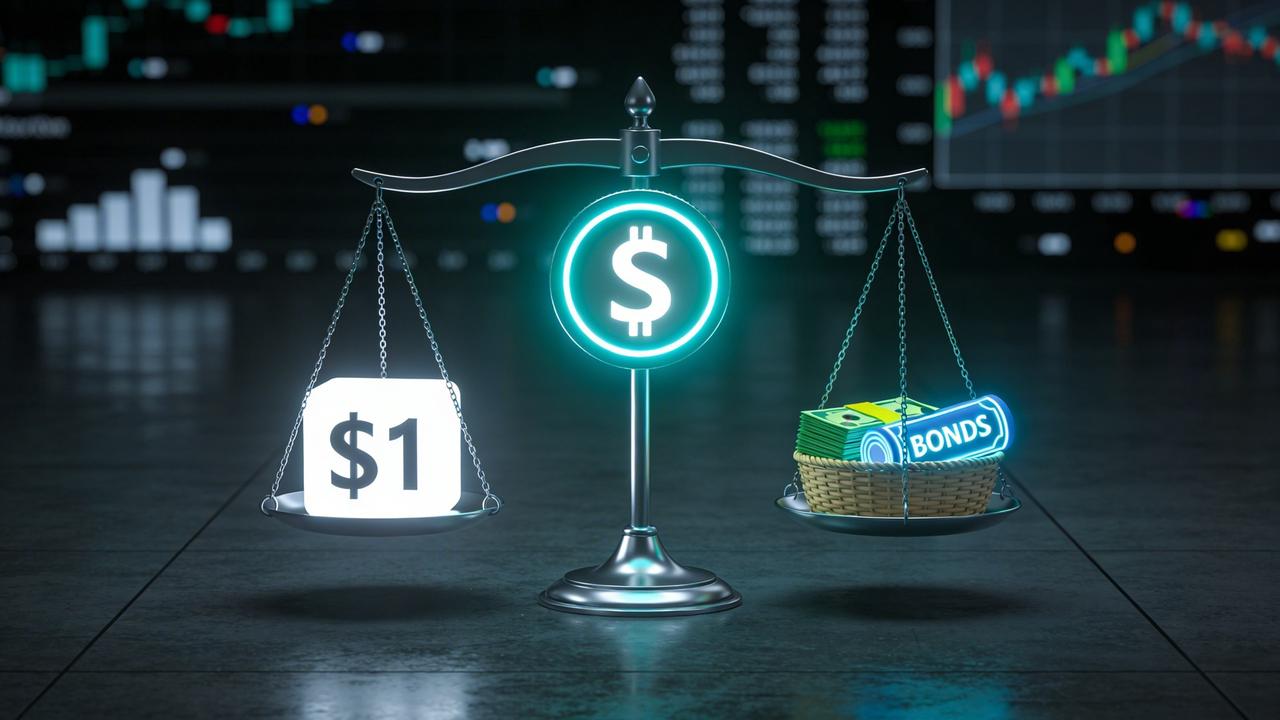
A stablecoin is a stable cryptocurrency designed to stay close to a target price, called a peg. Most stablecoins aim for a 1:1 peg to the US dollar, so 1 token stays near $1.
If you are wondering what is a stablecoin used for day to day, think of it as a digital dollar you can send, trade, or use inside crypto apps. Traders often use stablecoins to step out of volatile coins without converting back to a bank account. And once you hold stablecoins, you can move quickly between exchanges, wallets, and DeFi apps.
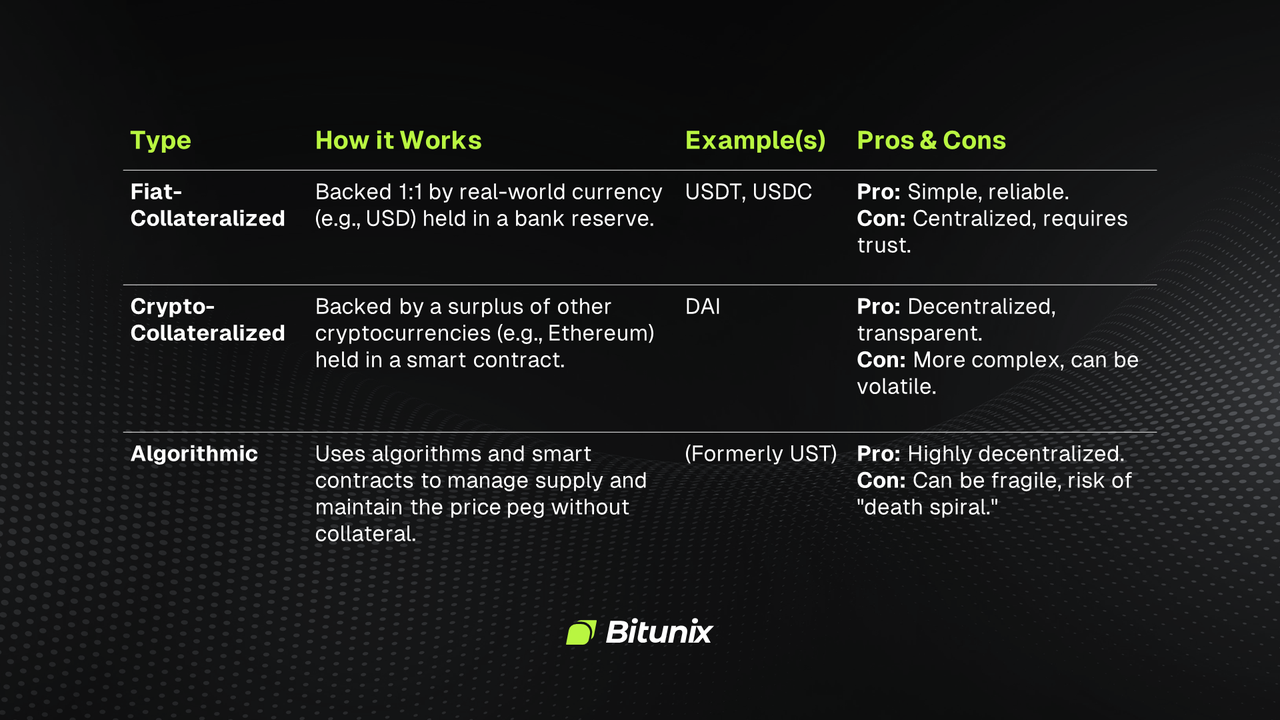
How Do Stablecoins Stay Stable? The Three Main Types
Here is the simple breakdown of the three main types of stablecoins available today across different exchanges:
A Closer Look at Fiat-Collateralized Stablecoins
Fiat-backed coins are the most common because they are easy to understand. A company issues tokens and holds backing assets. The idea is simple: if you can redeem 1 token for about $1 of value, the market price tends to stay near $1.
Two explanations are worth seeing in the issuer’s own words:
"Tether tokens (USDT) are pegged at 1-to-1 with a matching fiat currency and are backed 100% by Tether Reserves." And "USDC is fully reserved at all times by cash and equivalents kept within the regulated financial system."
What sits inside reserves varies by issuer and over time. For example, Circle explains that USDC reserves are held in structures designed to keep assets liquid and conservative, and it shares ongoing reserve reporting details.
Why Do Stablecoins Matter? Key Use Cases
Stablecoins can have some different applications in the crypto market, and these are the main ones:
1. A Hedge Against Volatility
If the market looks shaky, traders often rotate from BTC or ETH into USDT or USDC. It does not lock in profits forever, but it can reduce exposure to sudden drops. You still face stablecoin risks, but you avoid the usual coin-to-coin swings.
2. A Gateway for Trading
Stablecoins act as a base currency for many trading pairs. A lot of spot markets price assets against a dollar-pegged coin, which makes it easier to compare prices across coins and exchanges. This also makes arbitrage possible when prices differ.
3. Fast Global Payments
Stablecoins can move across borders without the usual bank delays. You still need to consider network fees, compliance checks, and recipient safety, but settlement can be much faster than some traditional routes.
4. The Foundation of DeFi
DeFi needs a dollar-like unit. Stablecoins provide that unit of account and much of the liquidity on DEXs and lending protocols. They let users borrow, lend, and earn interest without taking on the full price swings of BTC or ETH, and they power swaps and pools where pricing and collateral ratios are easier to manage.
Popular Stablecoins on Bitunix
On Bitunix, stablecoins are not just parking assets. They are the main currency for a large share of spot markets (especially USDT pairs) and a common way to manage risk when crypto volatility spikes.
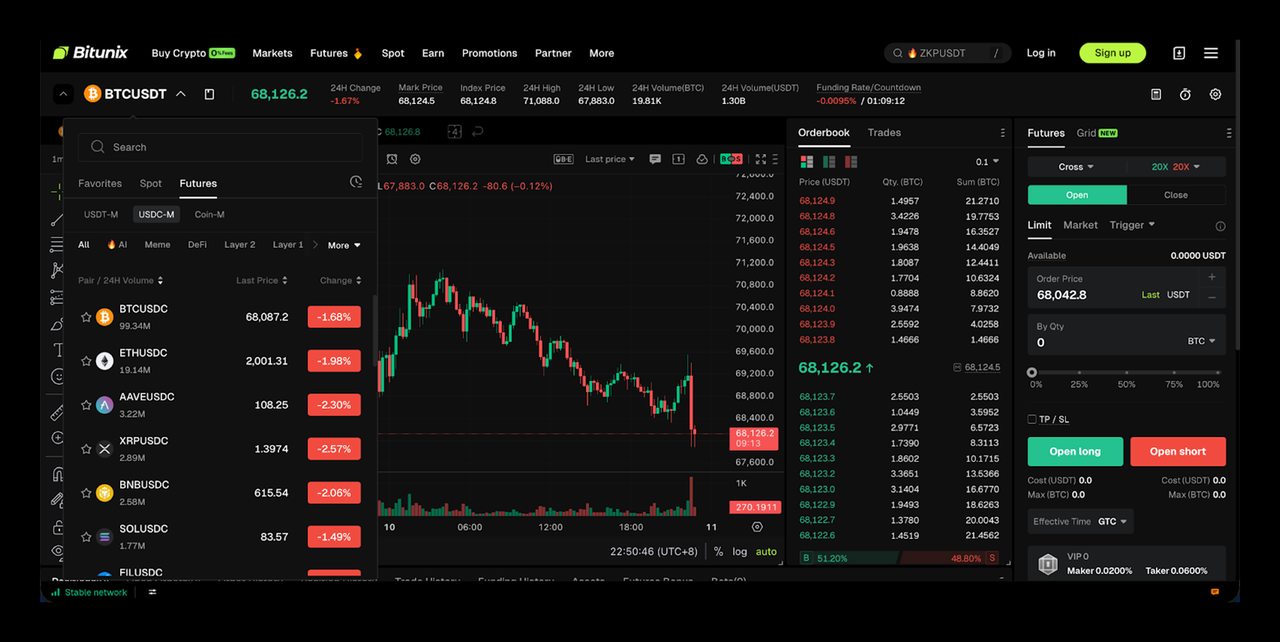
Data aggregators also show BTC/USDT as one of Bitunix’s most active pairs, which is usually a good signal that USDT markets are a core liquidity hub on the exchange.
Tether (USDT): The Market Leader
If your goal is to move fast between majors and altcoins, USDT pairs are typically the shortest path because so many listings launch as /USDT. Bitunix announcements frequently list new spot and perpetual futures markets as USDT pairs.
If you’re trying to find a specific market quickly, go to the Spot Market and use the search bar to locate the pair.
USD Coin (USDC): The Transparent Alternative
USDC is often chosen by users who value issuer transparency and a regulated system. On Bitunix, a practical use of USDC is routing between stablecoins, especially through the USDC/USDT market when you want to switch your digital dollars.
Two specific notes that are genuinely useful before you move funds:
- Fees and promos can change: Bitunix has very small trading fees on the USDC/USDT spot pair and added USDC perpetual futures support. It's great when available, but always verify it’s live in your region/account before planning around it.
- Network support matters: Bitunix stopped supporting USDC deposits and withdrawals on Tron (TRC20) since April 5, 2024, following Circle’s Tron USDC change. So you must double-check the network selector every time you deposit or withdraw USDC.
DAI: Where Bitunix Earn Becomes Relevant
If you’re holding stablecoins and your goal is steady, not exciting, Bitunix also offers Earn products that include USDT, USDC, and DAI (among other assets). That matters because it gives stablecoin holders an option inside the exchange without jumping into DeFi smart-contract risk.
Bitunix offers deep liquidity for major trading pairs, including BTC/USDT, ETH/USDT, and more. You can easily buy, sell, or trade these stable assets on our secure spot market.
What Are the Risks?
When investing and trading with stablecoins, these are the main risks:
De-Pegging Risk
Stablecoins can trade below or above $1, and algorithmic designs can be especially fragile. Regulators have pointed to TerraUSD (UST) losing its dollar peg in May 2022 as a real example of how quickly an algorithmic stablecoin can fail.
Reserve Risk
For fiat-backed coins, the key question is whether reserves exist, stay liquid, and match the issuer’s claims. That is why transparency pages and third-party attestations matter. Start with issuer disclosures, then look for independent reporting.
Regulatory Risk
Rules differ by country, and they keep evolving. A stablecoin can face restrictions on issuance, redemption, listings, or user access. If you rely on stablecoins for payments or savings-like use, keep an eye on policy updates.
Conclusion: The Stable Backbone of a Volatile World
Stablecoins are more than just another cryptocurrency; they are a fundamental piece of infrastructure for the entire digital asset economy. By providing a stable medium of exchange and a safe haven from volatility, they make crypto more practical and accessible for everyone.
But stable never means risk-free. If you plan to hold stablecoins on an exchange, the smart approach is to treat it like a checklist:
- Check fees before you trade: Bitunix has a maker/taker fee model with published VIP tiers (with examples like VIP 0 spot: 0.08% maker / 0.10% taker; VIP 0 futures: 0.02% maker / 0.06% taker).
- Use the right tool for the job: If your goal is to swap into USDT now, Bitunix positions Convert as a no maker/taker fee option designed for fast conversions. If your goal is to hold stablecoins and earn, Bitunix Earn includes stable assets like USDT/USDC/DAI.
Whether you're looking to protect your gains, earn yield in DeFi, or simply hold a stable digital dollar, stablecoins are the answer. Download the app, register, and explore the wide range of stablecoin trading pairs on Bitunix today.
FAQ
Is a stablecoin a good investment?
Usually not for growth. A stablecoin is designed to stay near $1, so it behaves more like cash than an investment. Its value is its utility, including trading, transfers, or earning yield.
Can a stablecoin lose its value?
Yes. Stablecoins can de-peg (trade away from $1) during stress, and failures can be total, and TerraUSD’s run and collapse in May 2022 is the textbook example. Algorithmic models are typically more fragile.
Why do traders use USDT to trade other cryptocurrencies?
Because USDT is widely used as a quote currency, so it’s faster to switch between coins without touching fiat rails. On Bitunix, BTC/USDT is often the most active market, which usually means deeper liquidity.
Is USDT the same as USD?
No, USD is a fiat currency and USDT is a token that aims to track USD. Tether says USDT is pegged 1:1 and backed by reserves, but it can still deviate and carries issuer/redemption risk.
How do stablecoin issuers make money?
Mainly by earning interest/dividends on reserve assets (cash and cash equivalents) held against the stablecoin supply. Some issuers also earn fees or spreads around issuance/redemption and institutional services.
Which stablecoin is safest?
There’s no universal safest. Compare reserve quality, transparency, redemption access, and regulation.
Are stablecoins regulated?
It depends on where you live. In the EU, MiCA sets a framework for stablecoin-like tokens (asset-referenced tokens and e-money tokens), including authorization and disclosure requirements. Other countries use different rules that change often.
Can users earn interest on stablecoins on Bitunix?
Bitunix offers Earn/Savings-style products where yields vary by asset and terms. Bitunix’s Earn page shows rates up to a headline APY and notes regional limits (for example, it isn't available to U.S. residents).
What happens if reserves are not fully backed?
Confidence breaks fast. Traders may sell the stablecoin below peg, redemptions can spike, and the issuer may struggle to meet withdrawals. Poor transparency makes this worse because nobody knows what’s really backing the token.
How do you buy USDT or USDC on Bitunix?
You can use One Click Buy or a simpler purchase path, or trade on Spot by searching pairs like BTC/USDT or USDC/USDT. P2P is another route with escrow and KYC. Also double-check networks.
Glossary
- Stablecoin: A crypto asset designed to track a stable reference price, often $1.
- Peg: The target price a stablecoin tries to maintain, like 1 token ≈ $1.
- Collateral: Assets used to back or support a stablecoin’s value.
- Reserves: Backing assets held by an issuer to support redemption and stability.
- Attestation: A report (often from an accounting firm) stating what reserves exist at a point in time.
- De-pegging: When a stablecoin trades meaningfully away from its target price.
- Fiat-collateralized: Backed primarily by cash and cash-like traditional assets.
- Crypto-collateralized: Backed by crypto locked on-chain, usually in excess of the stablecoin issued.
- Overcollateralization: Holding more collateral value than the stablecoin supply to absorb price drops.
- Smart contract: On-chain code that can hold collateral and enforce stablecoin rules automatically.
- Liquidation: Forced selling of collateral when a position falls below required collateral levels.
- Mint/Burn: Creating new tokens (mint) or destroying tokens (burn) to manage supply.
- Arbitrage: Trading across markets to profit from price differences, often helping stabilize pegs.
- Liquidity: How easily an asset can be traded without moving the price too much.
- Spread: The gap between the best buy price and best sell price in a market.
About Bitunix
Bitunix is a global cryptocurrency derivatives exchange trusted by over 3 million users across more than 100 countries. The platform is committed to providing a transparent, compliant, and secure trading environment for every user. Bitunix offers a fast registration process and a user-friendly verification system supported by mandatory KYC to ensure safety and compliance. With global standards of protection through Proof of Reserves (POR) and the Bitunix Care Fund, Bitunix prioritizes user trust and fund security. The K-Line Ultra chart system delivers a seamless trading experience for both beginners and advanced traders, while leverage of up to 200x and deep liquidity make Bitunix one of the most dynamic platforms in the market.
Bitunix Global Accounts
X | Telegram Announcements | Telegram Global | CoinMarketCap | Instagram | Facebook | LinkedIn | Reddit | Medium
Disclaimer: Trading digital assets involves risk and may result in the loss of capital. Always do your own research. Terms, conditions, and regional restrictions may apply.