Bitcoin Cash (BCH) is a cryptocurrency designed to make digital payments more practical by prioritizing transaction capacity, low fees, and peer-to-peer transfers. Created in 2017 following a contentious split within the Bitcoin community, BCH emerged from a fundamental disagreement over how a decentralized payment network should scale.
While Bitcoin increasingly gained recognition as a store of value, Bitcoin Cash continued to emphasize its role as electronic cash for everyday transactions. Over time, its development expanded beyond payment efficiency to include programmable transactions, token issuance, and more flexible smart contract functionality.
Understanding Bitcoin Cash requires looking beyond its origins as a Bitcoin fork. Its technical design, development history, and market performance help explain how BCH has established its own position in the cryptocurrency market.

Data Source: BitcoinCash
What Is Bitcoin Cash? Understanding the Payment-Focused Cryptocurrency
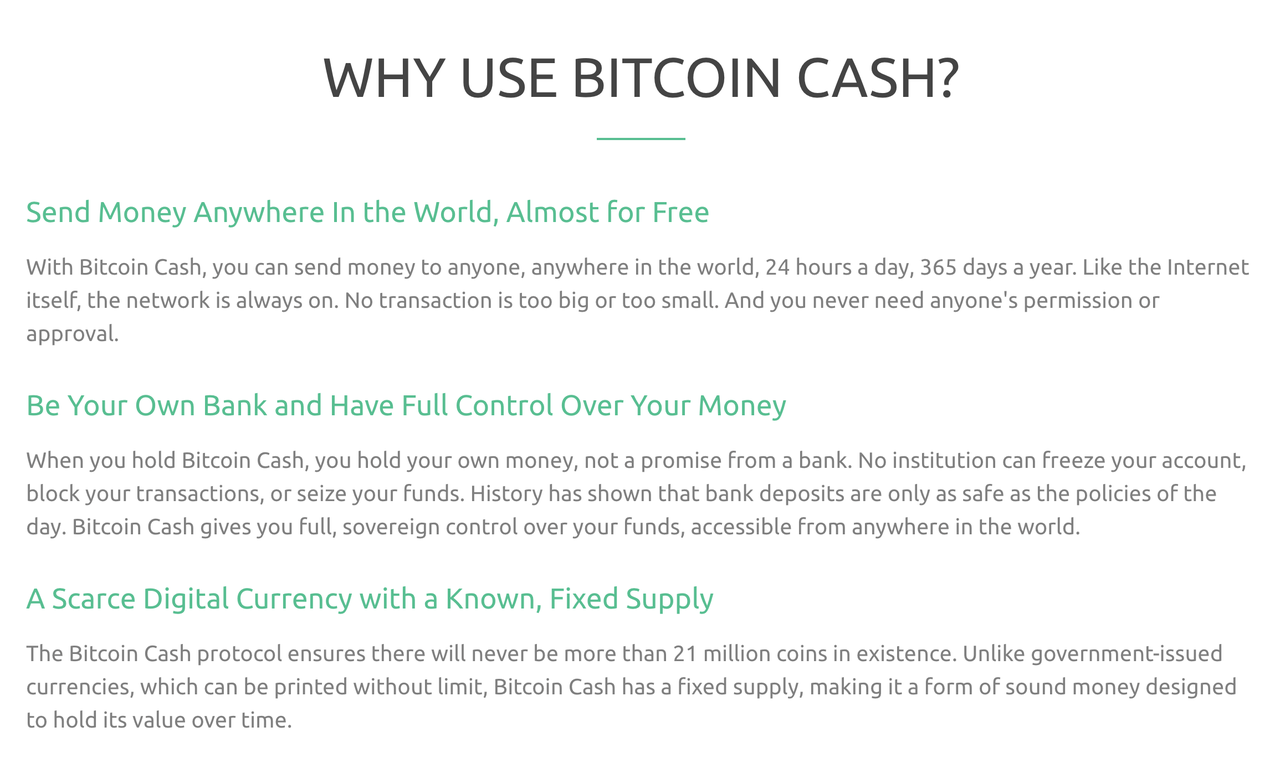
Bitcoin Cash is a decentralized, peer-to-peer cryptocurrency that allows users to transfer value directly without relying on a bank or payment processor. It shares Bitcoin's original transaction history up to the chain split on August 1, 2017, but has operated as a separate blockchain ever since.
BCH was created to address a concern among some Bitcoin supporters: as the network became more popular, its limited block capacity could contribute to transaction backlogs and higher fees. Supporters of Bitcoin Cash argued that increasing on-chain transaction capacity would help preserve Bitcoin's original vision of a peer-to-peer electronic cash system.
Several characteristics define Bitcoin Cash:
Fixed supply: BCH has a maximum supply of 21 million coins, following the same basic supply model as Bitcoin.
Proof-of-work consensus: Miners use computational power to validate transactions, produce blocks, and secure the network.
Peer-to-peer transfers: Users can send BCH directly to other wallet addresses without requiring a centralized intermediary.
Larger block capacity: Bitcoin Cash supports larger blocks than Bitcoin's base layer, allowing more transactions to be included in each block under comparable conditions.
Programmable transactions: Protocol upgrades have expanded the functionality of Bitcoin Cash, enabling applications beyond simple transfers of value.
BCH can serve as a payment currency, a transferable digital asset, and cryptocurrency traded on centralized and decentralized platforms. However, its suitability for everyday payments depends on factors such as merchant acceptance, wallet availability, network conditions, and price volatility.
Bitcoin Cash is not simply another name for Bitcoin. Although the two assets share a common origin, BCH and BTC have different blockchains, market prices, development priorities, and network rules.
Data Source: BitcoinCash
The Bitcoin Cash Fork: Why Did BCH Split From Bitcoin in 2017?
Bitcoin Cash was created because the Bitcoin community could not reach agreement on the best way to increase transaction capacity as adoption grew.
The dispute was not simply about block size. It reflected different views about decentralization, network economics, technical complexity, and the intended role of Bitcoin.
The Bitcoin Scaling Debate: On-Chain vs. Off-Chain Scaling
Bitcoin's original design processes transactions on a shared blockchain. As the number of users and transactions increased, the network's limited block capacity became a central issue.
Two broad approaches emerged.
On-chain scaling increases the capacity of the blockchain itself. Supporters argue that larger blocks can accommodate more transactions directly on the base layer, helping the network function as a practical payment system without requiring users to rely on additional layers.
Off-chain scaling moves some transaction activity outside the base blockchain while using the underlying network for settlement or security. The Lightning Network, for example, enables participants to conduct multiple payments through payment channels without recording every individual payment on Bitcoin's base layer.
Each approach has advantages and limitations. Larger blocks can increase direct transaction capacity, but they may raise the hardware and bandwidth requirements for nodes. Off-chain systems can enable faster payments and reduce base-layer transaction demand, but they introduce additional technical considerations involving liquidity, routing, channel management, and user experience.
Supporters of larger blocks viewed on-chain capacity as essential to Bitcoin's payment-focused mission. Others believed that keeping blocks smaller would make it easier for more people to run nodes, preserving a key component of decentralization while allowing additional layers to handle higher transaction volumes.
These competing priorities ultimately led to a chain split.
The 2017 Hard Fork: How Bitcoin Cash Was Created
On August 1, 2017, Bitcoin Cash launched through a hard fork that introduced different consensus rules, including a larger block size limit.
A hard fork occurs when a protocol change is not compatible with the rules followed by the existing network. When participants adopt different rule sets, the blockchain can split into separate networks.
At the time of the Bitcoin Cash split, the two chains shared the same transaction history up to the fork point. Afterward, transactions were recorded independently on Bitcoin and Bitcoin Cash, and the two networks developed separate market prices.
The original Bitcoin blockchain continued under the rules followed by Bitcoin Core and its broader ecosystem. Bitcoin Cash adopted a larger-block approach, initially increasing its default block size limit to 8 MB.
The split also created practical considerations for holders. People who controlled their private keys at the time of the fork could generally access the corresponding coins on both chains, subject to wallet support and the technical procedures required to separate transactions safely. Exchange customers depended on each platform's policies for recognizing and distributing forked assets.
Bitcoin Cash was not the last chain to emerge from disagreements over Bitcoin's direction. In November 2018, another hard fork split Bitcoin Cash into Bitcoin Cash and Bitcoin SV, reflecting further disagreements about block size and protocol development.
These events illustrate how decentralized networks can evolve through competing implementations when their communities disagree over fundamental design decisions.
Bitcoin Cash vs. Bitcoin: Key Differences in Design and Philosophy
Although BCH and BTC share a common history, they have developed into distinct cryptocurrency networks.
eature | Bitcoin Cash (BCH) | Bitcoin (BTC) |
Primary design emphasis | Peer-to-peer payments and on-chain capacity | Monetary asset, settlement network, and store of value |
Maximum supply | 21 million BCH | 21 million BTC |
Consensus mechanism | Proof of work | Proof of work |
Target block interval | Approximately 10 minutes | Approximately 10 minutes |
Block capacity | Larger, with an adaptive block size limit | More constrained base-layer capacity, using block weight rules |
Scaling approach | Emphasizes on-chain scaling | Uses base-layer improvements and additional scaling systems, including Lightning |
Native asset | BCH | BTC |
Blockchain | Separate chain since August 2017 | Original chain that continued after the split |
Bitcoin Cash Price History: Key Milestones and Market Performance
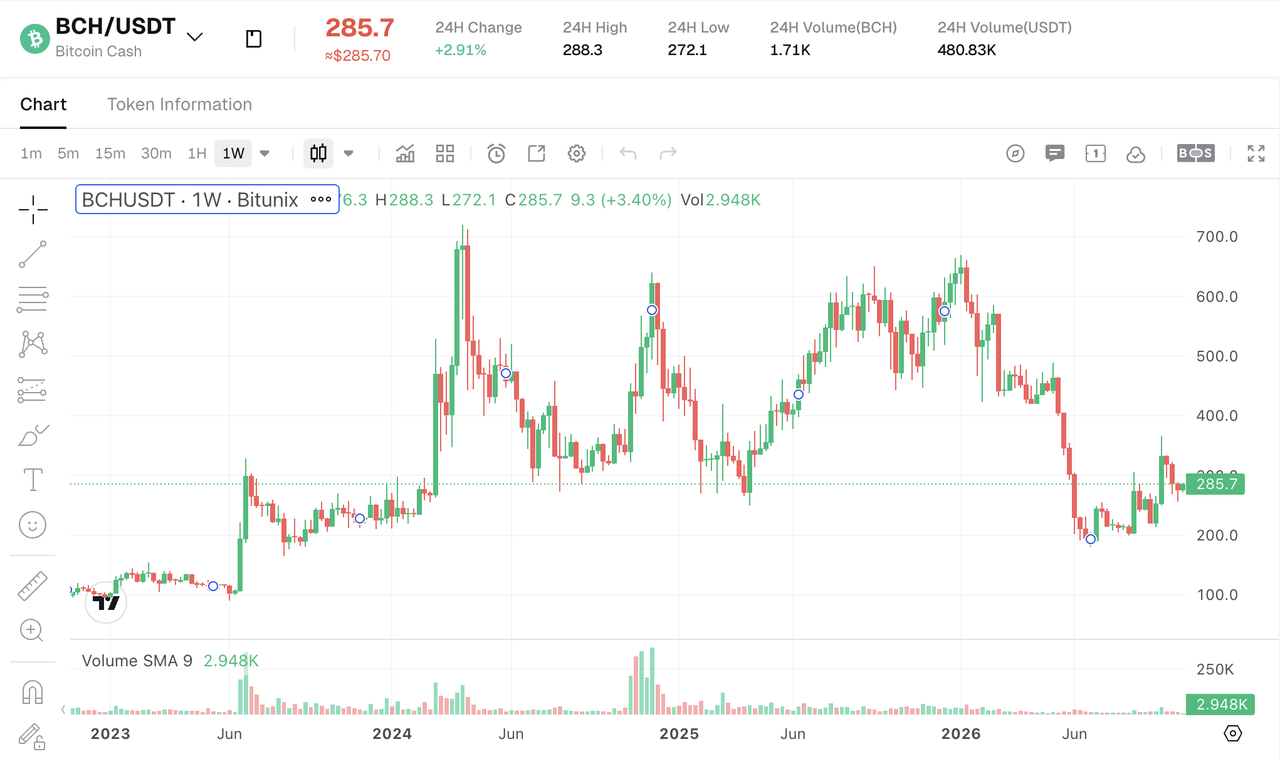
Bitcoin Cash (BCH) launched in August 2017 and quickly attracted attention during the cryptocurrency bull market. Its price surged above $3,000 in its first year, reflecting strong market interest in the Bitcoin fork and the broader crypto rally. However, BCH subsequently experienced a sharp correction as market sentiment weakened.
In the years that followed, BCH experienced several rallies that pushed its price above $600, including during the 2021 bull market and subsequent recovery periods. These moves often coincided with broader cryptocurrency market upswings, particularly Bitcoin's price rallies, although BCH's gains and losses were not always proportional to BTC's movements.
For much of its trading history, BCH has traded in the $100–$300 range, significantly below its early highs. Although BCH and BTC often move in the same direction during major market cycles, BCH has generally shown a different price trajectory and has not consistently matched Bitcoin's performance. Its long-term valuation reflects not only broader market conditions but also changing demand for BCH, competition from other payment networks, and investor perceptions of its role in the cryptocurrency ecosystem.
Data Source: Bitunix
Bitcoin Cash Development History: From the 2017 Fork to Recent Protocol Upgrades
2017–2020: Establishing an Independent Network
Following its 2017 hard fork, Bitcoin Cash focused on increasing block capacity and establishing independent consensus rules. The 2018 Monolith upgrade expanded block capacity and restored selected scripting functions, while the 2019 introduction of Schnorr signatures improved transaction-signing capabilities and laid the groundwork for more advanced applications.
2021–2023: Expanding Transaction and Token Functionality
Between 2021 and 2022, protocol upgrades expanded scripting capabilities, including transaction introspection and arithmetic operations. In May 2023, Cash Tokens introduced native fungible-token and non-fungible-token functionality, allowing developers to build token-based applications directly on the Bitcoin Cash blockchain.
2024–2026: Scaling and Programmability Improvements
Bitcoin Cash introduced the Adaptive Blocksize Limit Algorithm (ABLA) in May 2024 to adjust block capacity according to predefined rules and network activity. Subsequent upgrades in 2025 and 2026 expanded virtual-machine and scripting capabilities, including high-precision arithmetic, bounded loops, reusable functions, bitwise operations, and Pay-to-Script support. These changes aim to accommodate transaction growth while enabling more sophisticated on-chain applications beyond basic peer-to-peer payments.
How to Acquire BCH
New BCH is primarily issued through mining, where miners use computational power to validate transactions and produce new blocks. Unlike staking-based networks, Bitcoin Cash uses a proof-of-work consensus mechanism, so users cannot earn BCH by delegating tokens to validators. For most ordinary users, purchasing BCH on cryptocurrency exchanges is a more convenient option.
Centralized exchanges like Bitunix allow users to purchase BCH using supported fiat currencies or stablecoins such as USDT. Some platforms also support credit card purchases, making it easier for beginners to access the market. New users may need to register and complete identity verification (KYC) in accordance with applicable regulatory requirements. Before trading, users should review the platform's security measures, fees, and supported deposit and withdrawal networks.