Ethereum Classic (ETC) is a decentralized blockchain that supports smart contracts and decentralized applications while maintaining a proof-of-work (PoW) consensus mechanism. It emerged in 2016 following a controversial dispute over how the Ethereum community should respond to the DAO hack, an event that ultimately split the original Ethereum network into two separate blockchains.
Unlike Ethereum (ETH), which transitioned to proof of stake in September 2022, Ethereum Classic continues to rely on mining to secure its network and validate transactions. Its development philosophy emphasizes blockchain immutability, decentralization, and resistance to censorship.
Although ETC shares much of its technical foundation with Ethereum, the two networks have evolved in different directions. Understanding their historical split, technical architecture, and market performance helps explain Ethereum Classic's position in the cryptocurrency ecosystem.

Data Source: Ethereum Classic
What Is Ethereum Classic? Understanding the Original Ethereum Blockchain
Ethereum Classic is a public blockchain that enables developers to deploy smart contracts and build DApps. Its native token, ETC, is used to pay transaction fees, reward miners, and transfer value.
The network originated from Ethereum, which launched in July 2015. Following the DAO-related hard fork in July 2016, the modified chain continued as Ethereum, while the original chain retained the name Ethereum Classic.
ETC's defining features include PoW consensus, EVM compatibility, community-driven protocol upgrades, and a maximum supply of approximately 210.7 million ETC. Its commitment to preserving transaction history does not prevent technical upgrades, but changes are expected to remain consistent with its underlying principles.
How Do Smart Contracts Work on Ethereum Classic?
Smart contracts are blockchain-based programs that execute predefined instructions without requiring a centralized intermediary. They can support token transfers, digital asset management, and decentralized applications.
Ethereum Classic uses the Ethereum Virtual Machine (EVM), allowing developers to use Solidity and familiar Ethereum development tools. However, differences in network configuration and protocol support may require application adjustments.
Smart contract execution consumes computational resources measured in gas, with fees paid in ETC. Although this functionality supports applications beyond basic payments, projects remain exposed to software vulnerabilities and network risks.
How Does Proof of Work Secure Ethereum Classic?
ETC uses PoW, in which miners compete to produce valid blocks and receive block rewards and eligible transaction fees. Rewriting transaction history requires substantial computational resources, making attacks costly.
The network uses ETCHash, a modified version of Ethash introduced through the Thanos upgrade in November 2020. PoW maintains ETC's mining-based security model but requires electricity and computing hardware.
ETC has experienced 51% attacks, demonstrating that PoW does not eliminate security risks. Network security depends on the distribution of mining power, economic incentives, and defenses against chain reorganizations.
Data Source: Ethereum Classic
The Ethereum Classic Fork: The DAO Hack and the 2016 Ethereum Split
The DAO Hack: What Happened in 2016?
The DAO was a decentralized investment project built on Ethereum in 2016. It raised approximately 12.7 million ETH, worth around $150 million at the time, before an attacker exploited a reentrancy vulnerability on June 17, 2016.
The exploit allowed repeated withdrawal calls before the contract properly updated its internal accounting, moving approximately 3.6 million ETH into a child DAO. The incident raised concerns about investor losses and the security of smart contracts.
The Ethereum community debated whether to intervene, leave the blockchain unchanged, or modify its state to enable fund recovery. This technical incident developed into a wider dispute over blockchain immutability and governance.
The Hard Fork Debate: Code Immutability vs. Reversing the Exploit
Supporters of a hard fork argued that modifying the blockchain could help recover the affected funds and restore confidence. Opponents believed intervention would undermine the principle that transaction history should remain unchanged, even when a smart contract produces unintended results.
On July 20, 2016, the hard fork took effect at block 1,920,000. The modified chain became Ethereum, while those who rejected the change continued the original chain as Ethereum Classic.
ETC's philosophy is often summarized as "Code Is Law," reflecting its preference for preserving blockchain history rather than reversing application-level outcomes through exceptional intervention. This principle does not mean that smart contracts are free of bugs or security risks.
Ethereum vs. Ethereum Classic: How the Two Blockchains Diverged
Ethereum Classic (ETC) | Ethereum (ETH) | |
Consensus | Proof of work | Proof of stake |
Maximum supply | Approximately 210.7 million ETC | No fixed maximum supply |
Smart contracts | EVM-compatible | EVM-based |
Security model | Mining and computational work | Validators and staked ETH |
Core priorities | Immutability and PoW | Programmability and PoS |
Origin | Original chain after the 2016 split | Chain created through the 2016 hard fork |
The biggest technical divergence came in September 2022, when Ethereum transitioned to proof of stake while ETC retained mining-based consensus. ETC also follows a capped issuance schedule introduced through its December 2017 Gotham upgrade, whereas ETH has no fixed maximum supply.
Both networks support smart contracts and DApps, and developers can reuse parts of their tooling across them. However, differences in consensus, protocol features, ecosystems, and monetary policy mean that neither network is simply a substitute for the other.
Ethereum Classic Development History: From the DAO Fork to Its Continued Commitment to Proof of Work
From 2016 to 2018, Ethereum Classic established an independent upgrade roadmap focused on preserving its original chain and maintaining PoW. Early changes addressed replay protection, gas pricing, and the difficulty bomb. The Gotham upgrade in December 2017 introduced a predictable issuance schedule and a maximum supply of approximately 210.7 million ETC, while the difficulty bomb was removed in May 2018.
Between 2019 and 2021, Atlantis, Agharta, and Phoenix incorporated selected Ethereum protocol improvements to maintain compatibility. Thanos introduced ETCHash in November 2020, adjusting the mining algorithm's DAG epoch schedule, while Magneto followed in 2021 with features associated with Ethereum's Berlin upgrade.
From 2022 to 2024, Mystique incorporated selected features from Ethereum's London upgrade, and Spiral brought further execution-layer compatibility improvements. ETC continues to prioritize PoW security and EVM compatibility, with future changes shaped by community proposals.
ETC Price History: Key Milestones and Market Performance
Ethereum Classic began trading separately after the July 2016 fork and attracted attention during the 2017 cryptocurrency bull market. Its price subsequently declined during the 2018 bear market, while 51% attacks in 2020 added concerns about network security and mining concentration.
ETC rallied sharply during the 2021 bull market, reaching an all-time high of approximately $176 in May, according to CoinMarketCap historical data. The surge reflected broader market demand, but the subsequent volatility showed that price gains did not necessarily correspond to stronger network adoption.
Ethereum's transition to proof of stake in 2022 renewed interest in ETC's PoW model, while the Spiral upgrade in 2024 maintained compatibility with selected Ethereum execution-layer improvements. ETC's price in 2025–2026 continued to depend on market liquidity, Bitcoin's direction, investor sentiment, network security, and competition.
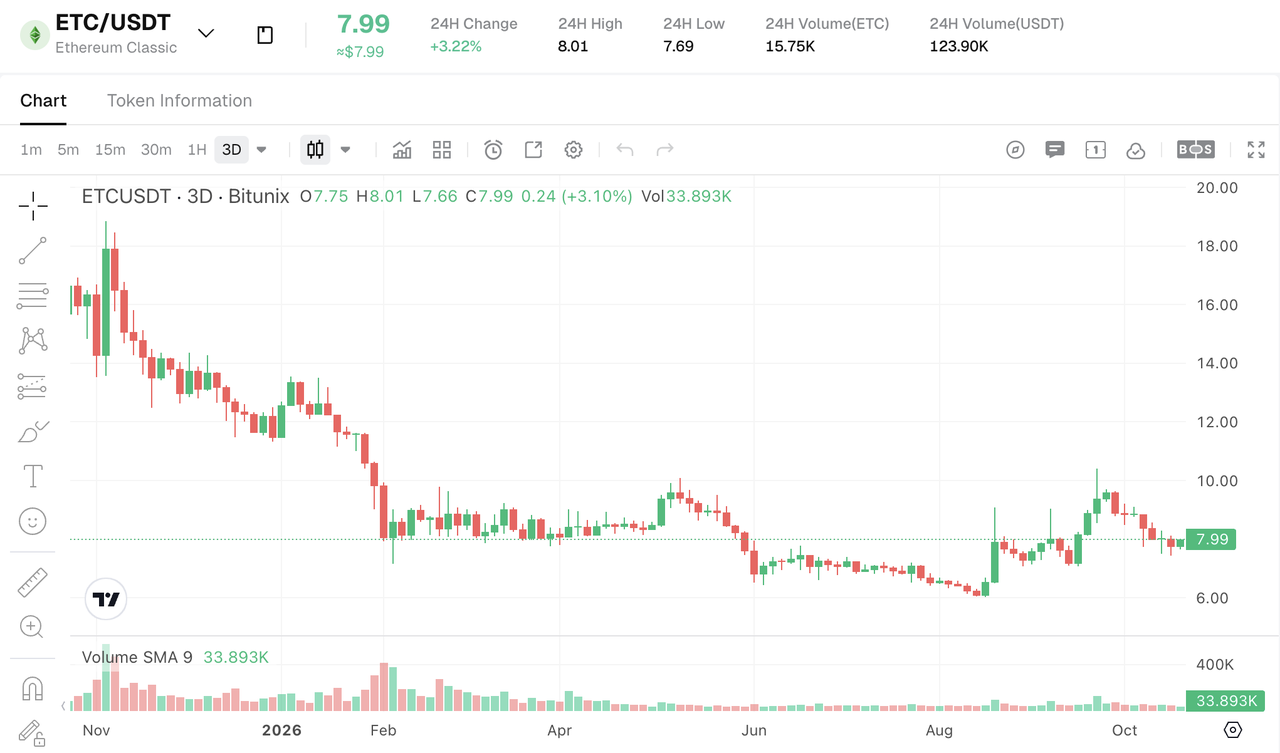
Data Source: Bitunix
How to Buy ETC
As the Ethereum Classic ecosystem continues to evolve, ETC has become an asset considered by cryptocurrency investors. For most users, participating in network mining requires specialized hardware and technical knowledge, while purchasing ETC through a centralized exchange offers a more convenient way to gain exposure to the Ethereum Classic ecosystem.
By purchasing ETC through a cryptocurrency exchange such as Bitunix, you can benefit from a straightforward trading process and security measures. Bitunix supports users in trading ETC directly with stablecoins such as USDT and provides security measures including multi-signature technology, hot and cold wallet separation, and real-time risk monitoring. After registering an account and completing the required identity verification (KYC), you can buy, deposit, and withdraw ETC through Bitunix's intuitive interface. Whether you intend to hold ETC for the long term or participate in the Ethereum Classic ecosystem, Bitunix offers a convenient starting point for your crypto journey.