For many people in crypto, Circle is best known as the company behind USDC, one of the largest U.S. dollar-pegged stablecoins. But Circle Internet Group (NYSE: CRCL) is more than a stablecoin issuer.
Circle is building financial infrastructure around stablecoins, including payments, blockchain infrastructure, institutional services, and developer tools. Its core business remains closely tied to USDC, because the company earns most of its revenue from the reserves backing the stablecoin. At the same time, Circle is trying to expand beyond reserve income by building additional products and infrastructure for onchain finance.
For investors, this makes CRCL an unusual stock. Its financial performance is influenced not only by traditional factors such as revenue growth and interest rates, but also by USDC circulation, stablecoin adoption, distribution costs, regulation, and the broader development of blockchain-based financial infrastructure.
Data Source: Businesswire
What Is Circle? Understanding Circle Internet Group
Circle Internet Group is a financial technology company focused on stablecoins and blockchain-based financial infrastructure. Its best-known product is USDC, a stablecoin designed to maintain a value of approximately $1 and backed by U.S. dollar-denominated reserve assets.
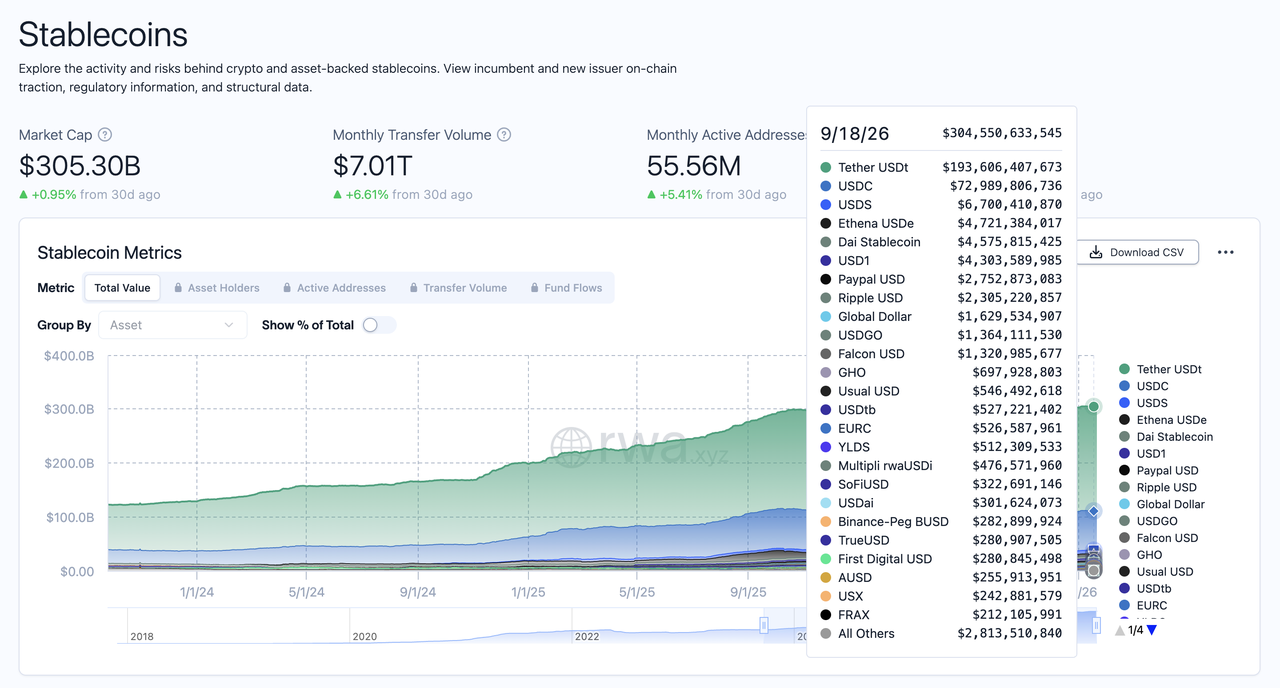
As of September 18, 2026, approximately $72.9 billion of USDC was in circulation. Circle says USDC is backed by highly liquid cash and cash-equivalent assets, with reserves equal to or greater than the amount of USDC in circulation. Circle also publishes monthly reserve attestations from a Big Four accounting firm.
USDC competes most directly with Tether's USDT. USDT remains the largest stable coin by market capitalization, while USDC has built a significant position among exchanges, financial institutions, payment companies, and other regulated-market participants. As of September 18, 2026, USDT had a market capitalization of about $193.6 billion compared with approximately $72.9 billion for USDC.
However, Circle's business strategy extends beyond simply competing for stablecoin market share. The company has been developing a broader infrastructure stack covering stablecoins, liquidity, payments, blockchain networks, and financial applications.
Circle currently describes its business in three major areas: blockchain infrastructure and developer tools, digital assets and related services such as USDC and Circle Mint, and applications including the Circle Payments Network and StableFX.
This distinction is important when looking at CRCL. Investors are not simply valuing a stablecoin; they are also evaluating whether Circle can turn USDC's distribution network into a broader financial infrastructure business.
Data Source: RWA.xyz
How Does Circle Make Money?
Circle's business model is unusual because its largest source of revenue comes from the assets backing USDC rather than from charging users a conventional transaction fee for holding the stablecoin.
The basic mechanism is straightforward. When USDC is issued, Circle holds reserve assets against the tokens in circulation. Those reserves generate interest and other income, while Circle can use part of that income to fund its operations and distribute economics to partners that help expand the USDC ecosystem.
This makes two variables particularly important to Circle's financial results: the amount of USDC in circulation and the income earned on its reserves.
USDC Reserve Income
Reserve income is the financial engine behind Circle's current business. Circle invests the reserves backing USDC in highly liquid assets, including cash and short-duration U.S. government securities and related instruments. As USDC circulation increases, the amount of reserves generating income also increases. Interest rates therefore matter significantly to Circle. When short-term interest rates are high, the yield generated by USDC reserves can increase, boosting reserve income. Conversely, falling interest rates can put pressure on revenue even if the amount of USDC in circulation continues to grow.
This creates an important relationship for CRCL investors:
USDC circulation × reserve yield = a major component of Circle's revenue potential.
However, Circle does not keep all of the economics generated by USDC reserves. One of the most important examples is its relationship with Coinbase. Under their collaboration agreement, Coinbase receives payments linked to the income generated by USDC reserves. The calculation takes into account factors including the amount of USDC held on Coinbase and broader ecosystem economics. Circle records these payments as distribution costs. In other words, some of the economics generated by USDC activity on Coinbase effectively flow back to Coinbase.
This is particularly important because Coinbase is both a major distribution channel for USDC and a shareholder-owned public company. Circle disclosed that it incurred $655.3 million in distribution costs related to its agreements with Coinbase during the first six months of 2026, compared with $635.5 million during the same period in 2025.
The arrangement also means that the more USDC is held on Coinbase's platform, the greater the amount of reserve income that can become payable to Coinbase under the agreement. Circle explicitly identifies this relationship as a factor affecting its distribution costs.
This is an important part of the Circle investment story because USDC growth does not automatically translate into an equivalent increase in Circle's profit. Distribution economics, including payments to Coinbase and other ecosystem participants, need to be considered alongside reserve income.
Subscription and Services Revenue
Circle is also developing revenue streams that are less directly dependent on USDC reserve yields. Its subscription and services business includes recurring revenue from integration and maintenance services, fund management, time-based access, and user-based licensing. Circle also generates transaction revenue from usage-based and volume-based services, including certain digital-asset transactions and infrastructure services. This part of the business is strategically important because it can help Circle diversify its revenue base.
If Circle can generate more revenue from infrastructure and services, its financial performance could become less sensitive to changes in short-term interest rates. This is one reason investors pay attention to Circle's efforts to expand its product ecosystem rather than focusing exclusively on USDC circulation.
Payments and Financial Infrastructure
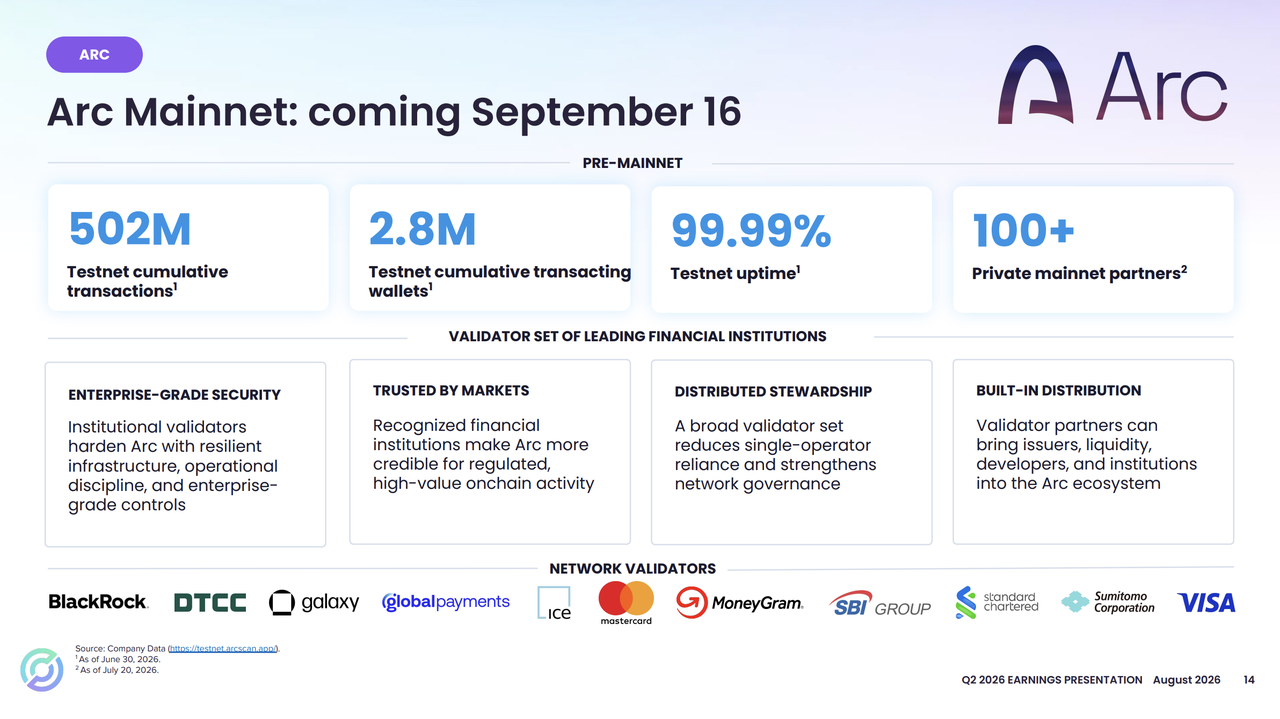
Circle is also positioning itself as infrastructure for payments and financial institutions. Its Circle Payments Network is designed to use stablecoins as settlement infrastructure, while other products provide liquidity, custody, treasury, and integration services. Circle has also been expanding its blockchain infrastructure strategy, including Arc, a Layer 1 blockchain designed specifically for financial applications. The strategic idea is relatively simple: if stablecoins become a widely used settlement layer for global payments and financial markets, Circle could potentially earn revenue from more parts of that infrastructure. That would represent a shift from a business primarily monetizing stablecoin reserves toward one that also monetizes the financial activity built around stablecoins.
Data Source: Circle
What Drives Circle Stock Price?
Several factors can influence CRCL because Circle sits at the intersection of the crypto market, financial markets, and the stablecoin industry.
USDC circulation is one of the most important factors. A larger USDC supply generally means a larger pool of reserves generating income. Circle reported that USDC circulation reached roughly $73 billion in the second quarter of 2026, while its broader strategy continues to target stablecoin adoption across exchanges, financial institutions, payments companies, and other applications.
Interest rates are another major factor. Because Circle earns income from USDC reserves, changes in short-term interest rates can affect the amount of revenue generated from a given level of USDC circulation. A growing USDC supply can partially offset lower yields, but the two variables should be considered separately.
Distribution costs are equally important. Circle pays Coinbase and other ecosystem participants to distribute and promote USDC. As a result, investors need to look not only at reserve income but also at how much of that income Circle retains after distribution expenses. The Coinbase arrangement is particularly significant because Circle's filings show that these costs can run into hundreds of millions of dollars per quarter.
Stablecoin competition also matters. USDT remains significantly larger by market capitalization, while USDC has continued expanding its presence across regulated financial institutions, exchanges, payment networks, and blockchain applications. Changes in the competitive position of USDC could affect Circle's future distribution and revenue growth.
Regulation is another major variable. Stablecoin rules can affect how issuers manage reserves, distribute stablecoins, work with financial institutions, and launch new products. Circle has positioned regulatory compliance as a central part of its business strategy, while the evolving regulatory framework creates both opportunities and additional operating requirements.
Circle Stock Performance
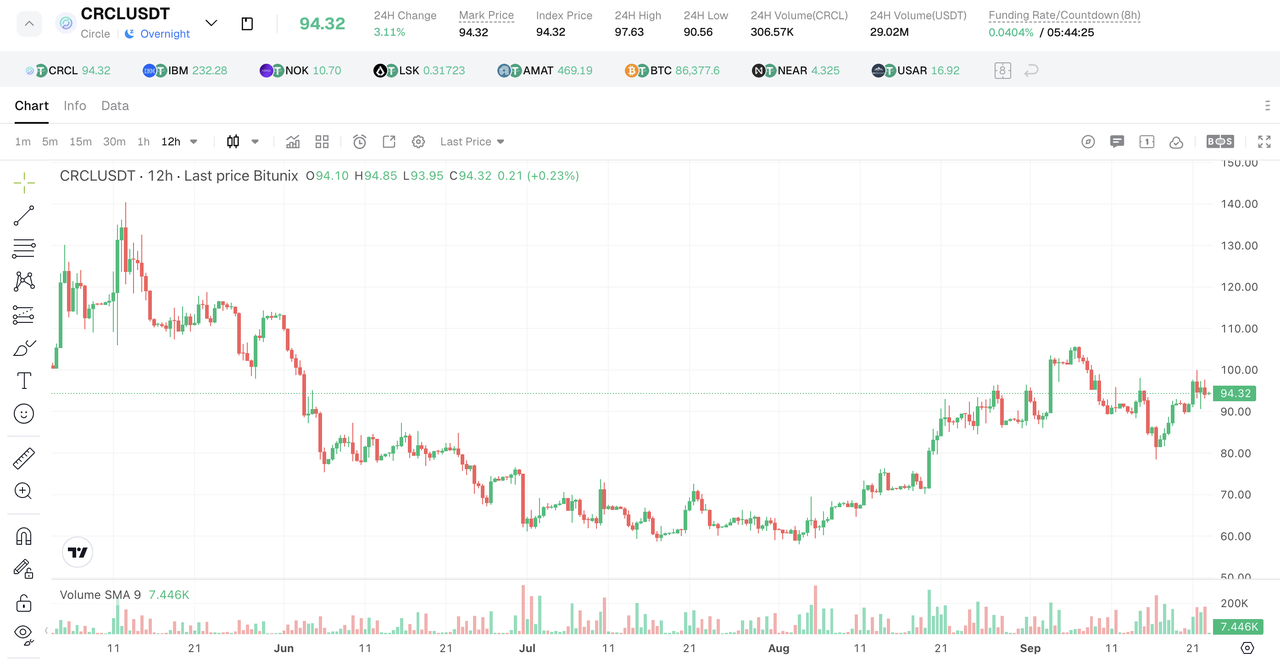
Circle went public on the New York Stock Exchange in June 2025 under the ticker CRCL. The stock experienced substantial volatility after going public as investors reassessed the growth potential and valuation of the stablecoin business. CRCL has also responded to major developments in the crypto and stablecoin markets. Changes in interest-rate expectations, regulatory developments, USDC circulation, and announcements involving major distribution partners have all become relevant to the stock's performance.
As of September 23, 2026, CRCL was trading at approximately $94.82, compared with a 52-week range of $49.90 to $159.47. The stock's year-to-date return was approximately 19.6% as of September 22, according to Yahoo Finance. These figures are market data and can change throughout the trading session.
Circle's recent corporate developments have also become increasingly important to its stock story. In September 2026, Binance agreed to invest $100 million in Circle through a private placement while entering into a five-year commercial agreement to promote USDC. The deal provides another major distribution channel for USDC while illustrating the importance of ecosystem partnerships to Circle's business model.
For investors analyzing CRCL's historical performance, it is therefore useful to separate short-term stock-price movements from the underlying operating indicators: USDC circulation, reserve income, distribution costs, interest rates, and growth in Circle's payments and infrastructure businesses.
Data Source: Bitunix
How to Buy CRCL Stock
For investors looking to gain exposure to Circle stock, the traditional approach is to purchase CRCL shares through a U.S. stock brokerage account. Investors typically need to open a U.S. trading account, complete identity verification, and then place orders to buy Circle shares directly. That said, trading U.S. stocks may involve account opening procedures, cross-border fund transfers, and transaction fees. Some brokerage platforms may also have relatively higher trading costs. In addition, traditional stock trading generally allows investors to benefit only from upward price movements, limiting flexibility when responding to short-term market volatility.
Beyond traditional stock investing, investors can also trade Circle contracts through cryptocurrency trading platforms such as Bitunix. Compared with directly purchasing shares, contract trading offers more flexible market participation options, allowing traders to take long positions when expecting Circle's stock price to rise or open short positions to potentially benefit from downward price movements. Bitunix CRCL contracts support a 0-fee trading model and offer up to 20x leverage, allowing users to access larger market positions with less capital and improve capital efficiency. Before initiating their first trade, users need to register a Bitunix account and complete identity verification (KYC). Through risk control systems, asset management measures, and transaction monitoring mechanisms, the platform provides users with a secure and efficient trading environment.