Meta Platforms (NASDAQ: META) is one of the most influential technology companies in the world. For many people, however, the company is still closely associated with its original product: Facebook.
That image no longer tells the whole story.
Today, Meta operates Facebook, Instagram, WhatsApp, Messenger, and Threads, while also investing heavily in artificial intelligence, smart glasses, virtual reality, and other emerging technologies. The company has evolved from a social networking platform into a broader technology ecosystem, with AI increasingly becoming central to both its existing products and its long-term strategy.
At the center of that transformation is Mark Zuckerberg, Meta's founder and CEO. From Facebook's launch in 2004 to the company's rebranding as Meta in 2021 and its current push into AI, Zuckerberg has played an unusually direct role in shaping the company's direction.
For investors and traders, understanding Meta therefore requires more than looking at its advertising revenue or stock price. It also means understanding how Zuckerberg's long-term bets are changing one of the world's largest social media businesses.
Data Source: Boston University
Meta Is More Than Facebook: The Company Behind Instagram, WhatsApp, and Threads
Meta was founded as Facebook in 2004, initially focused on connecting people through a social networking platform. Over time, the company expanded through product development and acquisitions, building a portfolio that now includes some of the world's most widely used social media and communication platforms.
Today, Meta's Family of Apps includes Facebook, Instagram, Messenger, WhatsApp, and Threads. The company also operates Meta AI across its apps and as a standalone service, while its Reality Labs segment develops products such as Meta Quest and AI-powered glasses.
Instagram: Meta's Visual and Creator-Focused Platform
Instagram has become one of Meta's most important platforms for visual content, creators, influencers, and businesses. What began primarily as a photo-sharing app has expanded into a broader platform built around photos, short-form video, stories, messaging, and creator content. For Meta, Instagram is also a major advertising platform, giving businesses access to a large and highly engaged audience while providing creators with tools to build and monetize their followers.

Data Source: Instagram
WhatsApp: Global Messaging at Massive Scale
WhatsApp plays a different role within Meta's ecosystem. Rather than focusing primarily on public content, it is built around private communication, including messaging, voice and video calls, group conversations, and business communication. Its global reach makes WhatsApp strategically important to Meta, particularly as the company works to expand business messaging and develop new ways to connect users, businesses, and AI-powered services.

Data Source: Sumaholife
Threads: Meta's Platform for Public Conversations
Threads is Meta's newer social platform for text-based public conversations. Launched in 2023, it was designed as a space where users can share posts, follow accounts, and participate in real-time discussions. Threads also benefits from its connection with Instagram, allowing Meta to leverage its existing user base and social graph while building another platform for public content and conversations.

Data Source: Theverge
Mark Zuckerberg and Meta: How One Founder Shaped the Company’s Direction
Meta is also unusual because its corporate strategy is closely associated with its founder. Mark Zuckerberg has remained CEO since Facebook's early years and has continued to influence the company's major strategic decisions. That makes Zuckerberg an important part of understanding Meta's business, particularly when the company makes large investments in technologies that may take years to generate meaningful revenue.
From Facebook to Meta
In October 2021, Facebook changed its corporate name to Meta Platforms. The name change reflected a broader strategic shift. Rather than defining the company around a single social network, Zuckerberg wanted Meta to focus on building what he described as metaverse and the next generation of digital interaction.
The rebranding also highlighted how far the company had moved beyond Facebook itself. Instagram, WhatsApp, Messenger, virtual reality, and other products have become increasingly important parts of the business.
The company's current strategy still reflects this broader vision. Meta describes its products as spanning mobile devices, computers, VR headsets, and AI glasses, rather than focusing on a single platform.
Zuckerberg's Bet on the Metaverse
The metaverse was one of Zuckerberg's biggest strategic bets. Meta poured billions of dollars into Reality Labs, Meta Quest headsets, virtual reality software, and other immersive technologies, hoping to build the next generation of digital interaction.
But the results have fallen far short of the scale of the investment. In 2025, Reality Labs generated only a small share of Meta’s revenue while recording an operating loss of approximately $19.2 billion. Meta has also said that it expects Reality Labs’ operating losses in 2026 to remain at a similar level.
Meta’s layoffs and continued cost-cutting efforts at Reality Labs have added to the pressure surrounding the metaverse strategy. In that sense, the restructuring provides another indication that Zuckerberg’s original metaverse bet has not delivered the results Meta initially hoped for.
The metaverse remains part of Meta’s long-term strategy, but the company has increasingly shifted its focus toward artificial intelligence. This suggests that AI has become a more immediate strategic priority, while the metaverse has moved further into the category of long-term, high-risk investment.

Data Source: Meta
From Metaverse to AI
After years of focusing heavily on the metaverse, Meta has increasingly shifted its attention toward artificial intelligence. One of the clearest examples is Llama, Meta’s family of large language models and one of the company’s most important AI projects.
Meta has released multiple generations of Llama models and has used them as a foundation for its broader AI strategy. Llama supports Meta’s development of AI assistants, generative AI products, and other AI-powered features, while Meta has also made several Llama models available to developers and researchers.
AI is also being integrated directly into Meta’s existing products. It helps power content recommendations and discovery across Facebook and Instagram, improves advertising tools, and supports Meta AI across its apps and devices. This allows Meta to use AI not only as a new product category, but also to improve the businesses it already operates.
This makes Meta’s AI strategy fundamentally different from its metaverse bet. The metaverse required Meta to build an entirely new computing platform around virtual and augmented reality. AI, by contrast, can be deployed across Meta’s existing apps, advertising systems, data centers, and wearable devices.

Data Source: Lab51
Why Zuckerberg Still Matters to Meta
Zuckerberg's influence matters because Meta's strategy often extends beyond the next quarter or even the next few years. His willingness to invest heavily in AI infrastructure, Reality Labs, wearables, and other emerging technologies can have a direct impact on Meta's expenses, capital spending, and profitability.
At the same time, Meta's enormous existing user base and advertising business give the company financial resources to pursue these long-term projects.
For investors, Zuckerberg's role is therefore both a strategic asset and an important factor to monitor. Major changes in the company's investment priorities can influence everything from capital expenditure to operating margins and future growth opportunities.

Data Source: InsideRetail
How Meta Makes Money: The Advertising Business Behind Its AI Ambitions
Despite its transformation into a broader technology company, advertising remains the foundation of Meta's business. Meta primarily sells advertising placements across its Family of Apps. Advertisers can use its platforms to reach users for objectives such as brand awareness, lead generation, conversions, and other forms of customer acquisition.
The scale of this business is enormous.
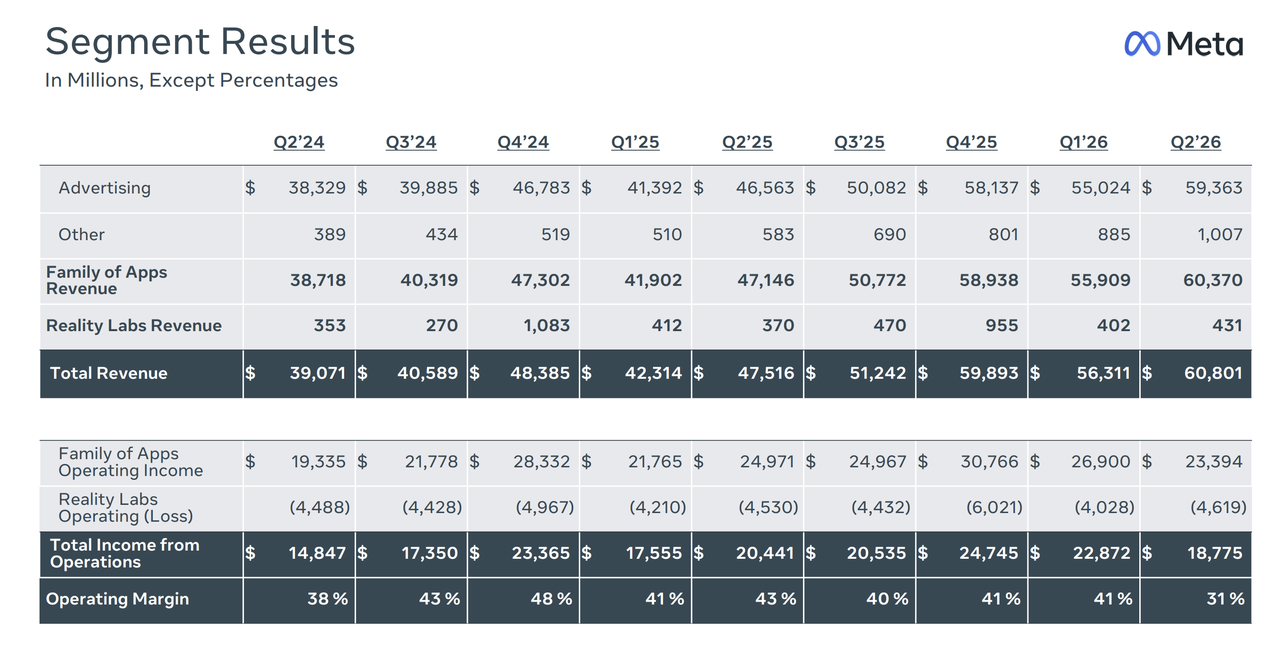
In the second quarter of 2026, Meta generated $60.801 billion in total revenue, up 28% year over year. Advertising revenue reached $59.363 billion, meaning advertising accounted for approximately 97% of the company's quarterly revenue.
Meta's advertising business benefited from growth in both ad volume and pricing in the second quarter. Ad impressions delivered across the Family of Apps increased 14% year over year, while the average price per ad increased 12%.
This advertising engine is also closely connected to Meta's AI strategy. Better recommendation algorithms can help users discover more relevant content. Better AI-powered advertising systems can help advertisers reach more valuable audiences. Higher engagement can create more opportunities to display ads.
That creates a powerful feedback loop:
Users → Engagement → AI Recommendations → Advertising → Revenue → AI Investment
Data Source: Meta
What Drives META Stock?
META is a large-cap technology stock held across major market indexes and institutional portfolios. As a result, its share price is influenced not only by Meta's own business performance, but also by broader market conditions and the decisions of its management team. Four factors are particularly important when analyzing META stock.
Macroeconomic Conditions and Federal Reserve Policy
The broader market environment is one of the first factors to watch when analyzing META. Meta is a major component of the S&P 500 and other large-cap indexes, which means its stock is widely held through institutional portfolios and index-tracking funds. This makes interest rates and Federal Reserve policy important drivers of the stock. When investors expect interest rates to fall, financial conditions can become more supportive of large-cap growth stocks. When rates remain high or expectations shift toward tighter monetary policy, institutional investors may reduce exposure to higher-valuation growth stocks.
Mark Zuckerberg’s Strategic Decisions
Zuckerberg is unusually important to Meta's long-term strategy. Meta's dual-class share structure gives Zuckerberg control of a majority of the company's voting power, allowing him to exercise significant influence over major corporate decisions. This matters because Meta is fundamentally a social media and internet platform business. Unlike a hardware company whose growth may depend heavily on a new chip, device, or technological breakthrough, Meta's performance is closely tied to product strategy, user engagement, monetization, acquisitions, and the allocation of capital. The company's shift from Facebook toward Instagram, Reels, AI, wearables, and the metaverse all illustrate how management decisions can reshape Meta's growth trajectory.
Financial Performance
Meta's quarterly results are another direct driver of META stock. Investors pay close attention to revenue growth, advertising revenue, user engagement, operating margins, earnings, and management's guidance for future quarters. This is particularly important because advertising remains the financial foundation of Meta's business. In Q2 2026, Meta generated $60.8 billion in total revenue, including $59.4 billion from advertising. Advertising revenue increased 27% year over year, while ad impressions increased 14% and the average price per ad increased 12%.
When Reality Labs Can Become Cash-Flow Positive
Reality Labs is another long-term factor that investors continue to watch. The business includes Meta's virtual and augmented reality hardware, software, and content, but it has generated substantial losses while Meta continues to invest in the metaverse and new computing platforms. In Q2 2026, Reality Labs generated only $431 million in revenue while recording an operating loss of $4.62 billion. For the first half of 2026, its operating loss reached $8.65 billion. This makes the eventual path to positive cash flow an important question for Meta. The company can continue funding Reality Labs because its core advertising business generates substantial operating cash flow, but the longer Reality Labs remains deeply loss-making, the greater the pressure on Meta's overall capital allocation.
Meta Stock Performance
Meta's stock performance over the past five years closely reflects the company's changing strategy. The stock went through a dramatic decline during the metaverse expansion, followed by a sharp recovery as Meta reduced costs, improved its core business, and increasingly benefited from the growth of AI.
From Metaverse Ambitions to a Historic Low
On October 28, 2021, Facebook officially became Meta and Zuckerberg announced a major strategic shift toward the metaverse. The company described the move as becoming “metaverse-first” and began investing heavily in Reality Labs, virtual reality, and related technologies.
The market subsequently went through a very different cycle. Meta's stock, which was trading above $300 around the time of the rebranding, fell sharply over the following year. By November 2022, the stock had dropped to an intraday low of about $87, representing a decline of more than 70% from its late-2021 levels.
The decline reflected several pressures at the same time, including a weaker digital advertising environment, higher interest rates, rising costs, and growing concerns about the scale of Meta's investment in the metaverse.
2022 Layoffs and the Beginning of the Recovery
A major turning point came in November 2022, when Meta announced that it would cut more than 11,000 jobs, or approximately 13% of its workforce. Zuckerberg said the company had increased investment too aggressively during the pandemic and that the expected acceleration in online commerce had not materialized as anticipated.
The layoffs marked the beginning of a broader shift toward cost control and capital efficiency. Meta reduced its workforce, cut discretionary spending, consolidated office space, and reassessed its infrastructure investments. The company subsequently entered a period of stronger financial and operational performance, while its growing focus on AI provided another important source of investor interest.
From Cost Cutting to AI-Driven Growth
Meta's stock began a much stronger recovery from its 2022 lows. The company benefited from improving advertising performance, better cost discipline, continued growth across Instagram and its other apps, and the rapid expansion of its AI capabilities.
The AI boom added another layer to the story. Meta increasingly used AI to improve content recommendations, advertising performance, and user engagement, while its Llama models and Meta AI products strengthened the company's position in the broader AI market.
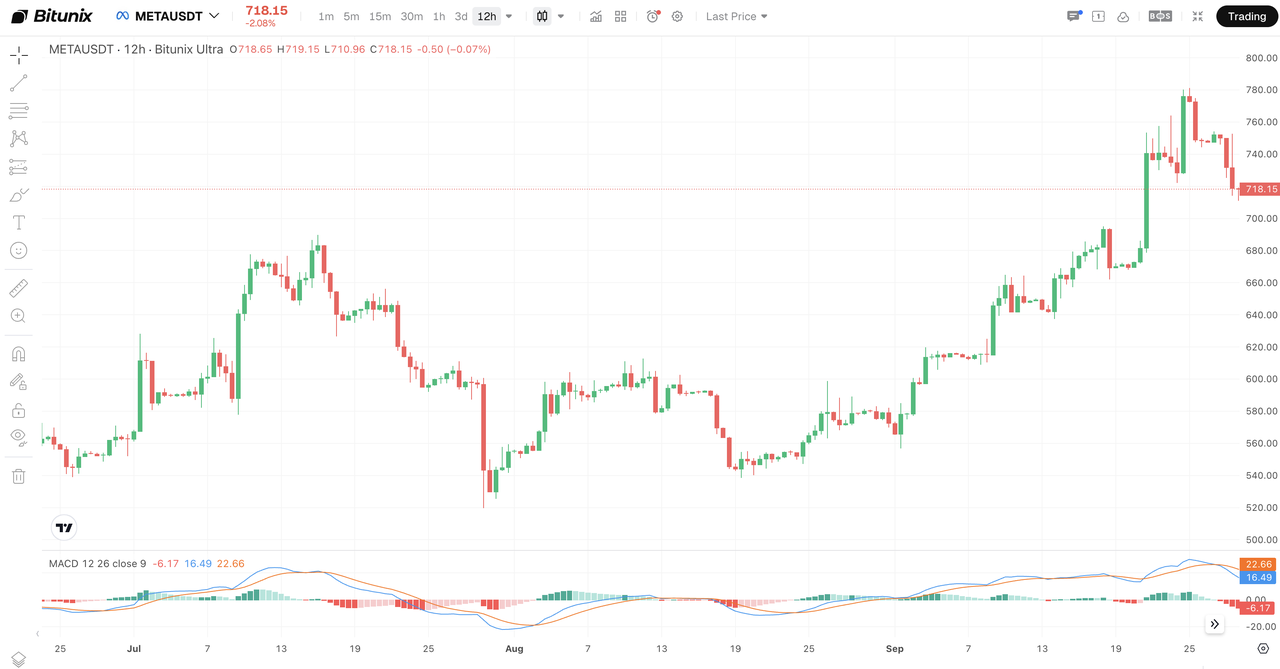
Over the following years, the combination of business growth, stronger profitability, and investor enthusiasm around AI pushed META dramatically higher. The stock eventually reached the roughly $790–$800 range in 2025–2026, approaching its recent record highs.
META Stock in September 2026
By late September 2026, META was trading around the $700 level, although the stock remained volatile. For example, shares jumped more than 11% on September 21 before giving back part of the gains in subsequent sessions. Historical market data shows META trading around $744 on September 23, while recent reports put the stock's previous high at around $796.
The long-term trajectory tells a clear story: Meta went from a $300-plus stock during the peak of its metaverse ambitions to below $90 in late 2022, before recovering to several times that level as the company shifted toward cost efficiency, stronger monetization, and artificial intelligence.
Data Source: Bitunix
How to Buy META Stock
For investors looking to gain exposure to Meta Platforms stock, the traditional approach is to purchase META shares through a U.S. stock brokerage account. Investors typically need to open a U.S. trading account, complete identity verification, and then place orders to buy Meta shares directly. That said, trading U.S. stocks may involve account opening procedures, cross-border fund transfers, and transaction fees. Some brokerage platforms may also have relatively higher trading costs. In addition, traditional stock trading generally allows investors to benefit only from upward price movements, limiting flexibility when responding to short-term market volatility.
Beyond traditional stock investing, investors can also trade Meta contracts through cryptocurrency trading platforms such as Bitunix. Compared with directly purchasing shares, contract trading offers more flexible market participation options, allowing traders to take long positions when expecting Meta's stock price to rise or open short positions to potentially benefit from downward price movements. Bitunix META contracts support a 0-fee trading model and offer up to 20x leverage, allowing users to access larger market positions with less capital and improve capital efficiency. Before initiating their first trade, users need to register a Bitunix account and complete identity verification (KYC). Through risk control systems, asset management measures, and transaction monitoring mechanisms, the platform provides users with a secure and efficient trading environment.