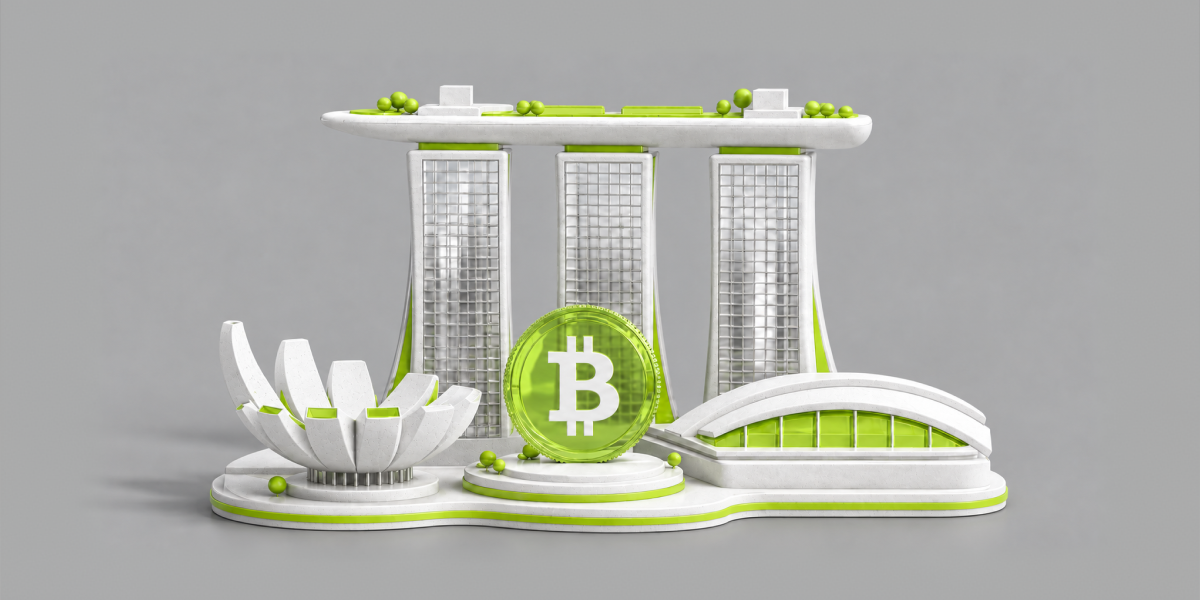
TOKEN2049 Singapore 2026 took place on 7–8 October at Marina Bay Sands, with 25,000 attendees from 160 countries at a sold-out event. Its biggest moments were the announcement of TOKEN2049 New York for June 2027, Arthur Hayes unveiling the FLOP agent network, Tom Lee's statement that BitMine will cap its holdings at 5% of all ETH, Coinbase completing its Deribit integration into a single Global Exchange, and a second day in which Nasdaq, Franklin Templeton, BlackRock and Morgan Stanley talked less about whether to use blockchains and more about what has to change when markets never close.
This TOKEN2049 recap is not a day-by-day log. The running news coverage lives in our TOKEN2049 Singapore 2026 live updates, and the pre-event guide to dates, tickets and side events is here. This piece cuts through the noise to focus on three things: the shifts that matter, where the market is headed, and key watchpoints for traders and builders in the months ahead.
TOKEN2049 Singapore 2026: Key Moments at a Glance
To set the stage, here are the core numbers and announcements that defined this year's narrative.
The Biggest Numbers and Moments
The sheer scale of this year's event was largely driven by an absence elsewhere. When security concerns forced TOKEN2049 Dubai to move from April 2026 to spring 2027, Singapore was left as the calendar's sole flagship. That bottleneck funneled the industry's entire annual spend, major product roadmaps, and keynotes into seven hyper-dense days.
Here is how the headline figures and defining moments stacked up as of October 9, 2026:
Metric / Moment | Headline Figure or Development | Why It Matters |
Expected Attendance | 25,000 attendees | The event was sold out ahead of its 7–8 October dates, underscoring continued demand for major crypto industry gatherings. |
Global Reach | 160 countries and 7,000+ companies | The event brought together participants from across the global digital asset ecosystem. |
Speakers | 300+ advertised speakers | The lineup included executives from Nasdaq, Franklin Templeton, Hyperliquid Labs, Polymarket, and major crypto firms. |
Exhibitors | 500+ exhibitors | The exhibition floor offered a platform for crypto exchanges, infrastructure providers, fintech companies and Web3 projects. |
Day 1 — 7 October | TOKEN2049 announced its expansion to New York | The new U.S. edition was announced during the Singapore event, with its inaugural conference scheduled for 16–17 June 2027. |
Day 1 — Market Discussions | Crypto market cycles, DeFi and institutional adoption | Sessions featured discussions on the next market cycle, DeFi's institutional potential and the evolution of digital asset markets. |
Day 2 — 8 October | Continued focus on institutional finance, stablecoins and blockchain infrastructure | The program brought together industry leaders to discuss digital asset adoption, payments and emerging crypto technologies. |
Side Events and Networking | 1,000+ side events announced | The wider event ecosystem extended beyond the main conference, with networking and industry gatherings across Singapore. |
Dubai Edition Postponed | Rescheduled to 21–22 April 2027 | Regional uncertainty and its implications for safety, travel and logistics shifted the 2026 global spotlight to Singapore. |
Major Announcements and Industry Developments
Behind the endless wall of headlines, three key trends drove the week's narrative.
Consolidation of derivatives liquidity. Coinbase's Global Exchange, Hyperliquid's stated move toward options on its existing order book, and Kalshi's push to bring perpetual contracts to the US all point in the same direction: fewer, deeper venues where spot, perps and options share margin.
Tokenization moving into regulated channels. The OKX–ICE joint venture (OKXICE) notified the SEC on 4 October that it intends to launch a tokenized securities venue covering 63 NYSE-listed stocks with 24/7 trading, using the SEC's new innovation exemption. OKX founder Star Xu used his main-stage slot to build on that filing. Jenny Johnson of Franklin Templeton, meanwhile, argued that many tokenized funds are digital copies of legacy products that miss what the chain is actually for.
Payments plumbing for stablecoins and agents. Nium and RedotPay announced an off-ramp partnership spanning 190 countries and 100 currencies; Anyflo emerged from stealth with the acquisition of Native; and Arthur Hayes' FLOP network proposed a new currency for AI agents built around compute.
The important caveat for all three clusters: most of it is forward-looking. The OKXICE venue cannot trade until the issuer opt-out period and SEC review are complete. FLOP's genesis block is targeted for Q1 2027. Hyperliquid gave no date for options. Treat these as signals about intent, not as delivered infrastructure.
Major Keynotes, Announcements and Industry News
Forget the scripted keynotes — the real signal lies in where speakers actively collided. Onstage friction always reveals more than canned consensus.
Key Takeaways From Leading Crypto Speakers
Hayes' keynote, titled "FLOP: Bigger Than Bitcoin," argued that agents consume compute, that no existing currency (fiat, stablecoins, Bitcoin or lab-specific "AI tokens") can be exchanged directly for compute, and that a Bitcoin-style network where GPU miners earn a currency that agents spend could become the universal payment layer for machine commerce.
He put real numbers behind the experiment: roughly 20 million agents have created identities on Maelstrom's Techno Core sandbox, about 18 million took part in a trading contest, and the planned genesis supply is approximately 2.48 billion FLOP distributed by airdrop with no presale.
A few hours later, Dragonfly's Haseeb Qureshi delivered what amounted to a rebuttal, opening with the admission that he had been wrong about agentic payments. His data point: agents are mostly paying with cards (Visa, Stripe, Ramp and Rain have all shipped agent-card products), and around 90% of volume on Coinbase's x402 agent-payment protocol is reward farming rather than organic commerce. His conclusion was that the agent does not need crypto, the human behind it does, mostly for privacy and self-protection in a world where AI makes surveillance cheap.
Both can be right about different timeframes. Hayes is describing a demand source that could exist once agents transact with each other at scale; Qureshi is describing what agents are doing today. The gap between the two is the single most useful thing to track coming out of the conference.
Lee's keynote framed the market as "Crypto Spring Turning Into Full Blown Bull Market," which is a view, not a fact. The concrete news was BitMine's self-imposed hard cap at 5% of ETH supply. With roughly 6.02 million ETH held (about 4.9%) as of 5 October, the largest corporate ETH treasury is close to the point where it stops accumulating. That is a demand-side change for ETH that is worth more attention than the keynote title.
The Hyperliquid founder said he would focus on options if he were starting over today, that HIP-4 provides the foundation (existing spot, order book and portfolio margin), and that perps can hedge the price risk of an options book. He also observed that no digital-asset platform has yet built a broad options user base, which is both the opportunity and the obstacle.
The Nasdaq CEO told the main stage that markets are moving toward round-the-clock trading and that this forces every bank and broker to run risk and collateral management in real time. She also argued that tokenizing collateral (Treasurys, equities, money-market funds, plus the money itself) could free tens of billions of dollars that currently sit immobilised in the system. Her framing of retail as "about 10 years ahead" of institutions on always-on access is worth remembering when institutional adoption is presented as the leading edge.
On the Day 2 institutional panel, the Canton Network CEO argued that the industry should entrench blockchain usage during the current US regulatory window, the way ride-hailing entrenched itself before regulators could react, so that the 2028 election cannot reverse it.
Binance co-CEO Richard Teng called reversal the industry's greatest fear. Franklin Templeton's Johnson said the industry should not depend on the CLARITY Act passing, since the SEC and CFTC are already providing clarity under existing authority. Read together, these three comments say more about institutional risk perception than any product announcement did.
Major Product Launches and Partnerships
The product news is easier to evaluate if you ask what each launch needs in order to matter.
The following table sets out the main launches and the condition under which each one becomes relevant to market participants:
Launch / Partnership | What was announced | What makes it matter |
Coinbase Global Exchange | Deribit integration complete; US institutions access via Coinbase Prime, options access "in the coming weeks"; Coinbase Pro to return by year-end | Whether US institutional flow actually migrates into Deribit's roughly $30 billion BTC options market |
OKXICE tokenized stocks | SEC notice filed 4 October for 24/7 trading of 63 NYSE-listed stocks on X Layer, with full shareholder rights | Issuer opt-outs during the 30-day window and the SEC's response |
FLOP (Maelstrom) | Proof of Useful Inference consensus; ~2.48B genesis supply via airdrop; testnet late October, mainnet Q1 2027 | Testnet launching on schedule and non-trivial agent demand for compute |
Nium × RedotPay | Stablecoin off-ramp expansion across Nium's 190-country, 100-currency network for RedotPay's 9M+ users | Measured growth in local-currency withdrawals outside existing corridors |
Anyflo | Launch from stealth plus acquisition of Native (Sui ecosystem); private alpha in October | Enterprise integrations beyond the Sui ecosystem |
Midnight (Cardano) | Privacy partner chain pitched by Charles Hoskinson; genesis block launched March 2026 | Usage of shielded features, independent of ecosystem disputes |
Largest corporate launch | Coinbase Global Exchange: Deribit integration complete, US institutions gain access via Coinbase Prime | Bridges US regulated institutional capital directly into Deribit's $30B+ crypto options liquidity pool via Coinbase Prime rails. |
Competitions | NEXUS Startup Competition ($250,000 prize pool); Origins hackathon ($150,000) | |
One pattern runs through the table: the announcements that are closest to live are the ones from companies consolidating liquidity they already have (Coinbase, OKX via ICE). The ones furthest from live are the ones proposing new demand (FLOP, agent payments). That is normal for a conference, but it is worth stating because stage coverage tends to flatten the difference.
The Biggest Crypto Trends From TOKEN2049 Singapore 2026
A trend, for the purposes of this recap, is something that appeared on multiple stages from multiple speakers with different commercial interests. Three qualify.
Crypto, AI and DeFi Convergence
AI dominated the floor on Day 1 and refused to cede the spotlight on Day 2. TRON founder Justin Sun called the fusion of crypto and autonomous agents the single defining use case of the next five years. BlackRock's Nikhil Sharma offered a crisp taxonomy for the trend: AI serves as the context layer guiding financial choices, while tokenized assets act as the execution layer carrying them out.
The useful way to read this trend is as three layers that are progressing at different speeds:
Agents as a demand narrative for payment rails. This is where Hayes, Eric Trump (who described agents booking travel from crypto wallets) and Jesse Pollak's "Agent Economy" panel sit. It is the most discussed layer and the least evidenced.
Agents as a reliability layer for crypto itself. Qureshi's strongest point was that once an AI sits between a user and their wallet, phishing, address poisoning and honeypot losses fall sharply, because the agent checks what humans skip. This is less exciting and more likely to show up in products within a year.
AI inside financial infrastructure. Friedman said AI is essential to running 24/7 risk and collateral management. Sharma said something similar for tokenized execution. This layer has nothing to do with tokens and a lot to do with whether institutions can operate always-on markets.
The DeFi thread connected to all three. The "DeFi's Institutional Breakthrough" panel (Aave, Ethena, Synthetix/Infinex, a16z crypto) and the Day 2 tokenization sessions both treated onchain protocols as infrastructure institutions can plug into rather than as a parallel system.
The caveat is scale: the entire onchain tokenized-asset and stablecoin market was roughly $349 billion as of early October 2026, with Ethereum holding about 53% of it. That is small next to the markets the Day 2 panellists run.
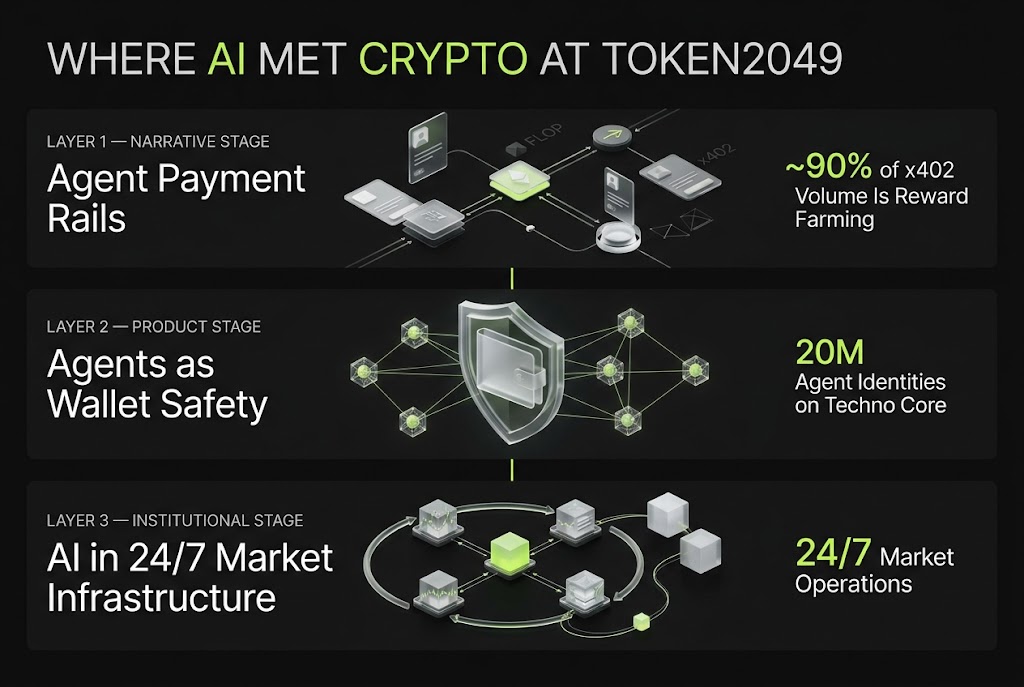
AI appeared at three different depths at TOKEN2049 Singapore 2026, and each layer is at a different stage of maturity.
Institutional Adoption and Regulation
Day 2 shifted focus to Wall Street. The conference's first-ever Institutional track brought 200 to 250 top execs into a closed-door room—including leaders from Goldman, BlackRock, Morgan Stanley, and Solana. With zero public streaming, details remain scarce.
What was said in public is enough to draw two conclusions.
First, the institutional conversation has moved from allocation to operations. Friedman talked about collateral mobility and real-time risk. The "Tokenization: The Next Investment Revolution" panel (Fidelity, Bitwise, BlackRock, Morgan Stanley, ICE) talked about execution layers. The regulation panel (Brian Quintenz, Hyperliquid Policy Center's Jake Chervinsky, VARA, Kraken) was titled "Finding Clarity Across Borders," which is an implementation question, not a permission question.
Second, the regulatory picture is less settled than the stage mood suggested, and Singapore itself provided the counterexample. During conference week, the Financial Times reported that Hyperliquid Labs confirmed Singapore as its registered headquarters while the Monetary Authority of Singapore said it does not regard the platform as falling within its jurisdiction, citing its decentralised design, and that it is not aware of Hyperliquid being regulated in any major jurisdiction.
MAS had already placed Hyperliquid on its Investor Alert List on 26 June 2026. For a venue that ICE's own CEO has described as larger than Nasdaq by trading activity, the absence of a primary regulator is a structural fact that the "clarity" panels did not resolve.
The tension here is real and worth stating plainly: the institutions on stage want rules they can build on, and several speakers openly framed the current US window as something to lock in before it can close. Traders using any venue should separate "where it is based" from "who regulates it," because the Hyperliquid case shows the two can be different.
Trading, Liquidity and Market Infrastructure
For active traders, this was the most consequential cluster, and it is the one where the conference's unofficial theme, "Everything Trades," was most literal.
The pieces fit together as follows:
Tokenized equities with 24/7 access. OKXICE's filing targets 63 NYSE-listed names including Nvidia, Apple, Microsoft and Coinbase, trading around the clock against USDC, USDG or USDT. Nasdaq is separately pursuing 23-hour weekday trading and tokenization of underlying equities rather than derivatives.
Options on perps venues. Yan's HIP-4 comments and Coinbase's Deribit integration both aim at the same thing: one margin account across spot, perpetuals and options.
US perpetuals. Kalshi's session on bringing perps to the US market and Coinbase citing CFTC guidance from May as the basis for connecting US clients to global derivatives liquidity suggest US-regulated perps are closer than they were a year ago.
Put together, the destination is a unified venue where crypto, stocks, commodities and indices share order books and margin, trading at any hour. Several speakers presented this as a roadmap. In practice, parts of it already exist outside the US regulatory perimeter.
What the stage discussions mostly skipped is the risk side of that convergence. Cross-asset margin improves capital efficiency, but it also means a gap in gold or an after-hours move in a single stock can liquidate a position that was opened in Bitcoin. The liquidation cascades earlier this autumn, which came up in side-event commentary during the week, are a reminder that "everything trades" also means "everything can be liquidated together."
This is where product design matters more than venue choice. Platforms like Bitunix are already building toward this unified model. Through Bitunix TradFi and CFDs, traders can settle stocks, commodities, forex, and indices natively in USDT alongside crypto perpetuals—backed by pre-trade guardrails like 'Fixed Risk' that hard-cap position loss upfront.
But across any venue, the underlying friction remains the same: how cross-asset margin is calculated, what happens when one market gaps overnight, and whether downside can actually be locked in before entry rather than calculated after the damage is done.
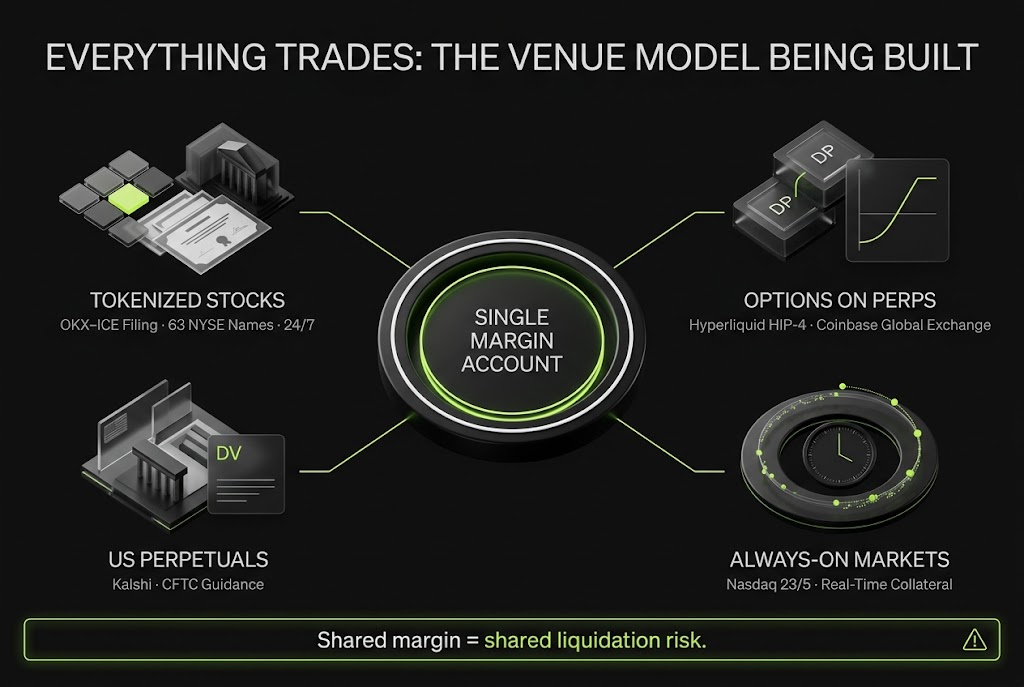
The announcements at TOKEN2049 Singapore 2026 point toward one margin account across crypto, equities and derivatives, trading at any hour.
Bitunix at TOKEN2049 Singapore 2026

The official Bitunix crypto exchange booth setup at TOKEN2049 Singapore, prepared for visitors, partners, and interactive activities.
Bitunix attended as a Gold Sponsor, aligning its floor presence directly with the macro trends discussed on the main stages.
Inside the Bitunix Booth
Located beside the main stage (PB1-24), the Bitunix booth was built around hands-on product experiences via interactive Trading Screen and Ultra Phone setups. Each core offering mapped directly onto a key conference trend:

Visitors exploring the Bitunix interactive Trading Screen and live crypto charts at the TOKEN2049 Singapore booth.
Bitunix TradFi (USDT-settled stocks, ETFs, commodities, and indices with zero spread, 24/7 trading, and up to 200x leverage) provided a live version of the "everything trades" model that OKX, ICE, and Nasdaq framed as the industry roadmap.
Bitunix CFD (commodities, equities, and forex featuring Chart Trading and One-Click execution) addressed the execution-quality challenge: in 24/7 markets, position management must live directly on the charting interface.
Bitunix Card (zero annual/conversion fees, up to 8% cashback, and 11.6% APR on idle funds) represented the consumer-facing side of the stablecoin-payments wave alongside Nium, RedotPay, and Anyflo.
The real value of the booth was practical comparison. Attendees listening to keynotes on tokenized equities or perpetual options could walk over to test how a unified account manages margin across asset classes in real time. Among the event activities, the custom Bitunix keyboard stood out as one of the most sought-after pieces of merch across the conference floor.
Inside The Ultra Talks and Ultra Experience Afterparty
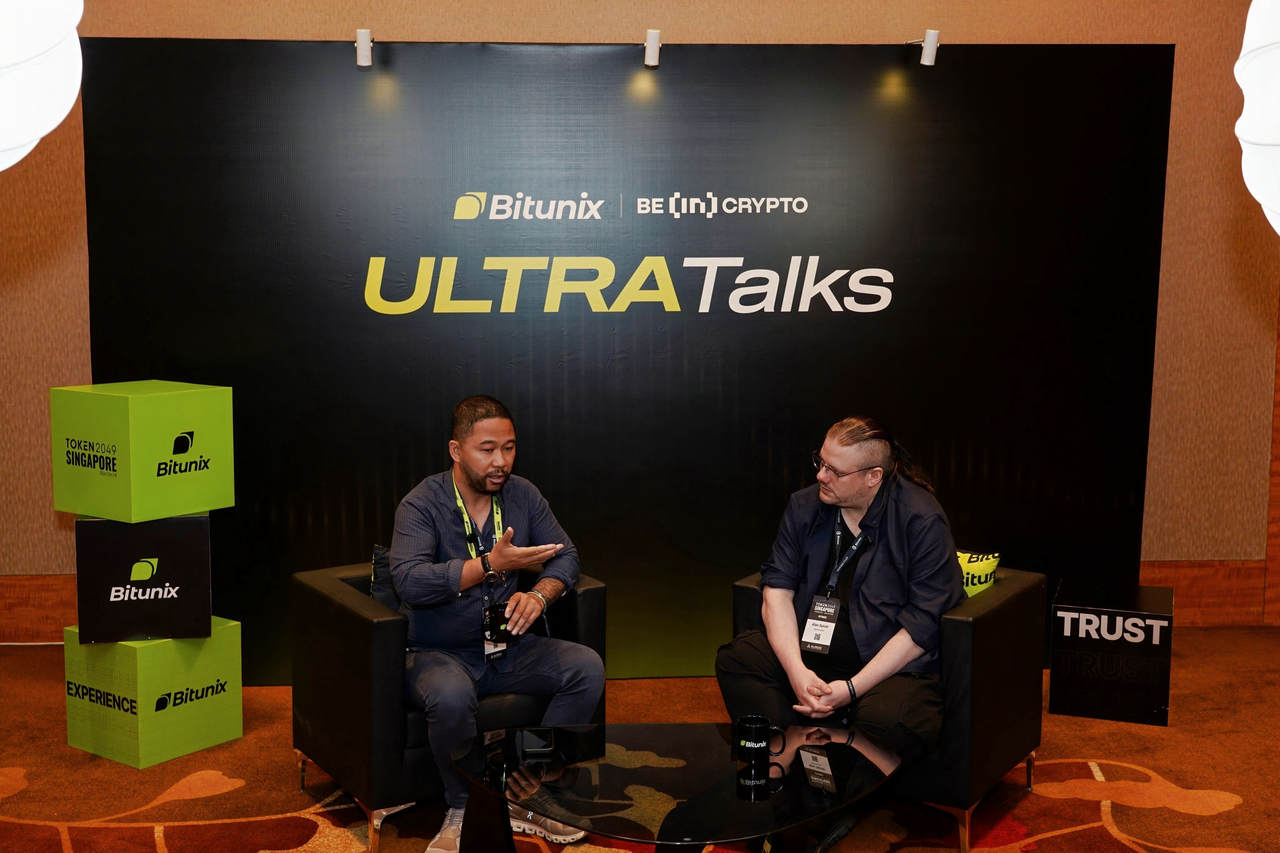
A KOL interview being filmed during the Bitunix and BeInCrypto "ULTRA Talks" event at TOKEN2049 Singapore
In a dedicated room away from the noisy exhibition floor, Bitunix partnered with BeInCrypto to host 21 KOL interviews across October 7–8, featuring trader-educators like Coach Miranda Miner (Global Miranda Miner Group).
This format provided a crucial counterweight to the official agenda. While main-stage programming is largely supply-side — founders, exchanges, and asset managers pitching what they are building — The Ultra Talks captured the demand side: active traders and educators sharing hands-on market insights, trading strategies, and regional perspectives.
The Ultra Experience afterparty followed Day 1 on October 7, providing a dedicated setting to continue the conversations started on the floor.
From Dubai to Singapore: Bitunix's TOKEN2049 Journey
Bitunix's TOKEN2049 presence has changed shape over three editions. In 2025, the company went big as a Platinum Sponsor in both Dubai and Singapore — the latter marking its tenth event sponsorship that year—with messaging anchored entirely on its K-line Ultra charting app.
By 2026, with Dubai pushed to 2027 and Singapore standing as the sole stop, the narrative shifted sharply from charting tools to multi-asset expansion, thrusting TradFi, CFDs, and its payment card into the spotlight for the first time.
That shift tracks the conference itself. TOKEN2049 Singapore 2025 was remembered for prediction markets and a sober, hedging-focused mood on the floor; 2026 was about tokenized equities, options and always-on markets. An exchange's booth is a reasonable proxy for where it thinks the next twelve months of demand will come from, and in Bitunix's case that answer is traditional assets traded with crypto-native tools.
What TOKEN2049 Singapore 2026 Means for Crypto Markets
Conferences rarely move markets on their own—and Bitcoin chopping in the low-to-mid $80,000s all week was proof enough. The real signal isn't immediate price action, but what the event reveals about industry positioning and the key metrics that will validate or bust these theses in the months ahead.
Key Highlights for Traders and Industry Participants
Different participants should take different things from the week:
For Traders: The defining story here is cross-asset convergence. Keep a close eye on perp options liquidity, tokenized equity volumes as venues like OKXICE go live, and how exchanges manage cross-margin when TradFi markets gap while crypto trades 24/7.
Continuous access through venues like Bitunix lets you trade Nvidia earnings or macro gold moves straight from a crypto wallet — but it's a double-edged sword. Trading around the clock makes tight stop-losses and conservative leverage more critical, not less: your position can get liquidated in the dead of night while traditional brokers are fast asleep.
For builders: Qureshi's x402 data point is the most actionable thing said all week. If 90% of agent-payment volume is reward farming, the organic use case has not been found yet, and the first team to find it will not be the one with the best token design.
For investors: Most Day 1 announcements are 2027 stories (FLOP mainnet, TOKEN2049 New York, Dubai's return). The 2026 stories are Day 2's: OKXICE's SEC process, Coinbase Prime options access, and whether Nasdaq's 23x5 trading receives approval in the second half of the year.
For everyone: Three of the most senior people at the event (Rooz, Teng, Johnson) spent their panel discussing how to make progress irreversible before 2028. That is a statement about perceived political risk, and it belongs in any assessment of US-dependent infrastructure.
What to Watch for the Rest of 2026
To separate hype from reality, here are the verifiable milestones, dates, and trigger conditions to track in the coming weeks:
Indicator | Timing | Why it matters |
FLOP testnet and airdrop | Late October 2026 (stated target) | First test of whether the Hayes roadmap holds; 90-day testnet precedes Q1 2027 mainnet |
OKXICE issuer opt-out window | 30 days from the 4 October notice | Determines how many of the 63 NYSE names actually list; SEC response follows |
Coinbase Prime options access | "Coming weeks" after 8 October; Coinbase Pro back by year-end | Measures whether US institutional flow moves into the Deribit book |
Hyperliquid options specification | No date given | Any HIP-4-based product spec would move the onchain derivatives conversation from intent to design |
BitMine treasury disclosures | Ongoing | Holdings vs. the stated 5% cap; the cap only matters if it binds |
Polymarket onchain asset | No date; no ticker | An official statement beyond exploratory comments |
Nasdaq 23x5 trading | H2 2026, subject to regulatory approval | A concrete step toward the always-on markets Friedman described |
Hyperliquid's regulatory status | Open | Whether any major jurisdiction asserts oversight after the MAS comments |
Two of these deserve a note on interpretation. The FLOP testnet is a pass/fail event in the sense that a slip would weaken the roadmap, but a launch on time would prove only that the supply side works; Hayes himself said the demand side is the real challenge. The OKXICE opt-out window is the opposite: a quiet outcome (few issuer objections) would be more significant than a loud one.
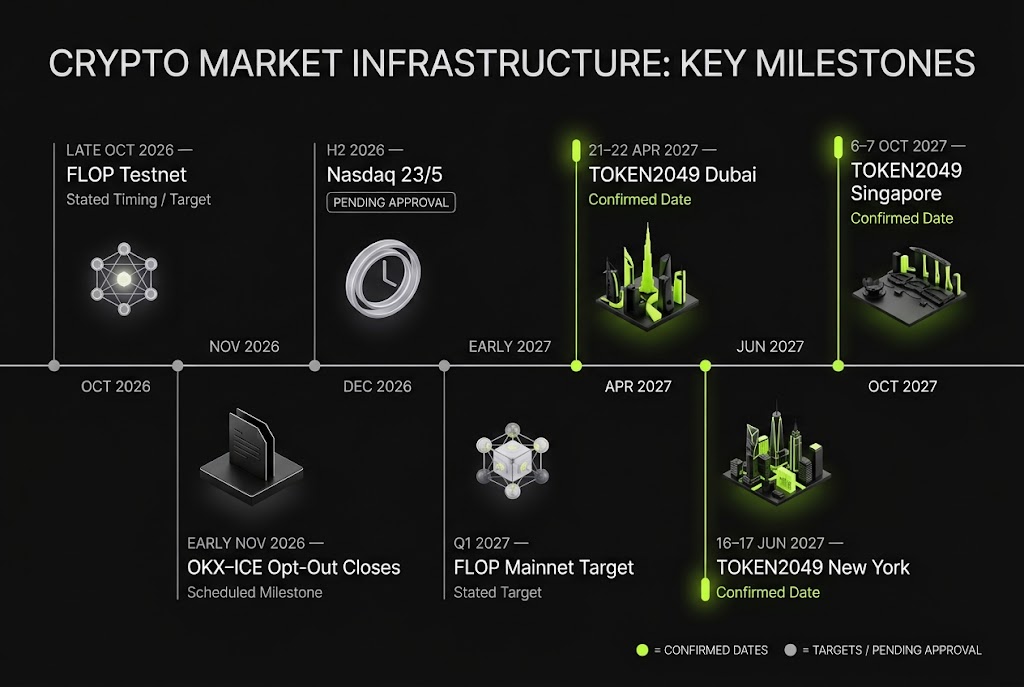
The post-conference checklist: stated targets from TOKEN2049 Singapore 2026 alongside the confirmed 2027 event calendar.
What's Next for TOKEN2049?
Organizers used the Singapore stage to lock in an expanded three-city circuit for 2027:
Dubai: April 21–22
New York: June 16–17
Singapore: October 6–7
Marking the franchise's US debut, the inaugural New York edition is aiming for 15,000 attendees with early tickets starting at $599. Tellingly, organizers dropped the New York announcement right before Eric Trump and Zach Witkoff took the stage—a subtle nod to where crypto's political and institutional center of gravity is shifting.
Two things are worth watching about the expansion itself. New York enters a crowded US conference calendar and will need to build the side-event economy that makes Singapore week useful; whether Asian funds and exchanges travel for it is an open question. Dubai, meanwhile, returns after a one-year gap caused by regional security conditions, with the Dubai Pavilion at this year's Singapore event (DET, VARA, OMNIYAT, Emaar) serving as a placeholder for the ecosystem that could not host in 2026.
For Bitunix, the 2027 calendar means three flagship stops instead of one. The product themes that defined this year's booth, multi-asset trading and crypto-to-fiat payments, are the ones most likely to carry forward, because they are also the ones the wider industry spent two days in Singapore describing as its next phase.
*This article covers TOKEN2049 Singapore 2026 as an industry recap. Speaker statements reflect their own views and commercial interests, and project roadmaps are stated targets rather than delivered products. Nothing here is a recommendation to trade.