Two assets sitting inside crypto's top ten share almost nothing except a correlated price chart. A comparison of Solana vs XRP highlights two very different approaches to blockchain design. Solana focuses on high-speed execution, supporting decentralized applications and on-chain activity, while XRP was built primarily as a settlement network for fast and efficient value transfers.
As of August 16, 2026, XRP traded near $1.00 with a market cap of around $62.4 billion, while SOL traded near $75 with a market cap of approximately $43.9 billion.
That gap tells you far more about supply architecture than about which network is winning.
This comparison strips out the tribal noise and looks at four things that actually move long-term outcomes: how each network is engineered, who is using it and for what, how the tokens are issued, and what kind of trading behavior each one produces. Market data throughout is dated, and where a number is contested, the disagreement is part of the story.
Why Are Solana and XRP Compared in 2026? Key Differences Explained
The pairing looks arbitrary at first, for Solana and XRP were designed a decade apart, target different customers, and compete with almost entirely different sets of rivals.
With the crypto landscape evolving, comparing these once-divergent assets actually reveals some compelling parallels: each cleared the U.S. spot-ETF bar within weeks, competes for the same large-cap altcoin capital, and spent 2026 well off their January 2025 peaks.
When two assets end up competing for the same slot in the same portfolio, the comparison becomes unavoidable — even if the networks themselves never compete for a single transaction.
Two Different Blockchain Visions: Web3 Applications vs Global Payments
Solana was built to be a single, fast, globally synchronized state machine. Its design bet was that if you make one chain fast enough and cheap enough, you don't need layer-2s: order books, lending markets, games, and payment apps can all live on the same ledger and compose with each other atomically. Everything in Solana's architecture — parallel execution, a stake-weighted leader schedule, sub-cent fees — follows from that bet.
The XRP Ledger began from the opposite premise. Launched in 2012, it was engineered as a settlement layer for value transfer, with programmability deliberately constrained. There is no general-purpose smart contract environment on XRPL mainnet by design; instead the protocol ships native primitives — a built-in decentralized exchange, an automated market maker, multi-purpose tokens, credentials, permissioned domains — that behave predictably enough for regulated institutions to underwrite. Settlement lands in three to five seconds at a cost of roughly $0.0002 per transaction, and the ledger has never halted.
The practical difference: Solana asks developers to build the financial system on top of it. XRPL asks financial institutions to plug into it.
Quick Overview: Solana and XRP Market Position in 2026
Before getting into mechanics, it helps to anchor the two assets against current market data. The snapshot below reflects prices and supply figures as of August 16, 2026, drawn from CoinGecko, CoinMarketCap, and exchange market pages.
Metric (as of Aug 16, 2026) | Solana (SOL) | XRP |
Price | ~$75 | ~$1.00 |
Market cap | ~$43.9B | ~$62.4B |
Market cap rank | #7 | #6 |
Circulating supply | ~582.8M SOL | ~62.68B XRP |
Max / total supply | No hard cap (disinflationary issuance) | 100B fixed (~99.99B remaining after burns) |
Fully diluted valuation | ≈ market cap | ~$99.3B |
All-time high | $293.31 (Jan 2025) | $3.65 (Jan 2025) |
Drawdown from ATH | ~74% | ~73% |
Spot ETF launch (U.S.) | Oct 28, 2025 | Nov 14, 2025 |
Cumulative spot ETF net inflows | ~$1.16B | ~$1.43B |
Two valuation metrics from that table deserve closer attention, as they reveal why the market views XRP and SOL differently. First, XRP's larger market cap on a lower unit price is purely a supply-count artifact — 62.7 billion tokens versus 583 million. Second, XRP's fully diluted valuation sits roughly $37 billion above its market cap because a large block of supply is still locked, while SOL's FDV and market cap are effectively the same number.
Key Factors to Compare: Technology, Adoption, Tokenomics, and Market Dynamics
Most head-to-head comparisons stop at transactions per second, which is close to useless as a differentiator now that both networks clear far more capacity than they use. The four dimensions worth real attention:
Technology: not peak throughput, but finality guarantees, client diversity, and failure behavior under stress.
Adoption: where activity is denominated — retail trading volume and app fees versus institutional settlement volume and tokenized assets.
Tokenomics: how new supply enters the market, who controls the timing, and whether network usage actually removes supply.
Market dynamics: what each token responds to, which determines position sizing and hedging behavior far more than the long-term thesis does.
Solana vs XRP Comparison 2026: Technology, Scalability, and Network Design
On paper, Solana and XRP promise the same thing: fast, dirt-cheap transactions. Under the hood, they aren't even playing the same sport.
Both networks solved the same problem — ordering transactions without a central operator — using approaches that share almost no assumptions. Solana leaned on cryptographic timekeeping and raw hardware performance. XRPL leaned on a curated trust graph. The engineering trade-offs from those two starting points explain nearly every behavioral difference between the chains, including the ones that show up in a trader's PnL.
Solana's Proof of History and High-Performance Architecture
Proof of History is often mislabeled as a consensus mechanism. It isn't. PoH is a verifiable delay function — a continuous SHA-256 hash chain that acts as a cryptographic clock, letting validators agree on the order of events without passing messages back and forth about timestamps.
Consensus itself has run on Tower BFT, a stake-weighted voting system layered on top of that clock. Combine the two with parallel transaction execution (Sealevel) and a pre-assigned leader schedule, and you get Solana's core property: one global ledger that processes non-conflicting transactions simultaneously instead of single-file.
Here's the part most 2026 comparisons still get wrong. Alpenglow, Solana's largest protocol change since mainnet launch, replaces both Tower BFT and Proof of History with a two-component design — Votor for voting and Rotor for data propagation.
Alpenglow aims to slash finality from several seconds down to just 100–150 milliseconds, while introducing "20+20" fault tolerance — meaning the network stays secure even if 20% of stake goes rogue and another 20% goes dark. Anza launched the upgrade on testnet in May 2026, targeting a mainnet rollout in Q3, with Q4 as a backup.
Running alongside it is Firedancer, the independent validator client written from scratch by Jump Crypto. Its significance is less about the million-plus TPS it hit in lab conditions and more about client diversity — a single-client network has a single-bug failure mode, which is exactly how several of Solana's historical outages played out. Firedancer's hybrid form, Frankendancer, was running on roughly a quarter of validators by early 2026.
>>> Related Reading: The Story of Solana: From Genesis to 2026
XRP Ledger's Consensus Model and Payment-Focused Infrastructure
XRPL replaces mining and stake-weighted voting with the XRP Ledger Consensus Protocol, built on a deceptively simple idea: a little trust goes a long way. Every server maintains a Unique Node List — a set of validators it trusts not to collude in the same way at the same time.
Servers propose candidate transaction sets, iterate until proposals converge, and a ledger closes once a supermajority above 80% of a server's trusted validators agree. No block rewards, no fee revenue for validators, no economic incentive to reorder transactions for profit.
That design buys three things institutions care about. Finality is deterministic — there is no probabilistic confirmation window to wait out, because each closed ledger contains the entire current state. Fees are negligible and burned rather than paid to a block producer. And the failure mode is a stall, not a fork: if trusted validators can't converge, the ledger stops closing rather than producing conflicting histories. XRPL has never required a coordinated restart.
The cost is programmability. Rather than a general-purpose virtual machine on mainnet, XRPL ships protocol-native features and pushes Solidity workloads to a bridged EVM sidechain (using eXRP as gas, connected via Axelar). Ripple frames this as measured programmability on mainnet plus full flexibility on the sidechain. Critics frame it as an admission that the base layer can't host the applications that generate on-chain economies. Both readings hold up.

Solana vs XRP network architecture compared: Solana's Proof of History and parallel execution pipeline (with the Alpenglow consensus upgrade targeting 100–150ms finality) versus the XRP Ledger's UNL-based consensus and deterministic 3–5 second settlement.
Transaction Speed, Scalability, and Network Efficiency Compared
Raw specifications flatter both chains and separate neither. What separates them is consistency under load and behavior when something breaks. The table below compares live operating characteristics rather than laboratory maximums, with figures current as of Q2–Q3 2026.
Characteristic | Solana | XRP Ledger |
Consensus | PoH + Tower BFT (Alpenglow replacing both; mainnet targeted Q3–Q4 2026) | XRP Ledger Consensus Protocol (UNL, 80%+ supermajority) |
Typical live throughput | ~600–1,900 TPS observed; block capacity raised via compute-unit increases | ~1,500 TPS design capacity; ~2.48M transactions/day average in Q1 2026 |
Finality | Multi-second today; 100–150ms targeted under Alpenglow | 3–5 seconds, deterministic |
Median fee | ~$0.00025 | ~$0.0002 (burned) |
Validator set | ~700–900 active validators; stake-weighted | ~70 validators, 800+ nodes; no stake weighting |
Client diversity | Agave + Firedancer/Frankendancer | Single client (xrpl daemon, formerly rippled) |
Full-network halts | Multiple through Feb 2024; none since | None |
Programmability | Full smart contracts (Rust/Sealevel) | Native primitives on mainnet; EVM via bridged sidechain |
The interesting asymmetry: Solana has more clients but a worse outage record; XRPL has a perfect uptime record on a single client and a validator set an order of magnitude smaller. Each network's strength is the direct inverse of its weakness.
Ecosystem Comparison: Solana DeFi Growth vs XRP Institutional Adoption
Technology sets the ceiling. Adoption determines whether anyone reaches it. And by 2026 the two ecosystems had diverged so far that they're barely measured with the same instruments — Solana's dashboards are built around DEX volume, app fees, and active wallets, while XRPL's are built around settlement volume, tokenized asset value, and licensing milestones.
Solana's Expansion Across DeFi, DePIN, Gaming, and Consumer Applications
Solana's 2026 activity data reads like a chain being used hard while its token price compresses. In February 2026 the network processed roughly $650 billion in adjusted stablecoin transaction volume — the highest monthly figure recorded by any chain that month, per Everstake — while sitting third by stablecoin supply at roughly $13–16 billion. High velocity on a modest deposit base is the defining signature of the chain. DEX volume told the same story: around $117.7 billion in January 2026, roughly 35% of all on-chain trading volume across networks that month.
Then there's the divergence that most price-focused coverage skipped. Dollar-denominated DeFi TVL on Solana fell sharply from its 2025 peak, dropping to roughly $5.5–8 billion during the first half of 2026. But SOL-denominated TVL crossed 80 million SOL in February 2026, an all-time high. Read together, those two series say participants didn't leave — the unit of account shrank around them. That distinction matters when a headline claims capital is fleeing a chain.
The application layer broadened well past trading. Payments and consumer rails picked up genuine enterprise traffic through 2026: PayPal expanding PYUSD-on-Solana for cross-border remittance, Visa and Shopify settlement flows, RedotPay's Solana-branded virtual card, Gusto piloting same-day USDC contractor payouts, and a dedicated stablecoin payments hub launched by the Solana Foundation.
Regulated institutions showed up too — Anchorage adding Solana staking for custody clients, Singapore Gulf Bank using Solana as a settlement rail for USD-to-USDC conversion, and OCBC's tokenized gold fund launching on the chain. Agent-driven payments, DePIN settlement, and tokenized equities added further transaction categories that don't depend on speculative trading.
XRP's Role in Cross-Border Payments and Enterprise Financial Solutions
XRP's adoption story is measured in licenses and corridors rather than app downloads, and 2026 was a heavy year for both. Ripple Payments now reports more than $100 billion in cumulative volume, coverage across 60-plus markets, connections to 51 real-time payment rails, and 20-plus banking partners.
On the regulatory side, Ripple secured full MiCA Crypto Asset Service Provider authorization from Luxembourg's CSSF in July 2026 following a preliminary green light in June — putting it among roughly 210 MiCA-compliant firms at a point when the large majority of EU crypto firms had not yet cleared the bar. Add a UK EMI licence and cryptoasset registration in January 2026, a conditionally approved U.S. national trust bank charter, and 75-plus licences globally.

Source: X(@Ripple)
The commercial pipeline through H1 2026 was dense: core banking integration with DXC Technology, the launch of Ripple Treasury for institutional liquidity management, a Convera partnership for business cross-border payments, a tokenized government bond settlement pilot with Kyobo Life Insurance in South Korea, custody infrastructure with Kbank, RLUSD's regulated launch in Japan through SBI VC Trade, a Flutterwave integration for Sub-Saharan African remittances, and Mastercard and JPMorgan tie-ups announced in July 2026.
On-ledger metrics moved in the same direction. Messari's State of XRP for Q1 2026 recorded average daily transactions rising 35.3% quarter-over-quarter to 2.48 million, and real-world asset market cap on XRPL climbing 124.1% to $2.25 billion. The XRPL lending protocol (XLS-65/66) entered validator voting in early 2026, bringing native fixed-term credit, single-asset vaults, and offchain underwriting into a settlement layer that previously had none.
There is a caveat that serious XRP analysis cannot skip: Ripple's wins and XRP's demand are not the same variable. A MiCA licence expands a regulated payments business. It creates token demand only if the volume that follows actually routes through XRP as a bridge asset rather than around it via RLUSD or direct fiat rails. Through 2026, several major Ripple announcements were followed by XRP price declines — a pattern that only makes sense once you separate corporate progress from token throughput.
Different Adoption Paths: Retail Liquidity vs Institutional Utility
The clearest way to see the divergence is to put the two adoption profiles against each other on comparable lines. The figures below cover Q1–Q3 2026.
Adoption dimension | Solana | XRP / XRPL |
Primary activity driver | DEX trading, stablecoin transfers, consumer apps | Cross-border settlement, tokenized assets, stablecoin corridors |
Headline volume metric | ~$650B monthly stablecoin volume (Feb 2026); ~$117.7B monthly DEX volume (Jan 2026) | $100B+ cumulative Ripple Payments volume; $100B+ processed via stablecoin infrastructure (Mar 2026) |
On-chain transactions | 100M+ daily (including vote transactions) | ~2.48M daily average (Q1 2026) |
Tokenized RWA value | Growing across credit, equities, gold funds | $2.25B, +124.1% QoQ (Q1 2026) |
Developer base | 17,708 active developers (Electric Capital 2025); weekly active down ~40% in early 2026 | Smaller native base; EVM sidechain used to widen the funnel |
Institutional access route | Spot ETFs, staking products, corporate treasuries | Spot ETFs, Ripple's licensed payment and custody stack |
Distribution of holders | Retail-heavy trading, ~50% institutional share of ETF assets | ~16% institutional share of ETF assets |
The asset with the institutional narrative has the more retail ETF shareholder base; the asset with the retail trading reputation has the more institutional one. The likely explanation is structural — XRP funds cannot pay a yield because XRPL has no staking, while Solana funds can pass through staking rewards, which is exactly the kind of feature that gets an allocation past an investment committee.
Solana vs XRP Tokenomics: Supply, Utility, and Market Dynamics
Tokenomics is where the two assets stop being different technologies and become genuinely different instruments. One has algorithmic issuance that governance can amend; the other has a fixed cap with a release schedule set inside a corporate treasury. Neither is strictly better, but they produce different sell-pressure patterns, and traders who ignore that end up mispricing the same headline twice.
SOL Supply Model, Inflation Mechanism, and Network Utility
SOL has no hard cap. Instead it runs a disinflationary schedule: issuance started at 8% annually and decays roughly 15% each year toward a 1.5% terminal floor. As of June 2026 the effective inflation rate was 3.82%.
New SOL pays validators and stakers, with roughly 432.65 million SOL staked as of August 2026 and staking yields in the mid-single digits. Transaction fees partially offset issuance through burns, but that offset has historically been small relative to emissions — low single-digit percentages of total staking rewards.
That gap is why Solana's monetary policy became an active governance fight rather than a settled parameter. SIMD-0228, a market-based emissions model backed by Multicoin Capital, failed a validator vote in March 2025. A follow-up, SIMD-0411, closed for inactivity in January 2026.
The current attempt, SIMD-0550, proposes doubling the disinflation rate — a change its own projections show cutting first-year staking yields from about 4.93% to 4.34%, then to roughly 3.00% in year two and 2.25% in year three at 68% staking participation. By mid-August 2026 the proposal had gathered support from roughly 25 million SOL, about 5.8% of staked supply, against a 15% signalling threshold, with a stake-weighted vote requiring a two-thirds supermajority if it clears.
The mechanism worth understanding: SOL is a fee-and-security asset. Every transaction on the chain — every stablecoin transfer, every DEX swap, every DePIN settlement — requires SOL for fees and priority tips, and validators must hold and stake it to operate. Usage creates a continuous structural bid. Issuance creates a continuous structural offer. Which one dominates is the whole argument.
XRP Supply Structure, Escrow System, and Liquidity Role
XRP's supply was created in full at launch: 100 billion tokens, no issuance, ever. Fees are burned rather than redistributed, which makes the supply mildly deflationary — though only mildly, with roughly 14 million XRP destroyed since 2012, a rounding error at this scale.
The structure that actually governs XRP's float is the escrow. In December 2017 Ripple locked 55 billion XRP into a series of on-ledger escrow contracts, each releasing up to 1 billion XRP at the start of a month, with unused amounts automatically re-locked into new contracts further out on the queue.
The schedule is enforced by ledger consensus, not by a corporate decision — nobody presses a button. As of mid-2026, roughly 38.15 billion XRP remained escrowed against roughly 61.9–62.7 billion in circulation, and Ripple's combined escrowed plus operational holdings amount to just over 39% of total supply.
Here's the nuance the monthly "Ripple unlocks $1 billion" headlines consistently flatten: Ripple historically re-escrows somewhere between 60% and 80% of each release, leaving roughly 200–400 million XRP available for operations, liquidity, and partnerships per month.
At that net rate, escrow depletion sits close to a decade out — though Ripple's own chief technology officer has argued no date can be pinned down, since the re-lock ratio depends on operational needs nobody can forecast that far ahead.
The recurring criticism is structural rather than technical. XRP is the only major crypto asset whose effective monthly supply expansion is decided in a company's treasury meeting. The schedule is transparent, capped, and verifiable on-ledger — and it is still one firm's judgment call, which leaves holders downstream of that firm's funding needs.
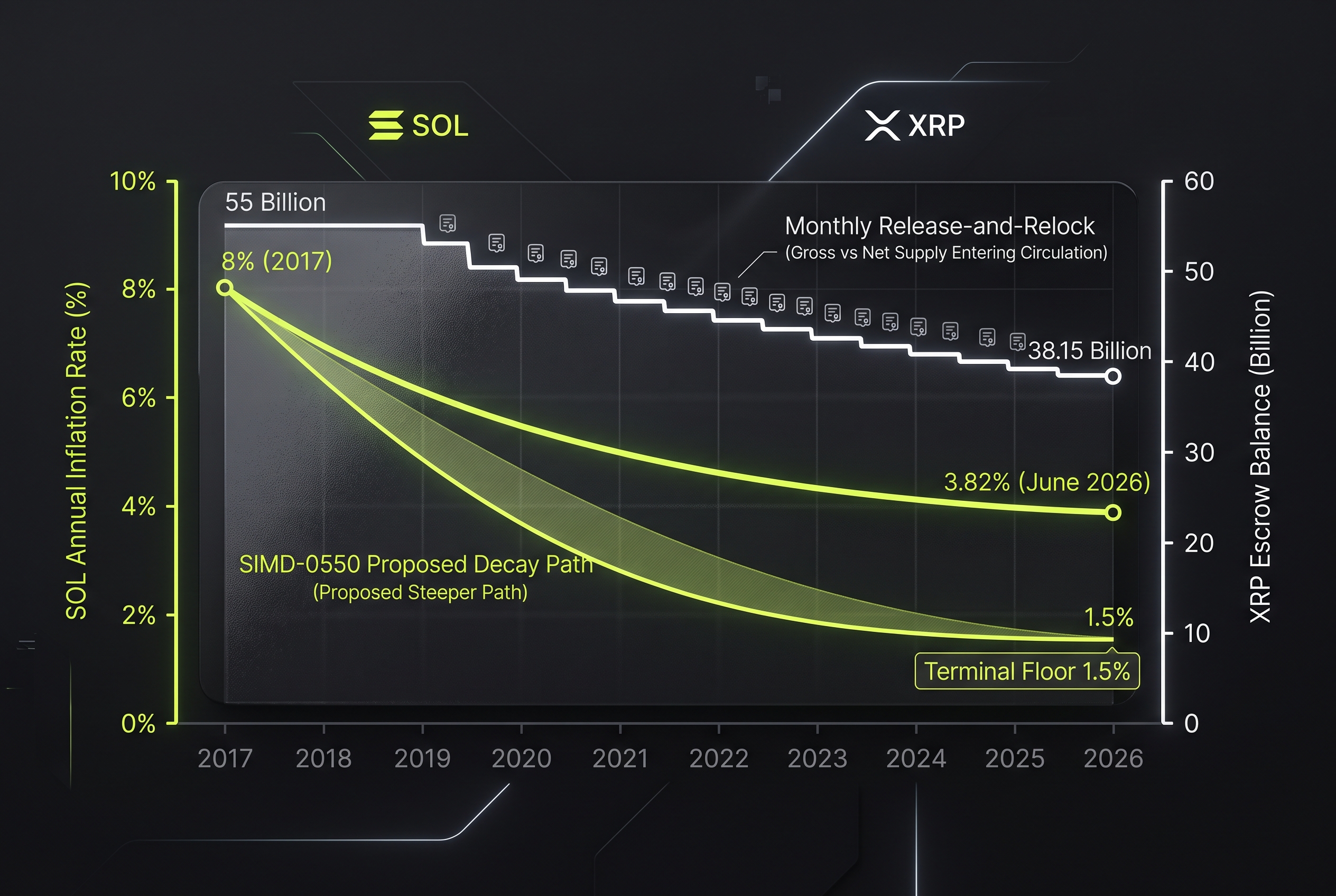
Solana vs XRP tokenomics compared: SOL's disinflationary issuance falling to 3.82% by June 2026 against XRP's escrow drawdown from 55 billion to roughly 38.15 billion tokens, where 60–80% of each monthly release is typically re-locked.
How Tokenomics Can Influence Long-Term Market Position
Three consequences follow, and each one is testable rather than theoretical.
Valuation optics differ permanently. XRP's fully diluted valuation sits near $99.3 billion against a $62.4 billion market cap, so anyone modelling on FDV sees a materially more expensive asset than someone modelling on circulating supply. SOL's two figures are effectively identical. Comparing the two on the wrong basis produces a 60% error before you've made a single assumption about adoption.
Supply pressure arrives on different clocks. SOL's dilution is continuous, predictable, and mechanically tied to staking participation. XRP's arrives in discrete monthly events whose net size depends on a corporate re-lock decision. Continuous pressure gets priced into the trend; discrete pressure creates recurring, dateable sentiment events on the first of each month.
Governance is a live variable for one asset and not the other. SOL holders face genuine monetary-policy risk in both directions — SIMD-0550 could tighten emissions materially, or fail like its two predecessors. XRP holders face no equivalent vote, because there is nothing to issue. What they face instead is counterparty concentration.
Growth Potential and Risks: What Could Drive SOL and XRP Performance?
Despite stronger fundamentals, both tokens spent 2026 stuck well below their January 2025 peaks. That disconnect between usage and price was the defining story of the year. Whether the gap closes comes down to one thing: separating real token value accrual from general business hype.
Solana Growth Drivers: Developer Activity, Ecosystem Expansion, and Market Liquidity
The bull case rests on three compounding inputs.
First, the infrastructure step-change: Alpenglow's sub-second finality and full Firedancer deployment would put Solana's latency profile in range of centralized matching engines, which matters enormously for on-chain order books, perpetuals venues, and any latency-sensitive application.
Second, payments and stablecoin throughput, where Solana's roughly 35% share of global on-chain stablecoin transfers by transaction count gives it a genuine, non-speculative fee base.
Third, the tokenomics vote — a successful SIMD-0550 would cut future emissions meaningfully, and supply-side changes tend to be re-rated faster than demand-side ones.
The narrative around Solana's developer headcount depends entirely on which metric you look at. Electric Capital ranks Solana second only to Ethereum with over 17,000 active developers, and the Foundation claimed a peak of 10,000+ unique builders in March 2026.
Yet Artemis data shows weekly active developers plunged 40% to just 942 early this year — a stark reminder of how fast talent migrated into AI. A large cumulative base with thinning weekly commits describes an ecosystem consolidating around experienced teams, not one expanding.
XRP Growth Drivers: Regulatory Progress, Partnerships, and Payment Adoption
XRP's near-term fate hangs heavily on Capitol Hill. All eyes are now on the CLARITY Act's first Senate floor vote on September 15, 2026 — a high-stakes procedural test set in motion by an August cloture filing after the bill missed its pre-recess window. Standard Chartered has projected $4–8 billion in cumulative XRP ETF inflows should the bill become law — several times the roughly $1.43 billion absorbed since launch.
Beyond legislation, the growth levers are RLUSD adoption (which deepens XRPL corridors and, via autobridging on the native DEX, can force XRP into cross-asset paths), the lending protocol's activation, the tokenized RWA base compounding off $2.25 billion, and the national trust bank charter converting into operational reality.
The honest counterweight is that ETF demand has been decaying, not building. Monthly XRP ETF inflows fell to $59.46 million in June 2026, $27.29 million in July, and roughly $1.01 million in the first half of August. Standard Chartered cut its 2026 XRP price target from $8 to $2.80 as those flows dried up. And the absence of staking on XRPL means no XRP fund can offer a yield, which structurally limits the buyer set relative to SOL products.
This is precisely the environment where directional conviction gets expensive. When an asset's next leg depends on a single dated catalyst — a September 15 procedural vote, a validator threshold, a mainnet activation — traders commonly express the view through spot or perpetual contracts on venues like Bitunix while keeping a hard stop-loss on any leveraged leg, since a stalled vote and a passed vote produce moves of similar magnitude in opposite directions.
Key Risks to Monitor: Network Reliability, Competition, and Adoption Challenges
Reliability remains Solana's most-cited vulnerability, and August 2026 gave the debate fresh material on both sides. The network reached 30 consecutive months without a full-cluster halt — roughly 913 days since the February 6, 2024 outage, with the official status page showing 100% uptime through June, July, and August.
Days later, on August 13, 2026, a routing fault at a single data center knocked 102 of 699 validators offline. The chain kept producing blocks, which is exactly what years of resilience work was meant to achieve. But the affected autonomous system carried over 25% of all staked SOL, and Solana needs roughly two-thirds of voting stake online to finalize normally.
The Foundation had already imposed delegation limits in May 2026 capping any single ASN or hosting provider at 25% of stake and total data-center concentration below 15%; the incident demonstrated why. Correlated infrastructure risk, not validator count, is the live decentralization question — the Nakamoto coefficient has drifted from 31 to around 20.
XRP's risks are structural rather than operational. Supply concentration in a single corporate entity is a permanent overhang. Token demand depends on payment volume choosing XRP as a bridge asset, which competes directly against stablecoin rails — including Ripple's own RLUSD — that settle without touching XRP at all. Regulatory progress cuts both ways: clearer rules help the company, but they also lower the barrier for banks to run tokenized deposits on infrastructure they control themselves.
Both assets share two exposures. Broad market beta dominates short-term returns — total crypto market cap sat near $2.24 trillion in mid-August 2026 with Bitcoin dominance around 57%, and neither SOL nor XRP has decoupled from that.
Meanwhile, both are being squeezed on their home turf. Solana is fending off Ethereum L2s and rival high-speed L1s for developer mindshare, while XRPL faces growing pressure from SWIFT's digital upgrades and the rise of bank-led stablecoins.
XRP vs Solana 2030 Forecast: Long-Term Outlook and Future Use Cases
Any XRP vs Solana 2030 forecast built on a single price number is a marketing exercise, not analysis. What can be modelled with some rigor is the shape of demand each network needs for its token to matter in five years — and those two shapes are almost unrelated, which is why the same macro backdrop can produce very different outcomes for each.
Solana's Potential Role in Future Web3 Infrastructure
The credible long-term case has Solana operating as general-purpose financial infrastructure: on-chain order books with latency competitive against centralized venues, stablecoin payment rails processing consumer and B2B volume at scale, tokenized equities and funds trading continuously, and machine-to-machine payments settling autonomously. Several of those are already running in early form — agent payment protocols, tokenized gold funds, live merchant settlement.
Market-cap framing beats price framing here. SOL trades at roughly 22% of Ethereum's market cap in 2026; the recurring bull argument is that a mature Solana could hold 25–30%. Whether that translates into a large per-token number depends entirely on what total on-chain market value looks like by 2030 — which is an assumption about the whole asset class, not about Solana.
The Solana-specific variables are narrower: does Alpenglow ship and hold under real load, does client diversity eliminate the correlated-failure mode, and does the fee base grow faster than issuance dilutes holders.
XRP's Potential Role in Global Settlement and Institutional Finance
The XRP case is easier to state and harder to verify. If tokenized settlement replaces a meaningful share of correspondent banking, and if XRP functions as the bridge asset inside those flows, the token captures value from volume it never had to originate. Ripple's own framing has referenced capturing a share of SWIFT-scale volume, and utility-based models built on that assumption produce large numbers.
The chain of conditions is where the scrutiny belongs. Tokenized settlement growing is likely. It routing through XRPL is plausible given the licensing footprint. It routing through XRP specifically is the contested link — because stablecoins can settle the same corridors, and the same institutions adopting XRPL are simultaneously exploring tokenized deposits on their own infrastructure.
XRPL's native autobridging does force XRP into cross-asset paths when direct liquidity is thin, which is a real structural mechanism. Whether it scales proportionally with corridor volume is the open question, and 2026's pattern of announcements landing without token appreciation is the market's current answer.
Factors That Could Shape Long-Term Network Growth
The variables that would move either asset over a multi-year horizon reduce to five, and they're worth watching as a scorecard rather than a forecast:
U.S. market-structure law. CLARITY Act passage or failure resets institutional access for both assets simultaneously.
Whether fee revenue outgrows issuance. For SOL, the emissions-versus-fees crossover is the entire long-term value question. For XRP, there is no issuance — but also no fee accrual to holders.
Where stablecoins settle. Both networks are competing for the same stablecoin flow. Solana currently wins on velocity; XRPL is building on compliance tooling.
Infrastructure concentration. Solana's data-center clustering and XRPL's small validator set are two versions of the same fragility.
Institutional product design. Yield-bearing SOL products versus non-yield XRP products will keep shaping relative flows regardless of narrative.
Solana and XRP Trading Strategies: Different Profiles for Market Participants
Long-term theses inform position sizing. They do not inform execution. As trading instruments, SOL and XRP behave differently enough that treating them interchangeably in a book is a straightforward way to get the risk wrong — different volatility, different catalyst calendars, different liquidity depth, and very different reactions to the same headline.
SOL Trading Profile: Higher Volatility and Ecosystem-Driven Market Cycles
SOL trades as a high-beta expression of on-chain activity. Its drivers are endogenous: DEX volume, app revenue cycles, upgrade milestones, ETF flow data, staking-yield changes. That produces sharper realized volatility than XRP in both directions and tighter correlation to overall risk appetite — the reason SOL sold off roughly 74% from its January 2025 high while its usage metrics were setting records.
Two practical implications. Upgrade dates are tradeable events with observable positioning — Solana ETFs recorded their largest single-day haul of $26.57 million on May 11, 2026, the same day Alpenglow hit community testnet. And SOL's deep perpetual liquidity makes it a common hedging instrument for broader altcoin exposure, not only a directional position.
XRP Trading Profile: Institutional Narratives and Market Sentiment
XRP's volatility is more episodic. It ranges quietly for extended stretches, then repositions violently around exogenous events — regulatory rulings, legislative votes, ETF approvals, major partnership announcements. In August 2026 the token spent weeks defending the $1.00 level with open interest building ahead of a U.S. CPI print, a fairly typical structure: derivatives positioning concentrating around a dated macro catalyst rather than a network development.
The behavioral quirk that defines XRP in 2026 is a textbook "sell the news" pattern. Ripple's deal and licence announcements repeatedly coincided with price declines, because the market has learned to distinguish corporate progress from token throughput.
For anyone holding spot XRP into a known catalyst — a Swell conference, a licensing decision, a September 15 procedural vote — this creates a specific problem: the event can be positive for the company and negative for the token.
Long-term holders often address it without liquidating spot, opening a proportionate perpetual short on a venue like Bitunix to hedge the position through the event window and lock in book value, then closing the hedge once the reaction has played out.
>>> Related Reading: Is XRP Dead? Why the Price Stalled While the Network Kept Running
Choosing Trading Approaches Based on Market Conditions and Risk Preferences
Neither profile is superior; they suit different books and different risk tolerances. The comparison below summarizes how each asset tends to behave, based on 2026 market structure.
Trading consideration | SOL | XRP |
Volatility character | Higher realized vol; trends with on-chain activity | Range-bound stretches punctuated by event gaps |
Primary catalysts | Protocol upgrades, DEX/app revenue, ETF flows, emissions votes | Legislation, licensing, ETF flows, partnership news |
Catalyst calendar | Semi-predictable (testnet → mainnet milestones, SIMD votes) | Binary and externally scheduled (votes, rulings) |
Correlation profile | High beta to broad crypto risk appetite | High beta with idiosyncratic regulatory spikes |
Common failure mode | Over-sizing into upgrade hype | Buying the announcement, holding through the fade |
Yield component | Staking rewards available (mid-single digits) | None — no native staking |
Matching Execution Venue and Risk Tools to Each Asset's Volatility Profile
Execution quality is where these two profiles stop being an academic distinction. An event-gap asset like XRP punishes thin order books — a stop placed inside a shallow book during a legislative headline fills at a materially worse level than the trigger price, and slippage on exit can exceed the loss the stop was meant to cap.
A high-beta asset like SOL punishes position sizing more than it punishes entries, because a 74% drawdown from a cycle high liquidates a poorly sized leveraged position long before the thesis has a chance to be right or wrong.
Three execution details do most of the work for both:
Depth and spreads on the specific pair, not the venue's headline volume. SOL-USDT and XRP-USDT depth behave differently during macro prints, and the difference shows up as slippage. Bitunix's positioning on market depth and tight spreads is aimed at exactly that gap between trigger price and fill price.
Predefined maximum loss on any leveraged leg. Tools that let a trader lock a maximum loss before entry — such as Bitunix's Fixed Risk — convert an open-ended leveraged exposure into a bounded one, which is the practical difference between a bad trade and a liquidated account. No tool removes market risk.
Super Alert triggers paired with chart management. Both assets frequently break out between screen checks. Bitunix's Super Alert tracks trendlines, indicators, and custom drawing overlays to deliver instant multi-channel notifications, letting traders jump straight to the live chart and adjust targets directly on price action without fumbling through order forms.
None of this is a substitute for sizing. Leverage magnifies losses as readily as gains, and both SOL and XRP have produced multi-day moves large enough to close a highly leveraged position regardless of how well the underlying thesis eventually holds up.
Solana vs XRP: What the Comparison Actually Resolves
Run the full comparison of Solana vs XRP and the honest conclusion is that these two assets answer different questions rather than competing for the same answer.
Solana is a bet that general-purpose on-chain finance grows large enough that a single fast execution layer captures durable fee revenue — a bet whose main risks are dilution, correlated infrastructure failure, and platform competition.
XRP is a bet that institutional settlement migrates onto public infrastructure and routes through a bridge asset rather than around it — a bet whose main risks are supply concentration and substitution by stablecoins.
As of August 2026, both assets sit roughly 73–74% below their January 2025 peaks while their underlying networks post record usage figures. That gap between activity and price is the actual subject of the debate. Whether it closes depends on things that are trackable: whether Alpenglow ships and holds, whether SIMD-0550 clears its threshold, whether the CLARITY Act survives its September 15 procedural vote, and whether payment volume on XRPL flows through XRP or past it.
Note: Market data cited throughout is current as of August 16–17, 2026 and changes rapidly. Always conduct your own research and never risk capital you cannot afford to lose.