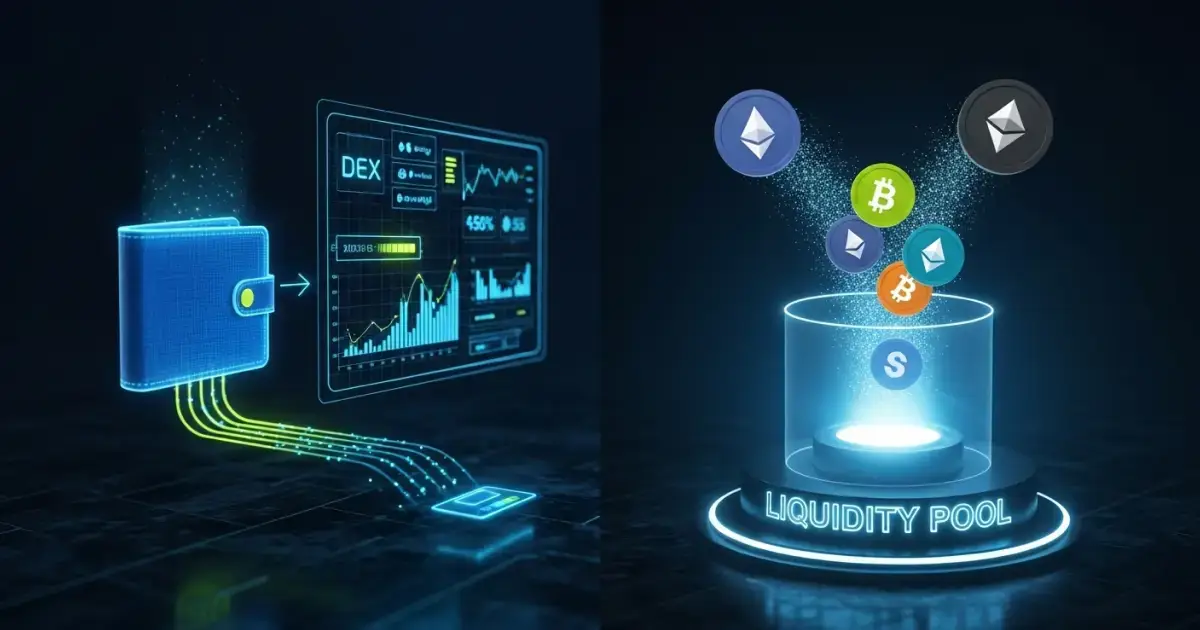
Decentralized finance reimagined how markets work. Instead of matching buyers and sellers through a central order book, many decentralized exchanges rely on liquidity pools that quote prices automatically. This choice did not happen by accident. It solved a set of problems that on-chain order books struggled with, such as thin liquidity, high gas cost, and the need for ultra fast matching engines.
This guide explains order books vs liquidity pools with plain language and detailed examples. You will learn how order book trading sets prices, how automated market makers quote trades from a pool, why DeFi liquidity models favor pools, and when an order book still makes sense. [ez-toc]What Is an Order Book
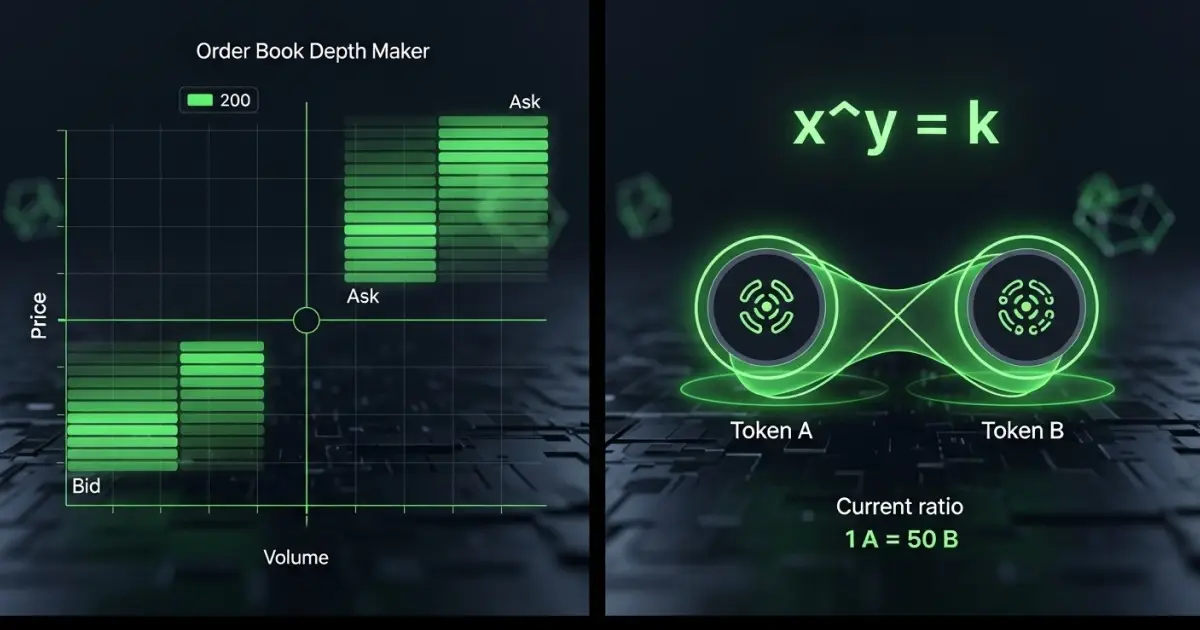
 An order book is a list of buy and sell orders for a particular asset. Each order specifies a price and a quantity. The order book displays these buy and sell orders, facilitating trading activities by matching buyers and sellers for the asset. The best bid is the highest price someone will pay. The best ask is the lowest price someone will sell. The difference between them is the spread. When a new order arrives, a matching engine compares it to the current book. If there is a compatible order on the other side, the engine executes a trade and removes or updates the filled orders.
Characteristics of order book trading:
An order book is a list of buy and sell orders for a particular asset. Each order specifies a price and a quantity. The order book displays these buy and sell orders, facilitating trading activities by matching buyers and sellers for the asset. The best bid is the highest price someone will pay. The best ask is the lowest price someone will sell. The difference between them is the spread. When a new order arrives, a matching engine compares it to the current book. If there is a compatible order on the other side, the engine executes a trade and removes or updates the filled orders.
Characteristics of order book trading:
- Price discovery is continuous: The book shows the market’s view of a fair price through bids and asks at many levels.
- Depth and spread matter: Tight spreads and large depth reduce trading costs. Thin books cause slippage when a market order eats through several levels.
- Market makers are essential: Specialists place limit orders on both sides to keep spreads tight and collect the spread and rebates.
- Speed is central: Modern centralized exchanges process thousands of updates per second. Fast connectivity and co-location are typical in professional environments. Professional traders rely on this speed for executing complex trading activities efficiently.
What Is a Liquidity Pool
 A liquidity pool is a smart contract that holds reserves of two tokens and quotes a price based on an algorithm. This is how liquidity pools work: users provide liquidity by depositing assets into the pool, and the assets deposited are then used to facilitate trades between other users. Anyone can deposit equal values of the two tokens into the pool and become a liquidity provider. In return, they receive a share of trading fees and are also issued LP tokens representing their share of the assets deposited. The pool does not need to search for a counterparty. It is the counterparty.
Why this matters on-chain:
A liquidity pool is a smart contract that holds reserves of two tokens and quotes a price based on an algorithm. This is how liquidity pools work: users provide liquidity by depositing assets into the pool, and the assets deposited are then used to facilitate trades between other users. Anyone can deposit equal values of the two tokens into the pool and become a liquidity provider. In return, they receive a share of trading fees and are also issued LP tokens representing their share of the assets deposited. The pool does not need to search for a counterparty. It is the counterparty.
Why this matters on-chain:
- You do not need a central order book or a custodian to rest orders.
- Fees for posting, canceling, and reshuffling orders are avoided.
- Transactions settle atomically in a single blockchain transaction, which fits the block by block nature of public chains.
Automated Market Makers in Action
 The automated market maker or AMM, also known as automated market makers (AMMs), is the algorithm that a pool uses to quote prices and facilitate trades. AMMs automatically set the exchange rate for token swaps based on the current reserves in the liquidity pool, eliminating the need for traditional order books. This mechanism enables efficient and continuous trading by allowing users to swap tokens directly with the pool.
In section 3.1, AMMs do not require matching buyers and sellers, which allows for seamless token swaps at any time, regardless of market participant activity.
The automated market maker or AMM, also known as automated market makers (AMMs), is the algorithm that a pool uses to quote prices and facilitate trades. AMMs automatically set the exchange rate for token swaps based on the current reserves in the liquidity pool, eliminating the need for traditional order books. This mechanism enables efficient and continuous trading by allowing users to swap tokens directly with the pool.
In section 3.1, AMMs do not require matching buyers and sellers, which allows for seamless token swaps at any time, regardless of market participant activity.
Constant Product Market Maker
 The first popular design used the rule x · y = k, where x and y are the token reserves and k is constant. If a trader buys token X, the pool’s X reserve decreases and the price rises because the product must remain constant. The more you buy in one transaction, the higher the price you pay. This is price impact. The fee that the trader pays stays in the pool and compensates liquidity providers.
Properties:
The first popular design used the rule x · y = k, where x and y are the token reserves and k is constant. If a trader buys token X, the pool’s X reserve decreases and the price rises because the product must remain constant. The more you buy in one transaction, the higher the price you pay. This is price impact. The fee that the trader pays stays in the pool and compensates liquidity providers.
Properties:
- Simple and trustless
- Works for any token pair
- Price impact rises smoothly with trade size
- Capital inefficient when prices stay in a narrow band
Stableswap Curves
 Stablecoin pairs or assets that track each other, such as USDC and DAI, benefit from a different curve. A stableswap AMM keeps the price near one while still allowing large trades with very low slippage. It does this by blending a constant sum region around the peg with a constant product region away from the peg.
Properties:
Stablecoin pairs or assets that track each other, such as USDC and DAI, benefit from a different curve. A stableswap AMM keeps the price near one while still allowing large trades with very low slippage. It does this by blending a constant sum region around the peg with a constant product region away from the peg.
Properties:
- Low slippage near the target ratio
- Efficient for assets that should trade at parity
- Less suitable for volatile pairs
Concentrated Liquidity
 Uniswap V3 introduced concentrated liquidity. Liquidity providers choose specific price ranges where their funds are active, concentrating their assets within those intervals. Inside the selected range, trades use only the liquidity allocated there. This increases capital efficiency because funds are not spread across prices that rarely occur. If the market price leaves your range, your position stops earning fees until you rebalance.
Properties:
Uniswap V3 introduced concentrated liquidity. Liquidity providers choose specific price ranges where their funds are active, concentrating their assets within those intervals. Inside the selected range, trades use only the liquidity allocated there. This increases capital efficiency because funds are not spread across prices that rarely occur. If the market price leaves your range, your position stops earning fees until you rebalance.
Properties:
- High fee capture per dollar of liquidity in active ranges
- Requires management or automation
- Makes pools function more like a grid of tiny order books
Order Books vs. Liquidity Pools at a Glance
| Feature | Order Book Trading | Liquidity Pools Explained |
| Counterparty | Another trader’s order | The pool itself |
| Price formation | Bids and asks placed by traders and market makers | Algorithmic pricing from reserves and an AMM curve |
| Capital source | Market makers and resting orders | Liquidity providers deposit funds |
| Settlement | Matching engine, often off-chain, finalizes then updates balances | Single on-chain transaction updates pool and balances |
| Trading pairs | Supports a wide range of trading pairs, typically curated for liquidity and market demand | Enables a variety of trading pairs, including long-tail or permissionless pairs, often without centralized approval |
| Best for | Mature markets with deep liquidity, complex order types, derivatives | On-chain spot swaps, long tail tokens, permissionless market making |
| Main costs | Spread, taker fees, maker fees, funding for leverage | Price impact, swap fee, gas, impermanent loss for LPs |
| Primary risks | Custody on a centralized exchange, order book spoofing, exchange downtime | Smart contract risk, MEV, impermanent loss, oracle issues for hybrids |
Why DeFi Uses Liquidity Pools
 Blockchains do not handle millions of order updates per second. Each update costs gas, and every cancel or refresh is a transaction. Early attempts at on-chain order books suffered from massive overhead, poor user experience, and thin books. Liquidity pools solved these issues in several ways. Decentralized exchanges (DEXs) and DeFi platforms use liquidity pools as a core mechanism to facilitate trading and liquidity provision. Decentralized finance (DeFi) and the broader DeFi ecosystem rely on these innovations to enable decentralized trading, allowing users to trade directly from their wallets without intermediaries.
Permissionless market making
Anyone can become a liquidity provider by depositing assets. This crowdsources market making and avoids the need to recruit professional firms.Atomic settlement
A swap happens in one transaction. There is no risk of orders resting in the book without being matched.Composability
Pools are smart contracts that other contracts can integrate with. Lending protocols, yield vaults, and aggregators all plug into AMMs. This is core to the DeFi design philosophy.Simplicity
An AMM requires only token transfers and math on reserves. The chain handles ordering. There is no separate matching engine to operate.Resilience
Because liquidity and pricing live on-chain, as long as the network is live, the market can operate.Growth and accessibility of the crypto market
Liquidity pools are fundamental to the growth and accessibility of the crypto market, allowing users to participate in decentralized finance (DeFi) without intermediaries and supporting the ongoing innovation of the DeFi ecosystem. These advantages explain why DeFi uses liquidity pools for most spot trading. Decentralized exchanges, as a key part of decentralized finance DeFi, leverage these pools to enable decentralized trading and empower users within the crypto market.What Liquidity Pools Improve and What They Sacrifice

Benefits to traders
- Always available counterparty: You can swap at any time against the pool provided there is liquidity in your size.
- Increased liquidity: User participation in pools leads to increased liquidity, resulting in better pricing and lower slippage for traders.
- Transparent pricing: The AMM formula is public. Anyone can simulate expected output.
- Permissionless access: No account creation, and custody remains with the user’s wallet.
Costs and tradeoffs
- Price impact: Large trades move the pool price. Traders must split trades or seek deeper routes to control impact.
- MEV exposure: Because transactions sit in a public mempool before inclusion, searchers can reorder transactions or sandwich a trade. Private relays and batch auctions help mitigate this.
- Limited order types: AMMs offer swaps at current price. Conditional orders, iceberg orders, or complex algo trading typically require specialized protocols.
Benefits to liquidity providers
- Fee income: Providers earn a share of swap fees, allowing them to generate passive income through ongoing trading fees and rewards.
- Programmable exposure: In concentrated liquidity, LPs choose ranges that align with their views and risk tolerance.
- Non custodial control: Funds live in a smart contract rather than with an exchange.
Costs and tradeoffs for LPs
Providing liquidity involves certain risks, including impermanent loss and smart contract vulnerabilities.- Impermanent loss: If the price changes relative to the deposit ratio, the value of the position may underperform holding the tokens.
- Smart contract risk: A bug can affect funds.
- Operational tasks: Concentrated liquidity positions need monitoring and rebalancing.
Price Discovery: How Each Model Finds a Fair Price
 Order books discover price from human or algorithmic intent expressed as limit orders. If many buyers want to pay slightly less than the last traded price, the bid side stacks up. If sellers rush in, the ask side grows. The intersection of supply and demand at many levels creates a detailed picture of value. Order books provide detailed data on price movements, which is essential for informed trading decisions. Market makers update orders constantly to reflect on new information.
Liquidity pools infer price from reserve ratios. In a constant product pool, the marginal price of token X in terms of token Y is y divided by x. When a trade happens, reserves shift, and the price adjusts. Pools track external prices indirectly through arbitrage. If the pool price deviates from other markets, arbitrageurs trade until the AMM price realigns.
Both methods work. Order books rely on explicit quotes. AMMs rely on implicit quotes shaped by arbitrage and user flow.
Order books discover price from human or algorithmic intent expressed as limit orders. If many buyers want to pay slightly less than the last traded price, the bid side stacks up. If sellers rush in, the ask side grows. The intersection of supply and demand at many levels creates a detailed picture of value. Order books provide detailed data on price movements, which is essential for informed trading decisions. Market makers update orders constantly to reflect on new information.
Liquidity pools infer price from reserve ratios. In a constant product pool, the marginal price of token X in terms of token Y is y divided by x. When a trade happens, reserves shift, and the price adjusts. Pools track external prices indirectly through arbitrage. If the pool price deviates from other markets, arbitrageurs trade until the AMM price realigns.
Both methods work. Order books rely on explicit quotes. AMMs rely on implicit quotes shaped by arbitrage and user flow.
When an Order Book Still Wins
Although pools dominate DeFi spot swaps, order books have strengths that do not disappear.- Large single trades in deep markets. A mature order book with professional market makers can fill a huge order with modest impact compared to a pool with limited depth.
- Advanced order types and derivatives. Perpetual futures, options, and complex strategies require features like stop orders, post only flags, and conditional triggers that AMMs do not natively provide.
- Latency sensitive trading. Professional strategies need sub millisecond response. On-chain pools cannot deliver that.
Worked Examples
Example 1: Swapping 100,000 USDC to ETH
- Order book: The best ask is 20 orders totaling 100,000 USDC worth of ETH with a spread of 0.02 percent. A market order fills the top of book and maybe one or two levels. Trading cost equals spread plus taker fee.
- Liquidity pool: The ETH USDC pool has 20 million USDC and equivalent ETH. Using the constant product rule and a 0.3 percent fee, a 100,000 USDC trade might move the price by several basis points depending on depth. An aggregator may split the trade across several pools to minimize price impact.
Example 2: Stablecoin swap
- Order book: Market makers keep a very tight spread given the stable nature of the assets.
- Stableswap pool: The curve is designed for this pair. Slippage near one is extremely low. For most users the pool is cheaper and simpler.
How Aggregators Choose Routes
Modern DeFi traders often use DEX aggregators. These services query multiple pools and sometimes order book platforms, then split a swap across them to minimize expected cost. Some aggregators also interact with hybrid models that combine features of AMMs and order books for optimal execution. They consider:- Pool depth and current price
- Swap fee levels
- Gas cost for extra hops
- Expected price impact
- MEV protection if available
Risk Management for Traders
Even with strong models, execution requires care. Security measures, such as using audited platforms and secure wallets, are essential to mitigate risks and maintain trust in trading. Use these practices to reduce cost and risk.- Set a realistic slippage tolerance: Large trades or volatile markets require tighter control. For stablecoin swaps you can set slippage very low.
- Use private relays when available: Some platforms accept private transactions that bypass the public mempool and reduce sandwich risk.
- Split large orders: Breaking a trade into parts over time or across pools can reduce impact.
- Check the token contract: Ensure you receive the correct token on the correct chain, especially when bridging or swapping wrappers.
- Understand fee tiers: Pools often offer several fee tiers. Choose the one that matches volatility and volume.
Risk Management for Liquidity Providers
If you plan to provide liquidity rather than trade, keep these points in mind.- Know your pair: Volatile pairs carry more impermanent loss risk. Stable pairs reduce it but pay lower fees.
- Choose ranges that match your thesis: In concentrated liquidity, pick a range where you expect price to live for a while.
- Automate with care: Strategy vaults can rebalance automatically. Choose reputable providers with audits and clear documentation.
- Track performance: Use tools that separate fee income from price exposure, so you know whether the position is beating a simple hold.
- Diversify pools and chains: Spread exposure to reduce the impact of a single incident.
- Consider liquidity mining: Liquidity mining is another way for liquidity providers to earn rewards by supplying assets to pools, often receiving platform tokens as incentives. This strategy is related to, but distinct from, earning trading fees through Automated Market Makers (AMMs).
How to Choose Between an Order Book and a Liquidity Pool
Use this quick decision framework: Both models offer numerous benefits depending on user needs and market conditions.Asset type and volatility
- Stable pairs or long tail tokens are ideal for pools.
- Highly liquid majors with mature market maker support can suit order books.
Trade size and urgency
- Small to medium spot swaps are efficient in AMMs.
- Huge single fills may be cheaper on a deep order book or through an RFQ service.
Needed features
- For conditional orders or derivatives, choose an order book.
- For simple spot swaps and composability with DeFi apps, choose pools.
Cost considerations
- Compare spread and taker fees on order books to swap fee and price impact in pools, plus gas in both cases.
Risk tolerance
- For non custodial trading with transparent math, pools fit well.
- For professional environments that require special order types and monitoring, an exchange with an order book may be better.