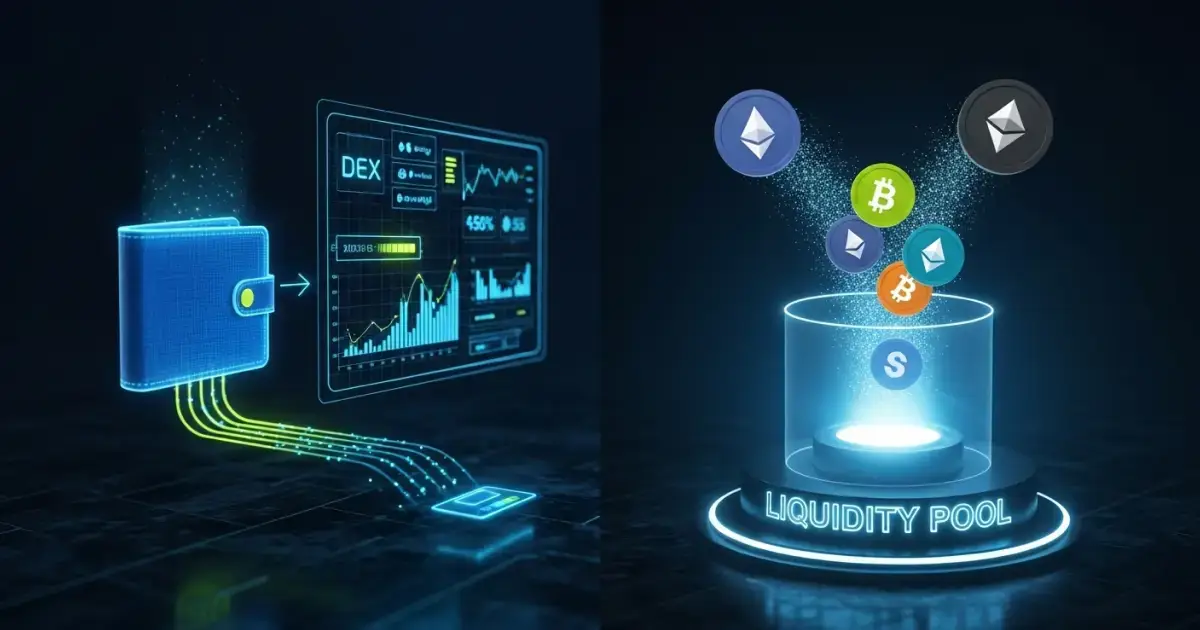
The world of decentralized finance (DeFi) has created new ways for people to trade, earn, and interact with digital assets. One of the most important innovations powering this ecosystem is the liquidity pool. Crypto liquidity pools allow users to swap tokens without relying on traditional centralized exchanges or order books. Instead, decentralized exchanges (DEXs) use smart contracts and community-provided liquidity to maintain markets and enable automated trading.
For beginners, liquidity pools may seem complex, but the basic concept is straightforward: they are shared pools of cryptocurrency that users can contribute to in exchange for potential rewards. By providing liquidity, users become active participants in decentralized markets while helping DeFi applications operate more efficiently.
In this guide, we will explain:
What liquidity pools are.
How liquidity pools work.
Different types of liquidity pools.
Benefits and risks for liquidity providers.
Key terms related to DeFi liquidity.
What Are Liquidity Pools?

A liquidity pool is a collection of cryptocurrency assets locked in a smart contract and used to facilitate decentralized trading, lending, or other blockchain-based financial activities. Unlike traditional financial markets, where liquidity is typically provided by banks, market makers, or financial institutions, DeFi liquidity is supplied by users who deposit their assets into protocols.
These users are known as liquidity providers (LPs). When users provide liquidity, they typically receive LP tokens representing their share of the pool. These tokens can later be redeemed for the underlying assets plus any earned fees or rewards.
Liquidity pools form the backbone of decentralized finance (DeFi) by enabling:
- Alternative trading infrastructure beyond traditional order books through Automated Market Makers (AMMs).
- Peer-to-peer asset swaps through smart contracts without traditional intermediaries.
- The operation of decentralized applications (dApps), including DEXs, lending protocols, and yield platforms.
- Creating opportunities for liquidity providers to earn trading fees and participate in additional incentive programs, such as yield farming.
For example, a user providing ETH and USDC to a liquidity pool allows traders to swap between these assets without needing a centralized intermediary.
Why Liquidity Matters in DeFi

Liquidity is one of the most important factors determining how efficiently a financial market operates. In simple terms, liquidity describes how easily an asset can be bought or sold without causing significant price changes.
In traditional finance (TradFi):
In DeFi:
When a pool has insufficient liquidity, large trades can significantly affect prices. This effect is known as slippage.
For example:
A $1,000 ETH/USDT swap in a $10,000 liquidity pool may significantly move the price.
The same trade in a $10 million pool would usually have much lower price impact.
Higher liquidity generally leads to:
DeFi Liquidity Landscape in 2026
By 2026, liquidity development in DeFi has expanded beyond individual blockchain ecosystems.
Major trends include:
Layer 2 Liquidity Expansion: Lower-cost networks have attracted more DeFi activity by reducing transaction fees and improving scalability.
Cross-Chain Liquidity Growth: Users increasingly seek liquidity access across multiple blockchain networks, creating demand for more secure interoperability solutions.
Sustainable Yield Models: The market has shifted toward evaluating real trading revenue and protocol fundamentals rather than relying only on token incentives.
As DeFi infrastructure matures, liquidity quality and risk management have become increasingly important factors for users and protocols.
Types of Liquidity Pools

Liquidity pools can be classified based on their asset structure, pricing mechanism, and intended use cases. Different pool designs serve different purposes, from reducing price volatility and improving trading efficiency to supporting cross-chain liquidity and specialized DeFi applications.
Understanding the differences between liquidity pool types can help users evaluate potential risks, including impermanent loss, smart contract exposure, and market volatility.
1. Volatile Asset Pools
Volatile asset pools are the most common type of liquidity pool, pairing cryptocurrencies with significant price fluctuations, such as ETH/USDT or BTC/ETH.
These pools typically generate higher trading activity because users frequently swap between major crypto assets. Liquidity providers can earn a share of trading fees, but they also face a higher risk of impermanent loss when the prices of paired assets move significantly in different directions.
Volatile asset pools are generally used by liquidity providers who understand market fluctuations and are comfortable with higher risk exposure.
2. Stablecoin Pools
Stablecoin pools consist of assets designed to maintain relatively stable values, such as USDC, USDT, and DAI.
Because the underlying assets usually have smaller price differences, these pools often experience lower impermanent loss compared with volatile asset pools. They are commonly used for stablecoin swaps, lending activities, and other DeFi applications that require efficient transactions with low price impact.
Popular StableSwap designs, such as those used by Curve Finance, are optimized specifically for stable asset trading.
3. Weighted and Multi-Token Pools
Weighted pools allow liquidity providers to contribute assets using customized ratios instead of the traditional 50/50 model.
For example, a pool may use an 80/20 or 70/30 allocation between two assets, giving providers more flexibility in managing their exposure. Protocols such as Balancer introduced weighted pool designs that support customized asset distributions and multi-token pools.
Multi-token pools extend this concept by allowing multiple assets within a single liquidity pool. These designs can provide broader exposure and support more complex trading strategies, although they may introduce additional complexity for liquidity providers.
4. StableSwap Pools
StableSwap pools are specialized liquidity pools designed for trading assets with similar values, particularly stablecoins and wrapped assets.
Unlike traditional AMMs that use a constant product formula, StableSwap algorithms are optimized to reduce slippage when swapping assets that are expected to maintain similar prices.
This makes them suitable for high-volume stablecoin transactions and efficient asset conversions within DeFi ecosystems.
5. Single-Sided Liquidity Pools
Traditional liquidity pools usually require users to deposit two assets in a trading pair. Single-sided liquidity pools allow users to provide only one asset while the protocol manages the balancing mechanism internally.
This model lowers the entry barrier for users who may not hold both assets in a pair. However, the underlying mechanism can vary significantly between protocols, and users should understand how asset exposure, fees, and risks are managed before providing liquidity.
6. Incentivized Pools and Liquidity Mining
Some liquidity pools offer additional incentives beyond standard trading fees to attract liquidity providers.
These incentives may include governance tokens, protocol rewards, or other forms of liquidity mining programs. While these pools can increase participation and improve market liquidity, reward structures may change over time, and token emissions can affect the long-term sustainability of returns.
Liquidity providers should evaluate both trading fee revenue and incentive mechanisms when assessing these pools.
7. Cross-Chain Liquidity Pools
Cross-chain liquidity pools enable users to provide liquidity or trade assets across multiple blockchain networks.
These pools aim to improve interoperability by allowing liquidity to move between ecosystems such as Ethereum, Polygon, and other compatible networks. They can reduce dependence on isolated blockchain environments and support multi-chain applications.
However, cross-chain liquidity systems may introduce additional risks related to bridges, messaging protocols, and smart contract security.
8. NFT Liquidity Pools and Emerging Models
Some DeFi protocols have extended liquidity pool concepts beyond fungible tokens to support NFT markets.
NFT liquidity pools allow users to trade, fractionalize, or provide liquidity for digital collectibles through automated mechanisms rather than traditional peer-to-peer marketplaces.
Although still a developing area compared with token-based liquidity pools, these models demonstrate how liquidity mechanisms continue to expand into new blockchain applications.
How Do Liquidity Pools Work? Step-by-Step

Liquidity pools work by allowing users to deposit crypto assets into smart contracts that automatically facilitate trading through an Automated Market Maker (AMM) model.
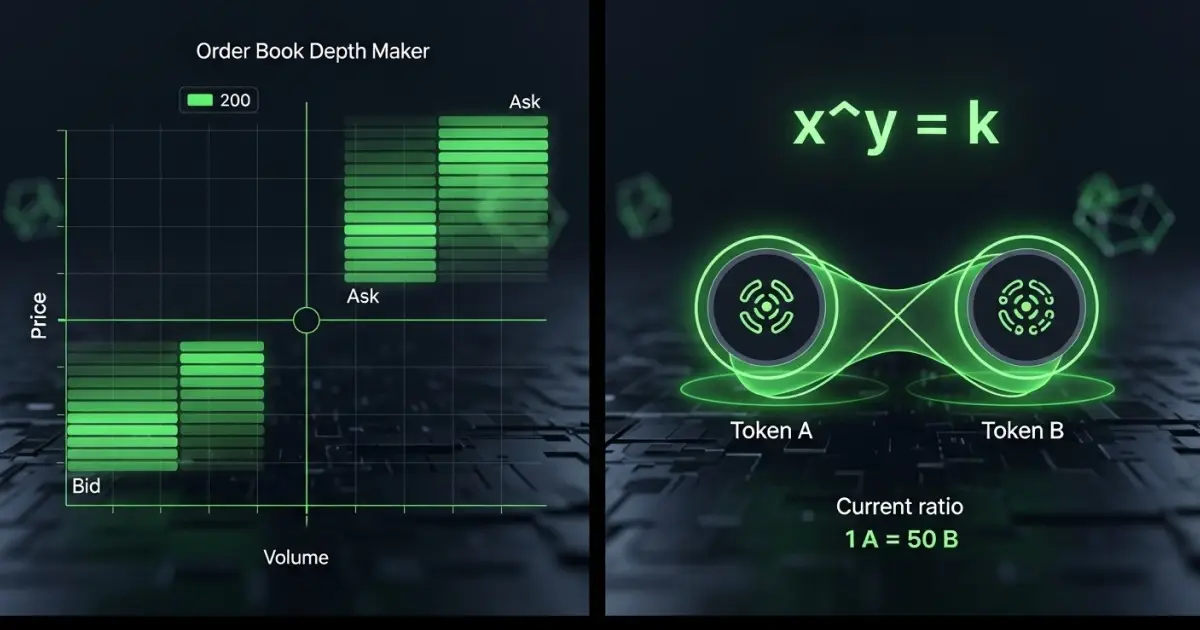
Unlike traditional exchanges that rely on order books to match buyers and sellers, liquidity pools use predefined mathematical formulas to determine asset prices based on the ratio of tokens available in the pool.
At a high level, the process involves:
Liquidity providers deposit assets into a smart contract.
The AMM algorithm calculates token prices based on pool reserves.
Traders swap assets directly against the liquidity pool.
Liquidity providers earn a share of trading fees and other protocol incentives.
Providers can withdraw their liquidity together with accumulated rewards.
Step 1: Funding the Liquidity Pool
A liquidity pool is created when users deposit crypto assets into a smart contract. For most traditional AMM pools, liquidity providers deposit two tokens in a trading pair, such as ETH/USDC. The deposited assets create the liquidity available for traders to swap between tokens.
For example:
A liquidity provider deposits 1 ETH and 2,000 USDC into an ETH/USDC pool.
The pool now contains both assets and can support ETH-to-USDC or USDC-to-ETH swaps.
In return, liquidity providers receive LP tokens representing their proportional ownership of the pool.
These LP tokens track the provider’s share of the pool and may be used to redeem deposited assets plus any earned fees or incentives.
Step 2: Automated Market Maker (AMM) Pricing
Instead of using an order book, liquidity pools rely on Automated Market Makers (AMMs) to determine prices automatically. The most common AMM model uses the constant product formula:
x * y = k
Where:
x represents the amount of one token in the pool.
y represents the amount of the other token.
k represents a constant value that remains unchanged after trades.
When a trader swaps one asset for another, the token ratio in the pool changes. The AMM algorithm automatically adjusts the price to maintain the balance between the two assets.
This mechanism enables decentralized price discovery without requiring a centralized market maker.
Step 3: Trading Through the Liquidity Pool
When traders swap tokens on a decentralized exchange (DEX), they interact directly with the liquidity pool rather than another individual trader.
For example:
A trader swaps ETH for USDC.
ETH is added to the pool.
USDC is removed from the pool.
The AMM recalculates the exchange rate based on the updated token ratio.
Each trade slightly changes the pool balance, which affects the next available price. Larger trades relative to pool size generally create greater price impact, resulting in higher slippage.
Step 4: Trading Fees and Liquidity Provider Rewards
Every swap usually includes a trading fee, which is distributed among liquidity providers based on their share of the pool.
For example:
A DEX charges a trading fee for each swap.
A portion of the fee is allocated to liquidity providers.
LPs earn rewards proportional to their contribution.
Some protocols also offer additional incentives through liquidity mining programs, where users may receive governance tokens or other rewards for providing liquidity.
However, these additional incentives can change over time and should be evaluated together with factors such as trading volume, token risk, and smart contract security.
Step 5: Withdrawing Liquidity
Liquidity providers can withdraw their funds by returning their LP tokens to the protocol.
After withdrawal:
The LP tokens are removed from circulation.
The provider receives their proportional share of the pool assets.
Any accumulated trading fees or incentives are included according to the protocol’s design.
The final amount of each token may differ from the original deposit because asset prices may have changed during the liquidity period. This difference is one of the main reasons liquidity providers need to understand impermanent loss before participating in a pool.
Benefits of Liquidity Pools

Liquidity pools provide the infrastructure that allows decentralized finance (DeFi) applications to operate without relying on traditional financial intermediaries. By allowing users to contribute assets to shared liquidity pools, DeFi protocols can support decentralized trading, lending, and other blockchain-based financial activities.
Decentralization
Liquidity pools reduce reliance on traditional market makers and centralized intermediaries by enabling automated trading through smart contracts.
Users can trade assets directly through decentralized exchanges (DEXs), while liquidity providers contribute the assets required for these markets to function.
Trading Accessibility
Liquidity pools allow users to access decentralized markets without needing approval from centralized financial institutions.
Anyone with a compatible wallet can interact with supported DeFi protocols, provide liquidity, or trade assets based on the rules defined by smart contracts.
Liquidity Provider Rewards
Liquidity providers may earn rewards by contributing assets to liquidity pools.
These rewards typically come from:
Trading fees generated by user swaps.
Protocol incentive programs.
Liquidity mining mechanisms.
However, potential rewards must be evaluated alongside risks such as impermanent loss, asset volatility, and smart contract vulnerabilities.
Always-On Market Infrastructure
Unlike traditional financial markets that operate during specific trading hours, decentralized exchanges powered by liquidity pools can operate continuously.
This enables users to swap assets at any time while allowing blockchain applications to provide uninterrupted financial services.
Flexible DeFi Applications
Liquidity pools support a wide range of decentralized applications, including:
Decentralized exchanges (DEXs).
Lending and borrowing platforms.
Yield optimization protocols.
Cross-chain applications.
Synthetic asset platforms.
This flexibility has made liquidity pools one of the core building blocks of the DeFi ecosystem.
Risks of Liquidity Pools

Although liquidity pools provide important infrastructure for DeFi, they also introduce several risks that users should understand before providing liquidity.
Impermanent Loss
Impermanent loss occurs when the value ratio between assets in a liquidity pool changes compared with simply holding the original assets.
For example, if ETH increases significantly while paired with a stablecoin, the AMM mechanism may automatically rebalance the pool, leaving the liquidity provider with less ETH exposure than they would have had by holding ETH directly.
The loss becomes permanent only when the liquidity provider withdraws their assets at an unfavorable ratio.
Smart Contract Vulnerabilities
Liquidity pools rely on smart contracts to manage deposits, pricing mechanisms, and withdrawals.
If the underlying code contains vulnerabilities, attackers may exploit the protocol and drain liquidity pools.
Common risk factors include:
Unverified code.
Insufficient security audits.
Vulnerabilities in external dependencies.
Poorly designed contract logic.
Users should evaluate protocol security history and audit information before providing liquidity.
Market Volatility
Liquidity providers are exposed to price movements of the assets contained in a pool.
High volatility can affect:
The value of deposited assets.
Trading fee revenue.
Impermanent loss exposure.
Overall liquidity provider returns.
This risk is especially significant for pools containing low-liquidity or highly speculative tokens.
Rug Pulls and Malicious Projects
Some liquidity pools, particularly those from unaudited or low-quality projects, may involve malicious actors who remove liquidity or manipulate token supply.
Before interacting with a new pool, users should consider:
Regulatory Uncertainty
As DeFi continues to evolve, regulatory frameworks may affect how decentralized protocols, liquidity providers, and token-based incentives operate.
Future regulations may influence areas such as:
Access requirements.
Reporting obligations.
Protocol operations.
Token classification.
Real-World Examples of Liquidity Pools
Liquidity pools are used by many major DeFi protocols, each focusing on different types of decentralized market infrastructure.
Platform | Main Function | Liquidity Pool Innovation |
|---|
Uniswap | Decentralized token swaps | Popularized AMM-based trading pools |
Curve Finance | Stablecoin trading | Optimized StableSwap model for low-slippage swaps |
Balancer | Custom liquidity pools | Introduced weighted and multi-token pool designs |
SushiSwap | DEX and liquidity incentives | Expanded liquidity mining mechanisms |
PancakeSwap | BNB Chain-based DeFi trading | Provided low-cost AMM trading infrastructure |
These platforms demonstrate how different liquidity pool designs can support different market needs, from stablecoin transactions to diversified asset exposure.
Use Cases of Liquidity Pools
Liquidity pools support a wide range of decentralized finance applications. By providing shared liquidity through smart contracts, they enable different financial activities without relying on traditional intermediaries.
Decentralized Trading
Liquidity pools power decentralized exchanges (DEXs) by replacing traditional order books with automated market makers (AMMs).
Users can swap tokens directly through smart contracts, while liquidity providers earn a share of trading fees generated by transactions.
Lending and Borrowing
Liquidity pools provide the underlying liquidity required by decentralized lending protocols.
Users can supply assets to lending markets, allowing other participants to borrow crypto assets while suppliers receive protocol-defined rewards.
Liquidity Mining
Some DeFi protocols distribute additional token incentives to encourage users to provide liquidity.
Liquidity providers may receive governance tokens or other rewards in addition to trading fees. However, users should evaluate reward sustainability and associated risks before participating.
Synthetic Assets
Certain protocols use liquidity pools to support synthetic assets that track the value of external assets.
These systems rely on smart contracts, collateral mechanisms, and price data sources to maintain asset representation.
Cross-Chain Liquidity
Cross-chain liquidity solutions allow assets and liquidity to move between different blockchain ecosystems.
By improving interoperability, these systems help users access applications and markets across multiple networks.
Future Trends of Liquidity Pools (2026 and Beyond)
Liquidity pools continue to evolve as DeFi infrastructure matures. Future developments are expected to focus on scalability, interoperability, security, and broader adoption.
Layer 2 Integration: Layer 2 networks and rollups can reduce transaction costs and improve trading efficiency, allowing liquidity pools to support higher transaction volumes.
Cross-Chain Liquidity: Interoperability solutions are improving connections between blockchain ecosystems, enabling liquidity to move more efficiently across different networks.
Institutional Adoption: As blockchain infrastructure develops, institutions may increasingly explore decentralized liquidity solutions for digital asset markets and financial applications.
AI-Powered Optimization: Artificial intelligence and automated strategies may help protocols optimize liquidity allocation, risk monitoring, and capital efficiency.
Compliance-Oriented Infrastructure: Some future liquidity protocols may introduce more transparent compliance frameworks, including identity verification solutions or regulatory-focused designs.