Ethereum's biggest problem right now isn't proving that demand exists — the network still settles billions of dollars in daily volume across DeFi, stablecoins, and tokenized assets. The harder question, the one that actually determines whether Ethereum is a good investment in 2026, is whether the asset can convert that usage back into value for ETH holders while most of the activity has migrated to Layer-2s that don't pay full fare to the base chain.
That tension — real usage, thinner direct fee capture — is the entire story of ETH's price action this year. As of late July 2026, ETH trades in the $1,880–$1,920 range, with a market capitalization near $230 billion, still well below its August 2025 peak of roughly $4,946.
Whether that gap represents a buying opportunity or a warning sign depends on which side of Ethereum's investment case you find more convincing. This piece walks through both.
Investment Synopsis: Risk-Reward Profile at a Glance
Ethereum in 2026 sits in an unusual position for a mature crypto asset: the network's fundamentals (developer activity, institutional custody products, stablecoin settlement volume) look stronger than they did during the 2021 bull run, yet the price sits far below its all-time high. That divergence is the crux of the "is Ethereum still a good investment" debate.
Core Investment Strengths and Market Position
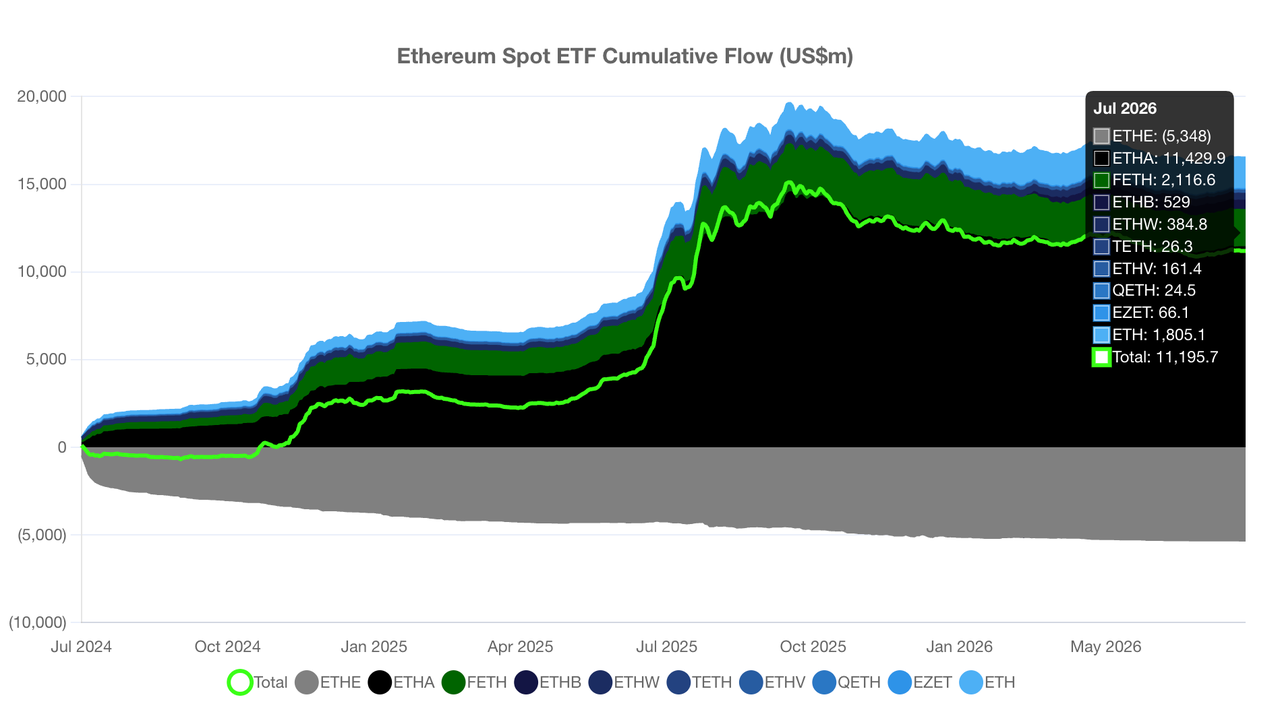
Institutional access has matured. Spot ETH ETFs have pulled in roughly $9.7–$11.4 billion in cumulative net inflows since their mid-2024 launch, with weekly inflows breaking an eight-week outflow streak in July 2026 as BlackRock's ETHA fund alone commands close to 68% of category assets.
ETH remains the dominant settlement layer for DeFi and stablecoins. Even with Layer-2 growth, aggregate value secured across the Ethereum L1 and L2 ecosystem still dwarfs most competing chains, and Ethereum retains the largest developer base in the industry.
Programmatic scarcity mechanics still exist, even though they've weakened. EIP-1559's burn mechanism can still make ETH net deflationary during periods of high demand, though 2025–2026 has seen the opposite: issuance has outpaced burn, pushing ETH supply mildly positive again.
Second-largest liquidity pool in crypto. Whatever an investor's view on valuation, ETH remains one of the two assets — alongside Bitcoin — with the deepest order books, the most derivatives coverage, and the broadest custody support among regulated institutions.
Primary Risk Factors to Consider Before Buying
L1 fee revenue has collapsed. Average mainnet transaction fees have fallen from double digits during peak congestion to roughly $0.10–$0.20 today, and daily L1 chain revenue has been reported near the $50,000–$60,000 range on quiet days — a fraction of the multi-million-dollar daily fee revenue Ethereum generated in 2021–2023.
Staking yields have compressed. Validator APR has drifted down from the 4%+ range seen in 2023 to roughly 2.4%–3.3% today, a mechanical consequence of more ETH being staked (an estimated 33% of supply, across 1.1 million-plus validators).
Layer-2 value leakage. As more activity moves to Base, Arbitrum, and other rollups, less of that economic activity translates into L1 gas burn — a structural headwind for any valuation model that ties ETH's price to fee capture.
Competitive pressure from faster monolithic L1s. Solana and other high-throughput chains continue to compete for the same DeFi and consumer-app developers Ethereum wants to keep.
Regulatory uncertainty persists, particularly around staking-as-a-security questions and how regulators in different jurisdictions classify liquid staking tokens and restaking protocols.
The Investment Thesis: Staking Yields, Network Utility, and Cash Flow Capture
Unlike Bitcoin, Ethereum has something resembling a cash-flow-generating asset structure — validators earn issuance rewards and priority fees for securing the network, and a portion of every transaction fee is permanently removed from circulation. That's the foundation of why some analysts treat ETH more like a productive asset than a pure store of value.
Generating Yield Through Proof-of-Stake Rewards
Since the Merge, ETH holders have been able to stake their tokens directly, through liquid staking providers, or through liquid restaking protocols layered on top. Current data puts staking participation at roughly 33% of total ETH supply, secured by well over a million active validators, with the Compass Staking Yield Reference Index recording consensus-layer yield near 2.4%–2.8% APY.
Solo validators running their own infrastructure can capture closer to 3.3%–4% once MEV rewards are included, while liquid staking tokens from providers charging 10%–25% fees on rewards net out closer to 2.0%–2.2%.

(Source: MacroMicro)
The yield compression itself isn't a red flag — it's mechanical. Ethereum's issuance schedule scales with the square root of total ETH staked, so the more validators join, the smaller each validator's slice becomes. The practical takeaway for investors: staking ETH today functions more like a modest, inflation-adjusted savings mechanism than a high-yield product, and the entry queue for new validators has at times stretched past two months due to backlog.
Transaction Fee Revenue and Asset Burn Dynamics
EIP-1559 introduced a base fee that gets burned rather than paid to validators, which made ETH net deflationary during periods of high on-chain demand in 2022–2023. That dynamic has reversed. With average transaction fees down sharply and much of the fee-paying activity migrating to Layer-2 rollups, daily ETH burn has fallen to levels that no longer offset new issuance — supply is now growing at roughly 0.85% annually rather than shrinking.
Here's the key idea: this doesn't necessarily mean the "ultrasound money" narrative is dead, but it does mean the burn mechanism currently contributes less to ETH's scarcity story than it did during the 2021–2023 cycle. Any valuation model built on a deflationary supply assumption needs updating.
Valuation Frameworks: Applying DCF and Metcalfe's Law to Ethereum
Because Ethereum generates something analogous to protocol revenue — transaction fees, MEV, and issuance-funded security spend — some analysts attempt to value it the way they'd value a cash-flow business or a network-effect platform. Both approaches have real limitations worth understanding before leaning on either one.
Discounted Cash Flow (DCF) Models for Protocol Revenue
A DCF approach to ETH treats network fee revenue (or, in more sophisticated versions, the sum of burned fees plus staking-security spend) as a proxy for cash flow, then discounts a projected future revenue stream back to present value. The technical trade-off is straightforward: this model rewards periods of high L1 congestion and penalizes the very scaling roadmap Ethereum has pursued since the Dencun upgrade.
That's the core critique of applying traditional DCF to Ethereum in 2026. L1 chain revenue has fallen from tens of millions of dollars in daily fees during 2021 peaks to a range of trackers put closer to tens of thousands of dollars per day now that rollups absorb the bulk of transaction volume.
A DCF model anchored purely to L1 gas revenue will systematically undervalue Ethereum relative to a model that also credits the network for the economic activity it secures indirectly through its L2 ecosystem — total value secured across Ethereum's rollup landscape is estimated in the $35–$45 billion range as of mid-2026, concentrated heavily in Base and Arbitrum.
DCF Input | L1-Only Model | L1 + L2 Settlement Model |
Revenue basis | Gas fees burned on mainnet only | Mainnet fees + blob fees + L2 economic security value |
Sensitivity to scaling roadmap | Penalizes L2 migration | Rewards L2 adoption as a growth driver |
Current directional signal | Bearish (fee revenue down sharply) | Neutral-to-bullish (aggregate activity still growing) |
Key weakness | Ignores where value actually moved | Harder to quantify precisely; relies on estimates |
Network Effects and Active Address Growth via Metcalfe's Law
Metcalfe's Law — the idea that a network's value scales with the square of its number of connected users — offers a different lens. Ethereum's L1 posted a record 200.4 million transactions in Q1 2026 alone, and active addresses across the ecosystem have continued climbing even as individual transaction fees have collapsed toward $0.10–$0.20.
The market often overlooks this: raw usage and fee revenue have decoupled, and a Metcalfe-style framework treats that usage growth as bullish even when the fee-based DCF model reads bearish.
The weakness here is equally real — Metcalfe's Law was designed for closed communication networks, not multi-chain ecosystems where a meaningful share of "network value" now accrues to L2 tokens (or to no token at all, in the case of app-specific rollups) rather than to ETH itself. Applying it to Ethereum requires deciding how much of L2 usage should even count toward ETH's own network value — a judgment call, not a formula.
Price Targets (2026–2030): Base, Bull, and Bear Case Scenarios
Any specific ETH price target beyond the current range should be read as a scenario, not a forecast.
The dispersion among professional forecasters is wide: some conservative estimates cluster ETH re-testing prior highs in the $4,000–$5,000 zone over a multi-year horizon, while more aggressive long-term calls — including a widely cited Standard Chartered projection — put Ethereum potentially exceeding $40,000 by the next decade if institutional adoption compounds. Neither end of that range should be treated as a guarantee.
Bullish Scenario: Institutional Adoption and DeFi Dominance
The bull case leans on continued spot ETF accumulation, staking products being added to more ETF wrappers, sustained stablecoin and RWA settlement growth on Ethereum rails, and Base/Arbitrum-style L2s maintaining their dominant share of a growing rollup market.
If ETF inflows sustain the pace seen in July 2026 — multiple consecutive weeks of net positive flows after an extended outflow streak — that creates a mechanical buying pressure, since fund issuers must acquire spot ETH to back new shares.
Bearish Scenario: Regulatory Pressures and Layer-2 Revenue Leakage
The bear case centers on the same L2 leakage dynamic discussed above, compounded by regulatory ambiguity around staking products, continued competition from faster monolithic L1s, and the risk that ETF inflows prove cyclical rather than structural — Bitcoin ETF assets under management still outweigh Ethereum's by more than seven to one, and a swing back to net ETF outflows has happened multiple times in 2026 already.
If L1 fee revenue keeps compressing without a corresponding valuation credit for L2 activity, ETH risks becoming what critics call a "used but not valued" asset — high utility, thin direct monetization.
Scenario | Key Drivers | Primary Risk to the Thesis |
Bull case | ETF inflows sustain, staking ETFs launch, RWA/stablecoin settlement grows | Inflows prove temporary; L2 leakage persists regardless |
Base case | Range-bound price tracking macro liquidity and BTC correlation | ETH underperforms both BTC and high-growth alt-L1s |
Bear case | ETF outflows resume, L2 fee capture worsens, regulatory setbacks | Structural devaluation of L1-centric valuation models |
>>> Related Reading: Will Ethereum Go Back Up? Market Analysis & ETH Price Prediction
Market Skepticism: Analyzing Price Lag, L2 Revenue Drift, and Alt-L1 Threats
Looking beyond short-term price movements, the skeptical case against Ethereum isn't that the network is failing — it's that its economic model hasn't caught up with its own architecture.
Why L2 Scaling Can Temporarily Dampen L1 Fee Value Capture
Ethereum deliberately chose to make L2 transactions cheap. The Dencun upgrade's blob-based data availability layer (EIP-4844) cut the cost of posting rollup data to L1 dramatically, and that success is precisely what suppressed L1 gas revenue.
Some analysts frame this as Ethereum trading a "high-margin, low-volume" business model for a "low-margin, high-volume" one — becoming the settlement and security layer for a sprawling multi-chain ecosystem rather than a congested world computer charging premium fees directly.
Whether that trade eventually shows up in ETH's price depends on whether the market starts valuing settlement-layer security the way it once valued raw fee revenue.
Competition from Fast Monolithic Layer-1 Blockchains
Solana and other high-throughput, single-layer blockchains continue to pitch developers on lower latency and simpler tooling compared with Ethereum's modular rollup-centric roadmap. This competition matters for ETH's investment case because developer mindshare, not just TVL, is the leading indicator of where the next cycle's application layer gets built.
Ethereum's advantage here remains its incumbency — the largest developer ecosystem, the deepest DeFi liquidity, and the broadest institutional custody support — but that advantage isn't unlimited.
Asset Allocation: Balancing Bitcoin and Ethereum in a Crypto Portfolio
When investors weigh Bitcoin against Ethereum, the debate often gets framed as a winner-take-all rivalry. In reality, the two crypto heavyweights serve fundamentally different structural roles. Rather than competing for the exact same allocation dollar, they operate as distinct asset classes within a broader portfolio framework.
Understanding those differences—and knowing how to dial exposure up or down across changing liquidity cycles—is key to managing a digital asset strategy today.
Risk Profiles: Bitcoin as Digital Gold vs. Ethereum as Tech Infrastructure
Bitcoin: The Hard-Money Core

(Source: Bitbo)
Bitcoin's case rests on monetary simplicity: a strict 21-million-supply cap, a predictable issuing curve, and an entrenched "digital gold" narrative.
It has evolved into a primary macro reserve asset. As of writing, spot Bitcoin ETFs hold over $78 billion in assets under management. That deep institutional liquidity gives BTC lower relative volatility during market downturns, acting as the defensive anchor of a crypto portfolio.
(Source: Farside Investors)
With spot Ethereum ETFs managing around $11 billion in AUM as of July, 2026—roughly one-seventh of Bitcoin's total—ETH remains heavily driven by crypto-native capital and tech growth sentiment. That gives it a higher-beta risk profile—delivering steeper downside during panics, but far greater upside velocity when market activity surges.
The Macro Factor: Rates, Liquidity, and Risk Appetite
Asset allocation isn't static; it lives inside the broader macro environment.
Global financial conditions remain nuanced. The U.S. Federal Reserve has kept benchmark interest rates anchored around 3.50%–3.75%, creating a persistent real-yield environment where liquidity remains carefully managed rather than freely available.
This setup creates a distinct split in how both assets behave:
In Risk-Off Regimes: When geopolitical tension spikes or sticky rates weigh on market confidence, capital tends to retreat up the risk curve. Backed by deep ETF liquidity, Bitcoin typically acts as the relative safe haven within the asset class.
In Risk-On Regimes: When rate-cut expectations solidify or global liquidity expands, capital pushes out for yield and outperformance. On-chain activity surges, fees pick up, and Ethereum's high-beta properties take over, frequently outstripping BTC's percentage gains.
Recommended Allocation Strategies Based on Investor Risk Tolerance
Because risk tolerance, time horizon, and existing traditional market exposure vary wildly from person to person, there is no silver-bullet ratio. Investors generally treat Bitcoin as the core portfolio stabilizer and Ethereum as the growth engine tied to application adoption.
Investor Profile | Typical BTC Share | Typical ETH Share | Strategic Focus |
Conservative | 70% – 80% | 20% – 30% | Prioritizes capital preservation with a heavy monetary anchor, using ETH strictly as a small growth kicker. Ideal for uncertain macro environments. |
Balanced | 50% – 60% | 40% – 50% | Splits exposure evenly between macro defense and smart-contract infrastructure growth. |
Growth-Oriented | 30% – 40% | 60% – 70% | Seeks maximum upside velocity, banking heavily on Web3 applications, Layer-2 adoption, and expanding liquidity conditions. |
Executing these allocations effectively comes down to flexibility. Rather than locking into a rigid long-term ratio, sophisticated traders continuously rebalance or hedge spot positions around macro catalysts—such as interest rate decisions or network upgrades—to manage volatility without tax-inefficiently dumping underlying holdings.
There's no universal allocation split that fits every investor, and this article isn't making that call — risk tolerance, time horizon, and existing portfolio exposure all matter more than any generic ratio. What's worth noting is the mechanism: many investors treat Bitcoin as the core, lower-volatility holding within a crypto allocation and Ethereum as the higher-beta component tied to on-chain application growth.
Platforms such as Bitunix provide traders with access to both spot and derivatives markets across BTC, ETH, and other major assets, allowing users to size and hedge exposure according to their own risk framework rather than a one-size-fits-all model.
How to Buy and Hold Ethereum Safely
Choosing Between Spot Purchases and Derivatives Hedging
Investors approaching ETH with a long-term view typically default to spot accumulation — buying and holding the underlying asset, potentially staking it for yield. Traders looking to manage short-term volatility or express a directional view without holding the asset outright often turn to derivatives instead, which allow position sizing and downside risk controls that spot holding alone doesn't offer.
Exchanges built for active traders, Bitunix included, offer tools like fixed-risk position limits that let users define maximum loss before entering a trade, which can be a meaningful risk-management layer given ETH's volatility profile.
Best Practices for Custody and Account Security
Use hardware wallets for long-term holdings rather than leaving significant balances on exchange hot wallets.
Verify staking providers' fee structures and slashing risk before delegating — fees among liquid staking protocols range from roughly 10% to 25% of rewards, and net yield varies accordingly.
Enable two-factor authentication and withdrawal whitelisting on every exchange account.
Never share private keys, seed phrases, or 2FA codes with anyone, including support staff claiming to represent an exchange.
Diversify custody — don't hold your entire position in a single wallet, provider, or platform.
Re-Evaluating Ethereum: Is ETH Still a Good Investment?

For investors asking whether Ethereum remains a compelling buy, the short answer is yes—but not under the same logic that drove previous cycles. Evaluating Ethereum's potential today requires setting aside outdated bull-case models and looking at how its underlying economic role has matured.
The Shift from Fee Monster to Settlement Layer: Ethereum's value proposition has evolved from a high-fee computing engine into the foundation and settlement hub for a broader multi-chain ecosystem. Judging ETH solely on L1 transaction fee revenue—the standard 2021 playbook—overlooks how Layer-2 networks are driving actual network volume and long-term ecosystem sustainability.
Staking Yields as an Institutional Benchmark: Staking rewards have normalized to a 2%–4% annual range. Rather than functioning as a high-APY speculative asset, ETH now behaves much like a yield-bearing sovereign internet bond, appealing to capital that prioritizes structural yield over hyper-inflationary emissions.
Institutional Access vs. Cyclical Realities: Institutional access via regulated spot ETFs and staking products has matured significantly. However, Ethereum ETF flows remain cyclical and sensitive to broader macroeconomic liquidity rather than behaving as a purely one-directional buy.
Evaluating Scenario Ranges, Not Price Targets: An informed investment decision shouldn't rely on hype or static price forecasts. Instead, evaluating ETH as an investment comes down to tracking clear, falsifiable catalysts—such as Layer-2 value capture, institutional ETF demand, and global liquidity trends.
Final Investment Verdict
Ethereum's fundamentals — developer activity, DeFi and stablecoin settlement volume, institutional custody infrastructure, and a growing (if imperfect) ETF access route — remain among the strongest in crypto outside of Bitcoin. The honest counterpoint is that ETH's price has lagged those fundamentals for over a year, largely because the network's own scaling success moved economic activity to Layer-2s faster than new valuation frameworks could credit ETH for it.
Whether that gap closes depends on catalysts that are genuinely uncertain: sustained ETF inflows, a valuation framework that properly prices L2 settlement demand, and Ethereum holding its competitive edge against faster monolithic chains.
About Bitunix
Bitunix is a global cryptocurrency derivatives exchange trusted by over 5 million users across more than 150 countries/districts. The platform is committed to providing a transparent, compliant, and secure trading environment for every user. Bitunix offers a fast registration process and a user-friendly verification system supported by mandatory KYC to ensure safety and compliance.
With global standards of protection through Proof of Reserves (POR) and the Bitunix Care Fund, Bitunix prioritizes user trust and fund security. The K-Line Ultra chart system delivers a seamless trading experience for both beginners and advanced traders, while leverage of up to 200x and deep liquidity make Bitunix one of the most dynamic platforms in the market.
Bitunix Global Accounts
X | Telegram Announcements | Telegram Global | CoinMarketCap | Instagram | Facebook | LinkedIn | Reddit | Medium