Smart contracts are the foundation of modern blockchain ecosystems. The concept of a smart contract refers to a self-executing agreement that is implemented as a computer program on blockchain technology. A smart contract is a computer program that can automatically execute an agreement when certain conditions are met. They enable developers to create decentralized applications, issue tokens, and establish systems that run without human intervention. Instead of relying on banks, brokers, or legal institutions, blockchain users can trust smart contracts to automatically execute transactions and enforce the terms of an agreement.
Ethereum has become the leading blockchain for smart contract development. Its robust infrastructure and thriving community have made it the platform of choice for building decentralized finance (DeFi) protocols, non-fungible tokens (NFTs), gaming systems, and more. Blockchain technology underpins the automation and trustless nature of smart contracts, providing decentralization, security, and transparency. This beginner-friendly guide explains the basics of smart contracts, how they work, their benefits and limitations, and how Ethereum enables their use at scale. By the end, you will have a clear understanding of why smart contracts matter and how they are reshaping the digital economy.What Are Smart Contracts?
 Smart contracts are self-executing programs stored on a blockchain. A smart legal contract formalizes agreements between parties and can be automatically executed when predefined conditions are met. They contain predefined rules, written in code, that automatically enforce agreements once conditions are met.
For example, imagine you want to buy a piece of digital artwork. Instead of relying on a marketplace or escrow service, a smart contract enforces the agreement between the buyer and seller (the parties) and automatically executes the transfer of ownership to you as soon as your payment is received. This happens without human intervention, reducing delays and eliminating the risk of fraud.
Smart contracts are self-executing programs stored on a blockchain. A smart legal contract formalizes agreements between parties and can be automatically executed when predefined conditions are met. They contain predefined rules, written in code, that automatically enforce agreements once conditions are met.
For example, imagine you want to buy a piece of digital artwork. Instead of relying on a marketplace or escrow service, a smart contract enforces the agreement between the buyer and seller (the parties) and automatically executes the transfer of ownership to you as soon as your payment is received. This happens without human intervention, reducing delays and eliminating the risk of fraud.
How Smart Contracts Work
 At their core, smart contracts follow an if/when…then model. The contract checks predetermined conditions, and if they are satisfied, it executes the action.
Example workflow:
At their core, smart contracts follow an if/when…then model. The contract checks predetermined conditions, and if they are satisfied, it executes the action.
Example workflow:
- A developer writes the code in a programming language such as Solidity.
- The code is compiled into bytecode and deployed on the Ethereum blockchain.
- Once deployed, the contract receives a unique blockchain address.
- Users interact with the contract by sending transactions from one account to another, allowing the smart contract to handle transactions automatically.
- The contract verifies inputs and its code is executed when predetermined conditions are met.
- Results are recorded permanently on the blockchain.
Ethereum Smart Contracts
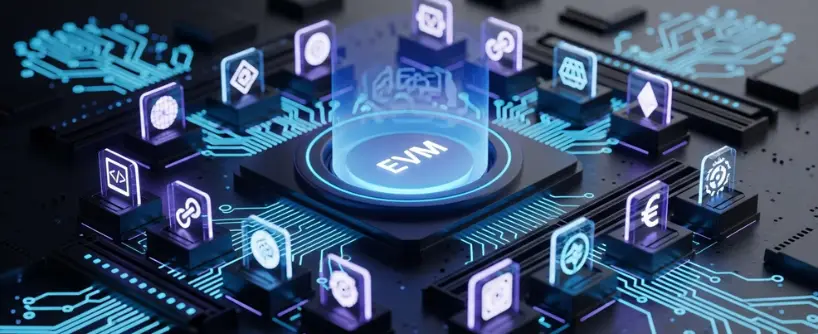 Ethereum was the first blockchain to introduce programmable smart contracts at scale. Its decentralized virtual machine, called the Ethereum Virtual Machine (EVM), executes contract code consistently across all network participants. The EVM is a completely isolated system, meaning it operates in a sandboxed environment with no access to external networks or filesystems, ensuring secure execution of smart contracts. Ethereum smart contracts can also interact with other smart contracts and other contracts within the ecosystem.
Why Ethereum Dominates
- Maturity: Ethereum has been operational since 2015 and hosts thousands of dApps.
- Standards: Popular token standards like ERC20, ERC721, and ERC1155 originated on Ethereum.
- Ecosystem: Development tools, libraries, and community resources are centered around Ethereum.
- Security: Ethereum’s large validator base makes it resilient to attacks.
Smart Contract Basics

Written in Solidity
Solidity is Ethereum’s most popular programming language. Every Solidity contract begins with a pragma solidity directive to specify the compiler version. Variables in a contract can store and update value, and the contract's code defines how these values are managed. It allows developers to define rules, manage permissions, and create reusable functions.Immutable Code
Once a new contract is deployed, its code becomes immutable and cannot be altered, ensuring stability and trust. Some contracts use proxy patterns for upgrades, but immutability is the default.Transparent Execution
Smart contract code and transactions are publicly visible on the blockchain. Each transaction is publicly visible, including the source account that initiated it. This transparency builds trust but also requires developers to code carefully, as flaws are equally visible.Benefits of Smart Contracts

- Automation: Smart contracts automate tasks and business processes, allowing transactions and agreements to execute automatically without intermediaries. This improves efficiency for businesses across various industries.
- Transparency: Code and results are verifiable on the blockchain, making blockchain-based operations more trustworthy for businesses.
- Security: Immutable contracts reduce fraud and tampering, providing a secure foundation for business activities.
- Cost Savings: Removing intermediaries lowers fees. Automating payments and supply chain management are key benefits for blockchain-based businesses, streamlining financial transactions and enhancing operational efficiency.
- Global Access: Anyone with internet access can interact with them, enabling businesses worldwide to leverage these advantages.
Limitations of Smart Contracts

- Code Errors: Bugs can lead to catastrophic financial losses.
- Immutability Risks: Errors are hard to fix once deployed.
- Scalability Issues: High gas fees on Ethereum can limit adoption.
- Dependency on Oracles: Real-world data requires external sources.
Real-World Applications of Smart Contracts

Decentralized Finance (DeFi)
DeFi is one of the biggest revolutions powered by smart contracts. Instead of relying on traditional banks, smart contracts handle lending, borrowing, trading, and savings automatically. For example, platforms like Aave and Compound allow users to deposit cryptocurrency into liquidity pools, where smart contracts then lend it out to borrowers. Interest rates are calculated in real time based on supply and demand, and both lenders and borrowers interact with the protocol without needing a middleman. Smart contracts also power decentralized exchanges (DEXs) such as Uniswap. These platforms allow users to trade tokens directly from their wallets. Liquidity pools and automated market makers (AMMs) are governed by smart contracts, ensuring trades are executed fairly and instantly. By removing centralized intermediaries, DeFi smart contracts reduce fees, increase transparency, and give users more control over their funds. Another major DeFi use case is yield farming, where users move assets across protocols to earn rewards. Smart contracts automate reward distribution, ensuring participants receive tokens proportional to their contributions. Without smart contracts, such complex systems would be impossible to run without trusted middlemen.Non-Fungible Tokens (NFTs)
NFTs have transformed digital ownership, and smart contracts are at the core of their functionality. Each NFT is powered by an ERC721 or ERC1155 contract on Ethereum or compatible blockchains. These contracts store unique identifiers, ownership details, and links to metadata such as images or music files. Marketplaces like OpenSea or Blur rely entirely on smart contracts to handle minting, transfers, and sales. When a buyer purchases an NFT, a smart contract verifies payment, transfers ownership, and updates the blockchain record permanently. This automation ensures that creators are paid royalties instantly, and buyers can trust the authenticity of their purchase. NFTs go beyond art and collectibles. Ticketing systems now issue concert or event tickets as NFTs, preventing counterfeiting. Real estate companies are exploring tokenized property deeds using smart contracts to prove ownership. Even in gaming, NFTs represent unique skins or in-game items, providing players with true ownership of digital assets.Gaming
Blockchain-based gaming has seen exponential growth thanks to smart contracts. Traditional games are controlled by centralized publishers, but blockchain games give players real ownership of in-game assets. Smart contracts issue fungible tokens for currencies and NFTs for rare items, skins, or weapons. Games like Axie Infinity became famous for creating play-to-earn models, where players earn real-world value by participating. Smart contracts manage battles, distribute rewards, and record asset ownership. Without them, it would be impossible to maintain trust in decentralized gaming economies. Another benefit of smart contracts in gaming is interoperability. An NFT sword earned in one blockchain game could potentially be used in another, thanks to shared standards. This creates entirely new ecosystems where players benefit from the value they generate. As Web3 gaming expands, smart contracts will remain its foundation.Supply Chain
Supply chains are often plagued by inefficiencies and lack of transparency. Smart contracts offer solutions by automating processes such as product tracking, payments, and quality control. Enterprises can record each step of a product’s journey on the blockchain, ensuring authenticity and accountability. For example, IBM’s Food Trust uses blockchain-based smart contracts to track food from farms to stores. If contamination is discovered, retailers can trace the exact source in seconds, preventing widespread recalls. Similarly, the diamond industry uses smart contracts to verify the origin of gems, ensuring they are conflict-free. Smart contracts also improve international trade. Instead of relying on manual paperwork and multiple intermediaries, trade agreements can be encoded into blockchain contracts. Payments can be released automatically once shipping milestones are verified, reducing delays and cutting costs.Insurance
Insurance is another industry where smart contracts are driving change. Traditional claims often involve delays, manual verification, and disputes. With smart contracts, payouts can be automated as soon as conditions are met. For example, flight insurance powered by smart contracts automatically compensates travelers if a flight is delayed or canceled. Oracles provide real-time flight data to the blockchain, and once a delay is confirmed, the smart contract releases payment instantly, no paperwork required. In agriculture, smart contracts linked to weather oracles can automate crop insurance. If rainfall falls below a threshold, payouts are triggered automatically. This reduces administrative costs for insurers and provides farmers with faster access to funds. By reducing fraud, cutting overhead, and speeding up settlements, smart contracts make insurance more efficient and customer-friendly.Smart Contract Code Example
pragma solidity ^0.8.0;

// This is a basic example of a smart contract.
contract SimpleStorage {
    uint256 private data; // Stores a value

    function set(uint256 x) public {
        data = x; // Set the value
    }

    function get() public view returns (uint256) {
        return data; // Retrieve the value
    }
}Beginner Guide to Smart Contracts

- Learn Solidity: Begin with tutorials and Ethereum developer documentation.
- Use Testnets: Deploy contracts on test networks like Goerli or Sepolia.
- Experiment with Tools: Frameworks like Hardhat and Truffle simplify testing, and many features are already implemented in widely used libraries, making development easier.
- Follow Best Practices: Adopt libraries such as OpenZeppelin.
- Prioritize Security: Always test extensively and seek audits.
Security in Smart Contracts
Security is the most important factor in development. Unlike traditional systems that depend on a central authority for enforcement, smart contracts operate autonomously on the blockchain. This increases security by removing the need for a trusted intermediary, but also places full responsibility on the code itself. Common vulnerabilities include:- Reentrancy Attacks: Exploiting repeated calls before state updates.
- Integer Overflows: Mathematical errors causing logic failures.
- Improper Access Control: Granting permissions too broadly.
- Use libraries with audited code.
- Limit admin privileges.
- Employ multi-signature wallets for governance.
- Conduct multiple audits and bug bounties.