
Article Summary
- This article provides a detailed price prediction and fundamental analysis for the Aerodrome Finance (AERO) token.
- It describes Aerodrome as the central liquidity hub and automated market maker (AMM) built on Base, Coinbase's Layer-2 network.
- The bull case focuses on Aerodrome's dominant position within the rapidly growing Base ecosystem, its innovative ve(3,3) tokenomics that incentivise long-term holding, and the massive user base of Coinbase.
- The bear case highlights the highly inflationary nature of the AERO token, intense competition from other DEXs migrating to Base, and the inherent volatility of yield farming protocols.
- It presents detailed price prediction scenarios (bearish, neutral, bullish) for both 2026 and 2030, based on Base network adoption and DEX trading volume.
Aerodrome Finance became important fast because Base needed a place where liquidity could gather, move efficiently, and stay useful to traders and protocols. Aerodrome stepped into that role as an automated market maker (AMM) and liquidity hub built specifically for Base, combining ideas from Uniswap V2/V3 and Curve-style design with a vote-locked incentive system that rewards active participation.
If you prefer to watch the asset from a crypto exchange before using the protocol directly, Bitunix already offers the AERO/USDT market. But the investment case does not depend on the listing alone. It depends on whether Aerodrome can keep turning Base adoption, trading activity, and token lockups into durable demand for AERO. This analysis looks at how that system works, where the upside comes from, and where it can break.
The Technology and Ecosystem
Aerodrome works because it turns governance into a market. Instead of paying liquidity providers in a simple farm-and-forget way, it forces protocols, traders, LPs, and token lockers into the same weekly incentive game. When that game works, Base gets deep liquidity, and AERO gets a reason to stay locked.
1. The ve(3,3) Model Explained
The official 2025 Aerodrome disclosure explains the design like this:
"Unlike traditional exchanges that extract value through fees, Aerodrome returns 100% of trading fees to veAERO voters, creating a truly community-owned marketplace."
That line gets to the heart of the ve(3,3) model. Users lock AERO to receive veAERO, which is represented as an NFT position, with the lock duration being an essential part of the process. Aerodrome's 2025 disclosure states that a user locking for 4 years has 4 times the voting power of someone locking for 1 year. Weekly votes then direct emissions toward specific pools, and the lockers who vote into productive pools collect the fees and incentives tied to those gauges.
The same disclosure also lays out the emission system: Aerodrome started with 10 million AERO per week, increased emissions during the launch phase, then shifted into a cruise phase with weekly reductions, and later hands monetary policy adjustments to veAERO voters through the Aero Fed.
2. The Base Network Advantage
Aerodrome's biggest structural edge is that it was built for Base rather than copied onto Base as an afterthought. Base is an Ethereum Layer 2 on the OP Stack, and its fee model splits costs into an L2 execution fee and an L1 security fee. That setup gives users cheaper transactions than mainnet while still settling to Ethereum. For an AMM, that matters a lot because swaps, LP management, vote claims, and rebases all get more usable when each step is cheap enough that normal people do not wince before clicking.
And the broader Base backdrop is not small anymore. DefiLlama's current Base dashboard shows over $1.14 billion in 24-hour DEX volume and more than $6.81 billion in 7-day DEX volume, with activity spread across a chain that already processes millions of transactions per day. Aerodrome sits inside a chain that already has enough traffic to make a Base network DEX relevant on its own terms.
3. The AERO Token
The AERO token does two jobs at once, and that is where both its strengths and challenges begin. In its liquid form, AERO is the emissions token used to reward liquidity providers and keep pools attractive. In its locked form, veAERO is the governance and fee-capture instrument.
Aerodrome's 2025 disclosure also notes that veAERO positions are ERC-721 NFTs representing locked positions, while AERO itself remains the fungible token that trades in the market. For traders using Bitunix spot or perpetual markets, that means you can take directional exposure to AERO without participating in weekly gauge voting. For on-chain users, though, the higher-value part of the design usually sits on the locked side.
The Bull Case: The Coinbase Catalyst
Looking at current forecast models through the lens of actual Base activity gives a much cleaner picture. CoinCodex's April 21, 2026 update puts AERO at about $0.3734 by the end of 2026 and $0.9680 by 2030, while Kraken's public calculator, using a standard 5% annual growth input, lands near $0.40 by the end of 2026 and $0.49 by 2031. Coinbase's projection tool lands in a similar range, showing about $0.39 for May 2026 and $0.47 by 2030 under the same 5% growth input. Those numbers leave room for a strong upside case if Aerodrome continues to convert Base growth into fees and lockups.
1. Dominating Base TVL
Aerodrome's strongest bull argument is that it already operates like core infrastructure on Base. Current DefiLlama data shows about $347.5 million in TVL, around $581.3 million in 24-hour DEX volume, and roughly $3.56 billion in 7-day DEX volume for Aerodrome alone. When compared with Base-wide DEX activity, Aerodrome accounts for about half of the chain's swap volume across both the 24-hour and 7-day views. That kind of market share gives it a clear edge as the main liquidity hub for new launches, active trading pairs, and users who want deep liquidity without leaving the Base ecosystem.
2. The Coinbase Funnel
Coinbase has been smoothing the road into on-chain trading, and Aerodrome sits right in the middle. In August 2025, Coinbase said users would be able to trade millions of on-chain assets directly in the Coinbase app, with DEX trading rolling out through Base-native assets first. By October 8, 2025, Coinbase said the feature was available to all U.S. customers except New York, using integrated self-custody and sponsored network fees to hide some of the usual on-chain friction. That does not name Aerodrome directly, but when the biggest liquidity hub on Base already handles about half the chain's DEX volume, it is a reasonable inference that Aerodrome stands to capture a meaningful share of any retail traffic that sticks.
3. The Flywheel Effect
The best thing about Aerodrome is that the tokenomics at least try to connect price with usage. DefiLlama currently shows about $82.53 million in annualized fees, $82.53 million in annualized revenue, and $82.53 million in annualized holders' revenue, with $6.76 million in fees over the last 30 days. When trading stays active, fee income supports veAERO holders. When fee income supports veAERO holders, locking looks smarter than selling. And as more AERO gets locked, circulating sell pressure eases while pools continue to receive emissions.
That dynamic supports a bull case for AERO because it gives the token a practical economic role beyond speculation. When Aerodrome handles more trading, fee generation improves, and stronger fee income makes locking AERO into veAERO more attractive. More locking reduces the amount of liquid AERO that can be sold into the market, while deeper liquidity keeps the platform useful for traders and new projects on Base. If that cycle keeps reinforcing itself, demand for the token rises as effective circulating supply tightens, which is exactly the kind of setup bulls want to see.
The Bear Case: Inflation and Competition
The skeptical case only needs math and memory. CoinCheckup's price prediction currently forecasts $0.2887 by May 21, 2026, and CoinCodex gives a 2026 range of $0.2649 to $0.3850 in one current view, while Bitget's public prediction page, again using a 5% annual growth frame, lands at $0.4676 for 2030. These are not collapse numbers, but they are far from the multi-dollar targets that show up when DeFi traders get overexcited. They also suggest the broader market still sees AERO as a grinding execution story.
1. High Token Inflation
Aerodrome's own 2025 risk disclosure is refreshingly direct here. The protocol says it relies on AERO emissions for growth, that those emissions started at 10 million AERO weekly, and that liquidity providers can leave if trading fee revenue does not replace emission rewards. That is the core weakness of the ve(3,3) model. It works well when fees stay high and lockers remain engaged, but it breaks down when emissions keep rising and the market decides the locked token is not worth the trouble. At that point, AERO becomes a subsidy machine that keeps printing into weaker demand.
2. The DEX Wars on Base
Aerodrome leads Base right now, but it does not operate without close competitors. DefiLlama's Base DEX ranking page currently shows Aerodrome at $452.75 million in 24-hour volume, compared with Uniswap at $117.09 million and PancakeSwap at $104.61 million. If Base keeps growing, competitors will keep showing up, and some of them will happily accept lower margins or aggressive incentives to peel away volume.
3. Yield Farming Fatigue
Aerodrome's own risk document warns that vote-buying can send emissions to low-volume pools with high bribes rather than productive trading pairs, and notes that short-term-focused liquidity providers can extract value without supporting long-term protocol health. Add in the complexity of epochs, voting, dual-token mechanics, and gauge management, and you have a familiar DeFi problem. Yield farming attracts attention quickly, but the crowd it attracts is not always patient, loyal, or interested in governance.
Aerodrome Finance Price Prediction Scenarios for 2026 and 2030
A good Aerodrome finance price prediction should admit that current forecasts cluster in one of two camps. Conservative model-driven tools such as CoinCodex, Kraken, Coinbase, and Bitget mostly sit below or around one dollar by 2030, depending on assumptions. On the other side, more aggressive narrative-driven pieces go much higher. Phemex, for example, published a 2025 article citing $3.04 by the end of 2026 and $35.15 to $45 by 2030 as optimistic outcomes.
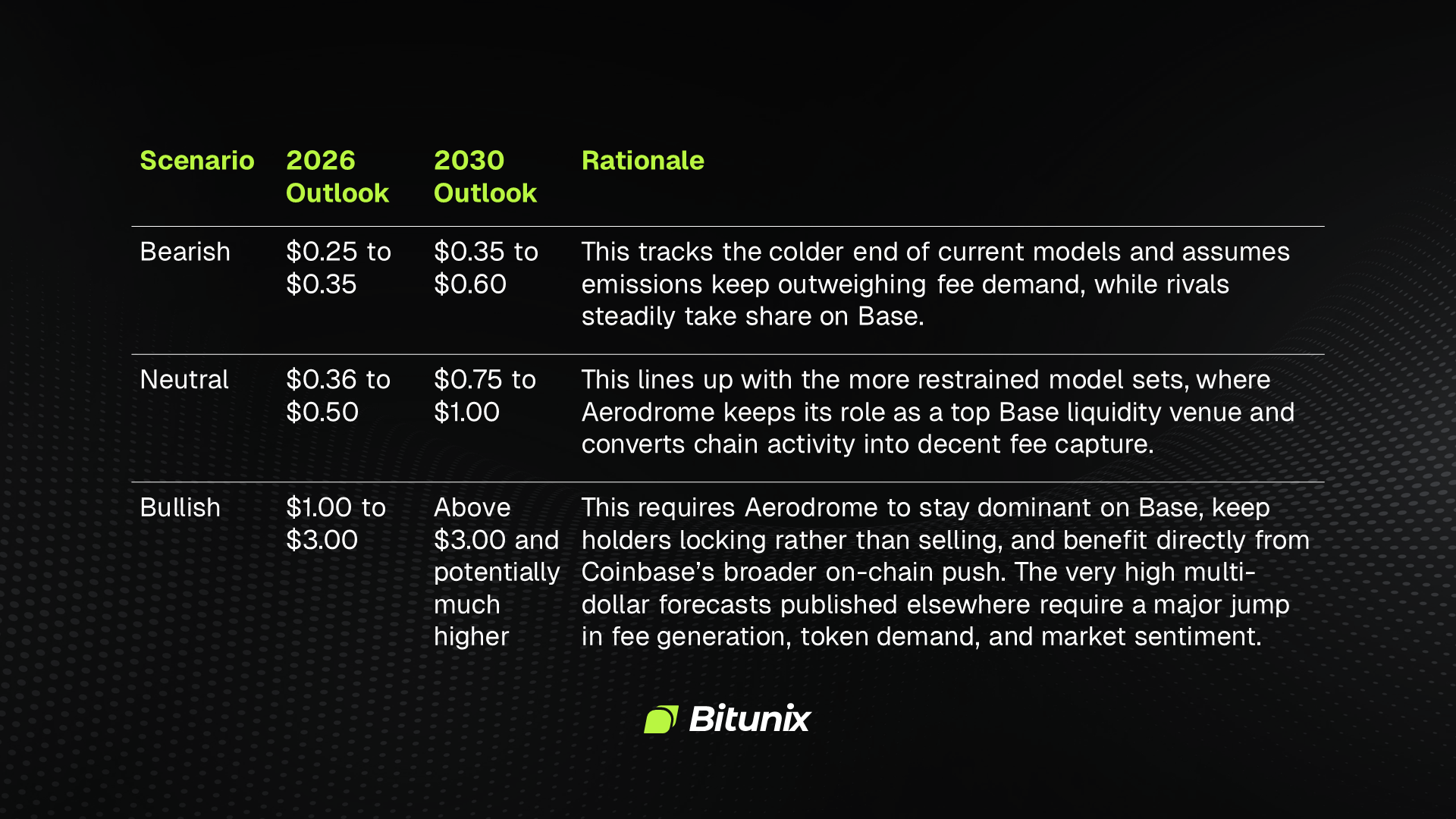
Aerodrome Finance scenario table comparing bearish, neutral, and bullish price outlooks for 2026 and 2030.
Conclusion: A Bet on Base
Aerodrome Finance represents one of the strongest pieces of DEX infrastructure on Base today. The protocol already handles roughly half of Base DEX volume, it generates meaningful fee revenue, and its veAERO structure gives the token a better reason to exist than many farm coins ever had. If Base keeps compounding its users, transactions, and asset activity, Aerodrome stays in the front row for that growth.
But AERO is still a leveraged bet on two things that have to work together: Base has to stay strong, and the ve(3,3) model has to stay worth playing. If either one weakens, price pressure shows up quickly. If both hold, the token has room to outperform the slow, mechanical models now circulating. And if you want to trade that view rather than LP into it, Bitunix already offers the AERO/USDT trading pair, so you can download the Bitunix app and register to track AERO and other Layer 2 assets from one place.
FAQ
What is Aerodrome Finance (AERO)?
Aerodrome Finance is an AMM and liquidity hub on Base. It combines swaps, liquidity pools, gauge voting, and vote-locked tokenomics so traders, LPs, and veAERO holders all interact inside the same incentive system.
What is the Base network?
Base is an Ethereum Layer 2 built on the OP Stack in collaboration with Optimism. It is designed to offer lower-cost on-chain activity while still relying on Ethereum for final settlement and security.
How does the ve(3,3) tokenomics model work?
Users lock AERO to receive veAERO. That veAERO gives voting power over weekly emissions, and voters collect the trading fees and incentives attached to the pools they support. Longer locks receive more voting power.
What is the difference between AERO and veAERO?
AERO is the liquid token used to trade and fund emissions. veAERO is the locked governance position, represented as an NFT, that controls gauge votes and collects fee-based rewards from supported pools.
How can I earn yield on Aerodrome?
You can earn through LP rewards, gauge incentives, and veAERO voting rewards. The trade-off is that the higher-yield paths usually require more work, greater lock commitment, or greater exposure to token and pool-specific risk.
Why is Aerodrome so dominant on Base?
Aerodrome is dominant on Base because it pairs deep liquidity with strong incentives. Its ve(3,3) design keeps emissions tied to useful pools, its AMM tools improve execution and reduce slippage, and its close fit with Base helps it capture users, volume, and fees faster than rivals.
What is the relationship between Aerodrome and Coinbase?
Aerodrome is not Coinbase's DEX, but it sits inside the Base chain that Coinbase incubated. As Coinbase expands in-app DEX trading and Base-native asset access, Aerodrome is positioned to benefit because of its scale on Base.
Is the AERO token inflationary?
Yes, emissions are a core part of the design. Aerodrome's 2025 disclosure says the protocol launched with 10 million AERO weekly emissions, then moved through scheduled phases that later led to monetary policy adjustments for veAERO voters.
What are the risks of investing in AERO?
The biggest risks are emissions dilution, rival DEX competition on Base, governance complexity, liquidity fragmentation, and short-term capital chasing rewards without adding durable value.
Where can I buy AERO tokens?
You can buy AERO on major centralized exchanges such as Gate.io, Bitunix, Bybit, Kraken, Coinbase, and Revolut, or swap for it directly on Base through Aerodrome or Uniswap.
Glossary
- AMM: An automated market maker is a smart-contract exchange that uses liquidity pools instead of a traditional order book.
- AERO token: The liquid asset of Aerodrome used for trading, emissions, and participation in the protocol economy.
- veAERO: The locked governance version of AERO that gives voting power and access to fee-based rewards.
- ve(3,3) model: A tokenomics structure that combines vote-locking with emissions voting and fee incentives to reward long-term participation.
- Gauge: A voting target that determines which liquidity pools receive AERO emissions in a given epoch.
- Epoch: Aerodrome's recurring weekly governance and rewards cycle, during which votes and incentives are allocated.
- Liquidity provider: A user who deposits token pairs into a pool so traders can swap against that pool.
- TVL: Total value locked, or the dollar value of assets currently deposited in a protocol's smart contracts.
- DEX volume: The amount of spot trading executed through decentralized exchanges over a given time period.
- Holders revenue: The share of protocol revenue that goes to token holders or governance participants rather than the treasury alone.
- OP Stack: The modular software framework used to build Layer 2 chains such as Base.
- Optimistic Rollup: A Layer 2 design that processes transactions off-chain and posts batches to Ethereum, assuming validity unless challenged.
- Impermanent loss: The trading-related risk LPs face when the price ratio between pooled assets changes significantly.
- Bribes or vote incentives: Extra token rewards offered to veAERO voters to direct emissions toward certain pools.
- Mercenary capital: Short-term liquidity that arrives for incentives and leaves once rewards weaken, often hurting token stability.
Disclaimer
This article does not provide:
(i) investment advice or investment recommendations;
(ii) an offer or solicitation to buy, sell, or hold digital assets;
(iii) financial, accounting, legal, or tax advice.
Digital assets, including stablecoins and NFTs, involve high risk and may fluctuate significantly. Consider whether trading or holding digital assets is appropriate for you given your financial situation. Consult a qualified legal, tax, or investment professional when needed. You are responsible for understanding and complying with applicable local laws and regulations.
About Bitunix
Bitunix is a global cryptocurrency derivatives exchange trusted by over 3 million users across more than 100 countries. At Bitunix, we are committed to providing a transparent, compliant, and secure trading environment for every user. Our platform features a fast registration process and a user-friendly verification system supported by mandatory KYC to ensure safety and compliance. With global standards of protection through Proof of Reserves (POR) and the Bitunix Care Fund, we prioritize user trust and fund security. The K-Line Ultra chart system delivers a seamless trading experience for both beginners and advanced traders, while leverage of up to 200x and deep liquidity make Bitunix one of the most dynamic platforms in the market.
Bitunix Global Accounts
X | Telegram Announcements | Telegram Global | CoinMarketCap | Instagram | Facebook | LinkedIn | Reddit | Medium