Decentraland is one of the earliest blockchain-based virtual worlds and one of the best-known projects from the first wave of the metaverse sector. Built on Ethereum, the platform allows users to explore a shared virtual environment, create experiences, own digital assets, and participate in a community-driven economy.
At the center of this ecosystem is MANA, Decentraland's native token. MANA can be used to purchase digital assets, participate in the platform's economy, and contribute to decentralized governance. Unlike traditional online games and virtual worlds, Decentraland is designed around user ownership, with LAND, Names, Wearables, and other digital assets represented on blockchain.
The project has evolved considerably since the metaverse boom of 2021. Decentraland is now focusing on improving its underlying technology, expanding access across desktop and mobile platforms, and developing shorter, more accessible multiplayer experiences. In March 2026, Decentraland launched on the Epic Games Store and released its Android mobile application, with iOS support also in development.
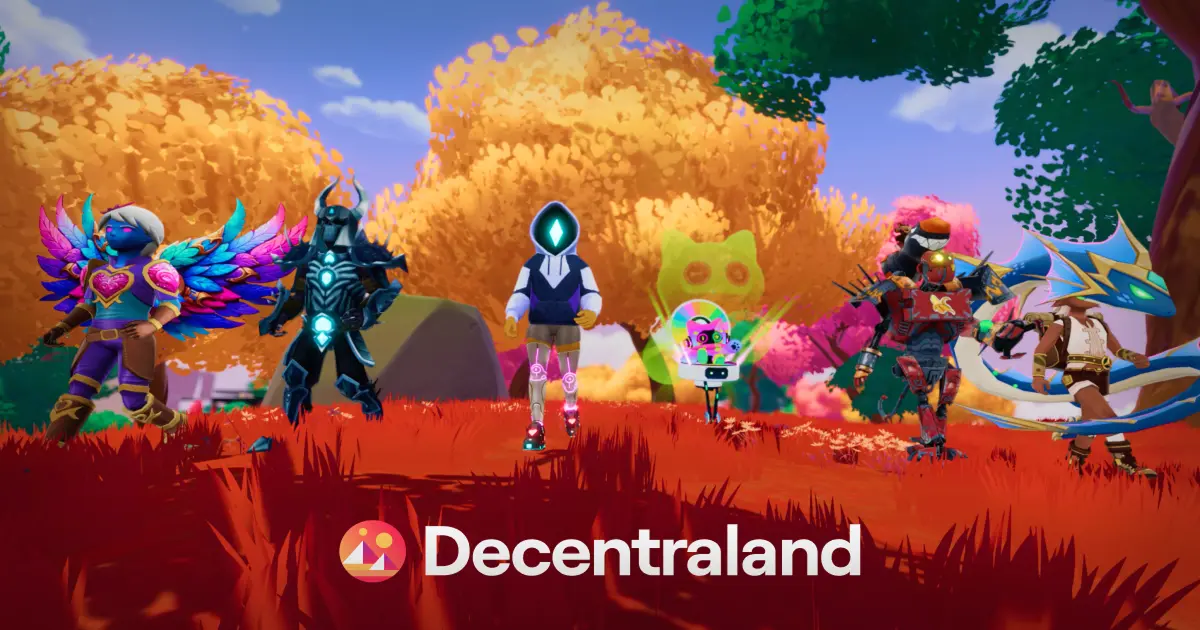
Data Source: Decentraland
What Is Decentraland (MANA)? Understanding the Decentraland Token
MANA is the native cryptocurrency of Decentraland, a decentralized social virtual world built on Ethereum. The token is primarily used within Decentraland's digital economy and can be exchanged for virtual assets and services.
Decentraland allows users to explore a persistent virtual environment containing community-created scenes, games, social spaces, events, and other interactive experiences. Users can also create and monetize content, customize their avatars, and own blockchain-based assets such as LAND, Names, Wearables, and Emotes.
MANA plays several roles within this ecosystem. It can be used to purchase digital assets, participate in certain transactions, and contribute to Decentraland's decentralized governance system. MANA holders can also receive voting power in the Decentraland DAO, although voting power is not determined solely by MANA holdings. LAND, NAMEs, and certain legacy Wearables can also contribute to a user's voting power.
One of Decentraland's defining characteristics is its emphasis on user ownership and community governance. The Decentraland DAO manages important components of the ecosystem, including LAND and Estate smart contracts, while community members can vote on proposals affecting the platform.
Who Created Decentraland?
The concept behind Decentraland was created in 2015 as an experiment in using blockchain technology to establish ownership of virtual land. The project later developed into a decentralized virtual world, with its first white paper published in 2017 and its public launch taking place in 2020.
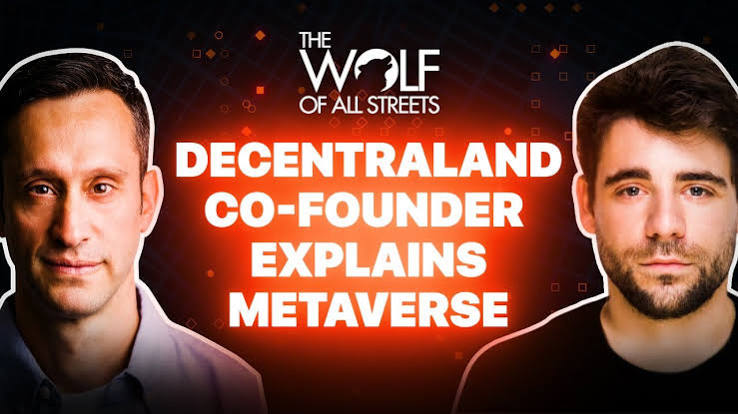
Decentraland was co-founded by Ari Meilich and Esteban Ordano. The two played important roles in the project's early development, with Meilich serving as project lead and Ordano working as its technical lead.
The project was structured around decentralization from an early stage. The Decentraland Foundation was established as a nonprofit organization to support development, security, and ecosystem growth, while the Decentraland DAO was designed to give users a role in governing the platform.
Today, the Foundation continues to support core infrastructure and development, but Decentraland's long-term direction is increasingly being shifted toward community governance. The Foundation's stated plan is to gradually transition responsibilities to the DAO, with the goal of becoming fully community-driven by 2030.
Data Source: UTB
Factors that affect MANA Price?
MANA's price is influenced by both broader crypto market conditions and the development of Decentraland itself. As a metaverse-related token, it can benefit from renewed investor interest in virtual worlds and digital ownership, while platform growth, partnerships, and improvements to the user experience could potentially create additional demand for the ecosystem.
Renewed Interest in Metaverse and Virtual Worlds
A renewed interest in metaverse applications and virtual worlds could provide a potential catalyst for MANA.
The metaverse narrative lost much of its momentum after the 2021 crypto market cycle, but virtual worlds have continued to develop as platforms for social interaction, digital identity, entertainment, events, and user-generated content. Decentraland's model is positioned around these use cases rather than relying exclusively on speculative virtual real estate.
The project's recent development efforts also suggest a shift toward making the platform easier to access. Decentraland launched on the Epic Games Store in March 2026 and released an Android mobile application, expanding access beyond its traditional desktop and browser audience. The platform has subsequently continued working toward cross-platform access, allowing users to access the same virtual world from desktop and mobile devices.
For MANA, the key factor would be whether broader access translates into sustained user activity. More users spending time in Decentraland could increase demand for digital assets, events, creator content, and other activities within the ecosystem. A revival of the metaverse narrative could therefore become more meaningful if it is accompanied by measurable growth in actual platform usage.
New Partnerships and Platform Development
Partnerships, new experiences, and technical improvements represent another potential source of growth for Decentraland.
The platform has historically attracted brands, artists, creators, and event organizers that use virtual spaces for marketing campaigns, entertainment, exhibitions, and social experiences. Its creator economy includes LAND, Wearables, Emotes, and user-generated scenes, allowing third-party creators to build directly within the Decentraland environment. The platform currently states that creators retain 97.5% of their earnings from sales, with 2.5% directed toward the DAO treasury.
Technical development is also becoming increasingly important. Decentraland's recent roadmap has focused on new desktop and mobile clients, improved performance, multiplayer functionality, and better support for creators. In early 2026, development teams were working on mobile and web clients while also testing smaller multiplayer experiences designed around shorter play sessions.
These developments could broaden Decentraland beyond its traditional image as a virtual-land platform. If new clients, creator tools, and social or multiplayer experiences succeed in attracting recurring users, the resulting increase in ecosystem activity could create additional utility for MANA.
MANA Tokenomics
MANA was originally introduced through Decentraland's 2017 token sale. The token has an 18-decimal denomination and operates as an ERC-20 token on Ethereum. MANA can also be burned in certain transactions within the Decentraland ecosystem, which has contributed to changes in its total supply over time.
Decentraland's maximum supply is approximately 2.193 billion MANA. According to a 2025 crypto-asset statement from Kraken, approximately 1.97 billion MANA were in circulation as of August 2025. The initial allocation was divided among token-sale participants, the Decentraland Foundation, the development team, and a community reserve.
MANA has several functions within the Decentraland ecosystem:
Digital asset purchases: MANA can be used to purchase assets and services within Decentraland.
Virtual economy: Users can exchange MANA for assets such as LAND and other digital goods.
Governance: MANA contributes to voting power within the Decentraland DAO.
Creator economy: MANA supports transactions involving community-created content and digital assets.
Ecosystem participation: MANA can be used as part of the broader economic infrastructure connecting users, creators, and digital property.
Because MANA is closely connected to Decentraland's economy, its long-term demand depends in part on whether users and creators continue to transact within the platform.
MANA Price History
MANA's price history is closely connected to the development of the broader metaverse narrative.
The token traded at relatively low levels during its early years before entering a major rally in 2021. As investor interest in NFTs, virtual land, blockchain gaming, and metaverse platforms accelerated, MANA became one of the most prominent metaverse tokens in the cryptocurrency market.
MANA reached its all-time high of approximately $5.85 on November 25, 2021.
The token subsequently experienced a prolonged decline as the broader cryptocurrency market entered a bear cycle and investor interest in metaverse-related assets weakened. MANA remained significantly below its 2021 peak during the following years, reflecting the broader decline in speculative demand for virtual-world tokens.
MANA's price history illustrates the strong relationship between the token and broader market narratives. Its performance has historically been influenced not only by developments within Decentraland but also by changes in investor interest in NFTs, virtual worlds, blockchain applications, and the wider crypto market.
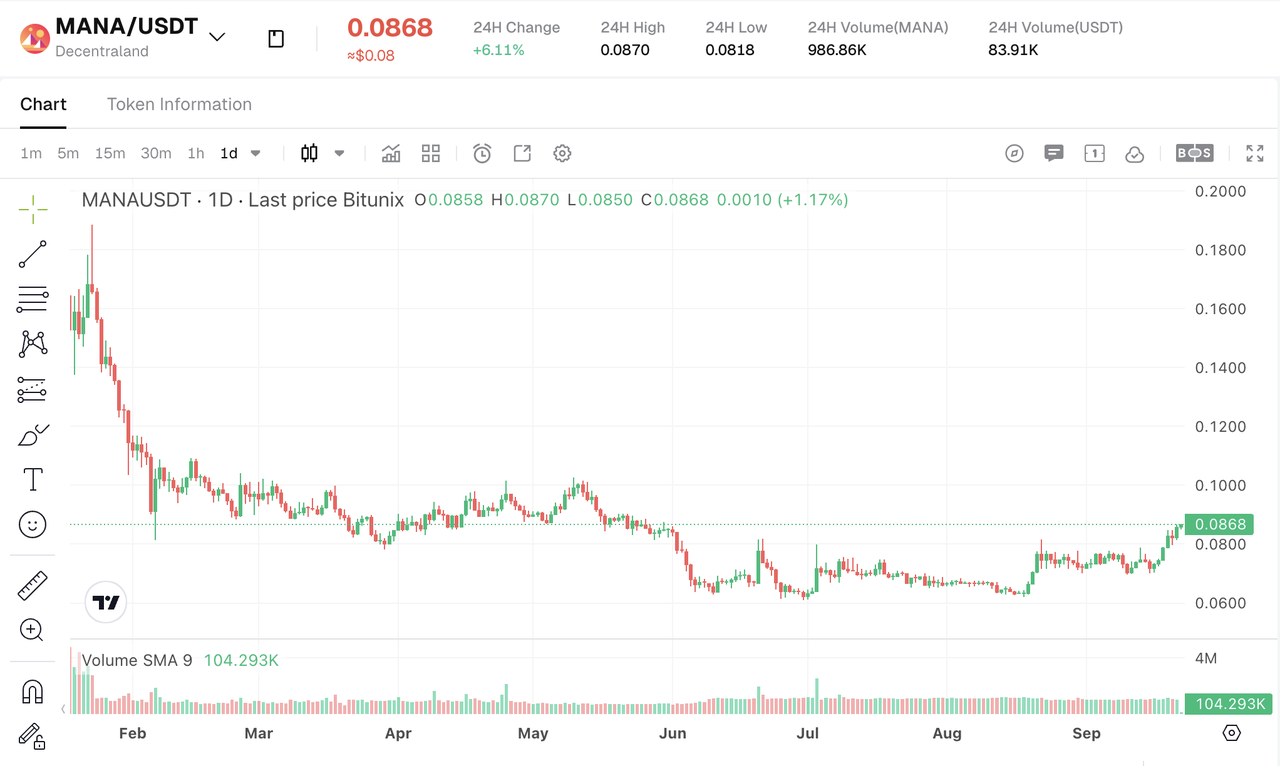
Data Source: Bitunix
How to Buy MANA
Users looking to trade MANA can currently access the token through centralized exchanges that support MANA or decentralized trading platforms compatible with Ethereum. For users familiar with on-chain trading, an Ethereum-compatible wallet can be connected to a relevant decentralized exchange (DEX) to trade MANA. Those who prefer a simpler trading interface may instead choose a centralized exchange that supports MANA. As Decentraland continues to develop its virtual-world and creator ecosystem, MANA remains available across both centralized and decentralized markets.
Buying MANA through centralized cryptocurrency exchanges such as Bitunix allows users to trade through a centralized intermediary and, depending on the platform, use fiat currencies or stablecoins such as USDT to purchase crypto assets. Some platforms may also support instant purchases by credit card, lowering the barrier to entry for new users. Before trading, users generally need to register an account and complete identity verification (KYC) to comply with applicable Anti-Money Laundering (AML) and Counter-Terrorist Financing requirements. Bitunix provides compliance and risk-control measures, including hot and cold wallet separation, multi-signature mechanisms, and real-time monitoring, to help protect user assets.