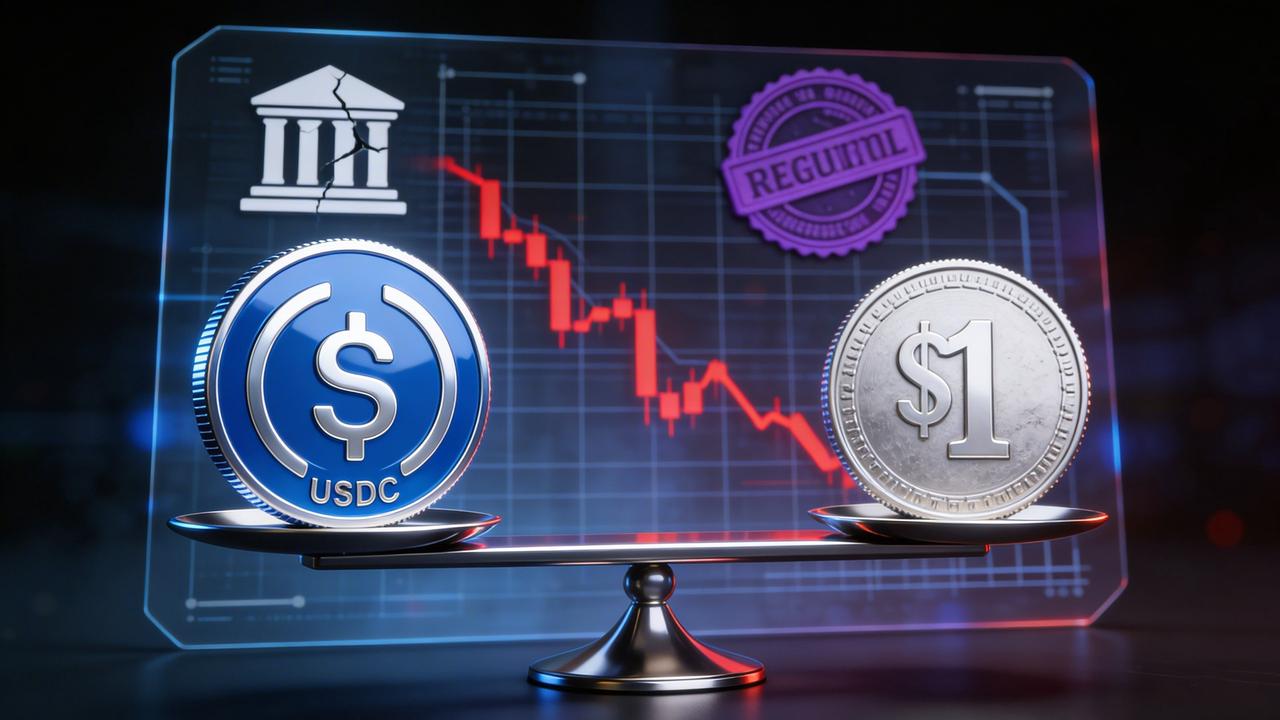
When you hold a stablecoin, you don't want price predictions—you want a price guarantee. For USD Coin (USDC), the promise is simple: one USDC will always equal one U.S. dollar. But in the volatile world of crypto, can that promise always be kept?
You will also see USDC everywhere inside a crypto exchange, including Bitunix, because traders use it as a parking spot between moves. The real question is not whether USDC will rise considerably. The question is whether the peg can hold when markets panic, banks wobble, or regulators change the rules.
We will dive deep into the structure of USDC, examining its reserves, the credibility of its issuer (Circle), and the external risks it faces to determine the likelihood that it will maintain its $1 peg in the future.
How USDC is Designed to Stay at $1
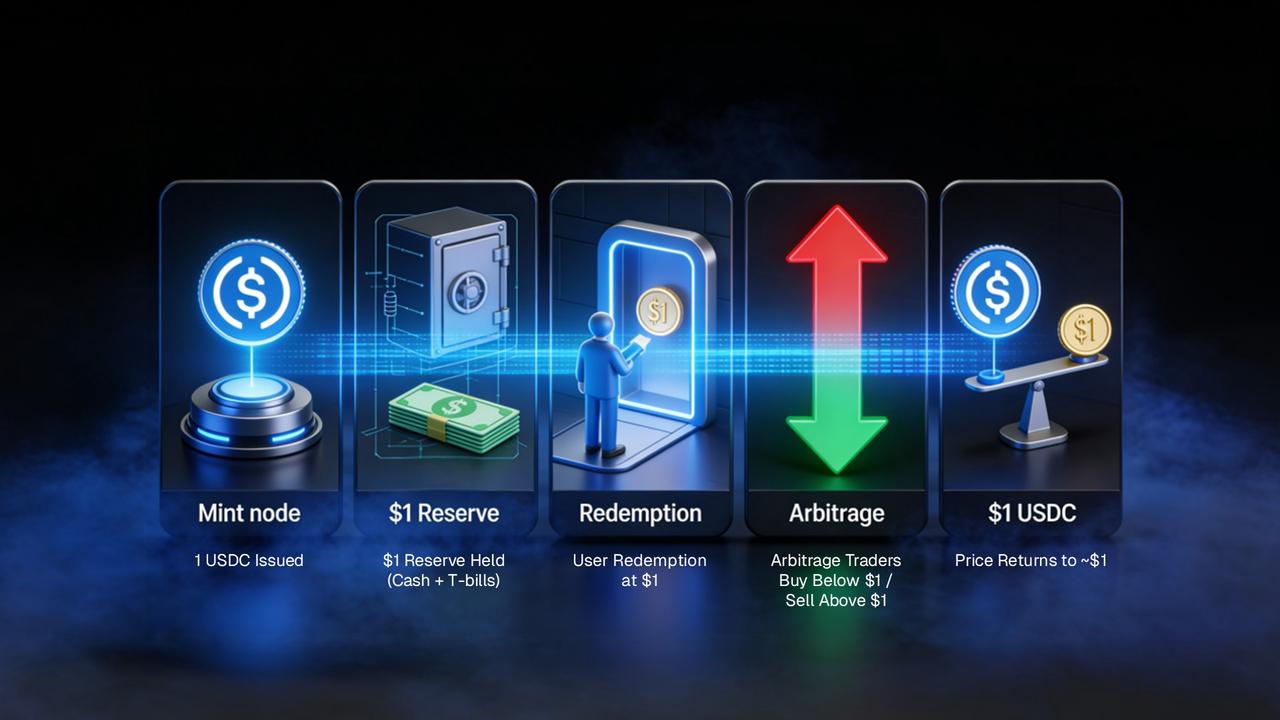
USDC is issued by Circle, and its stability depends on a basic design rule, which is that for every USDC in circulation, Circle holds about one dollar’s worth of reserves. That reserve-backed model is the core reason USDC usually trades very close to $1.
The 1:1 Reserve Model
In practice, the reserve is not just a pile of dollar bills in a vault. It is a portfolio built to behave like cash. Circle’s public reporting emphasizes that the reserves are meant to be highly liquid so redemptions can be processed quickly when users want dollars back.
High-Quality, Liquid Reserves
Circle has described USDC reserves as mainly a mix of cash and short-dated U.S. Treasuries. A key part of that setup is the Circle Reserve Fund, which is managed by BlackRock, with assets held at BNY Mellon. This matters because Treasuries are designed to be easy to sell in normal conditions, and cash is already cash. The peg is basically a liquidity promise.
A helpful real-life way to picture it is that if a lot of people redeem USDC on the same day, Circle needs assets it can convert to dollars without taking big losses. Treasuries and cash are meant to make that possible.
Transparency and Attestations
USDC’s strongest argument is reporting. Circle publishes frequent reserve disclosures and third-party assurance. Here is a direct explanation from Circle’s reserve reporting page:
"Circle publishes weekly USDC reserve composition reports and monthly independent assurance reports by a Big Four accounting firm."
That does not eliminate risk, but it reduces guessing. In stablecoins, less guessing usually means less panic.
The Bullish Case: Why the Peg Will Hold
A strong peg story for USDC is basically a story about operational discipline. Here, we describe the best scenario regarding the peg holding for USDC
1. Unmatched transparency
Circle’s reserve reporting cadence and third-party assurance are a practical advantage during uncertainty. When rumors start, markets look for documents. The more clearly a stablecoin issuer can show reserves and processes, the less room there is for a spiral driven by fear.
There is also a network effect. USDC is widely integrated across exchanges, payments experiments, and DeFi. On growth, Circle reported that USDC in circulation grew more than 78% year over year, with monthly transaction volume hitting $1 trillion in November 2024 and all-time USDC volume surpassing $18 trillion. Circle’s USDC stats page later showed $73.4B USDC in circulation as of Feb 13, 2026. For 2025 activity, Bloomberg reported $18.3 trillion in USDC transaction volume in 2025 out of $33 trillion total stablecoin volume.
A larger footprint increases scrutiny, but it also increases the number of professional players who step in to keep markets orderly.
2. Regulatory Positioning
Circle has consistently signaled that it wants to operate inside regulatory frameworks rather than around them. Circle has pushed USDC toward a traditional finance setup. In June 2025, it applied to the OCC to create a national trust bank, First National Digital Currency Bank, N.A. The plan was to put USDC reserve management and some custody services under federal supervision.
A national trust bank is a narrow bank. It focuses on custody and fiduciary services, and it cannot take deposits or make loans. In December 2025, Circle said the OCC gave conditional approval, pending final requirements.
For you, it signals more oversight around how reserves are handled. That does not guarantee safety, but it can reduce the odds of a sudden compliance surprise.
3. Strong Institutional Plumbing
USDC’s reserve structure and custody relationships matter. The reserve fund being managed by BlackRock and held at BNY Mellon is not a price catalyst, but it is relevant to reliability. If you are assessing a circle stablecoin, the quality of the pipes behind it is part of the assessment.
And adoption keeps pushing this direction. Coverage around stablecoin payment settlement highlights that large payment networks and banks have explored settling with stablecoins like USDC, which increases the incentive to keep the system solid.
The Bearish Case: The Risks to the Peg
USDC is built to stay at $1, but it is still exposed to real-world failure modes. The 2023 depeg event is the best proof that a stablecoin can be both well-designed and temporarily fragile. Here are the main reasons why USDC can depeg in the future.
1. Custodial risk: the SVB case study
In March 2023, USDC briefly broke its peg after Silicon Valley Bank failed, because Circle disclosed that some USDC reserves were held at SVB. The market feared those funds could be trapped, and USDC traded down to around $0.87 at the worst point before recovering as conditions clarified.
The lesson is simple: the peg is only as strong as the institutions holding the cash portion of reserves, plus the speed at which redemptions and liquidity can be managed during a shock. Even if the reserves are ultimately there, fear can still move the price in the short term.
2. Regulatory Risk
Stablecoin regulation is moving fast, and outcomes can change demand overnight. A strict U.S. framework could raise compliance costs, limit certain business relationships, or change who can issue and distribute stablecoins.
In PwC Legal's 2026 report, the policy momentum shifts from drafting rules to enforcing outcomes. In the EU, MiCAR moves from authorizations to tighter supervision, with a strong focus on reserve quality, redemption at par, governance, and disclosures, especially for significant tokens. The UK also moves toward a payments-use regime for fiat-backed stablecoins with conduct and prudential oversight.
In the US, PwC says the debate centers on federal frameworks for payment stablecoins and how they fit with state regimes. Regulators also sharpen expectations on reserves, disclosures, redemption rights, and operational resilience. PwC adds that jurisdictions are coordinating more on market integrity and financial crime controls, so rule changes can land faster and with less warning.
For you as a user, this risk usually shows up as uncertainty. Uncertainty can cause holders to rotate into alternatives, which is how pegs get stressed.
3. Market-Wide Panic And Redemption Spikes
In a broad crash, a lot of people try to exit at the same time. Even liquid assets can get messy when everyone hits the door together. The stablecoin market has reached roughly $290 billion in 2025, which helps explain why stablecoin runs matter to the whole market now.
If redemptions surge, the peg can dip temporarily while systems process withdrawals and arbitrage capital catches up. It usually recovers if reserves remain sound, but the dip can be uncomfortable and fast.
If you are moving funds across networks, you also face operational risks that are not about the peg at all, like sending assets on the wrong chain. This is common when users switch between low-fee rails such as TRC-20 USDT and Ethereum-based tokens without double-checking deposit networks.
Price Prediction: Scenarios for the Peg
Most price prediction tools are built for assets that trend up or down. Stablecoins are different, so typical forecasting is often standardized. CoinCodex explicitly notes that it does not provide predictions for USDC because stablecoins are designed to trade in step with their peg. Some exchange tools still display forecast-style numbers anyway, which you should treat as model output.
Scenario 1: The Peg Holds, The Normal World
Price range: $0.999 to $1.001
Why it happens: Routine trading, routine redemptions, no major shocks
What you would see: Tight spreads on major venues, smooth redemption channels, and no unusual headlines about reserves or banking partners. This is the baseline; most days, USDC behaves like a digital dollar because the system works as designed and because arbitrage keeps it tight.
Scenario 2: Temporary Depeg Under Stress
Price range: $0.95 to $0.99
Why it happens: A shock headline, a bank exposure rumor, a broad market liquidation wave
What you would see: Fast sell pressure, widening spreads, exchanges increasing confirmation requirements, and social media fear cycles. This is what March 2023 looked like in a nutshell, just with a more severe low. In reality, USDC did trade down to about $0.87 in 2023, showing the tail can be long when fear spikes. The recovery path usually depends on clarity about reserves and redemption ability.
Scenario 3: Catastrophic Depeg, The Tail Risk
Price range: Below $0.90 for longer than a short shock window
Why it happens: A fundamental reserve impairment, multiple major custodial failures, or a crippling regulatory action that blocks operations
What you would see: Sustained inability to redeem at par, prolonged exchange restrictions, and persistent discounting across venues. This is rare, but it is the scenario that stablecoin risk management is built around. If reserves are impaired, arbitrage cannot save a peg that has no solid backing.
Conclusion: A Bet on Transparency and the Banking System
Predicting USDC’s price is really predicting its stability. The evidence points to USDC being one of the more transparent stablecoins in the market, with frequent reserve reporting and third-party assurance that reduces uncertainty during stress.
The counterpoint is that you are still taking exposure to the traditional financial system that sits behind the reserves, especially the cash and custody layer. March 2023 proved that even a well-structured stablecoin can wobble when banking fear hits first, and details arrive later.
If you want a simple takeaway, USDC is built to hold its peg, and it usually does, but your real risk is not day-to-day volatility. Your real risk is stress events. If you manage that risk with good habits, like tracking reserve reporting and avoiding rushed transfers, you are using USDC the way it was meant to be used.
A lot of traders hold USDC for liquidity and to trade pairs like USDC/USDT, then rotate into other assets when setups appear. If you are doing that, treat USDC as a tool, not a long-term guarantee, and keep an eye on the few signals that actually matter.
For traders and investors who prioritize safety and transparency, USDC is a cornerstone of the crypto economy. Bitunix supports USDC trading pairs, so download the app, register, and start to take advantage of a secure platform to hold and trade this trusted stablecoin.