What Is MARA Holdings? Understanding Bitcoin Mining and Digital Infrastructure Company
MARA Holdings, Inc. (NASDAQ: MARA) is a U.S.-based digital infrastructure company best known for its large-scale Bitcoin mining operations. Formerly known as Marathon Digital Holdings, the company changed its name to MARA Holdings in August 2024 to reflect its broader business strategy and expansion beyond cryptocurrency mining. Its operations now span Bitcoin mining, energy infrastructure, and emerging artificial intelligence (AI) and high-performance computing (HPC) markets.
Founded in 2010, MARA has developed into one of the world's largest publicly traded Bitcoin mining companies. Its business model combines access to electricity, large-scale mining facilities, and specialized computing equipment to generate Bitcoin and monetize energy assets. The company is increasingly positioning itself as an energy-backed digital infrastructure provider, aiming to serve growing demand for AI computing, data centers, and other power-intensive applications.
MARA is listed on the Nasdaq under the ticker MARA. While Bitcoin mining remains its primary operating foundation, its long-term strategy focuses on expanding into higher-value digital infrastructure services and diversifying revenue beyond Bitcoin production.
Data Source: Finance Magnates
How Does MARA Make Money? Understanding Its Bitcoin Mining and AI Infrastructure Business
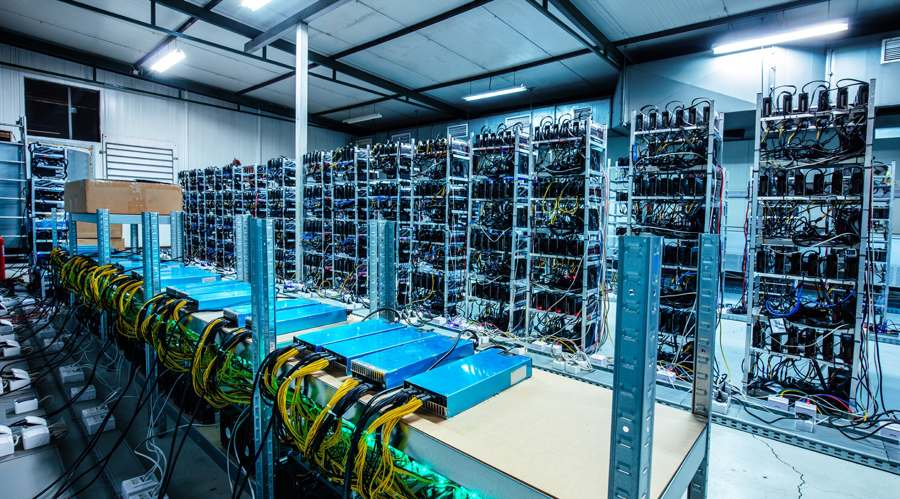
Bitcoin mining remains MARA's primary revenue source. The company operates specialized application-specific integrated circuit (ASIC) mining machines that compete to validate transactions and add new blocks to the Bitcoin blockchain. In return, miners receive block rewards and transaction fees, which MARA can sell or retain as part of its digital asset strategy.
Beyond mining, MARA generates revenue through its energy and digital infrastructure operations. The company owns, develops, and operates power-related assets and data center facilities, with plans to monetize these resources through electricity generation, infrastructure leasing, and computing services. Its acquisition of Exaion also expands its capabilities in private cloud, enterprise computing, and AI inference.
MARA's broader strategy is to allocate computing capacity across Bitcoin mining, AI, and HPC based on market demand and profitability. Bitcoin mining provides a flexible source of revenue while the company develops infrastructure for longer-term computing contracts. This approach could gradually reduce its dependence on cryptocurrency market cycles if AI and data center operations become meaningful revenue contributors.
Data Source: Data Center Dynamics
MARA's Bitcoin Mining Operations, Energy Assets, and AI Infrastructure Expansion
MARA operates large-scale Bitcoin mining facilities across multiple regions. As of September 30, 2026, the company reported approximately 435,000 mining rigs globally, including its share of equipment from an equity-method investee, and an energized hashrate of approximately 71.2 exahashes per second (EH/s). During the first nine months of 2026, it mined 6,916 BTC, demonstrating the scale of its mining infrastructure.
Energy ownership and control are central to MARA's expansion strategy. As of September 2026, its energy portfolio included approximately 1.9 gigawatts (GW) of capacity across 19 data centers in North America, the Middle East, Europe, and Latin America. The company also announced an agreement to acquire Long Ridge Energy & Power for approximately $1.5 billion, including assumed debt, adding a 505 MW natural gas power plant and significant land resources in Ohio. Subject to pending transactions and development milestones, MARA expects its potential power portfolio to reach approximately 4.8 GW.
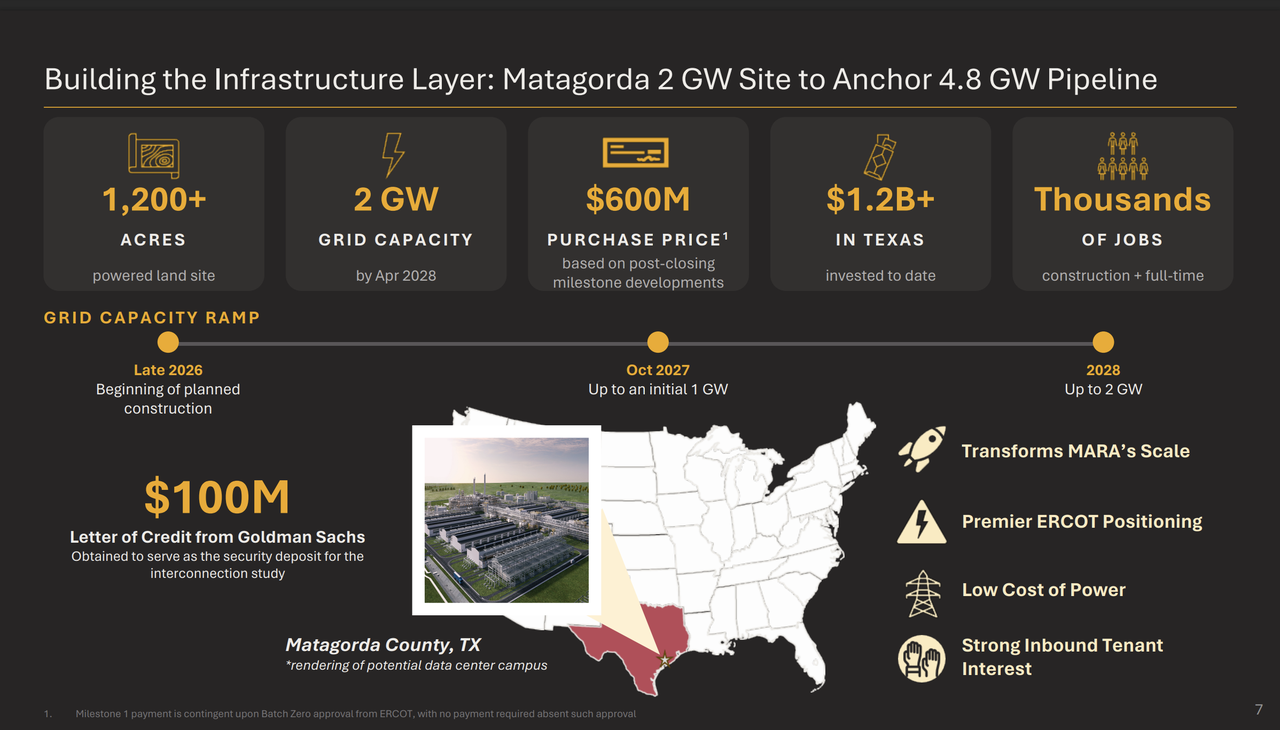
AI and HPC infrastructure represent the next stage of its business transformation. MARA acquired a majority interest in Exaion, a European digital infrastructure company providing secure cloud and AI inference services, and entered into a strategic agreement with Starwood Digital Ventures to develop large-scale data center facilities. It is also pursuing a major digital infrastructure site in Matagorda County, Texas, with approximately 2 GW of potential power capacity. These initiatives aim to position MARA to serve hyperscalers, enterprise AI customers, and other organizations requiring large amounts of computing power.
Data Source: MARA Investor presentation
MARA Financial Analysis: Revenue Growth, Mining Costs, Bitcoin Holdings, and Cash Flow
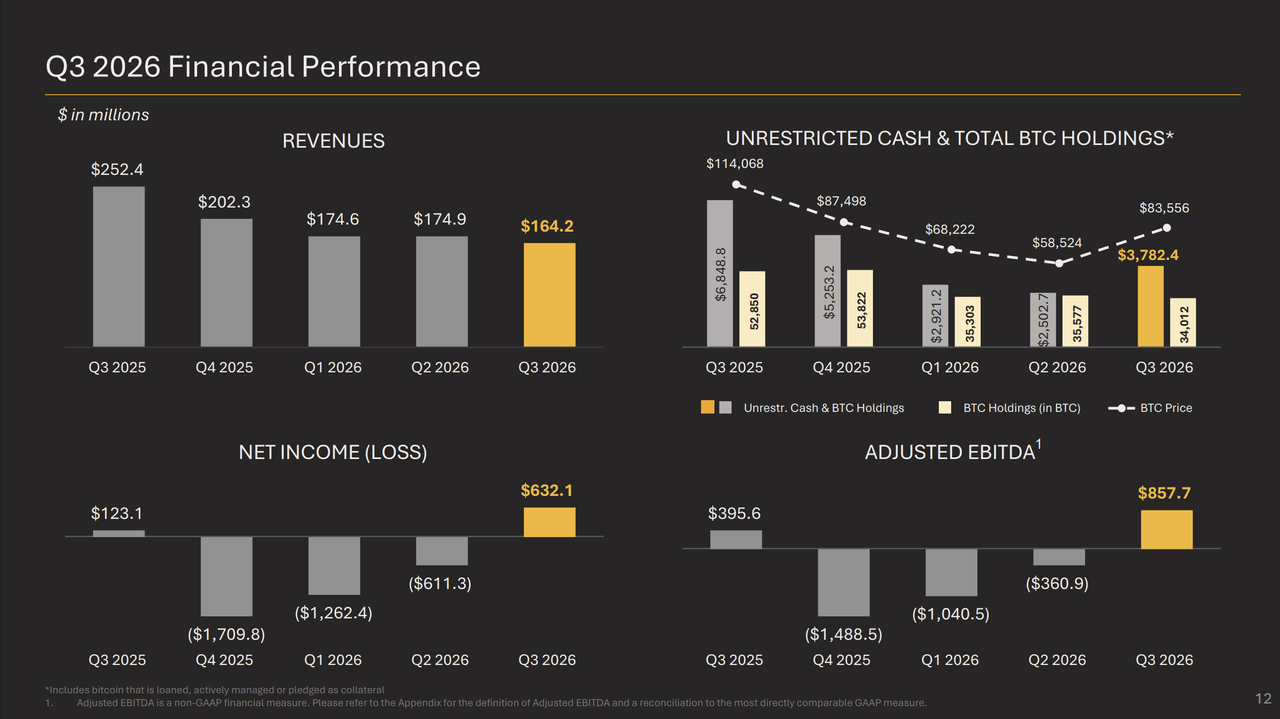
MARA's third-quarter 2026 financial results reflected the impact of weaker Bitcoin prices on its mining business. Revenue reached approximately $164.2 million, down 35% from $252.4 million in the same quarter of 2025. Bitcoin mining revenue declined approximately 34% to $159.0 million, primarily because the average price of Bitcoin mined fell 37%, partially offset by increased production.
Despite lower revenue, MARA reported net income of approximately $632.1 million, compared with $123.1 million a year earlier. However, this improvement was largely driven by approximately $885.3 million in combined fair-value gains on digital assets and Bitcoin receivables. These non-cash valuation gains should be distinguished from operating performance and recurring cash generation. For the first nine months of 2026, revenue totaled $513.7 million, down approximately 27% year over year.
Mining costs and liquidity are equally important when evaluating the company. During the first nine months of 2026, purchased energy costs reached $141.6 million, while third-party hosting and other energy costs totaled $210.7 million. Purchased energy costs per Bitcoin at owned mining sites increased to approximately $39,445. MARA held 34,012 BTC on September 30, 2026, but subsequently sold 13,597 BTC for approximately $1.1 billion and used $750 million to repay its Bitcoin-collateralized loans. The company also authorized a $500 million share repurchase program on November 9, 2026, highlighting its evolving approach to capital allocation.
Data Source: MARA Investor presentation
MARA Stock Performance and Valuation
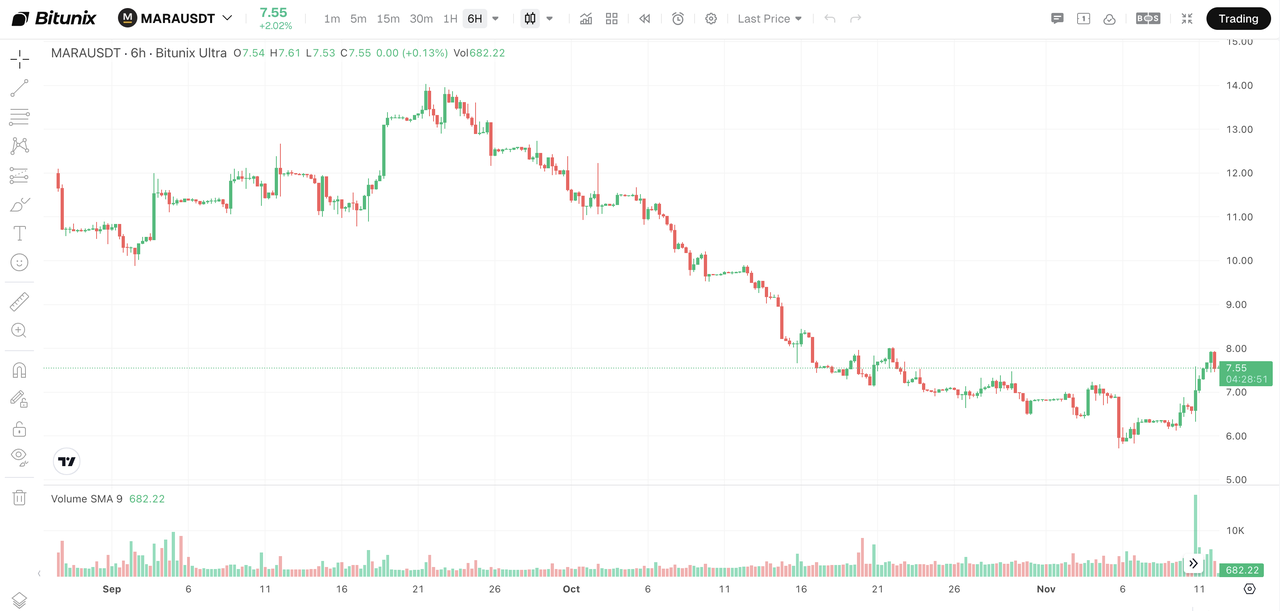
MARA stock is closely associated with Bitcoin's market performance, making it a high-beta equity within the cryptocurrency mining sector. Its share price is influenced by Bitcoin prices, mining profitability, network difficulty, energy costs, and investor expectations surrounding the company's AI infrastructure strategy. This combination can result in significant price movements during both cryptocurrency bull and bear markets.
As of November 11, 2026, MARA traded at approximately $7.66 per share, with a market capitalization of roughly $2.97 billion. Its 52-week trading range was approximately $5.69 to $16.43, reflecting substantial volatility over the previous year. Traditional valuation metrics such as price-to-earnings ratios are difficult to apply because the company's reported earnings can fluctuate significantly with Bitcoin fair-value adjustments.
Investors may also evaluate MARA using metrics such as enterprise value, price-to-book ratio, mining costs per Bitcoin, energized hashrate, and the potential value of its power and data center assets. As its business expands into AI and HPC, future valuation may increasingly depend on contracted infrastructure revenue, data center utilization, and returns on capital investment rather than Bitcoin production alone.
Data Source: Bitunix
What Could Drive MARA Stock?
Bitcoin Price and Mining Profitability
Bitcoin's market price remains one of the most important drivers of MARA's financial performance. Higher Bitcoin prices generally increase the dollar value of mining rewards and can improve mining margins, assuming network difficulty and operating costs remain relatively stable. Conversely, prolonged price declines can reduce mining revenue, pressure profitability, and force the company to adjust its Bitcoin treasury strategy.
Bitcoin Network Hashrate and Mining Difficulty
Bitcoin network hashrate and mining difficulty directly influence the competitiveness of mining operations. When global hashrate increases, miners generally need more computing power to maintain their share of block rewards. MARA's ability to improve fleet efficiency, deploy newer mining equipment, and maintain competitive operating costs will therefore play an important role in its long-term mining profitability.
Energy Costs and Power Infrastructure
Electricity is one of the largest operating expenses for Bitcoin miners. MARA's access to large-scale power infrastructure and its efforts to secure energy generation assets could help improve cost efficiency and reduce exposure to electricity price volatility. Its ability to manage power consumption, optimize energy procurement, and develop flexible computing facilities may also create additional sources of value beyond mining.
AI and HPC Data Center Expansion
The growing demand for AI training, inference, and high-performance computing creates an opportunity for MARA to monetize its existing energy and infrastructure assets. Successful data center development and long-term agreements with hyperscalers or enterprise customers could provide more predictable revenue than Bitcoin mining. However, construction costs, customer acquisition, financing requirements, and project execution remain important risks that investors should monitor.
MARA vs. Bitdeer: Comparing Bitcoin Mining Scale and Business Diversification
MARA Holdings (NASDAQ: MARA) and Bitdeer Technologies Group (NASDAQ: BTDR) are two major publicly traded companies in the Bitcoin mining industry, but their competitive positions have evolved differently. In the third quarter of 2026, Bitdeer reported 86.4 EH/s in total proprietary hashrate, surpassing MARA's 71.2 EH/s in energized hashrate and positioning Bitdeer ahead in reported proprietary mining capacity. Bitdeer also reported an additional 28.7 EH/s of co-mining hashrate operated through third-party data centers, although this figure should be distinguished from its proprietary hashrate.
A key difference lies in their business models. Bitdeer operates across several business lines, including self-mining, SEALMINER ASIC manufacturing and sales, cloud hashrate services, mining equipment hosting, and AI cloud infrastructure. This diversified structure allows Bitdeer to generate revenue from both its own mining operations and external customers purchasing mining equipment, computing capacity, and infrastructure services. By comparison, MARA remains more concentrated in Bitcoin mining and energy infrastructure, although its recent acquisitions and expansion plans are gradually broadening its business model.
Both companies are investing in AI and high-performance computing, but their strategies differ. Bitdeer is already generating AI Cloud revenue and developing a large-scale GPU infrastructure, with its third-quarter 2026 results reporting $20.4 million in AI Cloud revenue and an approximately $2.9 billion AI Cloud revenue backlog. MARA is pursuing AI infrastructure through its Exaion business, GPU-as-a-Service offerings, and partnerships to develop large-scale data centers, while leveraging its power assets to attract enterprise computing customers.
For investors, Bitdeer offers exposure to a broader combination of mining, hardware manufacturing, and AI services, whereas MARA provides a more concentrated investment case centered on Bitcoin mining, energy assets, and its transition toward AI infrastructure.

Key News & Facts about MARA Holdings
MARA has undergone several strategic developments as it expands from a Bitcoin mining company into a broader digital infrastructure business. The following milestones highlight its corporate evolution:
August 2024 – Corporate Rebranding: Marathon Digital Holdings changed its name to MARA Holdings, reflecting its broader ambitions in digital assets, energy, and computing infrastructure.
April 30, 2026 – Long Ridge Acquisition Agreement: MARA announced an agreement to acquire Long Ridge Energy & Power for approximately $1.5 billion, including assumed debt. The transaction includes a 505 MW natural gas power plant and land intended to support large-scale digital infrastructure development.
July 2026 – Matagorda County Expansion: MARA secured rights to a large digital infrastructure site in Texas with approximately 2 GW of potential power capacity, creating another pathway for future HPC and flexible computing operations.
November 9, 2026 – Third-Quarter Financial Results: MARA reported $164.2 million in quarterly revenue and approximately $632.1 million in net income. The company also authorized a share repurchase program of up to $500 million.
How to Trade MARA Stock
For investors looking to gain exposure to MARA Holdings stock, the traditional approach is to purchase MARA shares through a U.S. stock brokerage account. Investors typically need to open a U.S. trading account, complete identity verification, and then place orders to buy MARA shares directly. That said, trading U.S. stocks may involve account opening procedures, cross-border fund transfers, and transaction fees. Some brokerage platforms may also have relatively higher trading costs.
Beyond traditional stock investing, investors can also trade MARA contracts through cryptocurrency trading platforms such as Bitunix. Compared with directly purchasing shares, contract trading offers more flexible market participation options, allowing traders to take long positions when expecting MARA's stock price to rise or open short positions to potentially benefit from downward price movements. Bitunix MARA contracts support a 0-fee trading model and offer up to 20x leverage, allowing users to access larger market positions with less capital and improve capital efficiency. Before initiating their first trade, users need to register a Bitunix account and complete identity verification (KYC). Through risk control systems, asset management measures, and transaction monitoring mechanisms, the platform provides users with a secure and efficient trading environment.